Layla Zulfa
The global cryptocurrency market faced a significant correction on Friday as Bitcoin, the world’s largest digital asset by market capitalization, retreated from its recent highs following a pivotal address by Federal Reserve Chair Kevin Warsh. During his inaugural keynote at the Jackson Hole Economic Symposium, Warsh delivered a sobering assessment of the United States’ inflationary environment, suggesting that the pace of cooling remains insufficient to warrant a shift in monetary policy. This hawkish stance effectively halted a multi-day rally that had seen Bitcoin testing critical resistance levels, ultimately triggering a wave of liquidations and a recalibration of interest rate expectations across traditional and decentralized finance sectors.
Bitcoin fell as low as $76,877 during Friday’s trading session, a move that saw the asset surrender the majority of its double-digit gains accumulated throughout the week. This downward pressure emerged after the cryptocurrency reached an overnight peak of $81,455, a level situated within a formidable resistance zone that has consistently thwarted breakout attempts throughout the current calendar year. The rejection at this psychological and technical ceiling underscored the market’s sensitivity to macroeconomic signaling, particularly from the Federal Reserve’s leadership.
The Jackson Hole Catalyst and the Warsh Doctrine
The Jackson Hole Economic Symposium has historically served as a platform for central bankers to signal major shifts in monetary strategy. For Kevin Warsh, marking his 100th day as Chair of the Federal Reserve, the speech was a highly anticipated event for global markets. While investors were searching for signs of a potential "dovish pivot"—a softening of the Fed’s stance on interest rates—Warsh instead chose to emphasize the central bank’s commitment to its primary mandate of price stability.
In his keynote address, Warsh established a stringent set of criteria for future policy adjustments. He articulated that the Federal Reserve requires clear and sustained evidence that inflation is moving toward its 2% target at a "sufficient speed" before any declaration of victory can be made. "Short of that," Warsh noted, "the central bank still has work to do." By declining to provide the "forward guidance" that markets often rely on to price in future rate cuts, Warsh introduced a layer of uncertainty that immediately translated into sell-side pressure for risk-on assets like Bitcoin.

The market’s interpretation of Warsh’s remarks was decisively hawkish. According to the CME Group’s FedWatch tool, the probability of a rate hike in the upcoming September meeting surged to 55.7%, a dramatic increase from the 35.4% recorded just 24 hours prior. This shift in sentiment reflects a growing realization among traders that the era of restrictive monetary policy may persist longer than previously anticipated, increasing the opportunity cost of holding non-yielding assets.
Market Liquidations and Leveraged Washouts
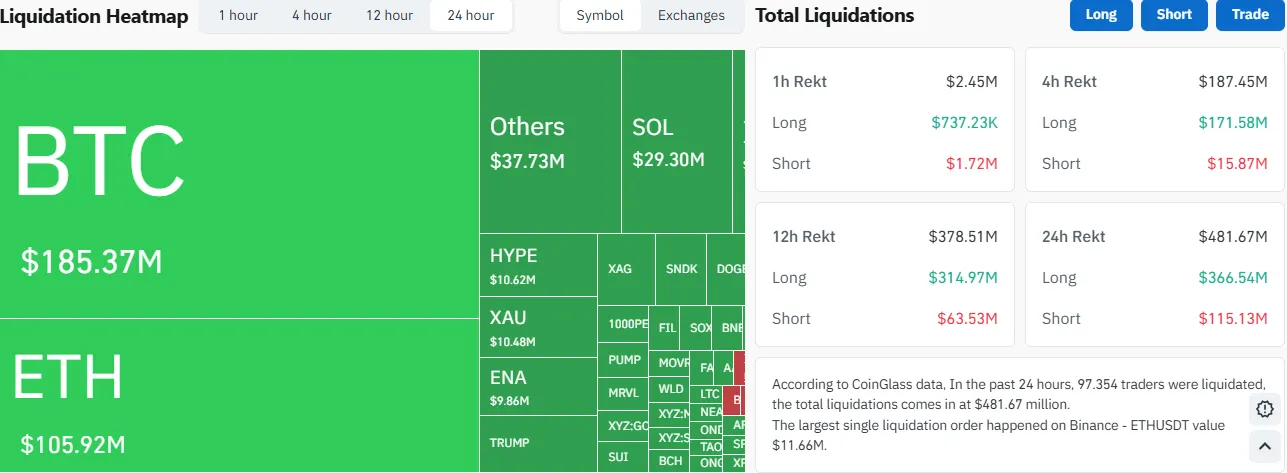
The sudden reversal in Bitcoin’s price action had a cascading effect on leveraged positions within the crypto ecosystem. Data provided by CoinGlass revealed that approximately $481 million in liquidations occurred across the broader crypto market in the 24-hour window surrounding the Jackson Hole speech. The vast majority of these liquidations—over $360 million—were from long positions, as traders who had bet on a breakout above the $81,000 level were caught off-guard by the swift retracement.
Bitcoin eventually closed the day at $77,557, representing a 3.39% decline. The volatility highlighted the precarious nature of the current market structure, where high levels of leverage often amplify price movements driven by macroeconomic headlines. For many analysts, the flush-out of long positions was seen as a necessary, albeit painful, "deleveraging" event that could potentially pave the way for more stable price discovery in the weeks ahead.
Technical Analysis: Digestion or Reversal?
Despite the sharp intraday drop, technical indicators suggest that the current pullback may be a period of market "digestion" rather than a fundamental trend reversal. The Relative Strength Index (RSI), a momentum oscillator that measures the speed and change of price movements, currently sits at 69.7. This is a notable cooling from the overbought readings above 80 that preceded the rejection at the $81,455 level earlier in the week.
Furthermore, the Average Directional Index (ADX), which quantifies trend strength, remains near 39.5. In technical analysis, an ADX reading above 25 typically indicates a strong trend. The fact that the ADX remains elevated suggests that the bullish structure established since the June lows near $68,858 remains largely intact. Bitcoin continues to trade within the bullish leg of its medium-term cycle, though the failure to clear the $81,000–$82,500 resistance shelf remains a significant hurdle for bulls.
Market participants are now closely monitoring the "golden zone" between $73,670 and $75,157. If the sell-off extends, this range is expected to provide substantial support. A daily close below this band would be a cause for concern, as it would call into question the 50-week moving average and the structural integrity of the breakout seen in June. Conversely, a reclaim of the $81,000 level would be required to re-establish the narrative of an imminent run toward new all-time highs.
Institutional Demand and the Macro Backdrop
While the immediate reaction to the Fed’s rhetoric was negative, the underlying fundamental demand for Bitcoin remains robust, driven largely by institutional adoption through U.S. spot Bitcoin Exchange-Traded Funds (ETFs). Through Wednesday, these investment vehicles saw $2.8 billion in net inflows over an eight-day winning streak, the longest such period of sustained demand since April. This suggests that while short-term traders may be reacting to interest rate jitters, long-term institutional allocators continue to view Bitcoin as a strategic asset.
The institutional appetite for Bitcoin is partly linked to broader fiscal developments. The U.S. Treasury Department recently announced plans to at least double its long-dated bond buybacks starting September 9. This move is intended to support the bond market, which has struggled with weak demand since early summer. Historically, interventions that lower long-end yields and soften the U.S. dollar have fueled the "debasement trade," a thesis where investors flock to scarce assets like Bitcoin as a hedge against the expansion of the monetary base.
This macro tailwind provided the fuel for Bitcoin’s climb from approximately $62,000 to the $80,000 mark earlier this month. Because Warsh’s comments did not explicitly alter the Treasury’s fiscal path, some analysts argue that the fundamental case for Bitcoin remains unchanged, even if the Fed’s timeline for rate cuts has been pushed further into the future.
Sentiment and Prediction Markets
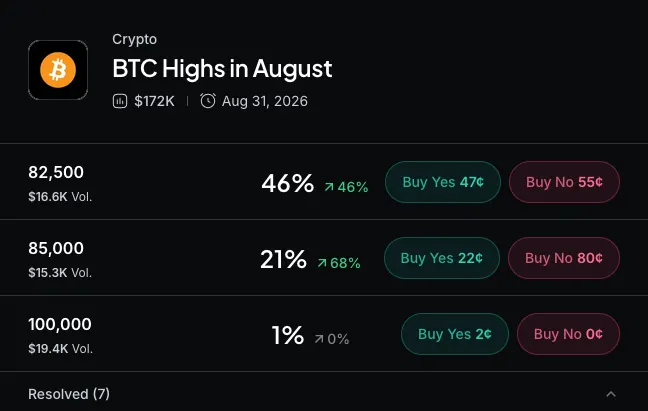
The dichotomy between short-term volatility and long-term optimism is perhaps best captured by activity in prediction markets. On the Myriad platform, the "BTC next move" market—which allows participants to bet on whether Bitcoin will first hit $84,000 or drop to $55,000—has seen significant volume, with over $231,000 traded since February.
Interestingly, Friday’s price drop did little to dampen the spirits of these forecasters. The probability of Bitcoin reaching $84,000 has surged to 77%, up 31.7 percentage points this month alone. In contrast, the scenario of a drop to $55,000 is currently priced at just 23%. This level of bullishness among predictors hasn’t been seen since April, indicating a widespread belief that the current resistance will eventually be overcome.
Broader Economic Implications and the Path Ahead
The road ahead for Bitcoin remains tethered to the Federal Reserve’s data-dependent approach. By moving away from forward guidance, Chair Warsh has essentially signaled that the market should expect heightened volatility surrounding every major economic data release. The Personal Consumption Expenditures (PCE) price index, the Fed’s preferred gauge of inflation, is currently running at an annual rate of 3.7%, nearly double the official 2% target.
Until there is a meaningful convergence between the PCE data and the Fed’s goals, Bitcoin and other risk assets will likely remain sensitive to "headline risk." Every consumer price print and employment report will be scrutinized for clues as to when the Fed might finally consider the "work" to be done.
In the short term, the market setup favors caution. The repeated rejection at the $81,000 level confirms that there is a significant supply of Bitcoin waiting to be sold at those prices, and without a clear signal from the central bank, bulls may lack the conviction to push through that ceiling. However, the combination of steady ETF inflows, Treasury buybacks, and resilient technical indicators suggests that the foundational support for the market remains firm.
As the financial world looks toward the September FOMC meeting, the primary question for investors is whether the Fed’s hawkishness is a temporary posture to manage expectations or a long-term commitment that will eventually stifle the current bull cycle. For now, Bitcoin sits in a state of high-stakes equilibrium, waiting for the next catalyst to determine if it will break toward the $84,000 mark or retreat further into its established support zones.