James Watt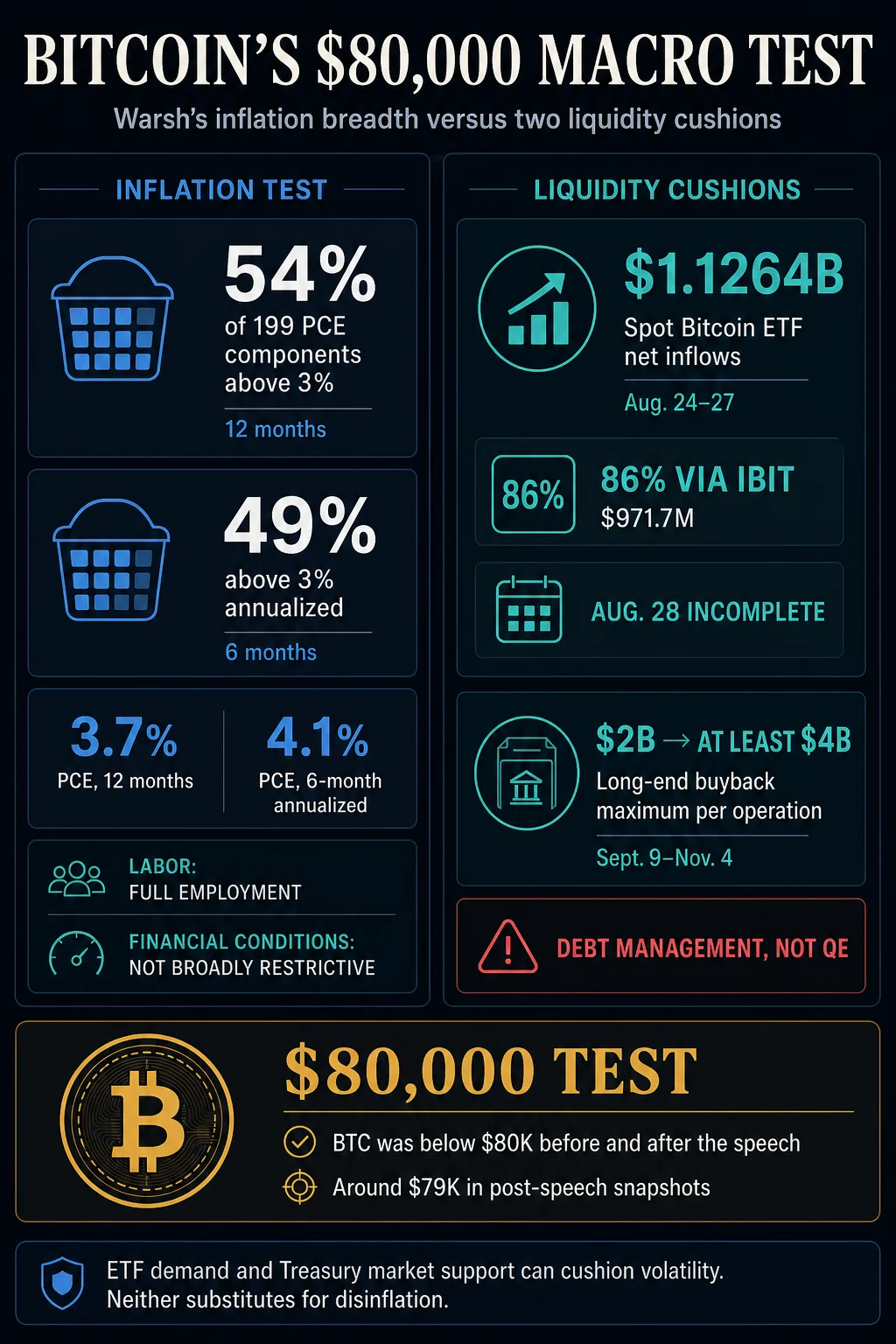
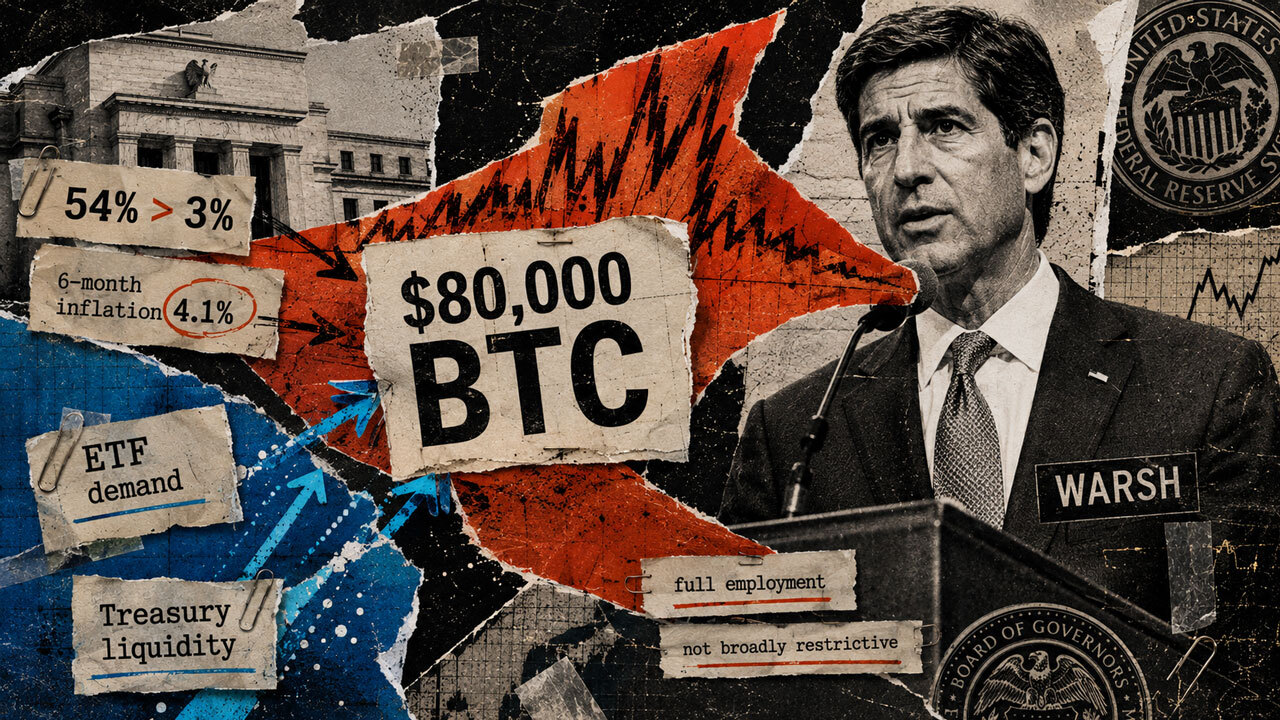
The global financial markets reached a critical inflection point this week as Bitcoin’s attempt to solidify its position above the $80,000 threshold collided with a hawkish shift in Federal Reserve rhetoric. During his highly anticipated Jackson Hole speech, Federal Reserve Chair Kevin Warsh introduced a new quantitative benchmark for assessing the persistence of inflation, identifying that 54% of the components within the Personal Consumption Expenditures (PCE) basket are currently rising at a rate faster than 3% annually. This "breadth test" has effectively recalibrated market expectations for monetary easing, creating a significant headwind for risk assets and non-yielding commodities like Bitcoin.
As of late August 2026, Bitcoin’s market trajectory has become a battleground between massive institutional inflows via spot Exchange-Traded Funds (ETFs) and a macro-economic environment characterized by "sticky" inflation. After reaching a peak of $81,280 in overnight trading, Bitcoin slipped back below the $80,000 mark during the Asian session, hovering near $79,000 as traders digested the implications of Warsh’s data-heavy address. The struggle to maintain the $80,000 level highlights a growing tension: while crypto-specific demand remains robust, the broader cost of capital is likely to remain elevated as long as more than half of the PCE basket exceeds the Fed’s comfort zone.
The 54 Percent Threshold: A New Macro Benchmark
Chair Kevin Warsh’s remarks at Jackson Hole have transformed what was previously an abstract debate over "sticky" inflation into a measurable, repeatable test for policy shifts. By highlighting the 54% figure, Warsh signaled that the Federal Reserve is looking beyond headline numbers to evaluate how deeply price pressures have permeated the economy. According to the Chair, 54% of the 199 components that make up the PCE basket rose faster than 3% over the past 12 months. Perhaps more concerning for proponents of near-term rate cuts was his revelation that 49% of these components were still running above 3% on an annualized basis over a shorter six-month window.
Historically, this level of breadth suggests an economy that is still overheating in key sectors. For context, Warsh noted that while the current 54% reading is an improvement from the post-pandemic peak of nearly 77%, it remains significantly higher than the 32% average maintained during the two decades preceding the 2020 lockdowns. This historical comparison serves as a stern reminder that the "normalization" of inflation is far from complete. The six-month annualized headline inflation rate currently sits at 4.1%, a figure that complicates any immediate pivot toward a more accommodative monetary policy.
The Bureau of Economic Analysis (BEA) reinforced this narrative in its July report, noting that the headline PCE price index rose 0.2% for the month and 3.7% on a year-over-year basis. Within the Warsh framework, these figures suggest that the Federal Reserve’s 2% target remains a distant goal. With labor markets described as consistent with full employment and credit markets showing few signs of restrictive stress, the "burden of proof" has shifted. For Bitcoin to see a sustained macro tailwind, the market now requires data showing that inflation is not just falling in the aggregate, but narrowing across the individual components of the PCE basket.
Chronology of Market Events: From ETF Surges to Jackson Hole
The current volatility follows a period of intense institutional accumulation that briefly pushed Bitcoin to record-challenging levels. The timeline of the past week illustrates a market attempting to front-run a potential Fed pivot, only to be met with a reality check from the central bank.
Between August 24 and August 27, 2026, U.S.-traded spot Bitcoin ETFs experienced one of their most significant four-day streaks of the year. On August 24, net inflows reached $337.6 million, followed by $314.3 million on August 25. The momentum continued with $232.2 million on August 26 and $242.3 million on August 27. In total, over $1.1 billion was absorbed by these instruments in less than a business week. This surge in demand was primarily driven by BlackRock’s iShares Bitcoin Trust (IBIT), which accounted for approximately 86% of the total inflows, or $971.7 million.
This concentrated demand provided the necessary liquidity for Bitcoin to pierce the $80,000 level on August 27, hitting a high of $81,280. However, the optimism was short-lived. As the text of Chair Warsh’s Jackson Hole speech was released on the morning of August 28, the market’s focus shifted from crypto-specific demand to global liquidity constraints. Bitcoin immediately began to retreat, losing the $80,000 handle as the U.S. Treasury two-year yield—a primary indicator of interest rate expectations—climbed from 4.22% to 4.29% in the minutes following the speech.
Institutional Absorption vs. Policy Discipline
The central question facing investors is whether the concentrated demand from ETFs can continue to act as a buffer against a "higher-for-longer" interest rate environment. The dominance of BlackRock’s IBIT in recent inflow data suggests that while institutional interest is high, it is not yet broad-based. A market that relies on a single product for 86% of its net buying is inherently exposed to the allocation shifts of a narrow group of institutional players.
For Bitcoin’s recovery to be considered "durable," analysts suggest three criteria must be met. First, ETF inflows must persist even in the face of the hawkish "Warsh test." Second, these inflows must diversify across other products, such as Fidelity’s FBTC or the Grayscale Bitcoin Trust, to prove that demand is systemic rather than product-specific. Third, Bitcoin must reclaim and hold $80,000 as a support level, rather than using it as a ceiling for profit-taking.
The lack of yield on Bitcoin makes it particularly sensitive to the "risk-free" rate offered by U.S. Treasuries. When the two-year yield rises, the opportunity cost of holding Bitcoin increases, making cash and short-dated government debt more attractive to portfolio managers. Warsh’s commitment to policy discipline has effectively raised the discount rate applied to risk assets, requiring a higher level of conviction from crypto investors to maintain current price levels.
Treasury Buybacks and the Liquidity Support Fallacy
Adding another layer of complexity to the market structure is the U.S. Treasury’s upcoming liquidity-support operations. The Treasury recently announced that it would increase its maximum buyback amounts for nominal securities in the 10-to-20-year and 20-to-30-year sectors. Starting September 9 and running through November 4, these operations will rise from $2 billion to at least $4 billion per operation.
While some market participants have characterized these buybacks as a form of "stealth Quantitative Easing" (QE), the Treasury has been careful to distinguish these operations from monetary policy. These buybacks are debt-management tools designed to improve the "plumbing" of the financial system by retiring older, less-liquid "off-the-run" securities and replacing them with highly liquid "on-the-run" debt.
While a more efficient Treasury market can indirectly support risk appetite by reducing friction in collateral and financing markets, it does not represent a net injection of new money into the system. Therefore, treating these buybacks as a catalyst for a Bitcoin rally may be an overstatement of their impact. Furthermore, since these operations do not begin until September 9, they offered no immediate protection against the volatility triggered by Warsh’s August 28 speech.
Bond Market Reactions and Near-Term Pressure
The bond market’s reaction to the Jackson Hole address was nuanced but clear in its implications for risk assets. While the two-year yield rose sharply, reflecting immediate concerns about the Fed’s path, the long end of the curve showed more mixed results. The 10-year yield edged up to 4.69%, but the 30-year yield actually slipped slightly to 5.17%.
This divergence suggests that while investors are bracing for a more aggressive Federal Reserve in the short term, they remain concerned about long-term economic growth and the massive supply of government debt. For Bitcoin, the move in the two-year yield is the more critical signal. As the portion of the curve most sensitive to Fed policy, the two-year yield serves as a barometer for the liquidity conditions that typically fuel crypto bull markets. As long as this yield remains elevated, Bitcoin will likely face persistent selling pressure on every attempt to break into new all-time high territory.
Analysis of Implications: The Path Forward
The convergence of the 54% PCE breadth reading and the $80,000 Bitcoin price level represents a new era of "macro-dependent" crypto trading. The era of Bitcoin moving independently of traditional financial benchmarks appears to have paused, replaced by a regime where the asset is treated as a high-beta play on global liquidity and inflation expectations.
To achieve a durable breakout, Bitcoin requires a "goldilocks" scenario: a cooling of the PCE breadth metrics that allows the Fed to soften its stance, combined with a continuation of the ETF-led institutional bid. If the 54% reading remains stagnant or increases in the coming months, the Fed will likely maintain its restrictive stance, potentially forcing a deeper correction in risk assets as the reality of "higher-for-longer" sets in.
Furthermore, the concentration of inflows into BlackRock’s IBIT suggests that the "institutionalization" of Bitcoin is still in its early, fragile stages. A broader participation rate among other ETF providers would signal a more mature market capable of absorbing macro shocks.
In conclusion, the $80,000 level is more than just a psychological milestone; it is currently the front line in a war between crypto-specific adoption and the gravitational pull of a hawkish central bank. Chair Kevin Warsh has provided the market with a clear scoreboard in the form of the 54% breadth test. Until that number begins to trend toward the historical 32% average, Bitcoin’s journey above $80,000 will likely remain a volatile and contested climb. The coming weeks, particularly following the start of Treasury buybacks on September 9 and the release of next month’s inflation data, will be decisive in determining whether the current dip is a temporary setback or the beginning of a broader macro-driven consolidation.