Nila Kartika Wati
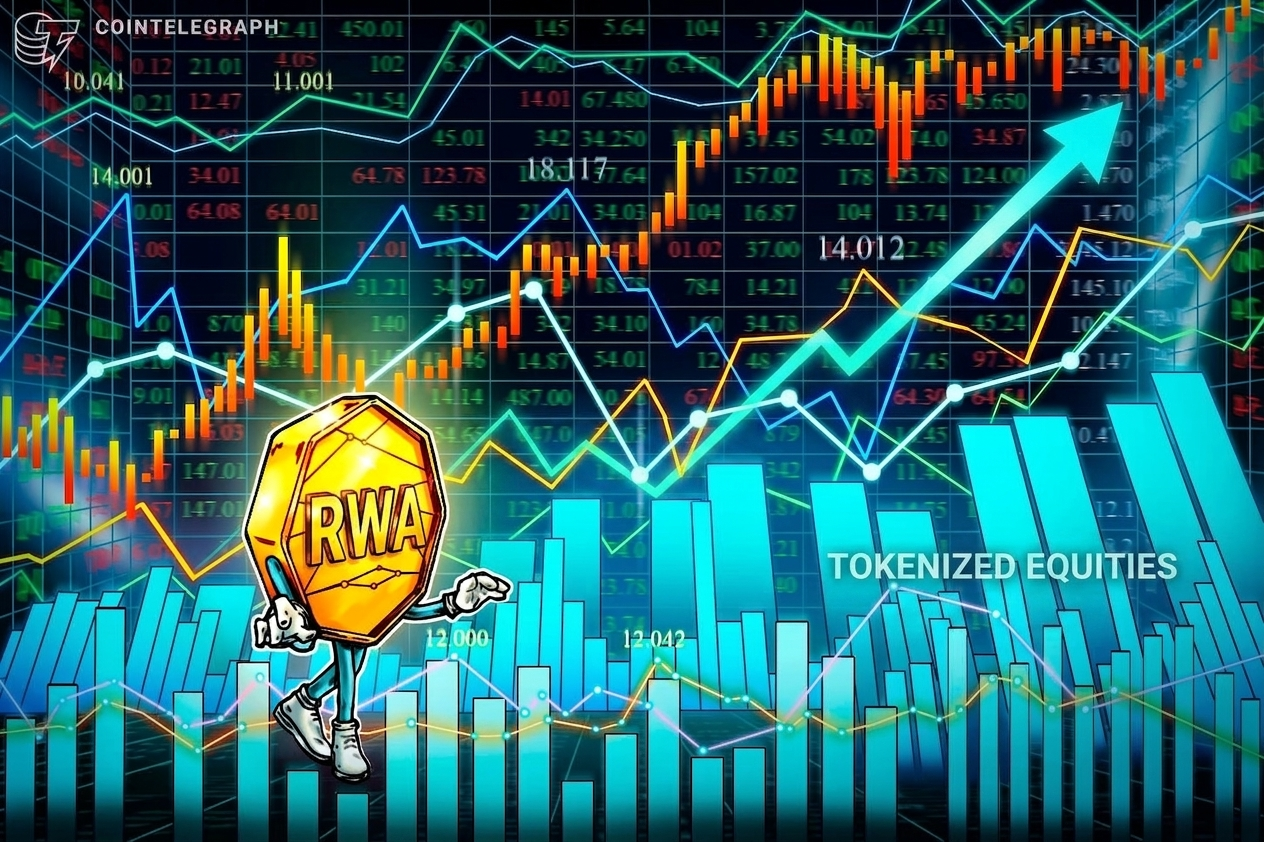
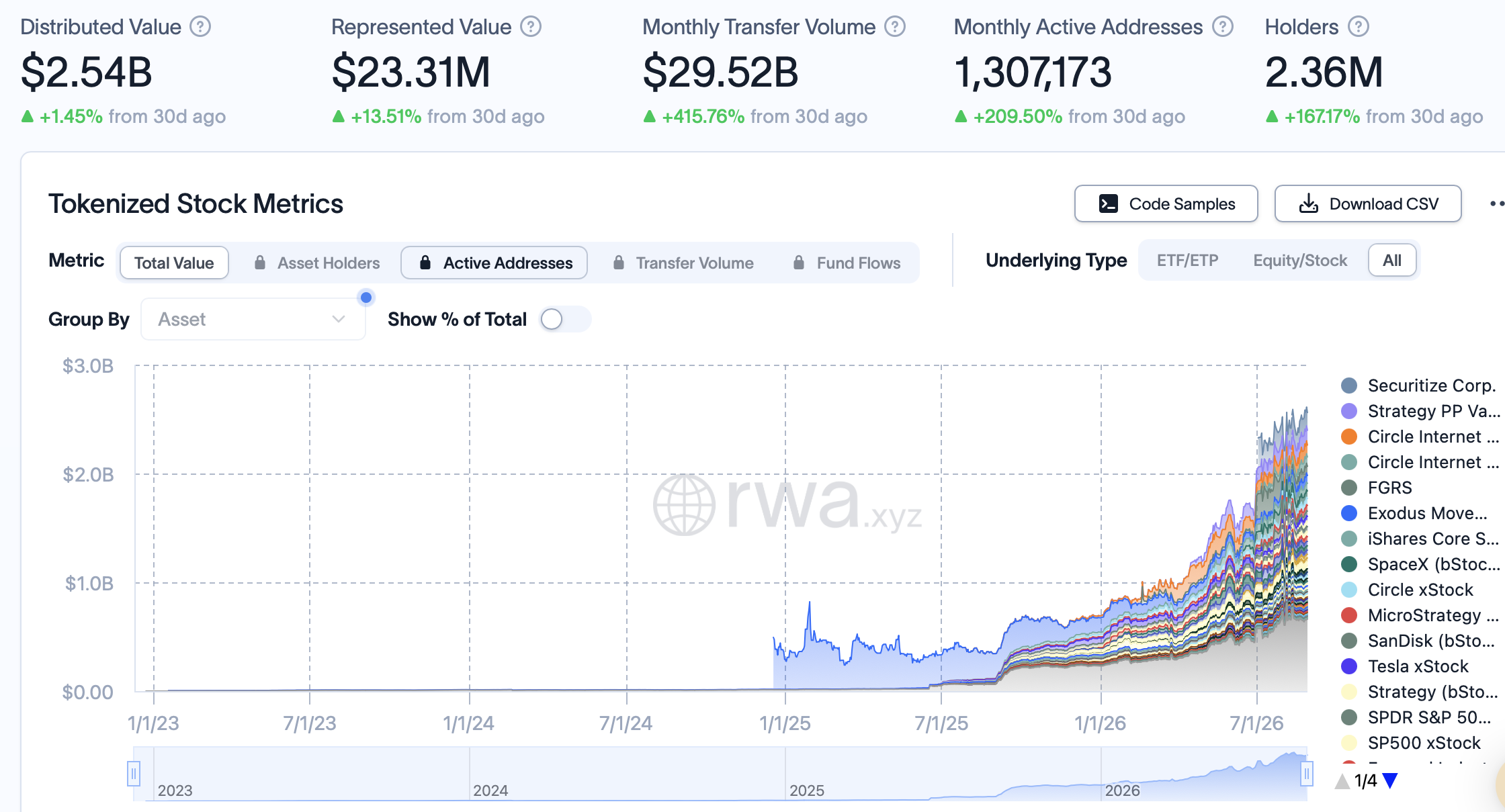
The landscape of digital finance is undergoing a significant transformation, with tokenized stock activity experiencing an unprecedented surge over the past 30 days. According to comprehensive data released by RWA.xyz, the monthly transfer volume for tokenized stocks escalated dramatically, climbing by an astounding 415% to reach a staggering $29.5 billion. This exponential growth underscores a burgeoning interest and increasing utility for digital representations of traditional equities within the blockchain ecosystem. The momentum is not confined to mere transaction volumes; broader participation metrics also reflect this upward trend. Over the same period, the number of monthly active addresses engaging with tokenized stocks witnessed a robust increase of more than 209%, reaching approximately 1.3 million unique participants. Concurrently, the total count of tokenized stock holders expanded by 167%, now standing at an impressive 2.36 million individuals and entities. These figures collectively paint a picture of rapidly expanding adoption and deepening integration of traditional financial assets into decentralized finance (DeFi) frameworks. Furthermore, the total value of tokenized stocks distributed on-chain continued its ascent, increasing by 1.45% over the last month to $2.54 billion. This current valuation represents a remarkable year-over-year growth of roughly 637% from $344 million recorded just 12 months prior, highlighting a sustained and accelerating trajectory of growth in this nascent yet powerful sector.
Understanding the Genesis of Tokenized Equities
The concept of tokenized stocks represents a groundbreaking convergence of traditional capital markets with blockchain technology. At its core, a tokenized stock is a digital representation of a real-world equity, such as shares in a publicly traded company, that exists on a blockchain network. These tokens derive their value from the underlying traditional security they represent, often backed by actual shares held in custody by regulated entities. The process typically involves a licensed financial institution or a specialized blockchain platform acquiring traditional shares and then issuing corresponding digital tokens on a blockchain. Each token can represent a full share or, more commonly, a fractional share, democratizing access to high-value equities that might otherwise be inaccessible to smaller investors.
The appeal of tokenized stocks stems from several inherent advantages offered by blockchain technology. Firstly, they enable fractional ownership, allowing investors to purchase small portions of expensive stocks like Nvidia or Alphabet, which might otherwise be out of reach. Secondly, blockchain platforms operate 24/7, facilitating continuous trading outside traditional market hours and geographical restrictions. This round-the-clock accessibility significantly enhances liquidity and offers unprecedented flexibility to global investors. Thirdly, the inherent transparency and immutability of blockchain ledgers provide a verifiable record of ownership and transactions, potentially reducing settlement times and operational costs associated with traditional securities. Finally, tokenized assets can seamlessly integrate into the broader decentralized finance (DeFi) ecosystem, where they can be used as collateral for loans, traded on decentralized exchanges (DEXs), or participate in various yield-generating protocols, unlocking new avenues for capital efficiency and financial innovation.
While the concept has been explored for several years, the recent surge indicates a maturation of both the underlying technology and market acceptance. Early attempts at asset tokenization often faced hurdles related to regulatory uncertainty, scalability issues, and a lack of institutional infrastructure. However, ongoing advancements in blockchain technology, coupled with a clearer (though still evolving) regulatory landscape in various jurisdictions, have paved the way for more robust and compliant solutions. This evolution has fostered greater confidence among both retail and institutional investors, fueling the current wave of adoption.
Deep Dive into Market Metrics and Dominant Players
The granular data from RWA.xyz provides further insight into the specific entities and platforms driving this remarkable growth. The $29.5 billion in monthly transfer volume is not merely a number; it represents a significant flow of capital and trading activity, suggesting active market participation rather than just passive holding. The rise in active addresses to 1.3 million and holders to 2.36 million signifies a broadening base of participants, indicating that tokenized stocks are moving beyond niche early adopters to attract a wider audience. The year-over-year growth in total value distributed on-chain from $344 million to $2.54 billion is particularly telling, demonstrating a sustained and accelerating trend that points towards long-term viability and increasing market confidence.
Within the ecosystem, specific tokenized stocks and platforms have emerged as frontrunners. Securitize Corp. currently stands as the largest individual tokenized stock tracked by RWA.xyz, boasting approximately $163 million in distributed value. Securitize is a prominent player in the digital asset securities space, providing a comprehensive platform for the issuance and lifecycle management of tokenized assets, which likely contributes to its leading position. Following closely is Strategy PP Variable xStock, with $136 million, and an Ondo-tokenized version of Circle Internet Group, commanding $109 million. Ondo Finance, a decentralized finance protocol, has been particularly active in bringing real-world assets on-chain, and its presence among top individual tokens highlights its strategic focus.
From a platform perspective, Ondo led the market with an impressive $842.8 million in distributed value. This dominance can be attributed to Ondo’s specialized focus on bridging traditional finance with DeFi, offering institutional-grade products that appeal to a wide range of investors seeking exposure to tokenized real-world assets. Kraken’s xStocks followed with $609.3 million, leveraging the reputation and user base of one of the oldest and most trusted cryptocurrency exchanges. Binance’s bStocks, backed by the world’s largest crypto exchange by trading volume, secured the third spot with $599.9 million. Collectively, these three platforms – Ondo, Kraken, and Binance – accounted for roughly 81% of the total market share for tokenized stocks, illustrating a significant concentration of activity among a few key players that have successfully navigated the complexities of integrating traditional equities into blockchain environments. Their success often hinges on a combination of robust technological infrastructure, strong liquidity provision, and a clear approach to regulatory compliance in the jurisdictions they operate.
A Chronology of Strategic Integrations and Product Launches
The recent explosion in tokenized stock activity is not a sudden, isolated event but rather the culmination of strategic integrations and innovative product launches by major players in the crypto and fintech sectors. These developments have progressively lowered barriers to entry, enhanced utility, and broadened the appeal of tokenized equities.
August 24: Coinbase Expands Access on Base
A pivotal moment occurred on August 24, when Coinbase, a leading cryptocurrency exchange, launched its tokenized US stocks on Base, its Ethereum Layer 2 blockchain. This move was designed to provide eligible non-US users with unprecedented access to major American equities around the clock. The B20 tokens represent shares in highly sought-after companies such as Nvidia, Apple, Meta, and Alphabet. A key feature of this offering is the ability for users to hold these assets in self-custody wallets, empowering them with direct control over their investments, a fundamental principle of decentralized finance. Furthermore, the integration into Base allows these tokenized stocks to be utilized across a variety of decentralized finance applications, unlocking new possibilities for capital deployment, such as using them as collateral for loans or participating in liquidity pools. This launch by Coinbase, a regulated and publicly traded entity, lends significant credibility to the tokenized stock market and expands its reach to a global audience hungry for diversified investment opportunities.
August 25: Bitwise Introduces Automated Portfolios
Building on Coinbase’s initiative, just one day later, Bitwise Asset Management, a prominent crypto asset manager, launched automated portfolios constructed from Coinbase’s newly introduced tokenized stocks. These portfolios are designed for eligible non-US investors, allowing them to follow preset investment strategies while maintaining self-custody of the underlying assets. The initial offerings strategically target high-growth sectors, including the "Magnificent Seven" (a group of tech giants often considered market leaders), robotics, and artificial intelligence sectors. This development is crucial as it addresses the need for structured investment products within the tokenized asset space, simplifying portfolio management for investors who may not want to actively trade individual stocks. By offering diversified and thematic portfolios, Bitwise is making tokenized investing more accessible and appealing to a broader spectrum of investors, including those who prefer a more passive, strategy-driven approach.
July: Expanding Utility – Bybit and Arcus
The groundwork for August’s surge was laid by earlier innovations in July. Bybit, a leading cryptocurrency exchange, significantly expanded the utility of tokenized stocks by adding tokenized shares of Nvidia, Apple, Tesla, and other US companies as collateral for margin loans. This move transforms tokenized equities from mere trading instruments into functional assets within the DeFi lending ecosystem, allowing users to leverage their holdings without liquidating them. This enhancement of capital efficiency is a powerful driver for adoption, as it enables investors to unlock liquidity from their investments for other opportunities.
Concurrently, the Robinhood-backed decentralized exchange (DEX) Arcus made a significant splash by launching more than 95 stock tokens and perpetual markets on Robinhood Chain. This initiative marks a crucial step by a company with ties to a major traditional brokerage firm into the tokenized asset space. By offering a wide array of stock tokens and perpetual contracts, Arcus is providing advanced trading instruments to a global audience, blending the accessibility of blockchain with sophisticated financial derivatives. The involvement of entities connected to mainstream finance, such as Robinhood, signals a growing acceptance and exploration of tokenization by established players, further blurring the lines between traditional and decentralized finance.
Inferred Statements and Market Reactions
The impressive growth figures and strategic expansions have naturally elicited reactions from key stakeholders across the ecosystem.
A senior analyst from RWA.xyz, preferring to remain anonymous due to internal policy, commented, "The data unequivocally points to an inflection point for tokenized equities. What we’re witnessing is not just speculative interest, but a genuine maturation of the market, driven by both institutional adoption seeking efficiency gains and a massive wave of retail demand for greater accessibility and utility. The year-over-year growth of over 600% in on-chain distributed value is a testament to the fundamental shift occurring in how investors perceive and interact with traditional assets."
A spokesperson for Coinbase, following their Base launch, stated, "Our foray into tokenized US stocks on Base is a direct reflection of our commitment to empowering global investors. We believe in an open financial system that offers 24/7 access, self-custody, and seamless integration with decentralized applications. This initiative provides eligible non-US users with unprecedented flexibility and control over their investments, aligning perfectly with our vision for a more inclusive financial future."
An Ondo Finance representative remarked, "Ondo’s leading position in distributed value underscores the robust demand for on-chain, yield-bearing real-world assets. We are dedicated to building the essential bridges between traditional finance and the decentralized world, offering products that combine the stability of conventional assets with the innovation of blockchain. The market’s response confirms that investors are actively seeking these hybrid solutions."
While specific regulatory bodies have not issued direct statements on these individual platform launches, the broader regulatory environment remains a key consideration. Industry experts suggest that regulators worldwide are closely observing the rapid evolution of asset tokenization. A hypothetical statement from a general regulatory oversight body might read, "We acknowledge the increasing innovation in digital asset markets, including the tokenization of traditional securities. Our primary focus remains on investor protection, market integrity, and ensuring financial stability. We continue to engage with industry stakeholders to develop clear, robust regulatory frameworks that foster responsible innovation while mitigating potential risks associated with these evolving financial products." This indicates a cautious but engaged approach to the burgeoning sector.
A prominent market analyst from a global investment bank, who wished to remain unnamed, provided an expert perspective: "The recent surge is indicative of a broader trend where the inherent efficiencies of blockchain are being applied to traditional asset classes. However, the sustainability of this growth will depend heavily on regulatory clarity and the development of robust, institutional-grade infrastructure. While the potential for democratization and enhanced liquidity is immense, challenges such as cross-border regulatory harmonization and the integration of tokenized assets into existing legal frameworks still need to be addressed for mainstream institutional adoption to truly take hold."
Broader Implications and Future Outlook
The dramatic surge in tokenized stock activity carries profound implications for the future of finance, signaling a transformative shift that could redefine market access, liquidity, and efficiency.
Democratization of Investment: Perhaps the most significant implication is the continued democratization of investment. By enabling fractional ownership and 24/7 global access, tokenized stocks are breaking down geographical and financial barriers that have historically limited participation in lucrative equity markets. This empowers a broader base of investors, particularly in emerging markets, to participate in global economic growth.
Enhanced Liquidity and Efficiency: The ability to trade assets around the clock, coupled with faster settlement times inherent to blockchain transactions (often seconds or minutes, compared to T+2 or T+3 in traditional markets), significantly enhances market liquidity and operational efficiency. This reduction in friction can lead to lower transaction costs and more dynamic capital allocation. The integration of tokenized stocks into DeFi protocols further amplifies capital efficiency, allowing assets to be collateralized and leveraged in novel ways.
Convergence of TradFi and DeFi: The increasing activity in tokenized stocks represents a tangible acceleration of the convergence between traditional finance (TradFi) and decentralized finance (DeFi). As major crypto platforms like Coinbase, Kraken, and Binance, alongside traditional asset managers like Bitwise, deepen their involvement, the lines between these two financial paradigms will continue to blur. This hybrid model could eventually lead to a more interconnected, resilient, and innovative global financial system.
Regulatory Challenges and Opportunities: While the growth is impressive, the fragmented global regulatory landscape remains a critical hurdle. The legal classification of tokenized stocks, compliance with securities laws, anti-money laundering (AML) and know-your-customer (KYC) requirements, and cross-border regulatory harmonization are complex issues that require careful navigation. Jurisdictions that provide clear and supportive regulatory frameworks are likely to attract more innovation and investment in this space. The ongoing dialogue between innovators and regulators will be crucial in shaping the future trajectory of this market.
Technological Advancements: The continuous evolution of blockchain technology, including advancements in scalability (e.g., Layer 2 solutions like Base), security, and interoperability between different chains, will further underpin the growth of tokenized assets. Robust oracle solutions, which reliably bring off-chain data (like stock prices) onto the blockchain, are also essential for the accurate pricing and functioning of these digital assets.
Institutional Adoption: The current surge, driven by both retail and institutional interest, suggests that traditional financial institutions are increasingly exploring or adopting tokenization strategies. Banks, asset managers, and brokerage firms may eventually leverage blockchain technology to issue their own tokenized securities, streamline back-office operations, and offer new product lines, potentially leading to a paradigm shift in how financial products are created, distributed, and managed.
Looking ahead, the trajectory for tokenized equities appears robust. The current $2.54 billion in total value distributed on-chain, while significant, is still a fraction of the multi-trillion dollar global equity market. This indicates immense headroom for growth. As regulatory clarity improves, technological infrastructure matures, and more diverse products and services emerge, tokenized stocks are poised to become a mainstream investment vehicle. Expert projections often point towards tokenized real-world assets, including equities, reaching multi-trillion dollar valuations within the next decade, transforming how individuals and institutions interact with capital markets globally. The past month’s remarkable growth serves as a powerful testament to this burgeoning potential.
This article is produced in accordance with Cointelegraph’s Editorial Policy and is intended for informational purposes only. It does not constitute investment advice or recommendations. All investments and trades carry risk; readers are encouraged to conduct independent research.