James Watt
The launch of the Coinbase US500 futures contract has reached a significant operational milestone, with trailing 24-hour matched volume surpassing the $100 million mark. This achievement serves as a critical early test of whether trading mechanisms pioneered in the cryptocurrency markets—specifically the "funding rate" model associated with perpetual swaps—can be successfully integrated into the highly regulated environment of United States equity derivatives. By blending the technical architecture of crypto-native trading with the oversight of the Commodity Futures Trading Commission (CFTC), Coinbase is attempting to carve out a unique niche in a market traditionally dominated by legacy institutions like the CME Group.
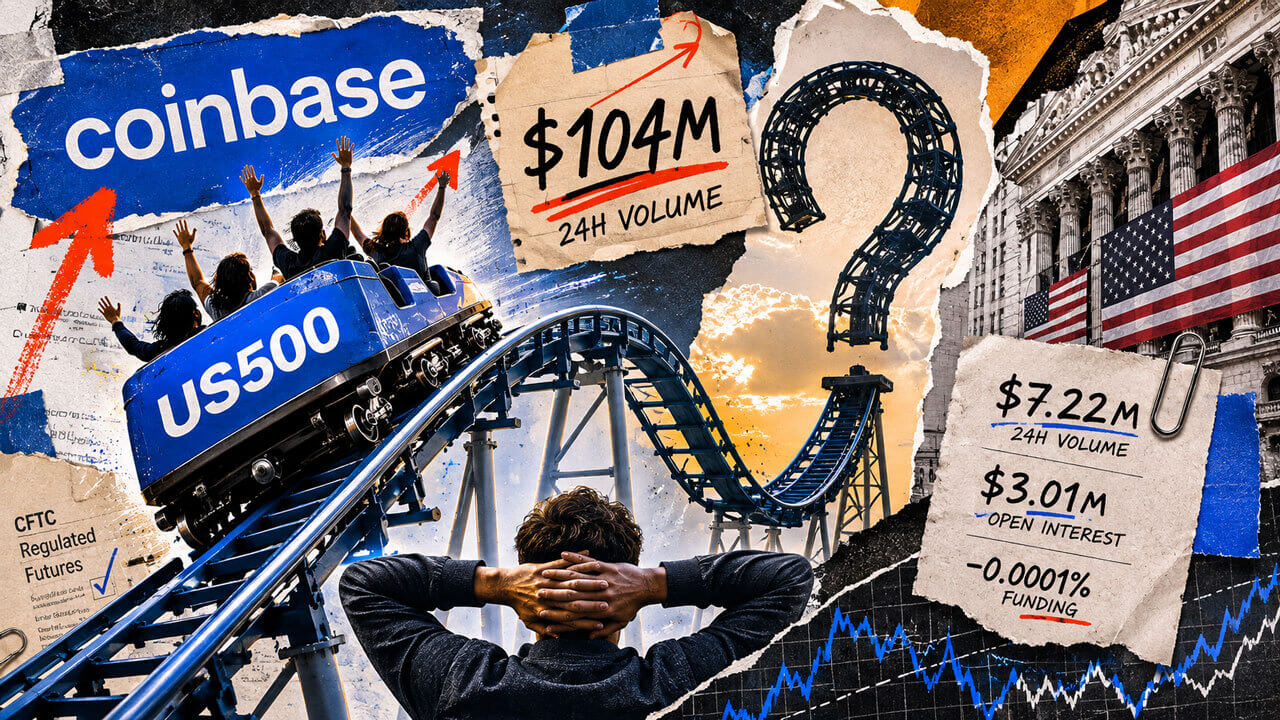
The milestone was highlighted by Coinbase CEO Brian Armstrong, who shared data on August 28 indicating that the US500 contract reached approximately $104 million in matched volume between August 25 and August 26. This surge followed a relatively quiet inaugural week for the product, which began trading on August 17. While the headline figure suggests a rapid ramp-up in activity, subsequent data provides a more nuanced view of the contract’s early lifecycle. Approximately 15 hours after the initial announcement, the Coinbase product page recorded a 24-hour volume of $7.22 million and open interest of $3.01 million. These fluctuating figures underscore the volatility inherent in new product launches, where initial bursts of liquidity from market makers and early adopters often precede a period of stabilization.
The Architectural Hybrid: Crypto-Native Funding in a Regulated Framework
The core innovation of the Coinbase US500 futures contract lies in its "perp-style" design. In traditional finance, futures contracts typically converge with the spot price as they approach a fixed expiration date. In the cryptocurrency world, however, the "perpetual swap" has become the dominant instrument. These swaps have no expiry date and use a periodic "funding rate" to keep the contract price tethered to the underlying spot price. If the futures price is higher than the spot price, longs pay shorts; if it is lower, shorts pay longs.
Coinbase has imported this funding-rate mechanism into a regulated framework, but with a structural twist: the contract is not truly perpetual. According to the July 30 self-certification filed with the CFTC, the US500 is a five-year, US dollar-settled equity-index future. The initial contract is set to expire on the third Thursday of December 2030. By combining a long-dated expiry with hourly funding calculations, Coinbase aims to offer a product that feels like a crypto perpetual swap while satisfying the legal requirements of a fixed-term derivative.
The funding rate is calculated hourly based on the delta between the futures price and the spot mark. These payments are then aggregated by the clearing house, Nodal Clear, during midday and end-of-day margin runs. This system allows for continuous price alignment without the need for the quarterly "rolls" common in traditional equity futures, potentially reducing the friction for retail traders accustomed to the seamless experience of crypto exchanges.
Chronology of the US500 Launch and Development
The path to the $100 million milestone began well before the August trading debut. The strategic foundation was laid when Coinbase sought to diversify its revenue streams beyond the volatile spot trading fees that characterize the cryptocurrency market.
- July 30, 2024: Coinbase Derivatives filed a self-certification with the CFTC for the US500 stock index futures contract. This filing detailed the "perp-style" design, the five-year duration, and the reliance on the MarketVector benchmark.
- August 7, 2024: The MarketVector Top 500 US Profitable Companies Continuous Index (MVPUSC) officially launched, providing the underlying benchmark for the Coinbase contract.
- August 17, 2024: Trading officially commenced for the US500 futures. The contract was made available to both institutional and retail traders via Coinbase’s integrated platform and third-party brokers.
- August 17–24, 2024: The first week of trading saw modest volumes as the market established liquidity and market makers adjusted their algorithms to the hourly funding mechanism.
- August 25–26, 2024: Matched volume spiked to $104 million, marking the first major liquidity milestone for the product.
- August 28, 2024: CEO Brian Armstrong publicly announced the milestone. Subsequent data showed a retraction in daily volume to $7.22 million, illustrating the "rolling window" nature of volume reporting and the early-stage volatility of the contract.
Defining the Benchmark: MarketVector vs. the S&P 500
A critical distinction for traders and analysts is the underlying index that the US500 tracks. While the "US500" moniker may evoke thoughts of the S&P 500, the contract actually references the MarketVector Top 500 US Profitable Companies Continuous Index (MVPUSC). MarketVector, a subsidiary of VanEck, designed this index to track the largest securities of profitable US companies.
The choice of MarketVector over a more traditional provider like S&P Dow Jones Indices is likely a strategic one. It allows Coinbase to offer exposure to the broad US equity market without the licensing complexities and costs associated with the S&P 500 brand. As of late August, the MVPUSC index listed 501 components, emphasizing "profitable" companies—a methodology that may result in slight performance deviations from the traditional S&P 500, which has its own specific inclusion criteria.
Traders receive cash-settled exposure to this benchmark, meaning there is no physical delivery of shares. This ensures that the product remains a pure play on price action, carrying no ownership or shareholder voting rights. For Coinbase, this simplifies the clearing and settlement process while providing a product that is familiar to those who trade index ETFs or traditional futures.
Analyzing the Data: Volume, Open Interest, and Market Health
To assess the long-term viability of the US500, analysts look beyond the $100 million headline. Matched volume is a measure of turnover—how many times contracts changed hands. While high volume is a sign of interest, it does not necessarily equate to "sticky" capital. Open interest, which stood at approximately $3.01 million on August 28, is often considered a more accurate gauge of market depth, as it represents the total number of outstanding contracts that have not been settled.
The ratio of volume to open interest in the late August readings (roughly 2.4 to 1) suggests a high degree of day-trading or market-making activity. In a mature market, open interest tends to be significantly higher relative to daily volume, indicating that participants are holding positions for the long term. For a product that is less than two weeks old, however, these numbers are typical of a "price discovery" phase.
The funding rate data also provides a glimpse into market sentiment. The recorded rate of negative 0.0001%—where shorts pay longs—indicates a slight bearish tilt or a surplus of selling pressure at that specific moment. Because the funding rate oscillates based on the futures-to-spot premium, a longer history of these rates will eventually reveal whether the Coinbase user base leans systematically bullish or bearish compared to the broader equity market.
Regulatory Compliance and Institutional Safeguards
Despite its crypto-inspired mechanics, the US500 operates strictly within the confines of the US regulated derivatives market. This is not a "wild west" crypto product; it is a CFTC-regulated instrument that follows a standard market calendar. Trading runs from Sunday at 8:00 p.m. ET to Friday at 5:00 p.m. ET, aligning with traditional global financial markets rather than the 24/7/365 schedule of the crypto spot market.
The contract is subject to:
- Exchange Position Limits: Preventing any single entity from exerting undue influence on the market.
- Price Limits and Circuit Breakers: Ensuring that extreme volatility does not lead to a systemic collapse, mirroring the protections found on the New York Stock Exchange and the CME.
- Centralized Clearing: By using Nodal Clear, Coinbase ensures that counterparty risk is managed by a regulated clearing house, providing a layer of security that institutional investors require.
Broader Implications for the Derivatives Landscape
The success or failure of the US500 will have significant implications for the future of financial engineering. If Coinbase can prove that the funding-rate model is an efficient way to manage equity derivatives, it may prompt traditional exchanges to explore similar "perp-style" structures for other asset classes, such as commodities or forex.
Furthermore, this move represents a major step in Coinbase’s evolution from a cryptocurrency exchange to a full-service financial platform. By offering equity futures, Coinbase is directly competing for the attention of retail traders who might otherwise use platforms like Robinhood or Interactive Brokers. The "crypto-fication" of the interface—making equity trading feel as seamless and dynamic as trading Bitcoin—could attract a younger demographic of investors who find traditional futures trading cumbersome.
However, challenges remain. The US equity derivatives market is incredibly crowded. Coinbase must compete with the deep liquidity and decades-long track record of the CME’s E-mini and Micro E-mini S&P 500 futures. Establishing a liquid pool of capital in the US500 will require consistent participation from institutional liquidity providers, not just retail enthusiasm.
Conclusion: A Measured Start to a Long-Term Experiment
The $104 million volume milestone is a successful "proof of concept" for the Coinbase US500 futures. It demonstrates that the technical infrastructure can handle significant turnover and that there is an appetite for a hybrid crypto-equity product. However, the drop-off in volume in subsequent days and the relatively low open interest suggest that the contract is still in its infancy.
The real test will be the "durable liquidity" mentioned in market analysis. Over the coming months, the industry will be watching to see if the funding rate remains stable, if open interest grows into the tens or hundreds of millions, and if the MarketVector benchmark gains wider acceptance among traders. For now, Coinbase has successfully bridged two worlds, creating a regulated instrument that speaks the language of crypto. Whether that language translates into a permanent shift in the US derivatives landscape remains to be seen.