admin
admin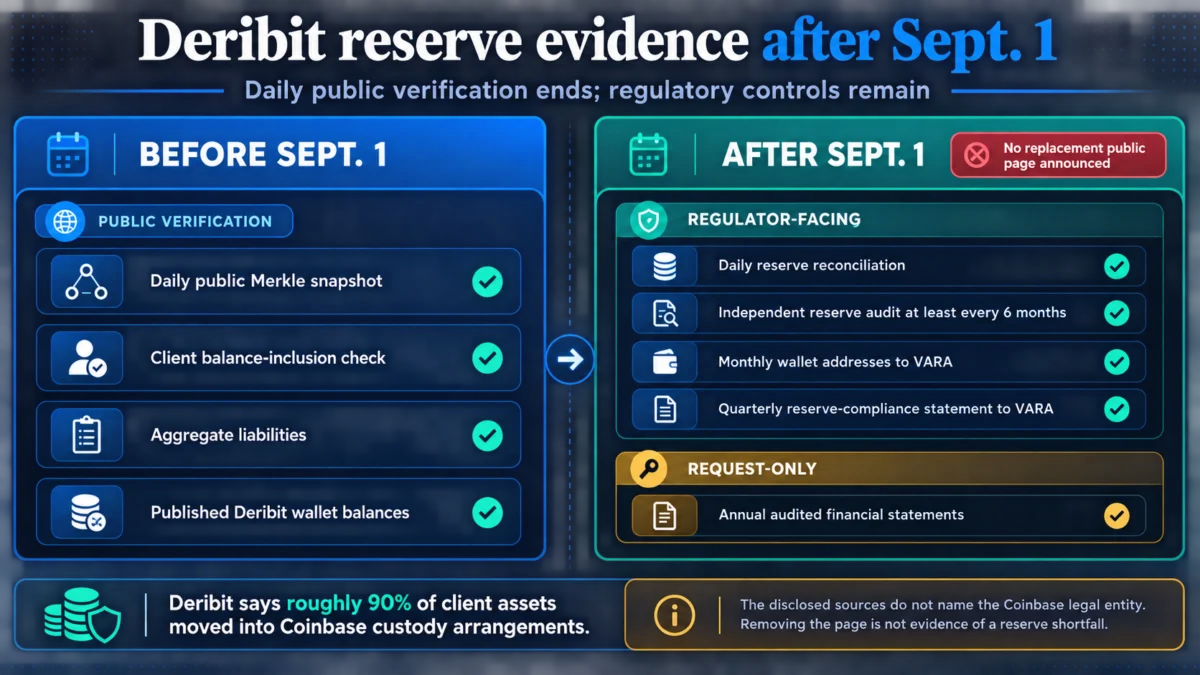
Deribit, a prominent cryptocurrency derivatives exchange, announced a significant shift in its asset custody and transparency practices, culminating in the removal of its daily public Proof of Reserves (PoR) page effective September 1. This change marks the discontinuation of a daily client-facing verification mechanism that allowed users to confirm the inclusion of their balances and compare aggregate liabilities against published wallet holdings. While regulatory-mandated reserve, reconciliation, and audit controls will persist, these measures offer a less immediate and public form of assurance compared to the former daily snapshot.
The exchange cited a comprehensive overhaul of its wallet infrastructure, a process intrinsically linked to its integration with Coinbase, as the primary driver for this decision. Since Coinbase acquired the derivatives platform in August 2025, approximately 90% of Deribit’s client assets have been transitioned into custody arrangements managed by Coinbase. Although Deribit’s disclosures name Coinbase at the corporate brand level, they do not specify the exact legal entity within the Coinbase umbrella that holds these migrated assets. This migration represents a substantial consolidation of assets under a single, albeit diversified, institutional custodian.
Historical Context of Proof of Reserves
The concept of Proof of Reserves gained significant traction within the cryptocurrency industry, particularly in the wake of the FTX collapse in late 2022. FTX’s failure exposed a critical lack of transparency regarding how exchanges held and managed customer assets, leading to widespread distrust. In response, many platforms, including Deribit, implemented PoR systems to demonstrate that customer funds were being held in reserve and not being commingled with company funds or used for other purposes. These systems typically involved cryptographic methods, such as Merkle trees, to allow customers to verify their balances without revealing sensitive information to other users or the public.
Deribit’s previous PoR system employed a privacy-preserving binary Merkle tree and a daily snapshot methodology. This allowed individual clients to use a unique proof identifier to locate the hashed entries corresponding to their balances within the dataset. Concurrently, any interested party could aggregate the liabilities presented in the file and compare this total against the wallet balances publicly disclosed by Deribit. This dual approach aimed to provide both individual and collective assurance of solvency.
Limitations of the Previous System

It is important to note that Deribit’s previously published public snapshot was, by its own methodology, narrower than its entire custody footprint. The exchange’s documentation indicated that assets held with third-party custodians were excluded from the daily public PoR because they were considered outside Deribit’s direct operational control. While Copper ClearLoop was cited as an example of such a custodian, the previous disclosures did not explicitly state whether all assets now held by Coinbase were already excluded from this daily public check. This suggests that the daily PoR, while valuable, did not represent a complete picture of all client assets under Deribit’s management.
The Implications of the Change
Following September 1, Deribit has not announced plans for a replacement public dashboard or a continuation of the client-level Merkle verification process. Instead, the exchange has stated that clients and counterparties can request audited financial statements and other due-diligence materials. This represents a shift towards less frequent, less directly verifiable, and more private forms of assurance. While these audited documents are crucial for regulatory compliance and institutional trust, they lack the real-time, self-service transparency that the daily PoR offered to individual retail clients.
The move signifies a potential reduction in the granular, immediate oversight that retail traders could exercise over their assets held on the platform. While institutional clients and regulators will still have access to robust audit trails, the average user will no longer be able to perform a daily, independent check of Deribit’s reserve status against their own holdings. This change, while framed as an infrastructure upgrade, could be perceived by some as a step back in transparency for the broader user base.
Regulatory Framework and Continued Compliance
The cessation of the public PoR page does not absolve Deribit FZE, the entity operating in Dubai, from its regulatory obligations. The Dubai Virtual Assets Regulatory Authority (VARA) imposes stringent requirements on covered virtual asset service providers. VARA mandates that these entities maintain reserves equivalent to 100% of client liabilities, hold these reserves one-to-one in the same asset class, reconcile them daily, and undergo an independent third-party reserve audit at least every six months.
Deribit’s own disclosures mention both annual and bi-annual Proof of Reserves audits. VARA’s rules establish a minimum of one audit every six months. Furthermore, a separate VARA provision necessitates an annual financial statement audit, with the annual report required to be accessible to clients and the regulator upon request. These regulatory mandates ensure a baseline level of financial scrutiny, even in the absence of a public PoR page.

Beyond these audit requirements, covered firms are obligated to submit wallet addresses monthly and quarterly statements demonstrating compliance with financial requirements, including reserve assets, directly to VARA. These reports are primarily regulator-facing rather than publicly disseminated, underscoring the shift in Deribit’s transparency approach.
Deribit FZE’s operational status is confirmed by VARA’s public register, where it is listed as an active exchange and broker-dealer Virtual Asset Service Provider (VASP). The exchange’s membership terms permit assets to be held either directly or through third-party custodians, provided they are segregated from company assets and clients retain legal title. The inclusion of Coinbase on Deribit’s list of third-party service providers, designated for custody and self-custody technology, further solidifies the integration, although the specific Coinbase entity involved remains unspecified.
Analysis of the Custody Shift
The decision to move approximately 90% of client assets to Coinbase custody is a significant strategic move. Coinbase, as a publicly traded company with a strong regulatory track record in the United States, offers a layer of institutional trust and robustness. This consolidation likely streamlines operations, enhances security, and potentially reduces costs associated with managing a dispersed custody infrastructure. For Deribit, partnering with a major player like Coinbase can be seen as a proactive measure to bolster confidence in its operational and financial integrity, especially in an environment where trust is paramount.
However, the concurrent removal of the daily public PoR check introduces a notable point of discussion. While Deribit maintains that all regulatory obligations are being met and that audited financials will be available, the loss of the daily, granular transparency mechanism might be viewed with concern by some market participants. The daily PoR provided a readily accessible, albeit limited, window into the exchange’s financial health from the perspective of individual users. Its removal shifts the burden of assurance more heavily onto regulatory oversight and private audits, which are inherently less immediate and accessible to the retail trading community.
The implications for market confidence are multifaceted. On one hand, the partnership with Coinbase signals a commitment to robust infrastructure and security. On the other hand, the reduction in public-facing transparency could fuel skepticism among those who prioritize immediate, self-verifiable data. The success of this transition will likely hinge on Deribit’s ability to effectively communicate the ongoing security and solvency measures to its user base and to ensure that the audit processes are both thorough and, where appropriate, made accessible to stakeholders.
The future of transparency in cryptocurrency exchanges is an evolving narrative. While regulatory frameworks are solidifying, the balance between operational efficiency, institutional partnerships, and public accessibility remains a key consideration for exchanges like Deribit. The removal of the daily PoR check by Deribit is a concrete step in this evolving landscape, highlighting the trade-offs between different models of trust and verification in the digital asset space. It is a clear indication that while regulatory compliance is a baseline, the methods by which exchanges demonstrate their financial integrity are subject to strategic adjustments and evolving industry practices. The market will undoubtedly continue to scrutinize such changes, seeking reassurance that client assets are safeguarded through a combination of robust infrastructure, diligent regulation, and transparent reporting.