admin
admin
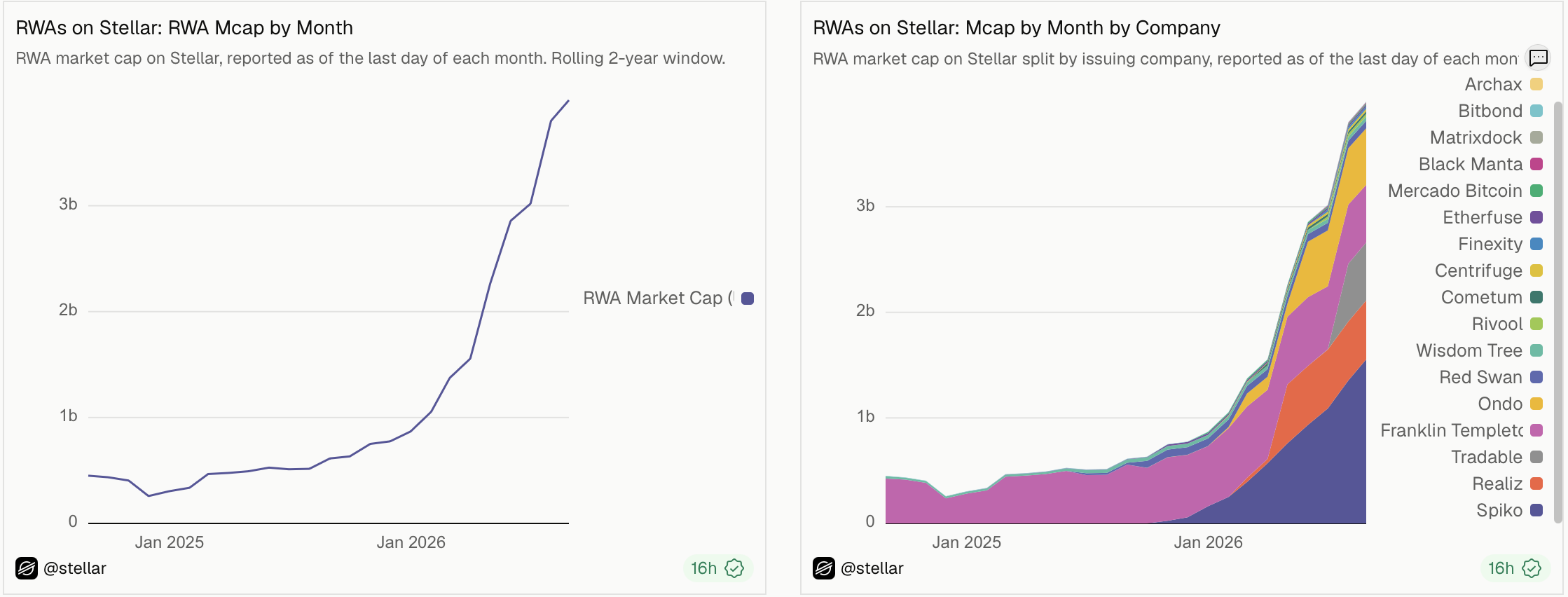
The Stellar network has achieved a significant milestone in the digital asset sector, with the total value of tokenized real-world assets (RWAs) on its blockchain climbing approximately 360% since the beginning of 2026. According to data retrieved from a Dune Analytics dashboard maintained by the Stellar Development Foundation, the market capitalization for these assets reached $3.996 billion as of August 29, 2026. This represents a substantial leap from the $868.8 million valuation recorded at the close of 2025, underscoring a rapid shift in institutional preference toward Stellar’s specialized infrastructure for asset issuance and global payments.
This surge in valuation is distributed across a diverse array of financial instruments, including United States Treasury bills, private and public credit, non-U.S. government debt, and various other tokenized asset classes. The growth reflects a broader industry trend where traditional financial products are being migrated onto blockchain rails to take advantage of 24/7 settlement, increased transparency, and reduced administrative overhead.
Dominance of Major Issuers and Asset Concentration
The Stellar RWA ecosystem is currently characterized by a high degree of concentration among a select group of institutional issuers. As of late August 2026, Spiko emerged as the primary driver of value on the network, accounting for approximately $1.55 billion of the total RWA market cap. Spiko’s dominance highlights the growing appetite for yield-bearing digital assets that are backed by highly liquid, traditional reserves.
Following Spiko, several other major players have established significant footprints on the network:
- Realiz: $559 million
- Tradable: $548 million
- Franklin Templeton: $546 million
- Ondo Finance: $535 million
The presence of legacy financial institutions like Franklin Templeton alongside native digital asset firms like Ondo Finance suggests that Stellar has successfully positioned itself as a bridge between traditional finance (TradFi) and decentralized finance (DeFi). Franklin Templeton, an early mover in the space, has long utilized Stellar for its OnChain U.S. Government Money Fund (FOBXX), citing the network’s low transaction costs and efficiency in handling high-volume transfers.
Global Expansion: Non-U.S. Government Debt and Emerging Markets
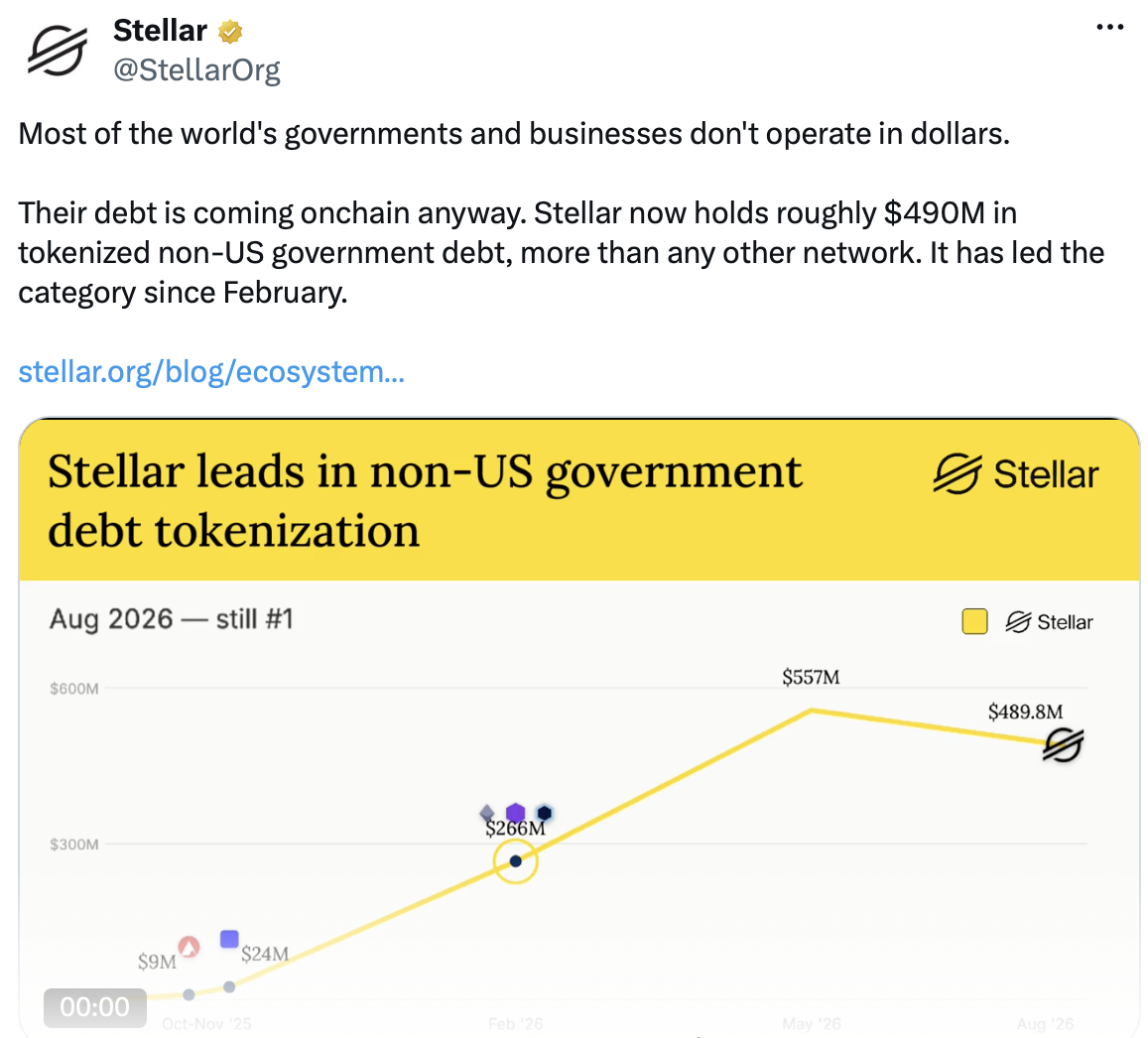
While U.S. dollar-denominated assets remain a cornerstone of the tokenization movement, Stellar has made significant inroads into non-U.S. government debt markets. Data provided by RWA.xyz and the Stellar Development Foundation indicates that the network held roughly $490 million in international sovereign debt as of August 20, 2026.
A key contributor to this growth is Etherfuse, a platform that facilitates the tokenization of Latin American debt instruments. Through Etherfuse, investors have gained access to tokenized Mexican CETES (Certificados de la Tesorería de la Federación) and Brazilian government bonds. This development is particularly noteworthy as it demonstrates Stellar’s utility in emerging markets, where local investors often seek more efficient ways to access government-backed securities or where international investors look for exposure to emerging market yields without the traditional frictions of cross-border brokerage.
The expansion into Mexican and Brazilian debt aligns with Stellar’s historical mission of fostering financial inclusion and creating a "world-wide" financial rail. By tokenizing these assets, the network allows for fractional ownership and secondary market liquidity that was previously unavailable to a broader range of global participants.
A Chronology of Institutional Adoption in 2026
The trajectory of Stellar’s RWA growth in 2026 can be traced through a series of high-profile partnerships and technical integrations that bolstered investor confidence.
May 2026: The DTCC Integration
The Depository Trust & Clearing Corporation (DTCC), the premier post-trade market infrastructure for the global financial services industry, announced plans to connect its tokenization services to the Stellar network. This move was designed to allow DTC-tokenized assets—potentially including U.S. Treasurys, major index ETFs, and Russell 1000 stocks—to be issued and traded on Stellar. While the full implementation is expected in the first half of 2027, the announcement acted as a massive catalyst for institutional interest in the network throughout mid-2026.
June 2026: MoneyGram and Stablecoin Evolution
MoneyGram International further deepened its relationship with Stellar by launching MGUSD, a dollar-denominated stablecoin. This asset allows users to hold dollar balances on-chain and move funds through MoneyGram’s extensive global retail network. As of August 2026, Stellar hosts approximately $438 million in reserve-verified stablecoins, providing the necessary liquidity and "on-ramps" for investors to move between cash and tokenized RWAs.
July 2026: Tradable’s Private Credit Push
Tokenization platform Tradable announced an ambitious plan to bring up to $1 billion in private credit assets to the Stellar blockchain. This initiative focused on the entire asset lifecycle, from investor onboarding to compliance and management. Tradable’s decision was influenced by Stellar’s built-in compliance features, such as the "clawback" function and "auth_required" flags, which allow issuers to satisfy regulatory requirements regarding asset recovery and investor whitelisting.
Technical Infrastructure and the Role of Soroban
The rapid scaling of RWAs on Stellar in 2026 is inextricably linked to the network’s technical evolution. The full-scale maturation of Soroban, Stellar’s smart contract platform, has allowed for more complex financial logic to be applied to tokenized assets. Unlike the early days of the network, which were limited to simple asset transfers, the current ecosystem supports sophisticated automated market makers (AMMs), lending protocols, and compliance engines.
Issuers like Spiko and Tradable utilize these smart contracts to automate dividend distributions, enforce holding periods, and manage jurisdictional restrictions. This automation reduces the "middleman" costs typically associated with private credit and government bonds, allowing for higher net yields for end investors.
The XLM Price Paradox: Utility vs. Speculation
Despite the 360% growth in the value of assets secured by the network, Stellar’s native utility token, XLM, has experienced a divergent market trend. Year-to-date, XLM is down approximately 11%, trading near the $0.18 mark as of late August.
This decoupling of network utility and token price is a subject of intense analysis within the industry. Analysts suggest several factors for this trend:
- Fee Efficiency: Stellar’s transaction fees remain extremely low. While the network is processing record volumes of RWA transfers, the actual demand for XLM to pay for transaction fees does not necessarily scale linearly with the dollar value of the assets being moved.
- Institutional Neutrality: Many institutional issuers utilize Stellar as a "backend" infrastructure. Investors holding tokenized Treasurys or Spiko assets may not even realize they are using a blockchain, as the XLM required for transactions is often "wrapped" or managed by the service provider (abstraction).
- Market Sentiment: While Stellar is leading in RWA growth, the broader altcoin market in 2026 has faced headwinds, with capital concentrating in Bitcoin or newer speculative ecosystems, even if those ecosystems lack the institutional RWA volume found on Stellar.
Official Responses and Strategic Outlook
The Stellar Development Foundation (SDF) has maintained a focus on "real-world utility" as its primary metric for success. In recent communications, the SDF emphasized that the goal of the network is not speculative price action for XLM, but rather the creation of a seamless global financial system.
"The world’s government debt is coming on-chain, and it is choosing Stellar because the network was built specifically for this purpose," the Foundation stated in a recent blog post. Industry observers note that the success of the DTCC integration in 2027 will likely be the next major test for the network, as it moves from tokenizing "niche" credit products to the core of the global equities and bonds markets.
Broader Implications for the Blockchain Industry
Stellar’s performance in 2026 serves as a case study for the "Institutional DeFi" movement. While other blockchains like Ethereum and Solana have seen significant RWA growth, Stellar’s focus on regulatory-friendly architecture has given it a competitive edge in attracting conservative financial entities.
The growth to $4 billion suggests that tokenization is moving out of the "proof-of-concept" phase and into a phase of meaningful capital allocation. As more assets move on-chain, the industry expects a "network effect" where the presence of high-quality assets like U.S. Treasurys attracts more liquidity, which in turn attracts more issuers.
For the broader market, Stellar’s success in non-U.S. debt markets—specifically in Brazil and Mexico—indicates that the next wave of growth may come from jurisdictions where traditional financial infrastructure is either inefficient or expensive. If Stellar can continue to capture these markets while successfully integrating with giants like the DTCC, it may solidify its position as the dominant institutional layer of the decentralized web, regardless of the short-term price fluctuations of its native token.
As the final quarter of 2026 approaches, the industry will be watching to see if the $4 billion mark is a ceiling or merely a stepping stone toward a $10 billion RWA ecosystem. With the private credit deals from Tradable still being offloaded onto the chain and the DTCC integration looming, the momentum appears to be skewed toward continued expansion.