admin
admin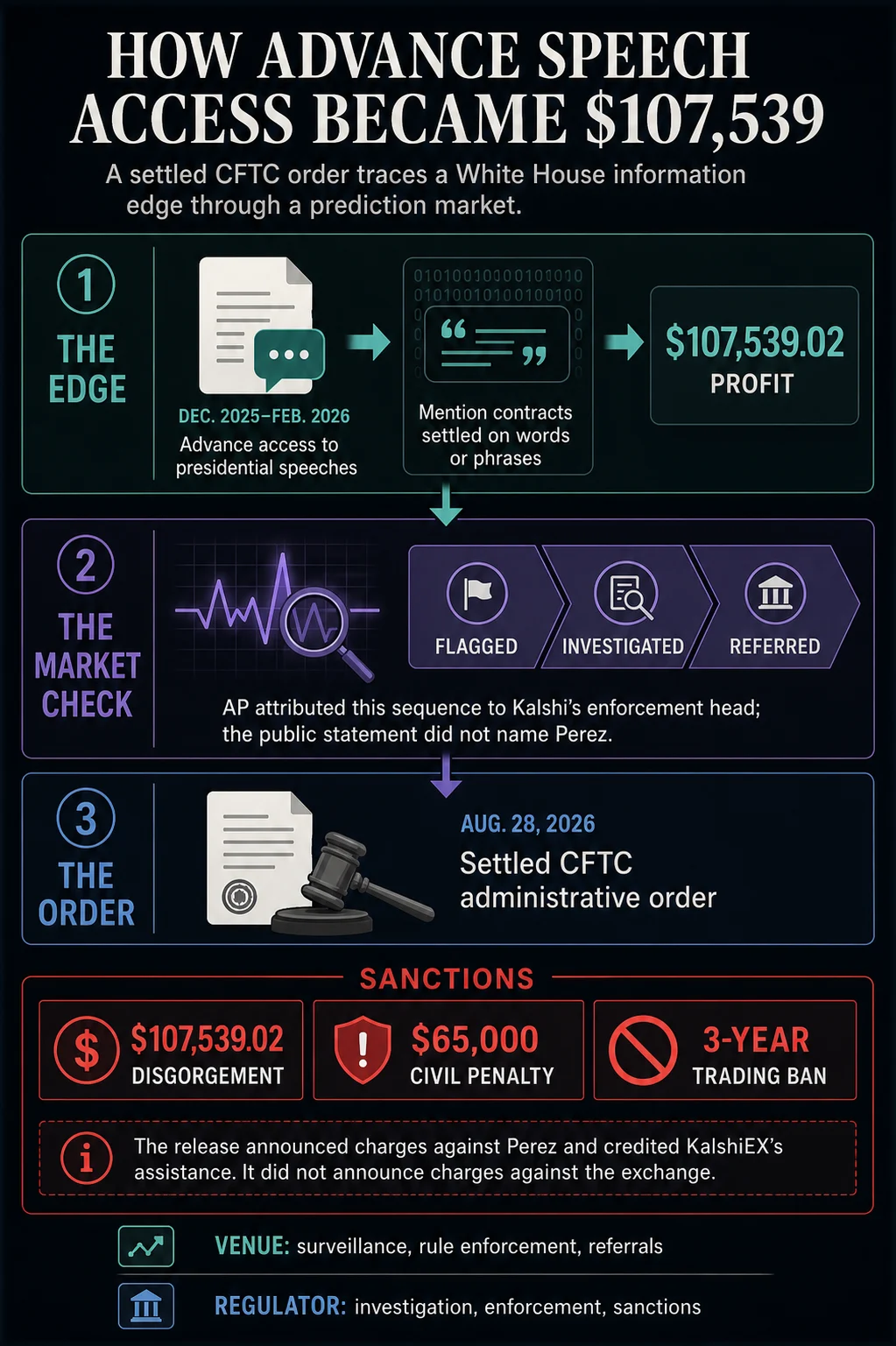
A former White House teleprompter operator, Gabriel Perez, has been ordered to forfeit over $107,000 in profits and pay a $65,000 civil penalty after the Commodity Futures Trading Commission (CFTC) found he exploited advance access to presidential speeches for insider trading on prediction markets. The regulatory action, which includes a three-year ban from trading, was significantly mitigated by Perez’s "exemplary cooperation" with the investigation. The CFTC’s findings, detailed in a settled administrative order, highlight a concerning intersection of nonpublic government information and speculative financial markets.
The Mechanics of the Scheme: Leveraging Unreleased Speeches
The core of the alleged misconduct involved trading on "mention market" contracts on the Kalshi exchange between December 2025 and February 2026. These contracts, categorized by the CFTC as swaps, were designed to settle based on whether specific words or phrases were included in presidential speeches. As a teleprompter operator, Perez had direct, advance access to the finalized text of these speeches before they were delivered to the public. This privileged position allowed him to ascertain the outcomes of these prediction contracts with near certainty, effectively transforming confidential government information into substantial financial gains.
According to the CFTC’s order, Perez systematically traded on this material nonpublic information. While other market participants were attempting to gauge the probability of certain phrases being uttered based on public sentiment, political analysis, or leaked information, Perez possessed the definitive answer. This gave him an insurmountable informational advantage, allowing him to consistently profit by buying or selling contracts with knowledge that was unavailable to the broader trading community. The order specifies that Perez’s trades generated $107,539.02 in profits, which he must now surrender.
A Chronology of Exploitation and Enforcement
The period under scrutiny for Perez’s trading activities spans from December 2025 to February 2026. During this time, he occupied a sensitive role within the White House, directly facilitating the delivery of presidential addresses. The CFTC’s investigation, which commenced after the trades were flagged, culminated in a settled administrative order issued on August 28, 2026.
The process of enforcement involved a collaborative effort, albeit one where the exchange played a crucial role in initiating the inquiry. Reports from the Associated Press in July 2026 indicated that Kalshi’s enforcement head, Robert DeNault, stated the exchange’s surveillance team had "promptly flagged, investigated and referred" the suspicious trades to the CFTC. While DeNault’s public statement at the time did not name Perez, the CFTC’s subsequent release confirmed the exchange’s assistance, a factor that contributed to the reduction in Perez’s penalty.
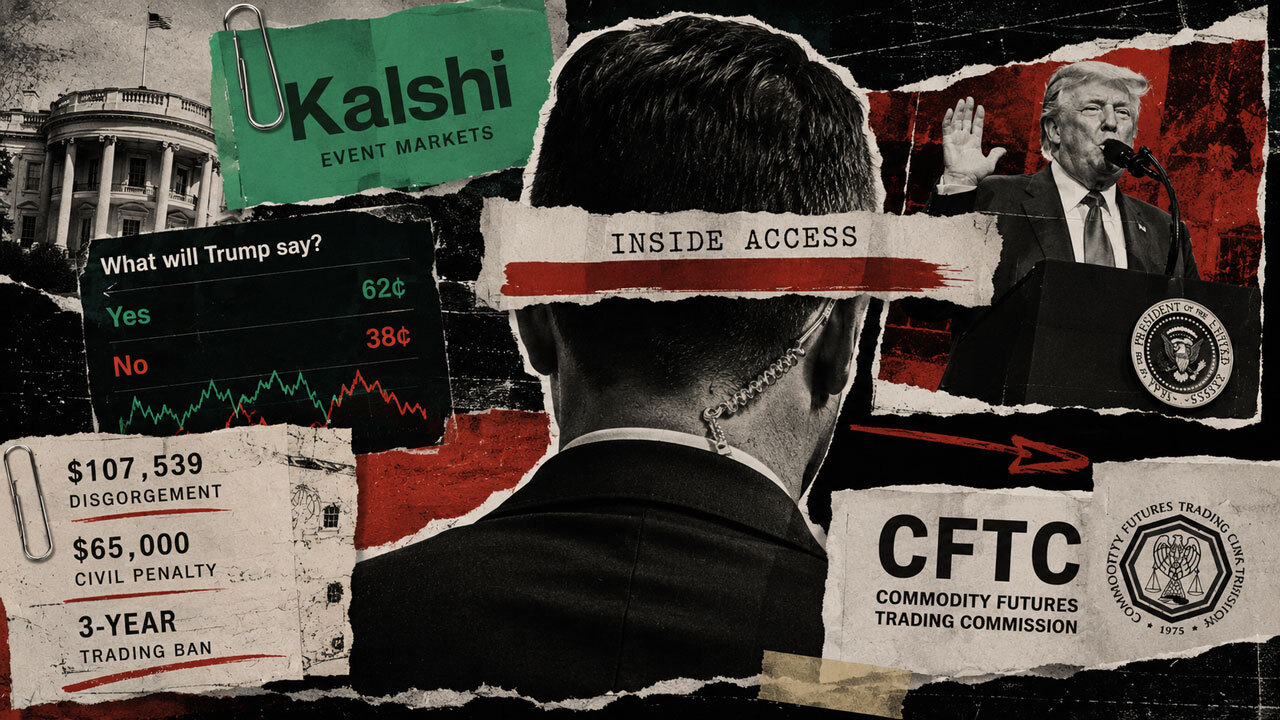
The CFTC’s final order details the settlement terms: disgorgement of illicit profits, a substantial civil monetary penalty, a cease-and-desist order, and a three-year ban from trading on CFTC-regulated markets. The credit given for Perez’s cooperation underscores the agency’s approach to incentivizing transparency and assistance in such investigations. It is important to note that the cited materials describe a civil regulatory settlement and do not indicate any criminal conviction against Gabriel Perez.
The Role of Prediction Markets and Regulatory Oversight
Prediction markets, such as Kalshi, operate by allowing users to bet on the outcome of future events. These markets can serve as valuable tools for price discovery and sentiment analysis, offering insights into public perception and potential future developments. However, their efficacy and integrity are contingent upon a level playing field, where all participants have access to the same information.
The CFTC’s mandate includes ensuring the fairness and transparency of derivatives markets, including prediction markets. The commission has previously issued advisories, such as one in February 2026, emphasizing the independent duty of designated contract markets to maintain robust audit trails, conduct comprehensive surveillance, and actively enforce rules against prohibited trading practices. In parallel, the CFTC retains its authority to investigate and prosecute illegal trading activities, often coordinating with exchanges on referrals.
The case involving Gabriel Perez illustrates a scenario where an individual exploited a unique position of trust and access to circumvent the intended mechanisms of a prediction market. The fact that Perez’s trading occurred between December 2025 and February 2026, and the CFTC’s order was issued in August 2026, suggests a significant lag time between the alleged misconduct and the final resolution.
Kalshi’s Enhanced Market Integrity Measures
In response to evolving risks and potential vulnerabilities within the prediction market landscape, Kalshi has taken steps to bolster its market integrity protocols. In June 2026, the exchange announced several new measures, including the implementation of risk scoring for markets deemed to have heightened insider or manipulation risk, employment verification for certain participants, and the expansion of whistleblower tools. These initiatives were introduced after the period of Perez’s alleged trading.
The timing of these enhanced controls raises questions about their potential effectiveness in preventing similar incidents. While these measures demonstrate Kalshi’s commitment to improving its oversight, the available information does not definitively establish whether they would have successfully blocked Perez’s activities had they been in place during his trading window. The convergence of exchange referral and regulatory enforcement after the profits were realized underscores the ongoing challenge of proactive prevention versus reactive remediation in market oversight.

Broader Implications and Future Considerations
The settlement with Gabriel Perez carries significant implications for both government ethics and the regulation of financial markets. It highlights the potential for sensitive, nonpublic government information to be weaponized in speculative trading environments, even those seemingly removed from traditional financial asset classes. The case serves as a stark reminder that the principle of insider trading is not confined to stock markets but extends to any arena where material nonpublic information can be leveraged for financial gain.
For government employees in positions with access to confidential information, the case reinforces the critical importance of adhering to strict ethical guidelines and conflict-of-interest policies. The use of teleprompter operators or other support staff in sensitive government functions, while often necessary for operational efficiency, necessitates robust oversight and clear communication regarding the prohibition of using such access for personal profit.
From a regulatory perspective, the incident underscores the ongoing need for vigilance and adaptation by bodies like the CFTC. As financial innovation continues to evolve, regulators must remain proactive in identifying emerging risks and ensuring that existing frameworks are sufficient to address them. The cooperation between the CFTC and Kalshi in this case is a positive sign, demonstrating the effectiveness of inter-agency and industry collaboration in upholding market integrity.
The settlement, which includes both disgorgement of profits and a penalty, aims to deter future misconduct and penalize illicit gains. The three-year trading ban further isolates individuals who violate trust and market rules. However, the timeline of events – from the trading period to the final order – suggests that the process of detection, investigation, and resolution can be lengthy. This lag time, while perhaps unavoidable in complex investigations, leaves a window of opportunity for illicit activities to occur.
The broader impact of this case may lead to increased scrutiny of information access protocols within government institutions and a renewed focus on the surveillance capabilities of financial exchanges, particularly those operating in novel market segments like prediction markets. The ongoing development and refinement of market integrity tools, such as those implemented by Kalshi, are crucial for maintaining confidence in the fairness and reliability of these platforms. The ultimate goal remains to foster an environment where market participants compete on skill and insight, rather than on privileged, undisclosed information.