admin
admin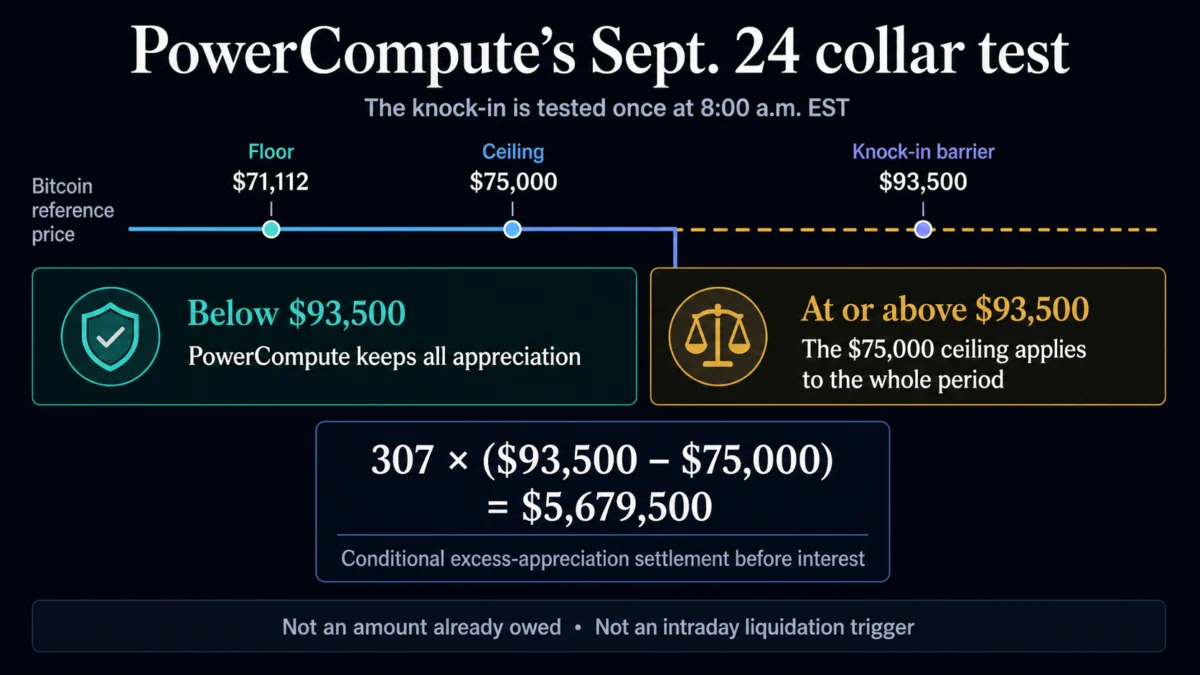
PowerCompute, a prominent player in the Bitcoin treasury and mining sector, has significantly increased its debt obligations by $3.765 million due to an early termination of a Bitcoin collar agreement. This adjustment, involving 307 Bitcoin, saw the unwind cost of the terminated contract being incorporated directly into the principal balance rather than settled in cash or a stablecoin like USDC. This strategic decision, revealed in a recent filing with the Securities and Exchange Commission (SEC), underscores the complex financial instruments utilized by cryptocurrency-focused companies to manage market volatility and secure financing.
The company’s filing on August 28th detailed a substantial revision to its existing credit facility with Arch Lending. The replacement 30-day collar agreement now carries a balance of $21,892,131.88, a notable increase from the previous $18,127,131.88. While the collateral remains pegged to 307 Bitcoin, the annual interest rate on this facility has also seen a considerable jump, escalating from a modest 2% to 6.5%. This escalation reflects both the increased principal and the prevailing market conditions for such leveraged crypto-denominated debt.
The Mechanics of the Bitcoin Collar Reset and Principal Increase
The decision to add the unwind cost to the principal balance was made by PowerCompute’s borrowing subsidiary, US Digital Mining and Hosting Co. This approach, as outlined in the accompanying annex to the filing, was mutually agreed upon as a substitute for any separate settlement of excess appreciation from the terminated period. This method effectively rolls the cost of exiting the previous agreement into the new financing arrangement, altering the principal amount owed and, consequently, the interest accrual.
The original Bitcoin collar was initiated on August 3rd and was scheduled to undergo a reset on September 2nd. However, PowerCompute opted for an early termination on August 25th, 22 days prior to its scheduled end. At the time of termination, the reference price for Bitcoin stood at $78,500. This price was above the "ceiling" set within the collar agreement, which was established at $66,370. The prior reset confirmation documents, readily available through SEC filings, clearly delineate these parameters. The initial loan filing, which established the $18.13 million balance and the 2% interest rate, also predates this significant adjustment.
The financial implications of this early termination are multifaceted. The newly established replacement loan, covering the period from August 25th to September 24th, incurs a total interest charge of $118,582.38. This calculation adheres to the 30/360 day count convention, a standard practice in many financial agreements. The specific annex governing the 30-day mechanics of the collar provides the granular commercial figures, even though the master agreement contains more expansive legal language. This distinction is critical for understanding the precise operational and financial terms of the agreement.
New Collar Parameters and Potential Appreciation Scenarios
The revised collar agreement, effective from August 25th, introduces a new set of parameters for the next reset, scheduled for September 24th. The key figures include a floor price of $71,112, a ceiling price of $75,000, and a "knock-in barrier" set at $93,500. Arch Lending will conduct a single test of the reference price on September 24th, at 8:00 a.m. Eastern Standard Time (EST), to determine the status of the agreement.
The dynamics of this collar are designed to manage Bitcoin price fluctuations. Crucially, if the reference price falls below the $93,500 knock-in barrier, the $75,000 ceiling has no practical effect. PowerCompute retains the full benefit of any Bitcoin price appreciation, even if the reference price surpasses the $75,000 ceiling. However, should the reference price reach or exceed the $93,500 knock-in barrier on the test date, the ceiling price then becomes applicable to the entire period.
The scenario where excess appreciation arises is specifically triggered if the September 24th reference price hits or goes above $93,500. In the event the reference price lands precisely at the barrier, the calculation for the conditional settlement is as follows:

307 BTC * ($93,500 – $75,000) = $5,679,500
This figure represents the calculated conditional settlement amount before accounting for interest. It is important to note that this is not an amount immediately owed but rather a potential liability contingent on the Bitcoin price reaching the specified barrier. PowerCompute has flexibility in settling this conditional amount, with options including the use of retained Bitcoin or settlement in U.S. Dollars or USDC. Furthermore, if PowerCompute chooses to roll over the loan, this potential settlement amount can be added to the principal balance or factored into the next pricing quote for the ceiling and interest rate.
Risk Management and Contractual Safeguards
The structure of this collar agreement includes important provisions to protect both parties and manage risk. The knock-in barrier is not an intraday liquidation trigger. The annex explicitly prohibits ordinary margin calls and liquidations during the rolling period. The agreement limits the lender’s ordinary recourse to the pledged Bitcoin, subject to specific exclusions and tests. The collar is tested solely at the scheduled reset date. However, a voluntary mid-period exit by PowerCompute would necessitate an earlier testing of the collar.
As of 2:23 a.m. UTC on August 29th, Bitcoin was trading around $77,808.23, according to CryptoSlate’s live Bitcoin price tracker. This snapshot places the current market price approximately 20.2% below the $93,500 barrier for the upcoming September 24th test. It is essential to emphasize that this comparison serves as contextual information and is not a predictive forecast of the Bitcoin price on the reset date.
Background and Previous Financial Engagements
This recent transaction follows a pattern of PowerCompute utilizing sophisticated financing strategies to manage its Bitcoin holdings and operational costs. CryptoSlate has previously reported on PowerCompute’s initial Bitcoin collar, which involved a similar mechanism for hedging against price drops. The company’s prior financial engagements have included a notable bridge loan that saw it stake a significant portion of its Bitcoin treasury, leading to considerable market attention when the deadline passed with little public information. The August 28th filing effectively converts the theoretical trade-offs of that earlier structure into a realized financing cost, initiating a new 30-day cycle of market observation and risk management.
The strategic use of Bitcoin collars by companies like PowerCompute reflects a growing trend within the cryptocurrency industry. As Bitcoin matures as an asset class, institutional investors and mining operations are increasingly employing derivatives and structured financial products to mitigate the inherent volatility of digital assets. These instruments allow companies to secure financing against their Bitcoin holdings while simultaneously providing a degree of protection against adverse price movements. However, they also introduce complexities and potential costs, as demonstrated by the $3.765 million increase in PowerCompute’s debt. The decision to capitalize the unwind cost rather than settle it in cash or stablecoins suggests a preference for maintaining liquidity or a strategic view on the future appreciation of Bitcoin, where adding to the principal might be seen as a more advantageous long-term financial maneuver.
The heightened interest rate from 2% to 6.5% on the Arch Lending facility is a significant increase and likely reflects a combination of factors. These include the elevated principal amount, the perceived risk associated with lending against volatile digital assets, and potentially the prevailing interest rate environment for such specialized financing. The terms of the new collar, with its specific floor, ceiling, and knock-in barrier, are designed to offer a defined range of outcomes for both PowerCompute and Arch Lending. The $93,500 knock-in barrier is particularly noteworthy, as it represents a substantial upward price movement from the current trading levels. Should Bitcoin reach this level, the calculation of excess appreciation becomes relevant, but the structure provides PowerCompute with considerable upside potential if the price remains below this significant threshold.
The inclusion of a diagram illustrating the collar test parameters further clarifies the operational mechanics for stakeholders. This visual aid, detailing the floor, ceiling, knock-in barrier, and the conditional settlement calculation, is a testament to the transparency efforts by PowerCompute in its SEC filings. It allows for a clearer understanding of the potential financial outcomes based on Bitcoin’s price performance on September 24th.
The company’s financial strategy, particularly its reliance on leveraged Bitcoin-backed debt, positions it at the intersection of traditional finance and the nascent digital asset economy. The ability to manage these complex financial instruments effectively will be crucial for PowerCompute’s continued success and its capacity to navigate the often-turbulent cryptocurrency markets. The recent debt increase and the revised interest rate are clear indicators of the costs associated with such sophisticated hedging and financing strategies. As the cryptocurrency landscape continues to evolve, the financial maneuvers of companies like PowerCompute will offer valuable insights into the emerging best practices for treasury management and risk mitigation in the digital asset age. The ongoing monitoring of its financial disclosures and market performance will be essential for investors and industry observers seeking to understand the broader implications of these complex financial structures.