James Watt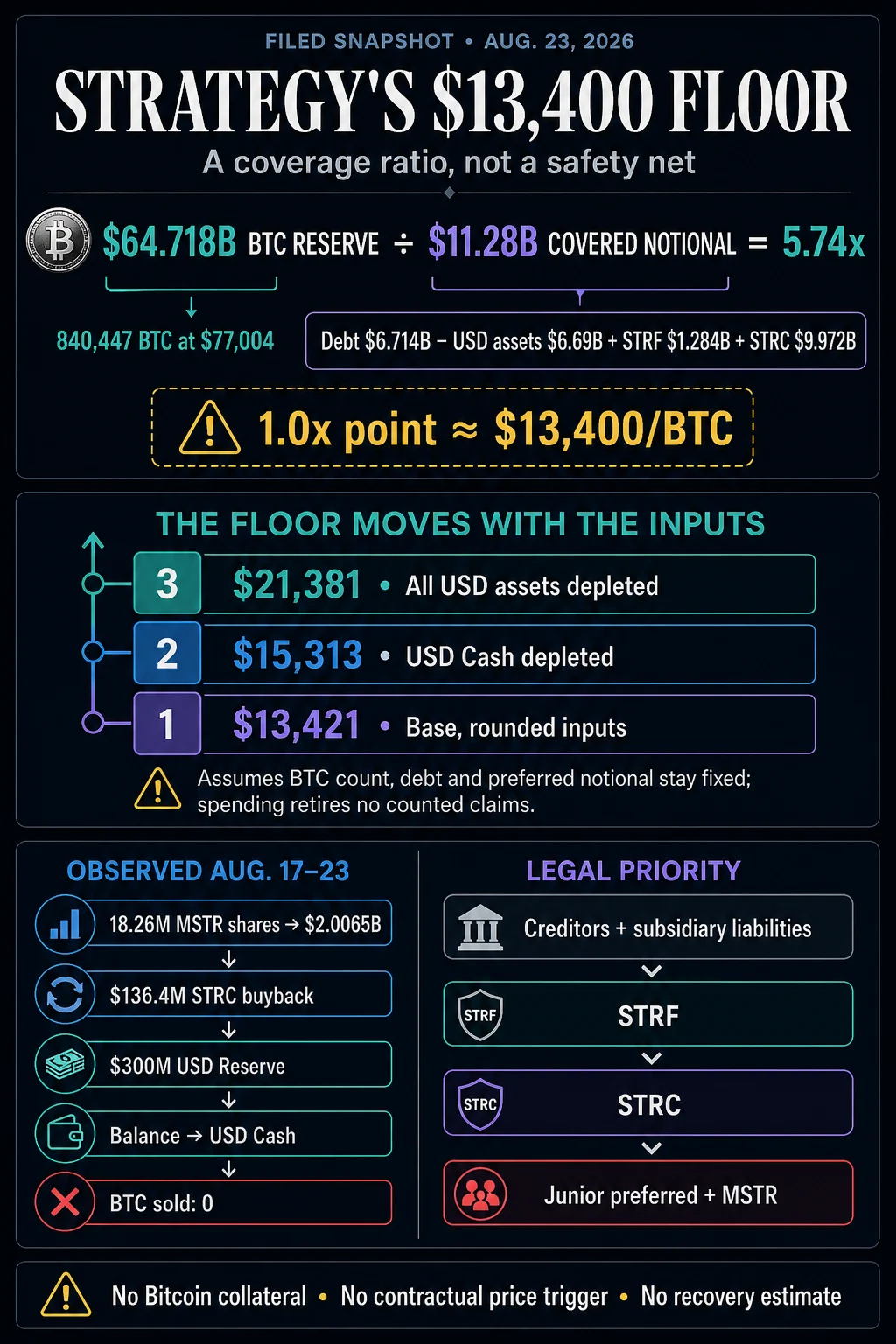
Strategy, the Bitcoin treasury company, is currently marketing a calculated $13,400 Bitcoin Floor for STRC, its variable-rate cumulative perpetual preferred stock, a metric that has drawn significant attention from institutional investors and market analysts alike. With Bitcoin trading near the $78,000 mark, the advertised floor appears to offer a massive buffer for investors; however, a closer examination of Securities and Exchange Commission (SEC) filings reveals that the metric is a specific technical threshold rather than a guaranteed price protection. According to the SEC-filed briefing, the Bitcoin Floor represents the specific valuation point at which Strategy’s illustrative STRC coverage ratio reaches 1.0x, providing a snapshot of the company’s balance sheet health relative to its preferred stock obligations.
The metric is purely illustrative and carries no direct claim on Strategy’s underlying Bitcoin reserves, nor does it provide a legal guarantee of solvency or recovery in the event of a liquidation. As of late August, STRC closed at a market price of $97.33, which, when measured against the current $12 annualized dividend, provides holders with an effective yield of 12.33%. This yield reflects the market’s assessment of the risk-reward profile of an instrument that sits between traditional corporate debt and common equity, uniquely tethered to the volatility of the world’s largest cryptocurrency.
Technical Mechanics of the BTC Rating and Floor
To understand the $13,400 figure, one must dissect the proprietary "BTC Rating" and the "BTC Floor" calculations used by Strategy. The BTC Rating is a quotient derived by dividing the total dollar value of Strategy’s Bitcoin reserves by a "covered-notional" denominator. Conversely, the Bitcoin Floor is the inverse of this calculation: the covered-notional denominator divided by the total number of Bitcoin held by the company.
The denominator is a complex figure that accounts for various layers of the company’s capital stack. Strategy’s current denominator begins with $6.714 billion in outstanding debt. From this, the company subtracts $6.69 billion in USD-denominated assets. It then adds $1.284 billion of senior STRF and $9.972 billion of STRC preferred stock. This calculation results in a net covered-notional figure of approximately $11.28 billion.
On the asset side of the ledger, Strategy holds 840,447 Bitcoin. At a dashboard price of $77,004 per BTC, these holdings were valued at approximately $64.718 billion. When this asset value is divided by the $11.28 billion denominator, it produces a coverage rating of 5.74x (displayed as 5.7x in marketing materials). The "floor"—the point where this ratio hits 1.0x—is calculated by dividing the $11.28 billion denominator by the 840,447 Bitcoin held, resulting in an unrounded figure of $13,415, commonly referred to as the $13,400 floor.
Sensitivities and the Role of USD Assets
The Bitcoin Floor is not a static number; it is highly sensitive to the company’s cash position and debt levels. While fluctuations in the spot price of Bitcoin change the displayed BTC Rating, they do not inherently change the floor price as long as the company’s internal inputs—such as the number of Bitcoin held and the amount of debt—remain constant. However, the movement of USD assets can significantly shift this threshold.
For instance, if Strategy were to deplete its $1.59 billion USD cash pool without simultaneously reducing its debt or preferred notional value, the modeled floor would rise to approximately $15,313. In a more extreme scenario, if all $6.69 billion of USD assets were spent on initiatives that did not retire any counted claims, the Bitcoin Floor would be pushed toward $21,381. These sensitivities highlight that the "buffer" is dependent not just on Bitcoin’s market performance, but on Strategy’s internal treasury management and discretionary spending.
Chronology of Recent Capital Market Operations
Strategy has remained active in the capital markets to bolster its treasury and manage its obligations. In the most recent disclosed week of operations, the company executed a massive secondary offering, selling 18,261,118 MSTR common shares. This move generated approximately $2.0065 billion in gross proceeds.
The allocation of these funds provides insight into the company’s current priorities:

- STRC Repurchases: The company spent $136.4 million to repurchase 1,431,212 shares of STRC, effectively reducing its preferred stock obligations.
- Reserve Building: Strategy added $300 million to its USD Reserve, a fund specifically designated by board policy to cover future preferred dividends and debt interest.
- Liquidity Management: The remaining balance of the share sale was funneled into USD Cash, providing a liquidity cushion for future operations or Bitcoin acquisitions.
Notably, during this period, Strategy sold no Bitcoin. The cost of this capital raise was borne by MSTR common shareholders in the form of immediate equity dilution. This strategy of using common equity to fund preferred stock repurchases and cash reserves is a hallmark of Strategy’s "Bitcoin Development Company" model, which seeks to maximize Bitcoin per share while maintaining a complex web of tiered financial instruments.
The Hierarchy of the Capital Stack and Investor Risk
For investors in STRC, understanding the legal and financial hierarchy is paramount. STRC is a cumulative perpetual preferred stock, meaning that while cash dividends require formal declaration by the board and the presence of legally available funds, any missed installments do not vanish; they accumulate and compound over time. However, the market price and timing of these cash flows can deteriorate long before the Bitcoin coverage ratio approaches the 1.0x floor.
In a hypothetical restructuring or legal recovery scenario, the hierarchy of claims is strictly defined:
- Senior Creditors and Subsidiary Liabilities: These hold the highest priority and must be satisfied first.
- Senior STRF: This instrument ranks ahead of STRC.
- STRC Preferred Stock: This sits in the middle of the stack.
- Junior Preferred and MSTR Common Stock: these are the most junior claims and would be the last to receive any recovery in a liquidation event.
This structure implies that while the $13,400 floor is a useful metric for assessing the health of the STRC coverage, it does not account for the operational "pressure points" that occur at much higher Bitcoin prices. These pressure points include the company’s ongoing access to capital markets, its available cash for dividend payments, and discretionary allocation decisions made by the board. Each of these factors can shift the cost of maintaining the treasury between MSTR common holders, STRC holders, and the Bitcoin reserve itself.
Strategic Implications and Market Reactions
The marketing of the "BTC Floor" is seen by many analysts as an attempt to institutionalize Bitcoin-backed corporate finance. By creating a metric that looks familiar to traditional credit analysts—similar to a loan-to-value (LTV) ratio or a debt-service coverage ratio (DSCR)—Strategy is attempting to bridge the gap between the volatile crypto markets and the more conservative world of fixed-income investing.
Market reactions to the STRC instrument have been generally positive among yield-seeking investors. The 12.33% effective yield is significantly higher than what is available in most investment-grade or even high-yield corporate bonds. However, critics point out that this yield comes with a unique "Bitcoin risk." If the price of Bitcoin were to experience a sustained and precipitous drop, the company’s ability to issue more common equity to fund its obligations could be compromised, potentially leading to a "death spiral" where the company is forced to sell Bitcoin to cover USD-denominated debts and dividends.
Strategy’s board has mitigated some of this risk through its $5.10 billion USD Reserve policy. This reserve acts as a firewall, ensuring that dividends and interest can be paid even during periods of market turbulence. Furthermore, the company still maintains $516.6 million of preferred repurchase authority and $1 billion for MSTR repurchases, although these programs are discretionary and do not require the company to act unless market conditions are favorable.
Analysis of the Long-Term Outlook
The success of Strategy’s financial engineering depends on a core thesis: that the long-term appreciation of Bitcoin will outpace the cost of the capital used to acquire it. By issuing STRC and MSTR shares to build a massive Bitcoin reserve, the company is essentially running a leveraged play on the digital asset.
The $13,400 floor provides a "worst-case" benchmark, but the real test for Strategy will be its ability to navigate the "mid-case" scenarios—prolonged periods of stagnation or 30-40% drawdowns in Bitcoin’s price. In these environments, the company’s reliance on capital market access becomes its greatest vulnerability. As long as the market remains willing to absorb new MSTR shares, Strategy can continue to service its STRC obligations and grow its Bitcoin holdings.
As Bitcoin continues to mature as an asset class, Strategy’s model provides a blueprint for how other corporations might eventually treat Bitcoin on their balance sheets. For now, however, Strategy remains in a league of its own, managing a multi-billion dollar treasury that functions more like a decentralized bank than a traditional software firm. The $13,400 floor is a testament to the scale of the company’s ambition, but as the SEC filings suggest, it is a figure that requires careful interpretation within the broader context of the company’s complex financial architecture.