Nila Kartika Wati
Cryptocurrency projects have recorded an unprecedented $638 million in token buybacks so far in 2026, with decentralized exchange Hyperliquid and memecoin launchpad Pump.fun accounting for a dominant nearly 90% of this historic expenditure. This significant increase from previous years underscores a growing trend within the digital asset industry to return value to token holders and bolster market stability, mirroring practices long established in traditional financial markets.
A New Milestone in Crypto Financial Strategy
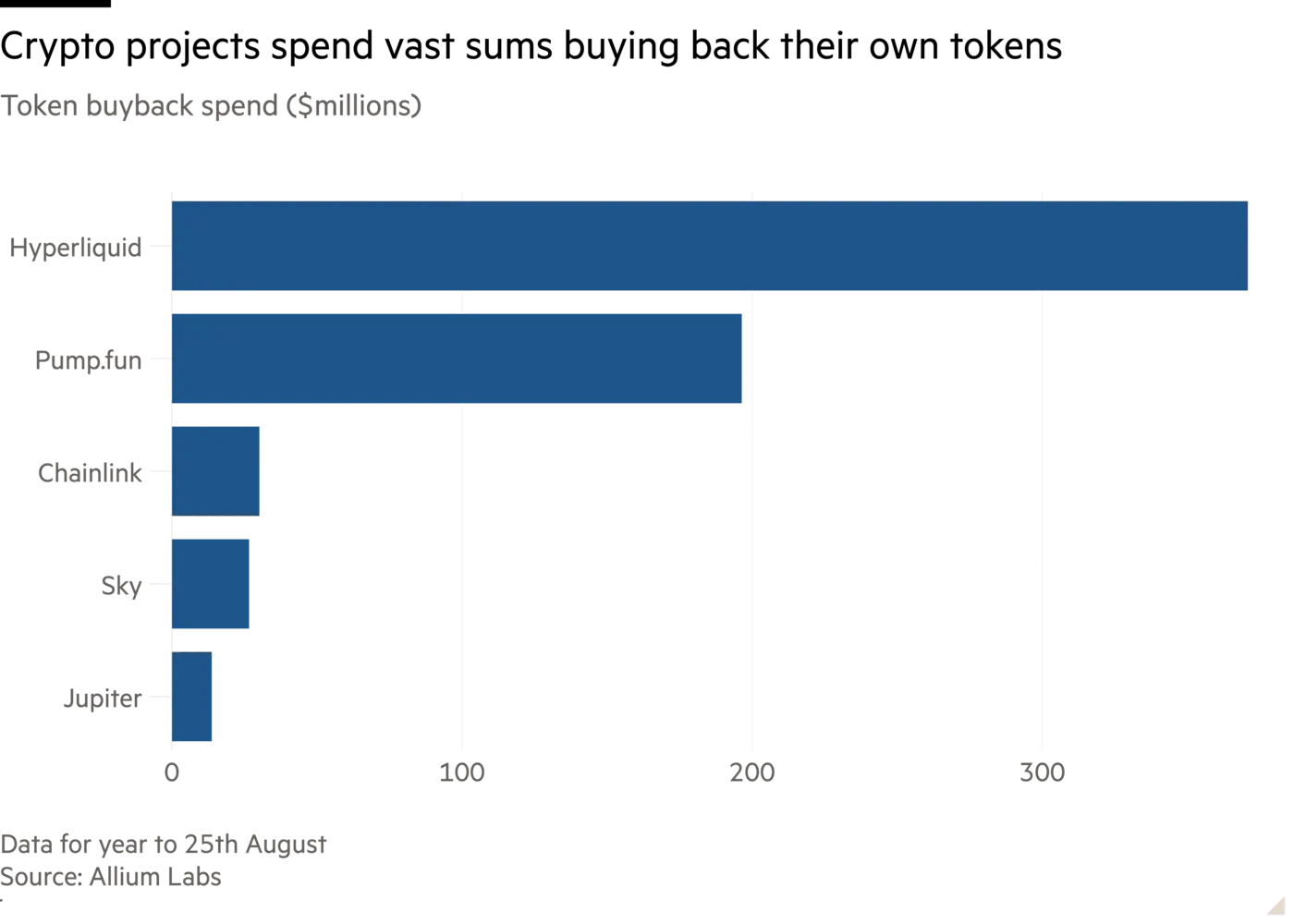
According to data compiled by Allium Labs and cited in a recent Financial Times report, the year-to-date figure of $638 million for token repurchases represents a substantial leap from $545 million recorded during the same period in 2025, and a staggering increase from just $366,000 in 2024. This exponential growth highlights a pivotal shift in how crypto projects manage their treasuries and engage with their token economies. Among the leading contributors, Hyperliquid alone spent approximately $370 million on buybacks, while Pump.fun contributed nearly $200 million, collectively demonstrating the outsized influence of these two platforms on the overall market trend.
Token buybacks in the cryptocurrency space function similarly to share buybacks conducted by publicly listed companies. In traditional finance, corporations repurchase their own stock from the open market to reduce the number of outstanding shares, which typically supports share prices by increasing demand and can boost earnings per share (EPS) for remaining shareholders. This practice often signals a company’s confidence in its future profitability and a commitment to returning capital to investors. In the crypto context, token buybacks aim to achieve comparable outcomes: reducing circulating supply, potentially increasing the token’s value, and enhancing returns for existing token holders.
While still considered a nascent strategy within the relatively young crypto industry, an increasing number of projects are recognizing and leveraging the benefits of token buybacks. This adoption signifies a maturation of the digital asset ecosystem, where projects are moving beyond initial fundraising and development phases to focus on sustainable economic models and long-term value creation for their communities.
Chronology of a Growing Trend: From Niche to Mainstream
The journey of token buybacks from a marginal practice to a significant market force can be traced through its accelerating adoption over recent years. In 2024, the total expenditure on buybacks was negligible, indicating that most projects were either in their early stages, focused on development, or had not yet adopted sophisticated financial strategies. The modest figure of $366,000 suggests that only a handful of projects, likely those with established revenue streams, explored this mechanism.
By 2025, the landscape began to shift, with buybacks climbing to $545 million by the same period. This increase points to a growing awareness and acceptance of the strategy among more mature projects. It likely coincided with a period where certain decentralized applications (dApps) and protocols started generating substantial, consistent revenue, allowing them the financial capacity to consider such initiatives.
The current year, 2026, marks a definitive turning point, with the cumulative buyback spend reaching $638 million, surpassing all previous records. This exponential rise, particularly with Hyperliquid and Pump.fun at the forefront, indicates that token buybacks are no longer an experimental venture but a recognized and effective tool for tokenomics management. The data, updated leading up to August 25, 2026, provides a clear snapshot of this accelerated adoption.

A notable recent example illustrating this trend is the Ethena Foundation. On a recent Thursday, the foundation initiated a vote on a fee-switch proposal, a mechanism designed to direct 95% of the net revenue generated from Ethena’s core business operations towards the repurchase of Ethena (ENA) tokens. The market reacted swiftly and positively to this announcement, with the ENA token experiencing a significant surge of 10.7% on the day the proposal was made public. This immediate positive price action underscores investor confidence in the value-accretive nature of buyback programs. The Ethena case serves as a prime example of how projects are actively seeking to implement these strategies to enhance token value and reward their communities.
Hyperliquid and Pump.fun: Architects of the Buyback Boom
The dominant roles of Hyperliquid and Pump.fun in this record-breaking buyback spree warrant a closer look at their business models and strategic financial decisions. Their success in outperforming the broader market downturn highlights the direct impact of these buyback programs on token valuations.
Hyperliquid, a prominent decentralized exchange (DEX), operates by facilitating the trading of various digital assets, including derivatives and perpetual contracts. Its revenue streams are primarily derived from trading fees generated on its platform. The platform has adopted an aggressive tokenomics strategy, committing an astounding 99% of its revenue towards HYPE token buybacks. This near-total allocation of revenue to buybacks demonstrates a strong commitment to enhancing token value and rewarding its holders. As reported on August 6, Hyperliquid generated a robust $169 million in revenue during the second quarter of 2026, with $141 million subsequently channeled into HYPE buybacks. This direct and substantial reinvestment into its own token has been a key driver of HYPE’s impressive market performance.
Pump.fun, a popular memecoin launchpad, offers a platform for users to easily create and launch new memecoins without requiring initial liquidity. Its revenue is generated through fees associated with these launches and subsequent trading activities on its platform. Pump.fun allocates a substantial 50% of its net protocol revenue for token repurchases of its native PUMP token. Based on an average daily revenue over the past 90 days, the platform boasts an impressive annualized revenue of $420 million. This consistent and significant revenue generation, coupled with a dedicated buyback program, has been instrumental in PUMP’s market resilience.
Market Outperformance Amidst Broader Decline
The efficacy of these token buyback strategies is vividly illustrated by the market performance of HYPE and PUMP tokens. In a period marked by a general downturn across the cryptocurrency market, both tokens have not only held their ground but have significantly outperformed their peers.
Year-to-date in 2026, the Hyperliquid (HYPE) token has seen a remarkable surge of 145%. Similarly, the Pump.fun (PUMP) token has recorded an impressive gain of 109%. These figures stand in stark contrast to the broader market trends during the same period. Bitcoin (BTC), the leading cryptocurrency and a benchmark for the market, experienced a 10% decline in its price. Concurrently, the total cryptocurrency market capitalization witnessed an 11.9% contraction, according to TradingView data.
This divergence underscores a critical implication: in volatile or bearish market conditions, well-executed token buyback programs can act as powerful mechanisms to cushion price declines, attract investor interest, and even drive significant appreciation. By reducing the available supply and signaling robust financial health, these projects have managed to create a counter-narrative to the prevailing market sentiment, demonstrating that fundamental value creation can indeed trump broader market forces.
Broader Impact and Implications for the Crypto Ecosystem
The burgeoning trend of token buybacks carries significant implications for the future of the cryptocurrency industry, signaling a shift towards more mature and sustainable financial models.
Enhanced Investor Confidence and Value Return: The primary effect of buybacks is to directly return value to token holders. By reducing the circulating supply, each remaining token theoretically represents a larger share of the project’s future potential or revenue. This can lead to increased investor confidence, as it demonstrates a project’s commitment to its token’s long-term value and its willingness to use generated revenue for the benefit of its community, rather than purely for operational expenses or expansion. This practice aligns crypto projects more closely with traditional equity markets, where shareholder value is a paramount concern.
Maturation of Crypto Financial Practices: The widespread adoption of buybacks suggests a maturation of financial management within the crypto space. Early-stage projects often rely heavily on token issuance and grants. As projects evolve and generate sustainable revenue, sophisticated financial strategies like buybacks become viable. This transition from speculative, early-stage funding to revenue-driven value creation marks an important step in the professionalization of the crypto industry. It signals that projects are increasingly focusing on generating real-world utility and cash flows, rather than solely on speculative growth.
Comparison to Traditional Finance: The analogy to corporate stock buybacks is compelling. Just as companies use buybacks to manage their capital structure, improve financial metrics, and signal health, crypto projects are now leveraging similar mechanisms. This convergence of financial strategies could eventually lead to a more standardized valuation framework for digital assets, where metrics like price-to-earnings (P/E) ratios (or analogous revenue-to-token value ratios) become more relevant. However, crucial distinctions remain; for instance, many crypto tokens also grant governance rights or utility within a specific ecosystem, adding layers of complexity not always present in traditional equities.
Analyst Perspectives and Future Outlook: Industry experts are increasingly optimistic about the long-term impact of these strategies. Matt Hougan, Chief Investment Officer at Bitwise, stated earlier in August that crypto valuations could potentially double within the next two years as protocols increasingly utilize revenue to fund token buybacks and burns. His perspective highlights the compounding effect of these actions: consistent buybacks and token burns (which permanently remove tokens from circulation) can lead to a significant reduction in supply over time, thereby increasing scarcity and potentially driving up value for remaining tokens. This outlook suggests that the current trend is not a fleeting phenomenon but a foundational shift that could redefine how crypto assets are valued and managed.
Challenges and Considerations: Despite the positive implications, token buybacks are not without their complexities and potential challenges.
- Sustainability: The long-term efficacy of buybacks depends heavily on the project’s ability to generate consistent and substantial revenue. Projects that initiate buybacks without sustainable revenue streams risk depleting their treasuries without achieving lasting value appreciation.
- Transparency: The mechanisms and frequency of buybacks need to be transparent to maintain investor trust. Clear communication about the source of funds, the amount spent, and the method of repurchase is crucial.
- Market Manipulation Concerns: In traditional finance, buybacks can sometimes be viewed critically if they are perceived as an attempt to artificially inflate stock prices without genuine business improvement. The crypto space, with its relatively less regulated environment, might face similar scrutiny, emphasizing the need for robust governance and transparency.
- Alternative Uses of Capital: Projects must weigh the benefits of buybacks against alternative uses of capital, such as funding research and development, expanding marketing efforts, or providing liquidity. The optimal strategy often involves a balanced approach.
Conclusion: A Sign of Maturation and Resilience
The record $638 million in token buybacks in 2026, largely spearheaded by Hyperliquid and Pump.fun, marks a significant turning point for the cryptocurrency industry. It demonstrates a clear evolution in financial strategy, where projects are increasingly adopting sophisticated mechanisms to return value to their communities and foster long-term sustainability. The outperformance of tokens with robust buyback programs against a declining broader market underscores the effectiveness of this approach in building resilience and investor confidence. As the crypto ecosystem continues to mature, it is likely that token buybacks, alongside other value-accretive strategies, will become an even more integral part of project tokenomics, paving the way for a more stable and professionally managed digital asset landscape. This trend not only signals a new era of financial responsibility within crypto but also offers a compelling blueprint for how projects can thrive even amidst market volatility.