Layla Zulfa
Bitcoin entered the final month of the third quarter trading at approximately $77,500, marking a modest 1.3% decline on the first day of September. This retracement follows one of the most significant monthly performances in the current market cycle, during which the digital asset successfully reclaimed critical long-term technical levels and shifted broader market sentiment from a state of cautious "fear" to "extreme greed." As the industry transitions into a historically volatile month, market participants are closely analyzing whether the current cooling period represents a temporary consolidation or the beginning of a larger correction driven by shifting macroeconomic policies.
The recent price action concludes an August that saw Bitcoin recover from a 21-month low of approximately $59,300, established in June, to briefly breach the $81,000 threshold. While the asset closed August with a net gain of roughly 25%, the momentum stalled in the final days of the month. This shift in trajectory is largely attributed to a complex interplay between Treasury-driven liquidity injections and a pivot toward hawkish rhetoric from the Federal Reserve. As of September 1, the market remains in a state of high tension, with prediction platforms suggesting a strong bias toward further upside, even as technical indicators and seasonal trends suggest potential headwinds.
The Macroeconomic Catalyst: Treasury Liquidity and Fed Hawkishness
The primary driver behind the mid-August rally was a strategic shift in fiscal policy. On August 19, Treasury Secretary Scott Bessent announced a decision to double the size of long-end bond buybacks. This move was designed to manage the maturity profile of U.S. debt but had the immediate secondary effect of injecting significant liquidity into the financial system. By reducing the supply of long-dated Treasuries, the move hammered bond yields, prompting investors to seek higher returns in risk-on assets, including equities and cryptocurrencies.
This liquidity surge triggered a massive short squeeze in the crypto markets, propelling Bitcoin from the mid-$60,000 range toward $80,000 in a matter of days. The upward pressure was further bolstered by the Securities and Exchange Commission (SEC), which offered a new regulatory framework for crypto-based investment contracts. This move was interpreted by institutional investors as a step toward regulatory clarity, providing a "tailwind" that allowed major capital allocators to increase their exposure with reduced legal uncertainty.

However, the "Bessent Rally" met a significant obstacle during the annual Jackson Hole Economic Symposium. Federal Reserve Chairman Kevin Warsh, in his first address as head of the central bank, delivered a speech that recalibrated market expectations regarding interest rates. Warsh noted that recent inflation data remained "more concerning" than the cooling labor market, effectively reviving the possibility of a rate hike at the upcoming Federal Open Market Committee (FOMC) meeting scheduled for September 15-16. This hawkish pivot dampened the "cheap money" narrative that had fueled the August surge, causing Bitcoin to slip from its $81,000 peak back to its current levels below $78,000.
Technical Analysis: A Tale of Two Timeframes
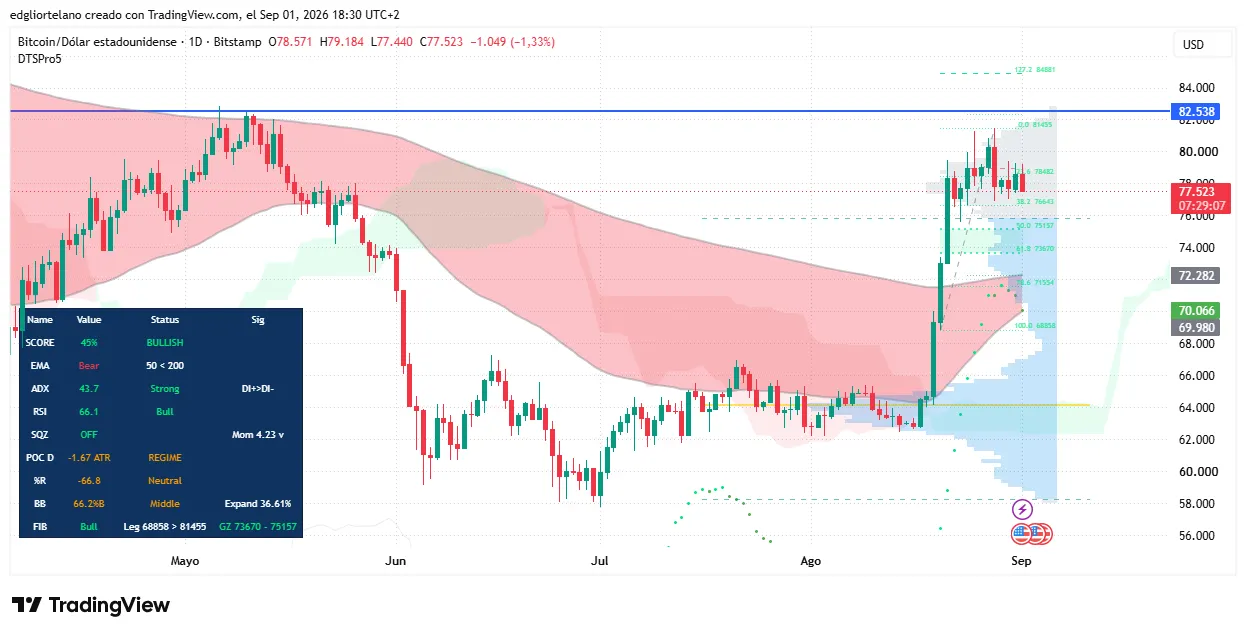
A granular look at Bitcoin’s technical indicators reveals a market that is fundamentally strong but overextended in the short term. On the daily chart, the Relative Strength Index (RSI) stands at 66.1. While this remains in bullish territory (above the 50.0 neutral mark), it is approaching the 70.0 level, which traditionally signals "overbought" conditions where professional traders begin to realize profits.
The Average Directional Index (ADX), which quantifies the strength of a trend without regard to its direction, is currently reading at 43.7. In technical analysis, any reading above 25.0 suggests a strong, established trend. The fact that the ADX is at 43.7 confirms that the August rally was not mere market noise but a structural shift in demand. However, a high ADX can also precede a period of exhaustion if not accompanied by new fundamental catalysts.
Despite these bullish indicators, a significant "wrinkle" remains in the daily chart structure. The 50-day and 200-day exponential moving averages (EMAs) are currently locked in a bearish crossover, often referred to as a "death cross." This occurs when the short-term average (50-day) resides below the long-term average (200-day). While the current price is trading well above both averages, the failure of the EMAs to flip into a "golden cross" suggests that the long-term trend has not yet fully synchronized with the recent price spike. Analysts note that the gap between these two lines is narrowing, and a sustained hold above $75,000 through mid-September could force a bullish crossover.
When shifting to the monthly timeframe, the outlook appears even more consequential. From the second half of 2025 through July 2026, Bitcoin’s price remained in a descending channel, trading consistently below its 50-month moving average. Historically, trading below this four-year smoothed average has been a hallmark of "crypto winters," having occurred only during the 2018-2019 bear market and the 2022 collapse following the FTX and Terra/LUNA crises. August’s 25% gain was the first time in nearly a year that Bitcoin closed a month above this critical line. This "reclamation" of the 50-month average is viewed by many as the definitive end of the mid-cycle correction, although the monthly RSI of 50.6 suggests the market is still in a "wait-and-see" mode regarding a full-scale bull run.
Institutional Inflows and Regulatory Evolution
The role of institutional participants cannot be understated in the current environment. Throughout August, spot Bitcoin exchange-traded funds (ETFs) continued to record net inflows, even on days when the price experienced intraday volatility. This suggests that the "buy the dip" mentality has shifted from retail speculators to institutional wealth managers.
Simultaneously, the SEC’s move to propose a new regulation for crypto assets marks a departure from the "regulation by enforcement" era that characterized previous years. The proposed framework aims to categorize which digital assets function as investment contracts under the Howey Test while providing a pathway for exchanges to register without the prohibitive requirements previously demanded. While the rulemaking process is expected to be lengthy, the mere existence of a formal proposal has reduced the "political risk premium" that has historically weighed on Bitcoin’s valuation.
Market Sentiment and Prediction Markets
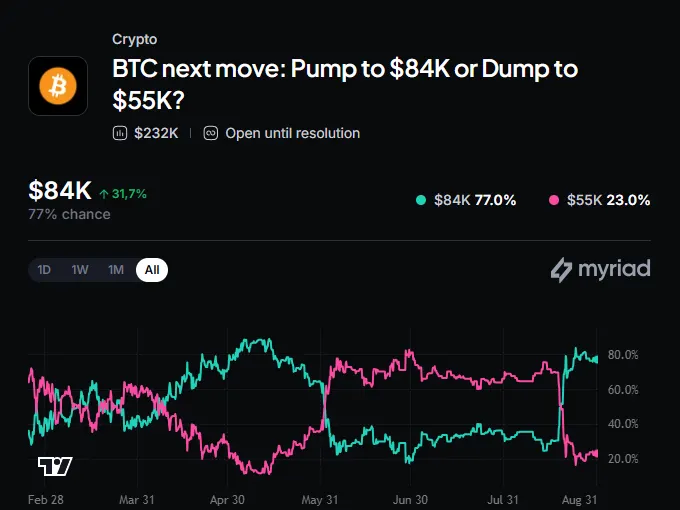
Market sentiment, as measured by various indices, reached "extreme greed" during the final week of August. This exuberance is clearly reflected in prediction markets such as Myriad, a platform developed by Dastan. Traders on the platform are currently placing heavy bets on continued upward movement. Data from Myriad shows a 77% probability that Bitcoin will reach the $84,000 mark before it falls back to a support level of $55,000.
This lopsided sentiment suggests that while the "smart money" may be cautious of the Fed’s next move, the broader trading community is focused on the momentum generated in August. However, contrarian analysts warn that such high levels of optimism often serve as a "top signal," as the market may have already priced in the positive developments regarding Treasury liquidity and regulatory progress.
Chronology of Key Events: June to September 2026
To understand the current price of $77,500, one must look at the sequence of events that defined the summer of 2026:
- June 15: Bitcoin hits a 21-month low near $59,300 amid concerns over stagnant global growth and a lack of regulatory clarity.
- July 1-31: Bitcoin trades sideways, consolidating between $62,000 and $65,000, failing to break above its 50-month moving average.
- August 19: Treasury Secretary Scott Bessent announces the doubling of long-end bond buybacks. Bitcoin immediately reacts, jumping from $68,000 to $74,000 in 24 hours.
- August 22: The SEC releases its proposed framework for crypto investment contracts. Institutional inflows into spot ETFs hit a monthly high.
- August 25: Bitcoin tops $81,000, its highest level since the previous cycle peak, as the "extreme greed" index peaks.
- August 28: Fed Chair Kevin Warsh delivers his Jackson Hole address. The hawkish tone causes an immediate $3,000 correction in Bitcoin’s price.
- September 1: Bitcoin opens the month at $78,571 before sliding to an intraday low of $77,440.
The September Obstacle: Seasonality and the FOMC
As the market looks ahead, the "September Effect" looms large. Historical data since 2013 indicates that September is Bitcoin’s weakest calendar month, often characterized by negative returns and a lack of buying pressure. This seasonal drag is compounded in 2026 by the timing of the Federal Reserve’s meeting on September 15-16.
If Chairman Warsh follows through on his hawkish rhetoric with a 25-basis-point rate hike, the liquidity-driven rally of August could face a sharp reversal. Conversely, if the Fed chooses to pause—citing the cooling labor market—Bitcoin could find the fuel necessary to reach the $84,000 target predicted by market participants.
Key Levels and Market Outlook
As the first week of September unfolds, traders are focusing on two primary price zones. The first is the resistance zone near $82,500. This level has proven "sticky," with multiple attempts to breach it in late August resulting in swift rejections. A daily close above $82,500 would likely signal a move toward new all-time highs.
On the downside, the $72,000 to $74,000 range serves as the immediate support floor. This area coincides with the pre-buyback price levels and the current 50-day EMA. Should Bitcoin fall below this range, the "winter signal" provided by the 50-month moving average could be reactivated, potentially leading to a retest of the $60,000 psychological barrier.
In conclusion, Bitcoin stands at a crossroads. The structural arguments for a bull market—reclaimed moving averages, strong trend strength (ADX), and regulatory progress—are robust. However, the immediate hurdles of a hawkish Federal Reserve and negative seasonal trends suggest that the "extreme greed" of August may be tempered by a period of "September sobriety." Investors and analysts alike will be watching the mid-month Fed decision as the ultimate arbiter of Bitcoin’s direction for the remainder of the year.