James Watt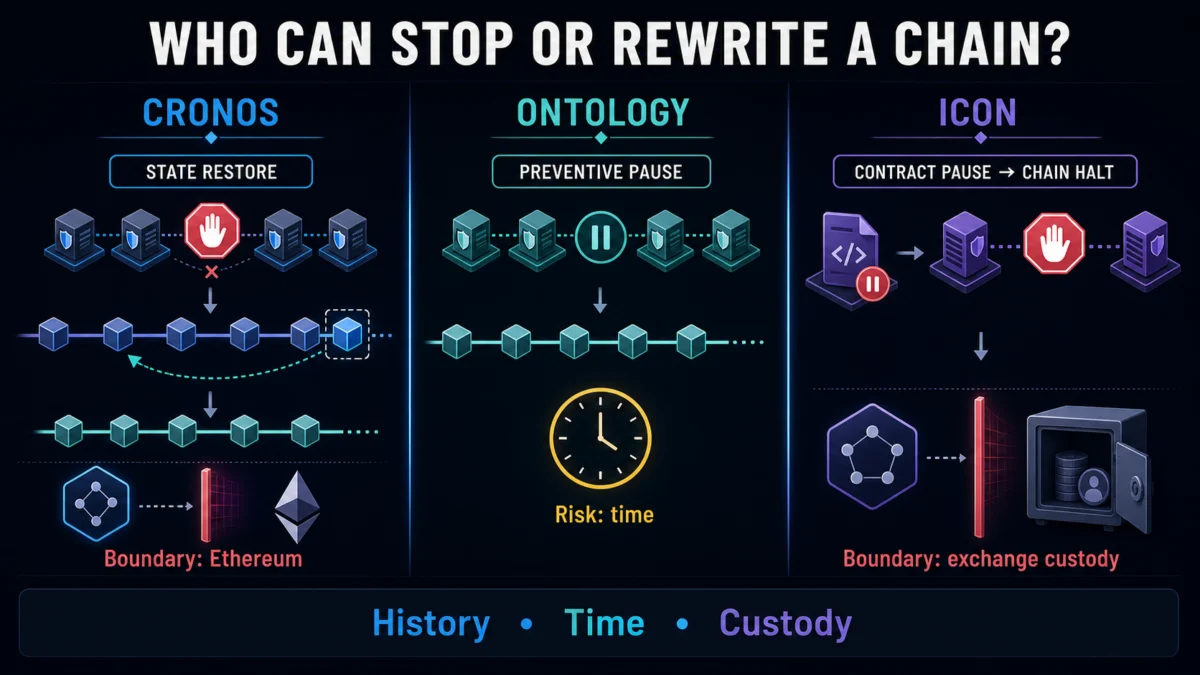
In a span of just 96 hours, the global cryptocurrency ecosystem witnessed a rare and systemic stress test as three distinct blockchain networks—Cronos, Ontology, and ICON—abruptly ceased block production. While each incident was triggered by security vulnerabilities or exploit activity, the responses from their respective governance bodies varied significantly, ranging from preventive pauses to the controversial replacement of canonical history. These events have reignited a fundamental debate within the industry regarding the trade-offs between network decentralization and the necessity of emergency intervention powers.
The sequence of events began on August 27 and concluded with the resumption of services across all three platforms by early September. The incidents highlight a critical reality in modern blockchain infrastructure: "immutability" is often subject to the consensus of a limited set of validators or the emergency mandates of core development teams. As these networks navigated their respective crises, they revealed the varying degrees of control that foundations and technical teams maintain over supposedly decentralized ledgers.
Cronos and the Tectonic Exploit: A Rare Exercise in State Restoration
The most significant intervention occurred on the Cronos network, an Ethereum-compatible blockchain built on the Cosmos SDK. On August 30, the network halted following a massive exploit targeting Tectonic, a leading decentralized money market protocol on the chain. The incident was not merely a pause in production but a full-scale restoration of the blockchain’s state to a point in time prior to the exploit.
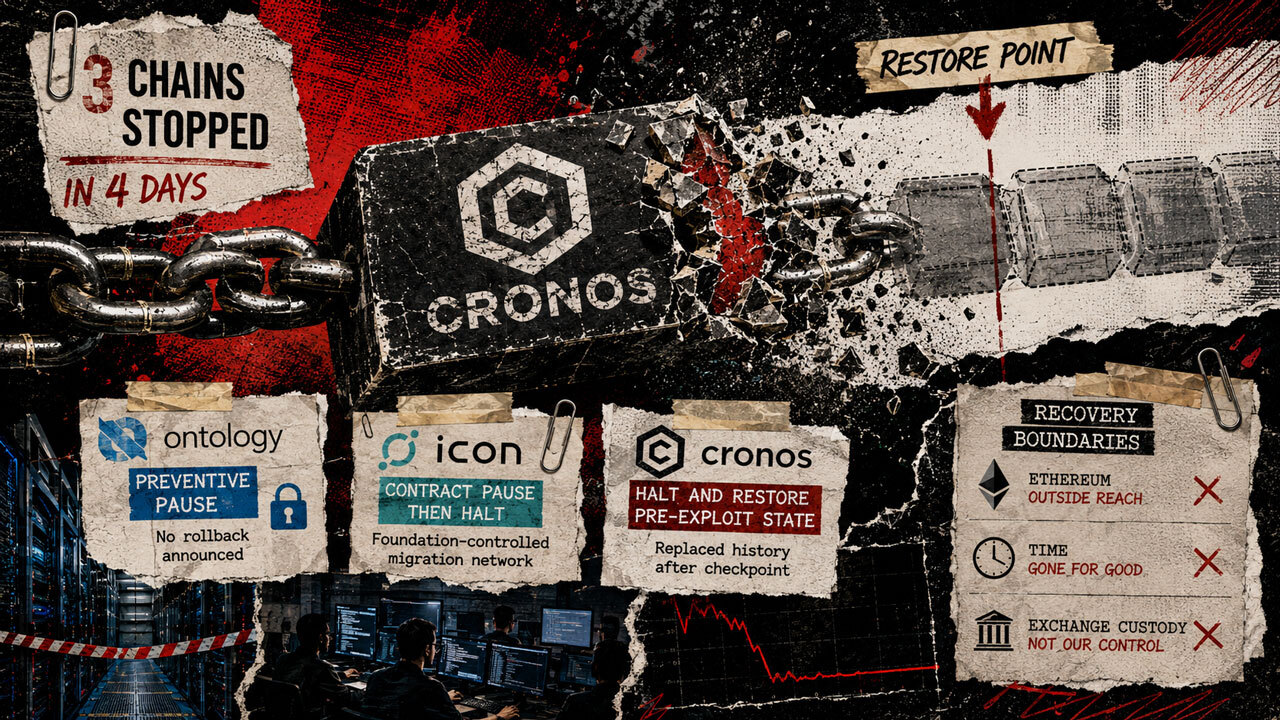
According to official statements from the Cronos team, the halt was executed via "validator-consensus emergency action." After the exploit was detected, validators collectively agreed to stop producing blocks and eventually restarted the chain from block 90,896,189. This specific block represented a "clean" state before the malicious activity affected Tectonic’s liquidity pools.
The technical implications of this move are profound. By reverting to a previous block, Cronos effectively deleted a portion of its history. Any legitimate transactions—transfers, swaps, or contract interactions—that occurred between the restore point and the moment of the halt were discarded. This process, known as a rollback, is rarely used in the blockchain industry due to its direct conflict with the principle of ledger finality.
Data provided by TRM Labs and Bitquery suggests the scale of the Tectonic exploit was substantial. TRM Labs estimated that approximately $75 million was illicitly borrowed from the protocol following a sophisticated price manipulation attack involving the TONIC token. Of this amount, roughly $68.7 million was effectively "erased" or reversed through the Cronos state restoration. However, the limits of blockchain sovereignty were also made clear: approximately $6 million to $8.3 million in assets had already been bridged to the Ethereum mainnet. Once these assets crossed the bridge, they moved beyond the jurisdictional reach of Cronos validators, remaining as successful "outflows" for the attackers.
Ontology: The Preventive Pause and the Mystery of Authority
While Cronos dealt with a confirmed loss, Ontology opted for a more cautious, preventive approach. On August 31, the network announced an emergency pause of its mainnet. Unlike Cronos, which responded to an active drain of funds, Ontology’s technical team identified a "potential security concern" during a routine daily check.
The Ontology team moved swiftly to suspend block production to allow for a comprehensive security review. In an update released on September 1, the foundation confirmed that "malicious attack activity" had indeed been detected, but emphasized that the preventive pause was successful in ensuring that no user assets were compromised.
The Ontology incident raises questions regarding the transparency of emergency thresholds. The network’s documentation on its VBFT (Verifiable Byzantine Fault Tolerance) consensus mechanism describes how nodes typically generate and confirm blocks. However, the specific "kill switch" or emergency-pause protocol used on August 31 is not explicitly detailed in public-facing governance documents. The decision-making process involved the core development team, the technical team, and network validators, but the specific voting power or tally required to trigger such a halt remains undisclosed.
For users, the Ontology pause resulted in operational paralysis rather than financial loss. For over 24 hours, on-chain transactions were impossible, and decentralized applications (dApps) built on Ontology were rendered inaccessible. While the "safety-first" approach protected capital, it highlighted the "liveness" risk inherent in networks where a centralized core team can unilaterally or semi-unilaterally freeze settlement.
ICON: The Race Between Code and Custody
The third network to face a crisis was ICON, which suffered a "replay exploit" within its migration contracts. This incident provides the most detailed timeline of how a delay in emergency response can lead to a loss of control over stolen assets.
On August 27, between 02:01 and 02:21 UTC, an attacker exploited a precision defect in ICON’s migration smart contracts. By replaying two previously valid signed withdrawal messages 1,492 times, the attacker managed to drain 119,866,000 ICX and 531,600 bnUSD from Foundation-held reserves.
The chronology of the ICON response is a study in the friction of incident management:
- 02:08 UTC: Automated monitoring systems fired the first alert.
- 03:40 UTC: Technical staff began a formal investigation after the initial alert was initially dismissed as a potential RPC (Remote Procedure Call) error.
- 03:53 UTC: The affected contract was paused.
- 05:54 UTC: Major centralized exchanges began suspending ICX deposits.
- 06:18 UTC: A network-wide halt was finally implemented.
By the time the ICON network was fully halted, the attacker had already moved a significant portion of the stolen ICX to various centralized exchanges. At this point, the ICON Foundation’s technical powers were exhausted. The recovery of the funds shifted from the realm of code to the realm of law. The Foundation was forced to rely on "preservation notices," legal counsel, and cooperation with law enforcement and exchange security teams to freeze the assets.
The ICON incident was unique because the network was operating in a "maintenance mode" during a token migration period. At the time of the halt, the network was being secured by a reduced set of seven core nodes controlled by the Foundation. This explicit control allowed for a faster halt than a fully decentralized network might achieve, yet the delay in human response still allowed the attacker to reach the "exit ramps" of centralized custody.
Comparative Analysis of Emergency Powers
The events across Cronos, Ontology, and ICON reveal three distinct philosophies of blockchain crisis management.
Cronos demonstrated a "Social Consensus" model where the preservation of the balance sheet took precedence over the sanctity of the ledger. By rolling back the chain, Cronos prioritized the recovery of Tectonic’s liquidity at the expense of transaction finality. This move is controversial because it suggests that the "canonical chain" is whatever the validators say it is, regardless of the mathematical history.
Ontology demonstrated a "Preemptive Defense" model. By halting the chain before an exploit could reach its conclusion, the team saved user funds but sacrificed network uptime. This model relies heavily on the vigilance of a core technical team and assumes that users will accept temporary illiquidity in exchange for long-term asset safety.
ICON demonstrated the "Hybrid Recovery" model. Because the exploit affected Foundation funds rather than user deposits, the network halt served as a containment measure while the actual recovery efforts moved off-chain. ICON’s experience serves as a warning: in the age of high-speed bridges and instant exchange deposits, a blockchain halt that occurs hours after an exploit is often "too little, too late" to stop the movement of value.
The Broader Implications for Decentralized Finance
The simultaneous halting of three networks brings the "Decentralization Paradox" to the forefront of the DeFi narrative. Proponents of blockchain technology often tout the "unstoppable" nature of code, yet these incidents prove that most major networks possess emergency levers that can stop, and in some cases reverse, the flow of time.
From a regulatory perspective, these emergency powers could be a double-edged sword. Regulators may look favorably upon the ability of a network to freeze stolen funds, seeing it as a necessary consumer protection mechanism. Conversely, the ability of a small group of validators or a single foundation to "rewrite" history could lead to the classification of these networks as centralized financial intermediaries rather than decentralized public utilities.
Furthermore, the Cronos incident highlights the "Bridge Boundary." As assets move across chains, the power of a single network’s governance diminishes. When the $6 million in Tectonic funds reached Ethereum, it became "immutable" from the perspective of Cronos. This creates a fragmented security landscape where the safety of an asset is only as strong as the weakest link in a multi-chain journey.
Conclusion and Outlook
As Cronos and Tectonic prepare their final postmortems, and as Ontology and ICON refine their monitoring protocols, the industry is left to reflect on the nature of trust. The "first layer of control" in a blockchain is its code, but the "deeper layer" is the human governance that manages that code during a crisis.
The events of late August and early September suggest that the industry is moving toward a more pragmatic, if less "pure," version of decentralization. In this version, emergency powers are an accepted, albeit scrutinized, part of the infrastructure. For investors and users, the takeaway is clear: the safety of assets on a blockchain depends not just on the robustness of the smart contracts, but on the speed, transparency, and authority of the humans who hold the emergency keys.
The practical test for any network moving forward will be the clarity of its emergency rules. Users are increasingly demanding to know: Who can order a stop? What is the threshold for a rollback? And who absorbs the loss when the "kill switch" is flipped too late? Until these questions are answered with standardized protocols, the "four days in August" will serve as a reminder that in the world of crypto, the chain only stays as long as the consensus holds.