Reza Arap Oktovian
In a technological undertaking described as akin to re-engineering an airplane’s engine mid-flight, Ethereum, the world’s second-largest blockchain by market capitalization and the backbone for hundreds of billions of dollars in digital assets, is poised for a seismic transition. Sometime in the latter half of this year, the network will move from its current Proof-of-Work (PoW) consensus mechanism to a Proof-of-Stake (PoS) model. This monumental shift, colloquially known as "The Merge," is a complex process that Ethereum developers are undertaking with the understanding that the blockchain must continuously produce valid blocks throughout the transition, irrespective of the ongoing operational demands.
Unlike many other prominent blockchains, such as Bitcoin, Ethereum’s development community, bolstered by the Ethereum Foundation (EF) and influential figures within the ecosystem, has collectively agreed to develop multiple, distinct client software versions to implement the Proof-of-Stake protocol, often referred to as Ethereum 2.0. These client software implementations are developed by different teams and are often written in various programming languages, a strategy designed to enhance network resilience.
The Architecture of the Post-Merge Ethereum Network
The core of this transition involves a "merge" between the existing Ethereum network nodes and the "beacon chain," a PoS-based chain that has been operational since December 2020. Following the merge, the operational responsibilities of nodes will be clearly delineated. Currently, nodes on the Ethereum network are responsible for both executing transactions and validating them. Post-merge, this dual role will be split into two distinct types of nodes: execution nodes and validator nodes.

Execution nodes will continue to manage the Ethereum Virtual Machine (EVM), the runtime environment for smart contracts, and will handle the execution of transactions. However, the critical task of validating these transactions will be offloaded to validator nodes operating on the consensus layer, specifically the beacon chain. This separation of duties is a deliberate architectural enhancement aimed at improving the network’s robustness by segmenting responsibilities into distinct logical layers.
While the execution and consensus layers will operate independently, their client software shares some codebase if developed in the same programming language. Execution clients have undergone minor modifications to integrate seamlessly with the merge. Substantial portions of existing execution clients, including the EVM, can be reused with slight adaptations. Ultimately, the validation components within execution clients that were previously tied to the Proof-of-Work chain may be deprecated.
The term "merge" itself is a conceptual representation rather than a literal fusion of two distinct chains into one. At a predetermined block height, current Ethereum nodes will cease their validation activities, handing over this responsibility to the newly designated validators. This architectural evolution is a classic strategy for increasing system resilience through the separation of concerns.
The Crucial Role of Client Diversity
A fundamental principle underpinning the safety and security of the merged Ethereum network is the existence of multiple, independently developed client software implementations. The rationale behind this approach is that a single fault, bug, or vulnerability within one client should not compromise the entire network, precisely because these clients are built using different codebases and potentially different programming languages.

This contrasts with the approach taken by blockchains like Bitcoin, whose protocol and its primary implementation are considerably simpler. Ethereum, by virtue of its extensive functionality and complexity as a smart contract platform, presents a larger attack surface and a higher inherent risk of vulnerabilities. The multi-client strategy is designed to mitigate this risk.
However, the effectiveness of this multi-client strategy hinges critically on the distribution of staking power across these different clients. The ideal scenario is an even or near-even distribution, with no single client commanding an overwhelming majority of the network’s staking power. Specifically, it is crucial that no one client controls more than 33% of the staking power. The current situation, where one client holds significantly more than 66%, undermines the intended benefits of client diversity.
The implications of an uneven client distribution are profound. If a client with less than one-third of the staking power encounters a serious bug, the network can continue to operate smoothly. The faulty client can be patched, and the network will recover without significant disruption.
A bug in a client holding between one-third and one-half of the staking power would be more serious but likely manageable through automated network mechanisms, with minimal user impact.
Should a critical bug affect a client controlling more than half of the staking power, the network would experience significant complications and disturbances. While automated recovery mechanisms would eventually address the situation, user experience would undoubtedly be impacted.
The most dire scenario, however, arises if a bug affects a client with more than two-thirds of the staking power. In this situation, the client in question would possess a "supermajority," granting it overwhelming control over the network’s consensus. The buggy chain would then finalize, leaving non-buggy clients with two undesirable options: either to permanently fork the chain, creating two separate Ethereums, or to join the buggy chain and accept the consequences of the exploit.
The Prysm Dominance: A Point of Concern
As of the time of reporting, the Prysm client, developed by Prysmatic Labs, commands approximately two-thirds of the network’s staking power. This concentration of power in a single client is far from ideal and presents a significant risk should Prysm harbor an exploitable bug leading to a consensus failure. While the likelihood of such a scenario is considered low, it remains a non-zero threat.
The Ethereum network currently supports several other consensus clients, including Lighthouse, Teku, Nimbus, Grandine, and Loadstar. Among these, Grandine and Loadstar have negligible market shares, each representing less than 1% of the network. Notably, Grandine is the only client developed under a closed-source license.
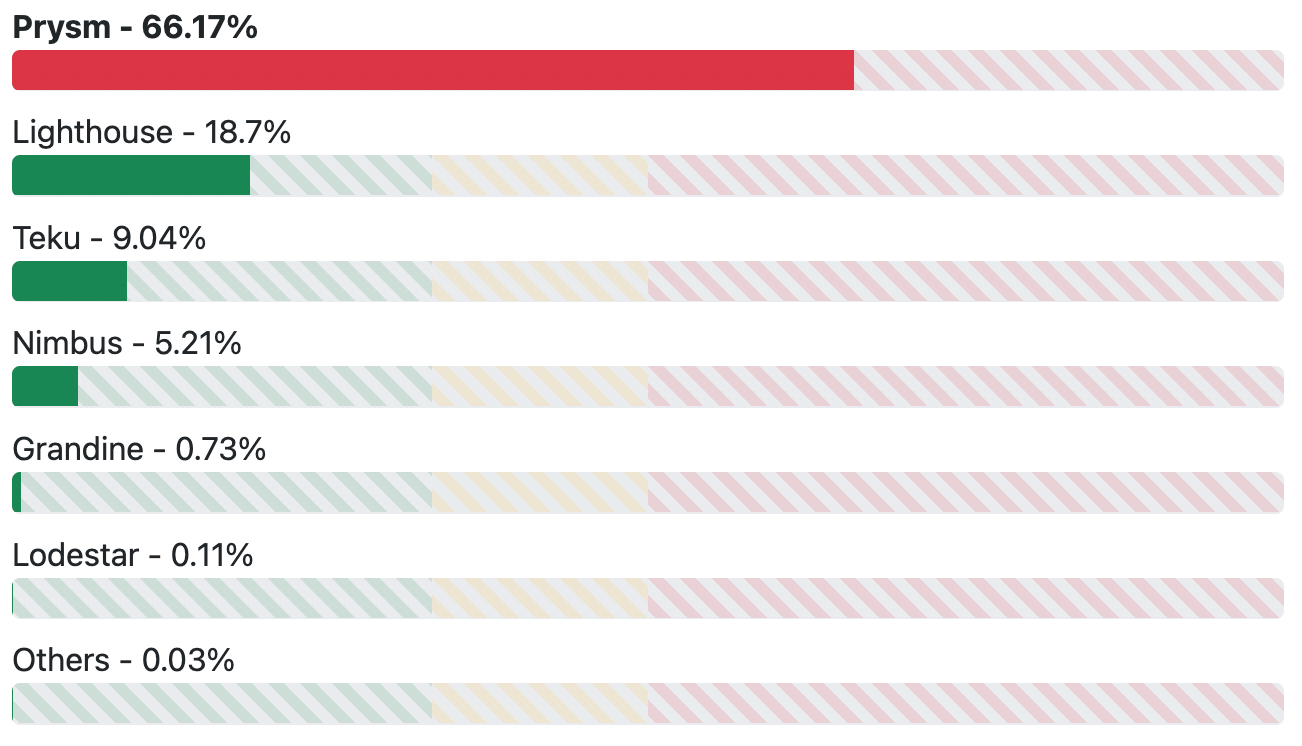
The distribution of consensus clients, as illustrated by data, shows Prysm’s dominance, though it hovers just below the critical two-thirds threshold. Resources like clientdiversity.org provide up-to-date information on this distribution.
The reasons behind Prysm’s significant market share are multifaceted. Ethereum core developer Marius van der Wijden, who works on the Geth (Golang Ethereum) Proof-of-Work client, attributes Prysm’s success to several key factors. A primary driver is its "first-mover advantage"; Prysm was among the earliest prototype implementations of a beacon chain client, allowing it to optimize and develop tooling, such as a user-friendly Web UI, and comprehensive documentation ahead of competitors.
Furthermore, Prysm’s use of the Go programming language (Golang) has been a significant advantage. Golang is known for its performance and ease of development, making it accessible to developers already familiar with Geth, which is also written in Golang. This familiarity facilitates code auditing and understanding, contributing to trust and adoption.
Execution Layer Diversity: A Different Challenge
While consensus client diversity is a critical concern for network security, the distribution of execution clients presents a separate, albeit less critical, challenge in the post-merge era. Currently, the Geth client dominates the execution layer with over 85% market share. However, Van der Wijden explains that this imbalance is less concerning post-merge because execution nodes will primarily be responsible for transaction execution and not for providing network security, a role that will fall to the consensus layer validators.
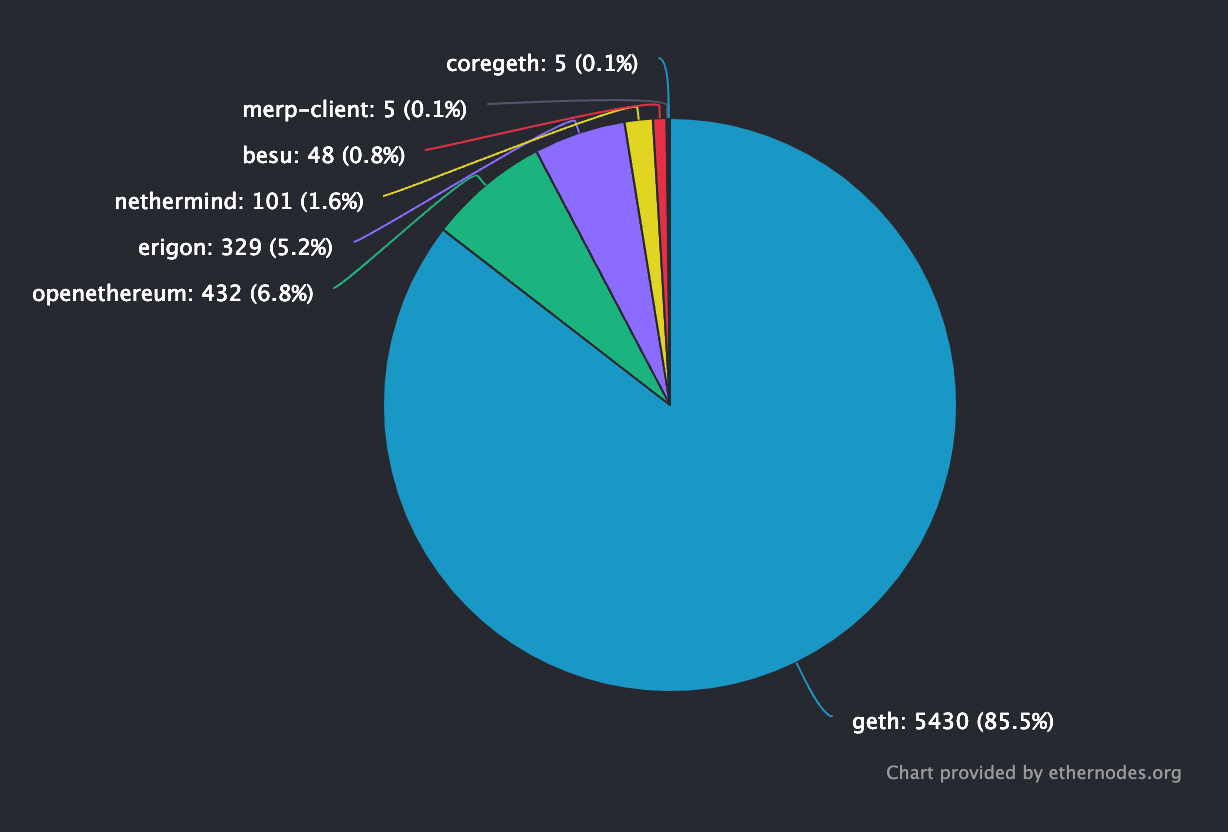
Even with the Geth dominance on the execution layer, stakers will have the flexibility to run multiple execution layer clients alongside a single beacon client to ensure they remain on the correct chain.
The Role of Major Exchanges in Prysm’s Dominance
A significant factor contributing to Prysm’s dominance is the involvement of major cryptocurrency exchanges acting as staking services. These services allow users to stake Ether without requiring the full 32 ETH threshold, and their widespread adoption of Prysm has amplified the client diversity issue. Exchanges like Coinbase, Kraken, and Binance are prominent among these large-scale stakers.
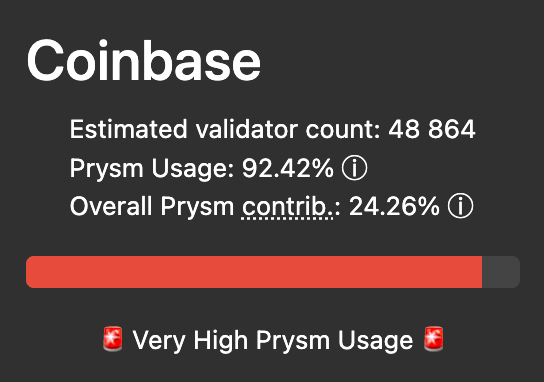
Coinbase, with a substantial number of validator nodes, contributes significantly to Prysm’s overall usage. According to available data, a large percentage of Coinbase’s validators run the Prysm client. When questioned about their client diversity, Coinbase pointed to security as the primary rationale for their initial choice of Prysm. They highlighted Prysm’s support for remote signers, a feature that enhances security by isolating private keys in secure environments. Coinbase also noted their ongoing efforts to support other clients like Lighthouse and to integrate remote signer capabilities into them.
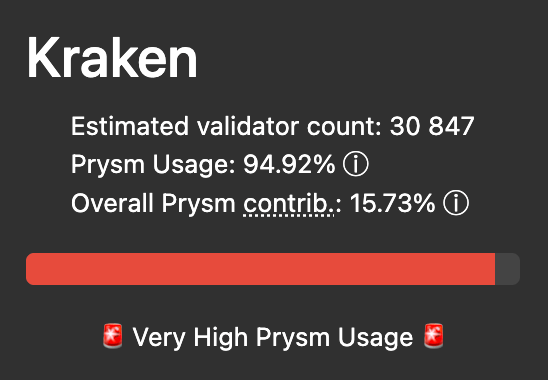
Kraken, another major exchange, echoed similar sentiments regarding Prysm’s maturity and stability during their initial setup. However, Kraken also revealed their active efforts to diversify, including the deployment of new validators using the Teku client and migrating some existing ones to improve client diversity and offer a more resilient staking service.
Binance, another major player, did not provide a comment regarding their client diversity strategy.
Lido, a leading staking service, while having a large number of validators, exhibits a lower percentage of Prysm usage compared to some exchanges, contributing less to the overall Prysm dominance.
Decentralized Alternatives and a Path Forward
In contrast to the large centralized staking services, decentralized staking pool Rocket Pool demonstrates a significantly more diverse client distribution, with a very low percentage of its validators running Prysm. This highlights that decentralized approaches can inherently foster greater client diversity.
The collective influence of the major staking services and pools is substantial, and they hold the key to rectifying the client diversity imbalance. Discussions are reportedly ongoing between these services and the Ethereum Foundation, with core developer Marius van der Wijden describing the progression of these talks as "good."
Van der Wijden suggests that large staking pools are actively working on migrating parts of their infrastructure to other clients. This transition may take time due to the need to update their metrics and monitoring systems for new clients, a process that can be more complex for larger operations compared to individual home validators. He also emphasized that switching client software is generally not a risky or difficult process for node operators, provided proper procedures are followed, such as persisting the slashing database.
Navigating The Merge Amidst Client Distribution Concerns
With The Merge approaching rapidly, the Ethereum community faces the prospect of proceeding with a less-than-ideal client distribution. The likelihood of Prysm’s dominance falling below the critical 33% threshold in the short term appears slim. Nevertheless, this situation does not deter Marius van der Wijden and other core Ethereum developers from pursuing The Merge.
Van der Wijden expressed confidence in the safety of proceeding with The Merge, citing the robust testing and fuzzing infrastructure in place to identify discrepancies between clients. He believes that even in the unlikely event of a consensus failure, the community possesses the capability to quickly resolve forks through new releases. Furthermore, he stated that there is a strong consensus within the community against bailing out stakers who operate a majority client in the event of misbehavior. The network’s security and integrity remain paramount as it embarks on this transformative journey.