
 James Watt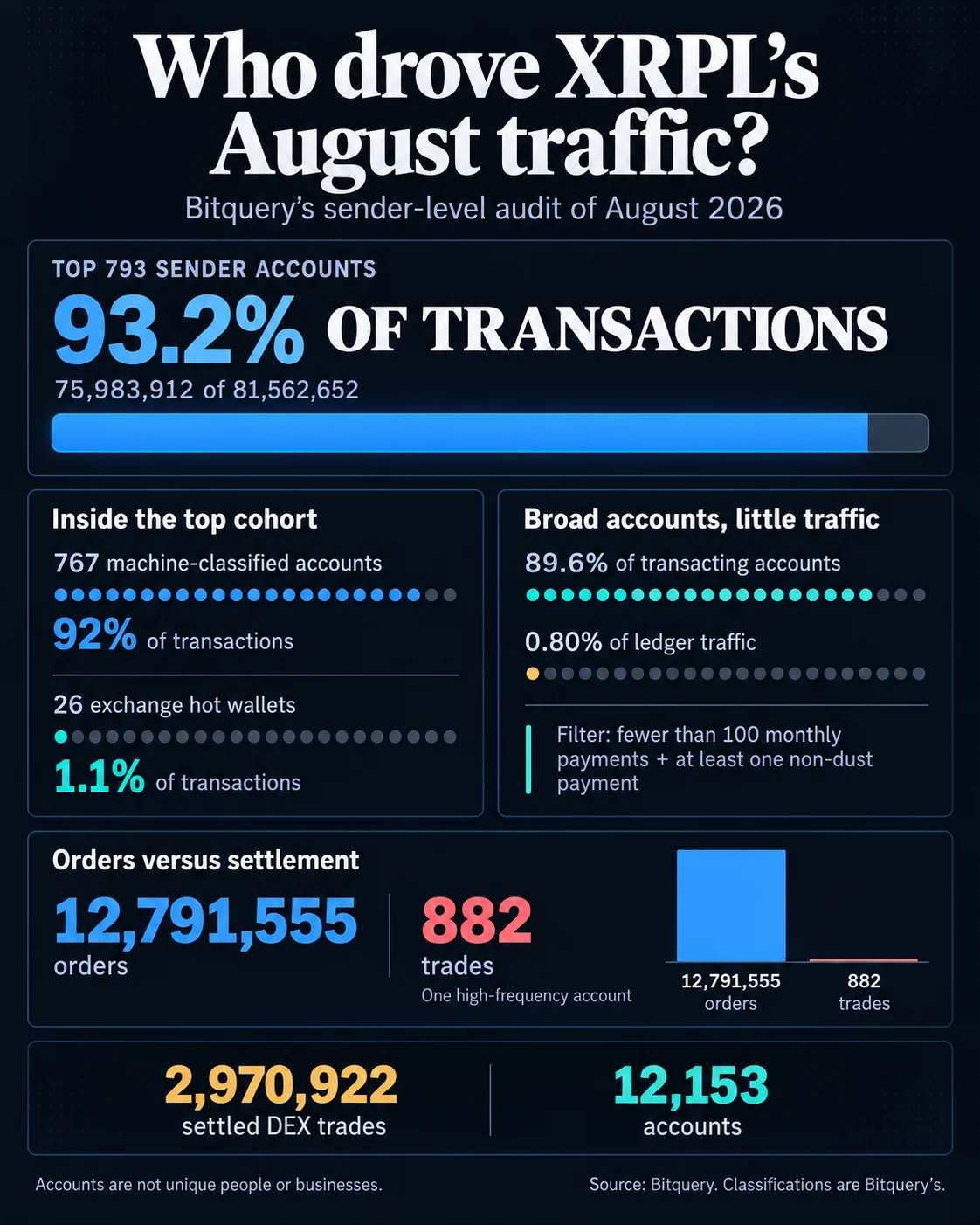
The XRP Ledger (XRPL) has officially surpassed the milestone of 5 billion validated transactions, marking a significant era of throughput for the decentralized network. However, recent forensic data analysis reveals a stark reality regarding the nature of this activity: the vast majority of transactions are generated by a remarkably small number of automated accounts. As the network transitions toward its goal of becoming a premier hub for institutional decentralized finance (DeFi), the discrepancy between raw transaction counts and actual economic settlement has become a focal point for market analysts and stakeholders.
The Concentration of Network Throughput
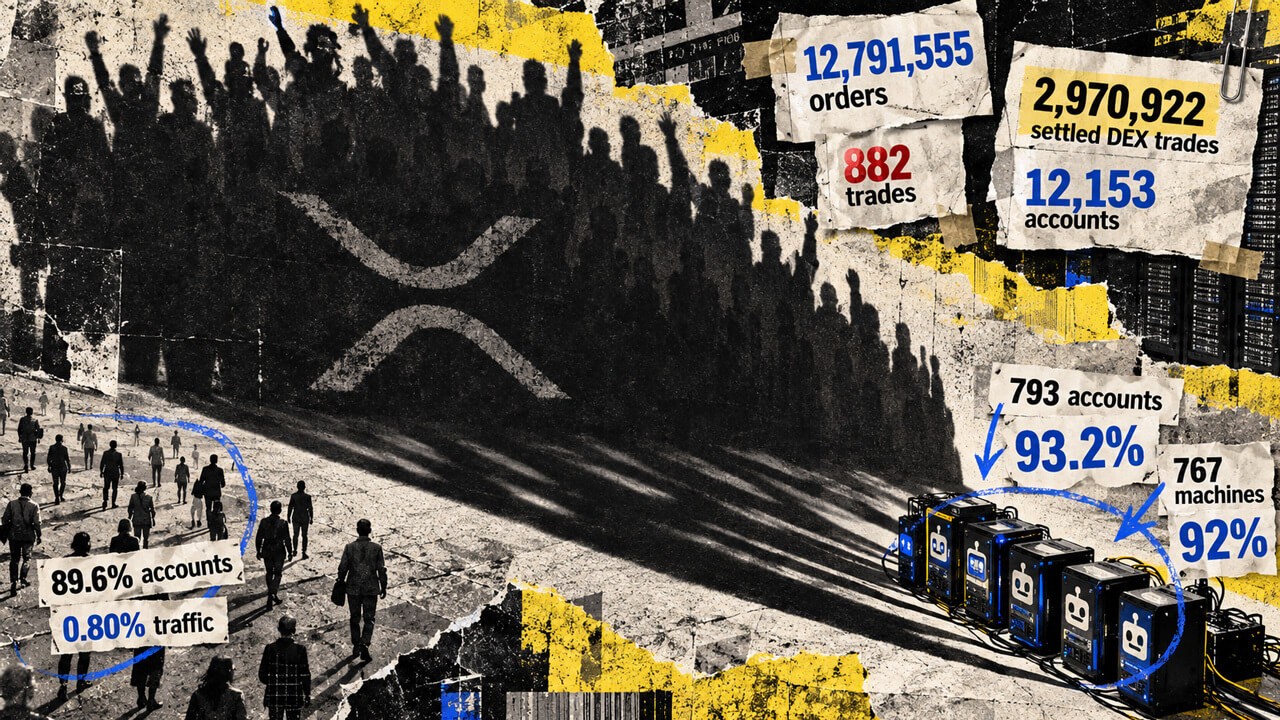
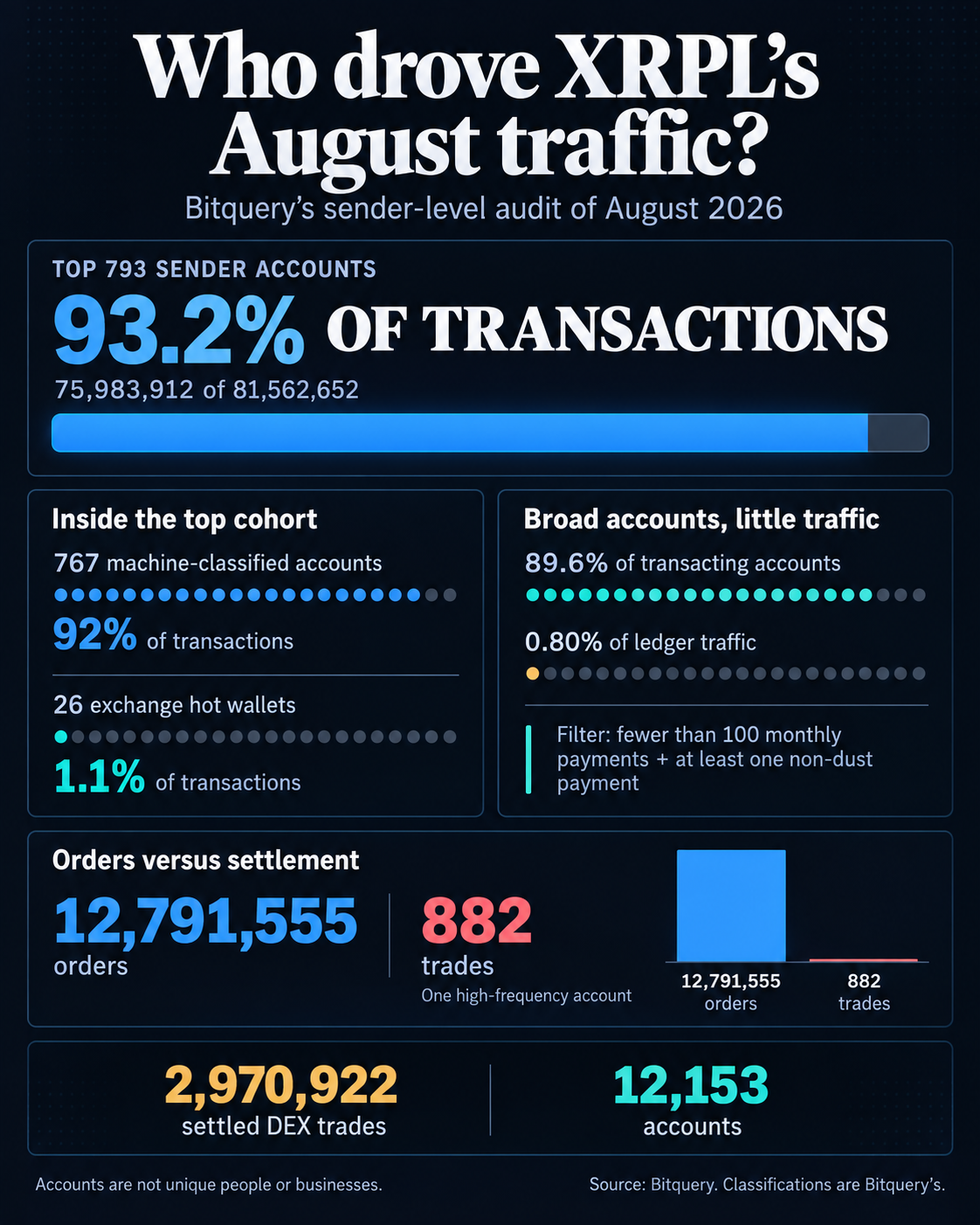
According to a comprehensive adoption audit conducted by the data firm Bitquery, the XRP Ledger’s activity in August was dominated by a tiny fraction of its total user base. Out of the 81.56 million transactions recorded during the month, approximately 75.98 million—representing 93.2% of all activity—were generated by just 793 sender accounts. This concentration suggests that while the ledger is capable of handling immense volume, the diversity of participants contributing to that volume is narrowing.
Bitquery’s classification of these accounts further clarifies the nature of the traffic. Of the 793 dominant accounts, 767 were identified as machines or automated bots, responsible for 92% of the month’s total transactions. An additional 1.1% of activity was attributed to 26 exchange hot wallets, which facilitate the movement of assets for thousands of retail and institutional customers. This leaves a negligible percentage of the network’s total throughput to be accounted for by manual, individual user transactions.
The data highlights a growing trend of "machine-to-machine" interaction on the XRPL. While high transaction counts are often cited as a sign of network health and adoption, the Bitquery report suggests that the 5 billion transaction milestone is largely a byproduct of high-frequency automation rather than a surge in unique human participants.
A Closer Look at the August Audit
The disparity between network "noise" and economic "signal" is perhaps most visible when examining the behavior of individual high-volume accounts. Bitquery identified a single address that was responsible for nearly 13 million transactions in August alone. This account accounted for roughly one-sixth of the entire network’s activity for the month.
Despite the massive volume, the actual economic impact of this account was minimal. Of the 12.79 million decentralized exchange (DEX) orders placed by this single address, only 882 resulted in settled trades. This represents a fill rate of less than 0.007%, illustrating how automated market-making strategies or high-frequency trading bots can inflate transaction metrics without necessarily contributing to deep liquidity or significant asset exchange.
Across the broader ledger, Bitquery recorded 2.97 million settled trades on the XRPL’s built-in decentralized exchange, involving 12,153 distinct accounts. When compared to the 81 million total transactions for the period, it becomes evident that the vast majority of ledger entries are non-settling events. These include:
- DEX Order Bots: Generating 39.25 million transactions (48.1% of traffic).
- Dust-Spraying Accounts: Contributing 18.79 million transactions, often used for marketing or network stress-testing.
- NFT Automation and Spam: Accounting for several million additional entries.
Conversely, the "retail" side of the network appears relatively quiet. Nearly 50% of the accounts active in August sent only a single transaction, and 80% sent five or fewer. When Bitquery applied a "lower-frequency filter" to exclude dust-level transfers, they found that while this group represented nearly 90% of all transacting accounts, they were responsible for a mere 0.8% of total ledger activity.
The Institutional Pivot: Volume vs. Participant Count
While the concentration of transactions might initially seem concerning for decentralization advocates, quarterly data from Evernorth Research provides a more nuanced perspective. Their analysis of the second quarter of the year suggests that the shrinking number of participants is coinciding with a significant increase in the value and size of individual trades, a pattern consistent with professional and institutional adoption.
Evernorth found that order-book trading volume on the XRPL rose by 79% year-over-year in Q2. During the same period, the number of accounts initiating those trades fell by approximately 40%. This mathematical shift resulted in the average volume per trading account jumping from 1,072 XRP to 3,217 XRP.
"The pattern we are seeing is consistent with professional flow taking a larger share of activity," Evernorth noted in its report. This shift is likely driven by the introduction of institution-facing infrastructure on the XRPL, including permissioned domains and specialized trading venues designed to meet regulatory compliance standards.
Key metrics from the Evernorth report include:
- Total Value Held: The average value held on the XRPL reached a six-quarter high of $4.26 billion.
- Stablecoin Growth: Balances of RLUSD (Ripple USD) averaged $539 million, a staggering 642% increase from the previous year.
- Value Velocity: The amount of value moved through stablecoins on the network increased by 925% year-over-year.
These figures suggest that while fewer people are using the ledger, those who remain—likely market makers, institutional liquidity providers, and professional traders—are moving significantly larger sums of capital.
The Chronology of XRPL Development
The journey to 5 billion transactions has been marked by several key technical and strategic shifts. Launched in 2012, the XRP Ledger was one of the first blockchains to operate without a proof-of-work mining mechanism, utilizing a unique consensus algorithm instead.
- 2012–2018: The early years were defined by Ripple’s push for cross-border payment utility, positioning XRP as a bridge currency for banking institutions.
- 2019–2021: The network saw a rise in retail interest and the emergence of the first NFT standards and decentralized exchange features.
- 2022–Present: The focus has shifted toward "Institutional DeFi." This era has been defined by the proposal and implementation of Automated Market Makers (AMMs), the development of the RLUSD stablecoin, and the integration of institutional-grade custody solutions.
The recent data from August reflects the culmination of these efforts. The network is no longer just a playground for retail speculation; it is becoming a high-throughput engine for automated financial services. However, the "spam" and bot activity identified by Bitquery are persistent side effects of a network with low transaction fees, where the cost of placing millions of orders is negligible compared to the potential profits of high-frequency trading.
Implications for the XRP Asset
For investors and holders of the XRP token, the critical question is how this concentrated activity impacts the asset’s value. The utility of XRP on the ledger is three-fold: it serves as a transaction fee "burner," a reserve requirement for accounts, and a bridge asset for liquidity.
The Evernorth data shows that while trading volume is up, not all of it passes through XRP. In the second quarter, approximately 18% of trades and 9% of total value involved swaps between two non-XRP assets (such as stablecoin-to-stablecoin trades). This underscores a potential decoupling where the XRPL can succeed as a technical platform without necessarily driving proportional demand for the XRP token.
However, the "Institutional DeFi" strategy hinges on the idea that as more professional capital enters the ecosystem, the demand for XRP as a highly liquid, neutral collateral asset will increase. The growth in RLUSD balances is a primary indicator of this trend. If RLUSD becomes a dominant medium of exchange on the ledger, XRP’s role as the primary routing asset for those trades will be the ultimate test of its market adoption.
Analysis: Noise vs. Utility
The current state of the XRP Ledger presents a dichotomy. On one hand, the 5 billion transaction milestone and the 925% increase in stablecoin value movement suggest a network that is scaling and attracting serious capital. On the other hand, the fact that a few hundred bots generate nearly all the traffic raises questions about the "organic" nature of the ecosystem.
Industry analysts suggest that this concentration is a natural evolution for a blockchain aiming for institutional integration. Unlike Ethereum or Solana, which have large, vibrant retail "meme coin" ecosystems that drive diverse transaction types, the XRPL is increasingly optimized for settlement and liquidity provisioning. In such an environment, human users are often replaced by sophisticated algorithms that can provide tighter spreads and more efficient markets.
The challenge for Ripple and the XRPL community will be to ensure that this automated activity translates into meaningful liquidity that benefits all participants. If the ledger remains dominated by bots placing millions of orders that never settle, it risks becoming a "ghost network" where impressive technical metrics mask a lack of real-world utility. Conversely, if the rising trade volumes and stablecoin balances lead to a robust, liquid market for institutional assets, the concentration of activity among a few hundred professional accounts may simply be the hallmark of a mature financial utility.
Future Outlook
As the XRPL moves into its next phase, the focus will likely shift from raw transaction counts to "settlement efficiency." The success of the network will be measured by the growth of recurring institutional accounts and the depth of liquidity in its automated market makers.
The upcoming quarters will be pivotal in determining whether the current concentration is a temporary anomaly or a permanent feature of a more institutional market. For firms committing capital to the XRPL, the clearest signals of health will not be found in the 5 billion transaction headline, but in the sustained growth of settled trades and the continued integration of XRP as a core routing and collateral asset in the global financial system.








