
 Reza Arap Oktovian
Around the middle of this year, Ethereum, the second-largest blockchain in terms of monetary value, and with hundreds of billions of dollars worth of assets depending on its operation, will transition from the Proof-of-Work consensus algorithm securing the system today, to the Proof-of-Stake system of tomorrow – a procedure described by many as changing the engine of an airplane while flying it. Ethereum can, under no circumstances whatsoever, stop producing valid blocks. This monumental undertaking, known as "The Merge," represents a fundamental shift in how the network operates, promising significant improvements in energy efficiency and scalability, but also introducing unique challenges, particularly concerning the diversity of client software used by network participants.
The transition from Proof-of-Work (PoW) to Proof-of-Stake (PoS) is not merely an upgrade; it’s a complete re-architecture of Ethereum’s foundational consensus mechanism. PoW, famously employed by Bitcoin, relies on miners expending significant computational power to solve complex cryptographic puzzles, thereby validating transactions and securing the network. This process is notoriously energy-intensive. Ethereum’s move to PoS, however, will shift this responsibility to "validators" who "stake" their ETH holdings to propose and attest to new blocks. This change is projected to reduce Ethereum’s energy consumption by over 99.9%, a critical factor in addressing environmental concerns surrounding blockchain technology.

Unlike many other blockchain ecosystems, Ethereum’s development has been characterized by a highly collaborative and decentralized approach. The Ethereum Foundation (EF), alongside a vibrant community of developers and prominent figures, has championed the development of multiple client software implementations for the PoS protocol, often referred to collectively as Ethereum 2.0. This strategy is designed to enhance network resilience by diversifying the codebase and the teams responsible for its maintenance. These client implementations are developed independently by various teams, often in different programming languages, mitigating the risk of a single point of failure through a shared vulnerability.
The Mechanics of "The Merge": A Symbiotic Integration
The transition itself is often described as a "merge," a process that will see the existing Ethereum network seamlessly integrate with the "beacon chain." The beacon chain, which has been operational since December 2020, currently serves as the PoS "skeleton" of Ethereum, preparing for the eventual integration of the mainnet execution layer. This merge will not result in the creation of two separate chains that are then combined, but rather a pivotal moment at a specific block height where the current PoW nodes will cease their validation duties, transferring this responsibility to the PoS validators on the beacon chain.
Post-merge, the functional roles of nodes will be bifurcated. Currently, Ethereum nodes perform both the execution of transactions and their validation. In the new architecture, this separation of concerns will enhance robustness. One type of node will continue to manage the Ethereum Virtual Machine (EVM), interacting with users and smart contracts, executing transactions, and relaying them to a separate set of validator nodes. These "execution nodes" will largely perform their current functions, but the critical task of validating transactions will be exclusively handled by "validator nodes" operating on the PoS consensus layer, also known as the beacon chain.
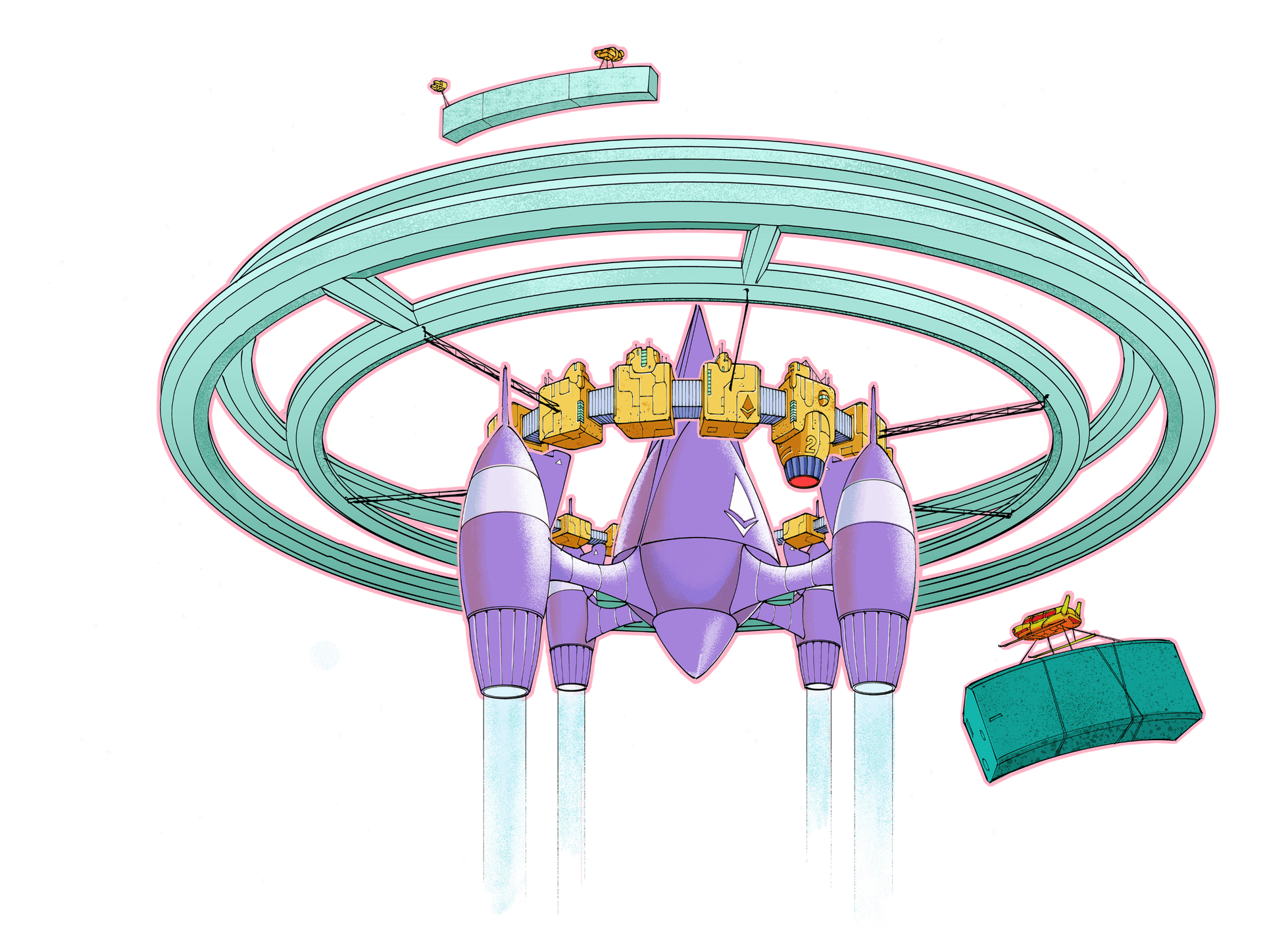
This division of labor is a key architectural enhancement. While execution clients will undergo minor modifications to accommodate the merge, and their EVM components will remain largely reusable, the validation logic will be entirely offloaded to the consensus layer. This means that eventually, execution clients might even shed the parts of their code responsible for PoW validation, further streamlining their operations. The success of this intricate maneuver hinges on the coordinated functioning of these distinct yet interconnected layers.
Client Diversity: A Crucial Pillar of Network Security
The strategy of developing multiple, independently coded client implementations is a cornerstone of Ethereum’s approach to security and decentralization. The core rationale is that if a bug or vulnerability is discovered in one client, it will not compromise the entire network because other clients, built with different codebases and potentially different programming languages, will remain unaffected. This contrasts with simpler blockchain protocols, where a single codebase might be more susceptible to widespread exploits.
Ethereum’s inherent complexity, an order of magnitude greater than that of Bitcoin, necessitates this multi-client approach. However, the effectiveness of this strategy is intrinsically linked to the distribution of staking power across these different clients. The Ethereum community has established critical thresholds for client usage: if any single client is adopted by more than 33% of the network’s staking power, the risk of a coordinated attack or a widespread bug impacting consensus increases significantly. The situation becomes critical if a single client commands more than 66% of the staking power, as this could lead to a "supermajority" scenario where the network’s integrity is jeopardized.
The implications of a client failure are stratified based on its market share. A bug in a client used by less than one-third of stakers would likely be contained, with the network continuing to operate smoothly while the bug is addressed. A failure in a client between one-third and one-half of the market share would be more serious, potentially causing user-level disruptions that might be mitigated by automatic network mechanisms. However, if a bug affects a client controlling over 50% of the staking power, it could trigger automated recovery mechanisms, but these would likely result in significant network disturbances and user impact.
The most dire scenario, and the one that community members are actively working to prevent, is a bug impacting a client used by more than two-thirds of the staking power. In such a case, the buggy client would possess a supermajority, giving it the power to finalize blocks and effectively dictate the state of the blockchain. Non-buggy clients would then face a stark choice: permanently fork the chain, creating two distinct Ethereums, or capitulate and join the buggy chain, accepting whatever consequences the bug has introduced.
The Prysm Dominance: A Point of Concern
As "The Merge" draws nearer, a significant concern has emerged regarding the distribution of consensus clients. As of early 2022, the Prysm client, developed by Prysmatic Labs, commands a substantial portion of the network’s staking power, hovering around 33% (two-thirds of the staking power). This level of dominance, while not yet exceeding the critical 66% threshold, represents a precarious situation. A critical bug or vulnerability within Prysm, if exploited, could potentially lead to a consensus failure, impacting the stability and security of the entire Ethereum network. While this scenario is considered unlikely, its non-zero probability warrants serious attention.
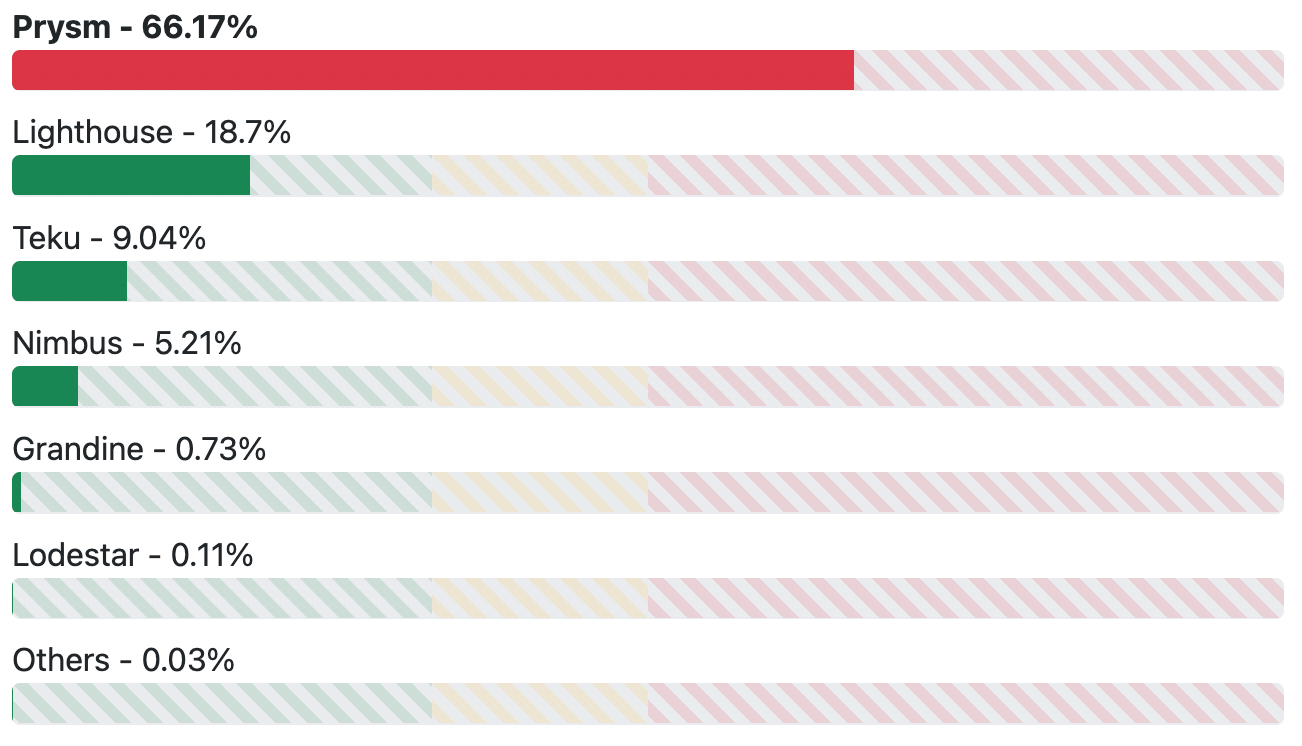
The competitive landscape for consensus clients includes Lighthouse, Teku, Nimbus, Grandine, and Loadstar. Grandine and Loadstar currently hold very small market shares, each well below 1%. Notably, Grandine is the only client developed under a closed-source license, which raises transparency concerns within the open-source ethos of the Ethereum community.
The distribution of consensus clients at the time of reporting indicates a clear lead for Prysm, though it remains just below the critical two-thirds threshold. Resources like clientdiversity.org provide real-time data and insights into this crucial metric.
Understanding Prysm’s Ascendancy: A First-Mover Advantage
The significant adoption of the Prysm client can be attributed to several key factors, as explained by Marius van der Wijden, an Ethereum core developer. "I think the big reasons for Prysm’s success are a first-mover advantage, tooling, and golang," van der Wijden stated. Prysm was among the earliest prototype implementations of a beacon client, allowing its developers to optimize early and dedicate more time to building supplementary tools, such as a user-friendly Web UI, and comprehensive documentation.
The choice of Go (Golang) as the programming language for Prysm has also been a significant advantage. Go is known for its performance, ease of readability, and rapid development capabilities. Since Go-ethereum, a leading PoW execution client, is also written in Go, developers familiar with Geth could more readily understand and audit Prysm’s codebase, fostering trust and familiarity within the developer community.
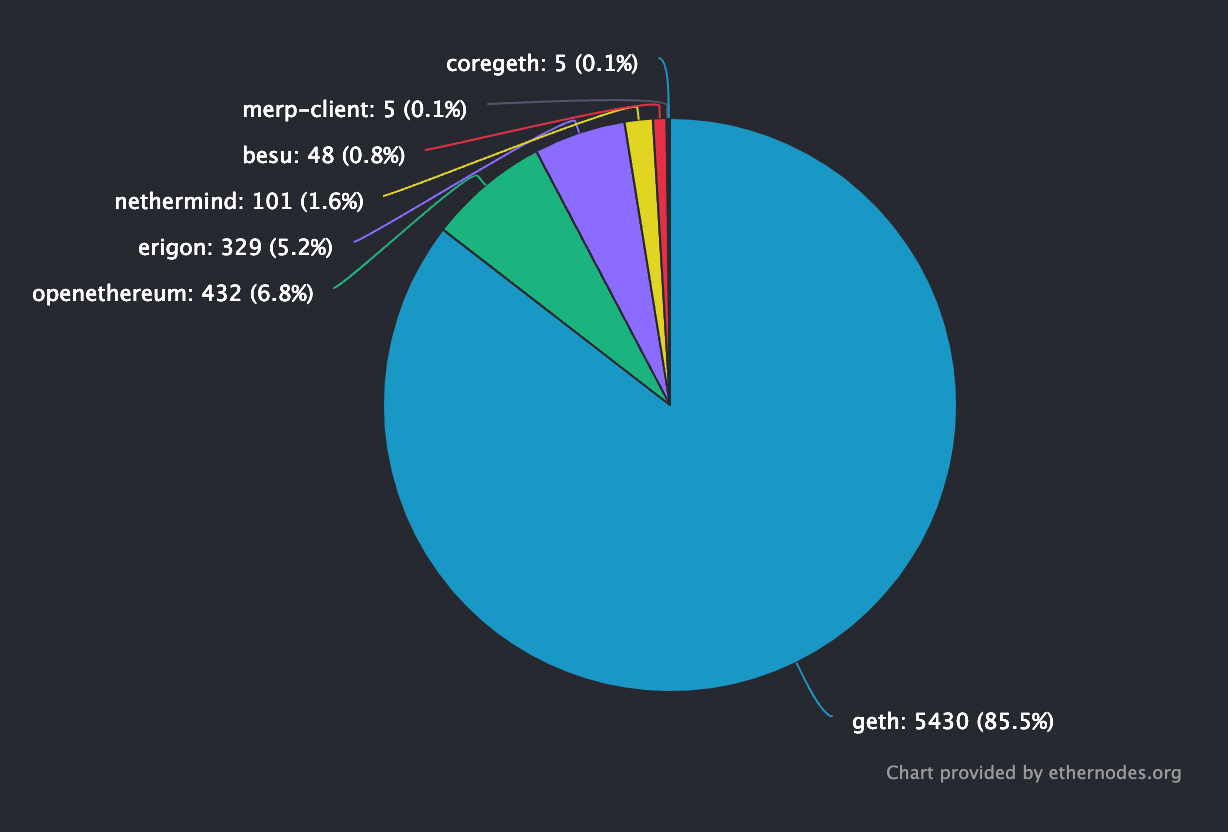
This ease of understanding and auditing is particularly important given the client diversity landscape for execution clients. While consensus clients are critical for network security, execution clients handle transaction processing. The distribution of PoW execution clients, at the time of writing, was even more concentrated, with Geth holding over 85% of the market share. However, post-merge, this concentration is less concerning, as execution nodes will not be responsible for securing the network in the same way consensus clients will be.
"Go-ethereum currently has a supermajority of 85% on the execution layer. It will be a bit better post-merge since stakers can run multiple execution layer clients, with one beacon client, in order to always end up on the correct chain," van der Wijden elaborated.
The Role of Major Exchanges in Prysm’s Dominance
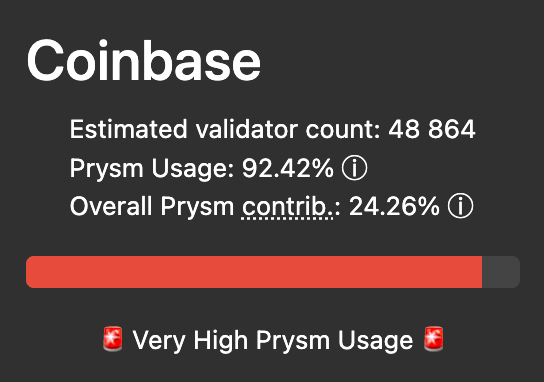
A critical factor contributing to Prysm’s high market share is the involvement of major cryptocurrency exchanges acting as staking service providers. These entities aggregate staked ETH from numerous users, allowing individuals to participate in staking without needing to hold the minimum requirement of 32 ETH. The adoption of Prysm by these large staking services has had a disproportionate impact on client diversity.
Coinbase, a prominent exchange, with a significant portion of its validators running Prysm, contributes substantially to the client diversity issue. According to data, Coinbase’s validators running Prysm constitute a significant percentage of the overall Prysm usage. When approached for comment, Coinbase cited security as the primary driver for their initial choice of Prysm. They highlighted Prysm’s support for "remote signers," a feature crucial for isolating validator keys in secure environments, thereby enhancing the security of their staking operations. Coinbase also noted their ongoing efforts to support other clients like Lighthouse and migrate some existing validators to more diverse solutions.
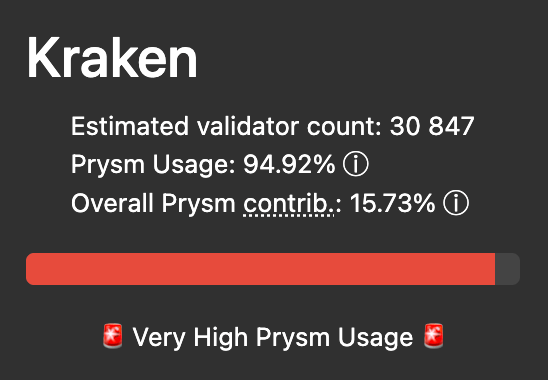
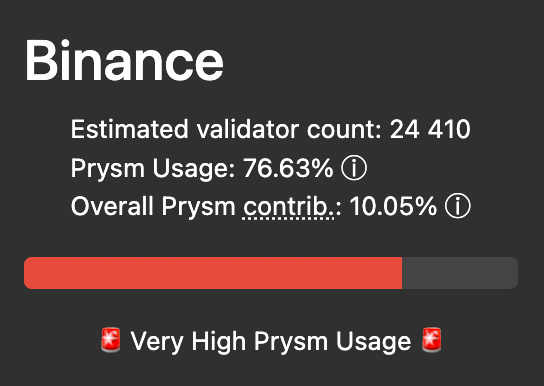
Kraken, another major exchange, echoed similar sentiments, initially selecting Prysm due to its perceived maturity and stability. However, Kraken has also begun deploying new validators on the Teku client and migrating some existing ones to improve client diversity. Binance, the world’s largest cryptocurrency exchange by trading volume, did not respond to requests for comment regarding their client distribution strategy.
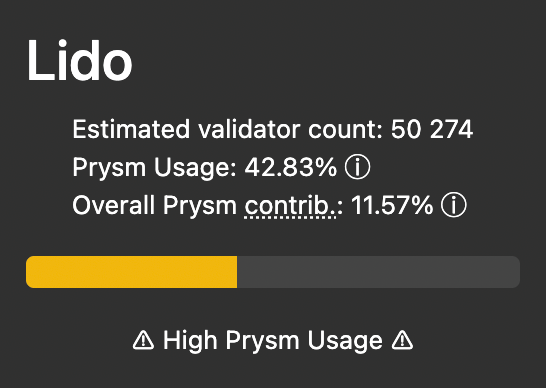
Lido, a decentralized staking solution, while having a larger validator count than some exchanges, exhibits a more moderate Prysm usage rate. Despite this, its significant stake still contributes to the overall Prysm dominance.
Decentralized Alternatives and the Path Forward
In contrast to the concentrated adoption by large staking services, decentralized staking pools like Rocket Pool demonstrate a significantly healthier client diversity. Rocket Pool’s validators show a very low percentage of Prysm usage, contributing minimally to the overall dominance of the client.
The concentration of staking power on Prysm is a challenge that the major staking services and pools, along with the Ethereum Foundation, are actively discussing. Ethereum core developer Marius van der Wijden indicated that these discussions are progressing positively. "Yes, there are talks about this, both internally and externally. I think big staking pools are working on switching parts of their infrastructure to other clients. They need to update their metrics and monitoring infrastructure for the new clients, so it might take longer for them to switch than home validators," he explained.
Van der Wijden emphasized that switching client software is not inherently risky or difficult for individual node operators. The major implementations are well-tested, and the primary consideration for larger stakers involves adapting their infrastructure to accommodate different client APIs.
Assessing the Safety of "The Merge"
Despite the less-than-ideal client distribution, particularly the continued dominance of Prysm, the Ethereum core development team remains committed to proceeding with "The Merge." The likelihood of Prysm’s market share falling below the critical 33% threshold before the merge is considered low. However, developers maintain that the overall risk of a consensus failure is minimal.
"I think it’s safe to pursue. The chances of a consensus failure happening are very small in my opinion. We have great testing and fuzzing infrastructure that runs permanently to find differences between clients. Even if a consensus failure occurs, we will be able to push out new releases and resolve forks quickly and easily," van der Wijden asserted. He also stressed the community’s consensus on not bailing out stakers who run a majority client if their clients misbehave, reinforcing the importance of responsible client adoption and diversification.
The successful execution of "The Merge" will mark a pivotal moment in blockchain history, transforming Ethereum into a more sustainable and scalable platform. However, the ongoing challenge of ensuring robust client diversity will remain a critical focus for the community as Ethereum continues to evolve. The concerted efforts of major staking providers and ongoing community dialogue are essential to mitigating the risks associated with concentrated client adoption and securing the future of the Ethereum network.







