
 James Watt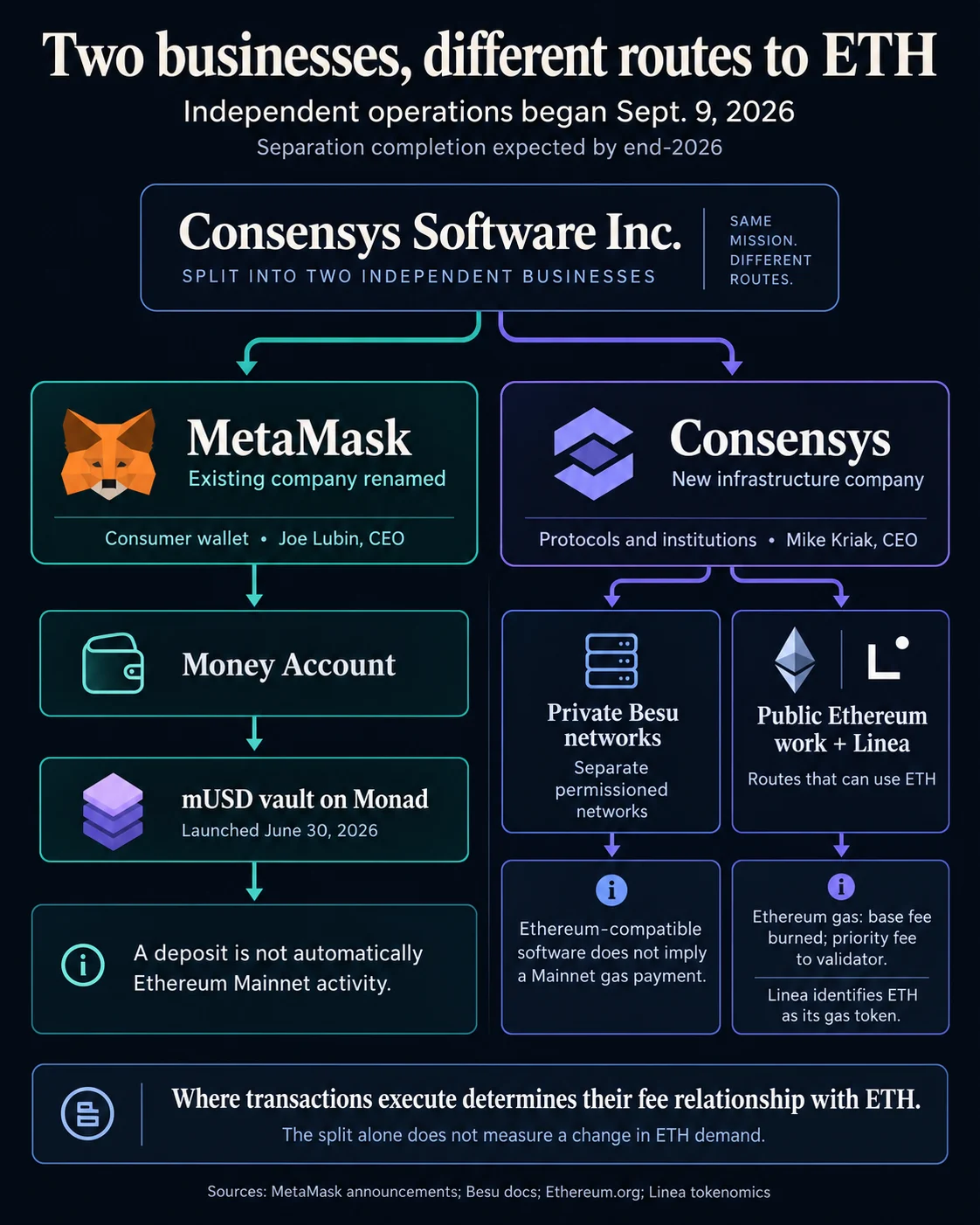
Consensys, the influential blockchain software firm founded by Ethereum co-founder Joseph Lubin, officially announced on September 9 a comprehensive plan to restructure its business into two distinct, independent corporate entities. This strategic pivot involves the separation of its flagship consumer product, the MetaMask wallet, from its institutional and protocol-focused infrastructure business. By decoupling these divisions, the organization aims to provide each with dedicated management teams, specialized investment priorities, and the agility required to navigate an increasingly complex and competitive decentralized landscape. For the broader Ethereum ecosystem and holders of the native Ether (ETH) token, this move raises fundamental questions regarding the future of network activity, the distribution of transaction fees, and the long-term economic relationship between software adoption and asset value.
The restructuring marks a definitive evolution for Consensys, which has historically operated as a conglomerate encompassing a wide array of projects ranging from developer tools to enterprise consulting. Under the new framework, the existing Consensys Software Inc. will transition to operate primarily as MetaMask, focusing on the consumer-facing wallet experience and retail financial services. Meanwhile, the institutional infrastructure, protocol development, and Layer 2 scaling operations will be housed within a newly formed company that will retain the Consensys name. This entity will manage the Linea blockchain—a zero-knowledge Ethereum Virtual Machine (zkEVM) rollup—as well as critical client software such as Hyperledger Besu and Teku.
A Chronological Overview of the Consensys Evolution
To understand the magnitude of this separation, it is necessary to examine the decade-long trajectory of Consensys. Founded in 2014 by Joseph Lubin, the company was initially envisioned as a "venture production studio" designed to seed and develop projects that would bolster the Ethereum ecosystem. In its early years, Consensys operated with a highly decentralized and experimental structure, fostering dozens of "spokes" or internal startups.
By 2020, the company underwent its first major reorganization, consolidating its core software products—including MetaMask and Infura—into Consensys Software Inc. (CSI), while its venture capital and investment arms were moved to Consensys Mesh. This 2020 shift was largely seen as a move toward professionalization and commercial viability. The 2024 announcement represents the final stage of this maturation, transforming the company from a multi-product software house into two specialized market leaders.
The transition is expected to be completed by the end of 2026. During this period, the leadership roles have been clearly defined: Joseph Lubin will lead the MetaMask entity as Chairman and CEO while simultaneously serving as the Executive Chairman of the newly formed Consensys. Mike Kriak, formerly the Chief Operating Officer of Consensys, has been appointed as the CEO of the infrastructure-focused Consensys entity. For the millions of daily active users of MetaMask, the company has emphasized that the transition will require no action and will not impact assets, private keys, or the functionality of the application.
The Divergent Economics of Wallets and Networks
One of the most significant implications of this split lies in the differing economic models of the two new entities. A cryptocurrency wallet like MetaMask serves as the primary interface for the decentralized web, acting as the gateway through which users interact with various protocols. This positioning allows the wallet provider to generate revenue through service-oriented fees that are entirely separate from the underlying blockchain’s transaction costs.
For example, MetaMask currently charges a service fee of 0.875% on its "Swap" feature, which enables users to trade tokens directly within the wallet interface. This fee is distinct from the "gas" fees paid to the Ethereum network or the liquidity provider fees paid to decentralized exchanges like Uniswap. Consequently, an increase in MetaMask’s revenue does not automatically correlate to increased demand for ETH or higher revenue for the Ethereum network. The wallet’s profitability is tied to user volume and service utilization, whereas the network’s economic health is tied to the consumption of block space.
This distinction is further highlighted by the introduction of the MetaMask "Money Account," a feature launched in mid-2024. The Money Account functions as a high-yield savings and payment tool, converting user deposits into the mUSD stablecoin. Notably, this product operates on Monad, a high-performance Layer 1 blockchain that is separate from Ethereum. While this expands the utility of the MetaMask wallet, the transactions associated with the Money Account do not utilize Ethereum Mainnet, illustrating how a consumer-facing product can scale independently of the Ethereum protocol.
Institutional Infrastructure and the Private Network Divide
The newly formed Consensys infrastructure company will oversee a suite of tools that are foundational to the Ethereum ecosystem but often operate under different economic constraints. Hyperledger Besu, an open-source Ethereum client, is a prime example. Besu is widely used for both the public Ethereum Mainnet and for private, permissioned networks favored by large-scale institutions and central banks.
In a private network setting, Besu utilizes a Proof-of-Authority (PoA) consensus mechanism where transactions are validated by a set of approved participants rather than a decentralized set of stakers. These networks typically have their own chain identifiers and do not require the payment of gas fees in ETH to the public Ethereum network. While the use of Besu by institutions validates the technical robustness of Ethereum-compatible software, it does not necessarily translate into direct economic demand for the ETH token.
This creates a nuanced reality for investors and analysts:
- Public Ethereum Transactions: These involve the direct use of ETH for execution, where a portion of the fee is burned (reducing supply) and a portion is paid to validators.
- Private Besu Networks: These utilize Ethereum’s codebase for institutional efficiency but do not interact with the ETH asset or the public ledger.
- Layer 2 Solutions (Linea): These sit in the middle. Linea uses ETH as its native gas token and has designs to burn ETH as part of its long-term tokenomics, thereby maintaining a direct link to the value of the Ethereum network.
Supporting Data and Market Context
The decision to split comes at a time when the competitive landscape for both wallets and Layer 2 solutions is intensifying. According to recent market data, MetaMask remains the dominant non-custodial wallet with over 30 million monthly active users. However, it faces growing competition from "chain-agnostic" wallets and those focused on the Solana ecosystem, such as Phantom. By becoming an independent entity, MetaMask can more aggressively pursue cross-chain integrations and financial services that may have been restricted under a purely Ethereum-centric mandate.
On the infrastructure side, the competition is equally fierce. Linea, which will remain with the Consensys infrastructure business, currently competes with other major rollups such as Arbitrum, Optimism, and Base. As of late 2024, the Total Value Locked (TVL) in Layer 2 networks has reached record highs, but the fragmentation of liquidity remains a challenge. The infrastructure entity’s ability to focus solely on protocol efficiency and institutional onboarding is seen as a strategic advantage in the "rollup wars."
The financial performance of these sectors also varies. While Ethereum Mainnet gas fees have fluctuated significantly following the Dencun upgrade—which lowered costs for Layer 2s—the revenue generated by wallet service fees has remained relatively stable, providing a consistent cash flow that can fund the development of the MetaMask brand.
Analysis of Implications for the Ethereum Ecosystem
The separation of Consensys into two entities reflects a broader trend in the technology sector toward "unbundling." For Ethereum, this move is a double-edged sword. On one hand, it allows for specialized growth. A dedicated MetaMask company can innovate faster in the consumer space, potentially onboarding the next billion users into the decentralized economy. A dedicated infrastructure company can focus on the technical rigors of scaling and institutional compliance.
On the other hand, the split formalizes the reality that "using Ethereum software" is no longer synonymous with "using the Ethereum network." If the most popular wallet (MetaMask) and the most popular enterprise software (Besu) increasingly route activity toward private chains or alternative Layer 1s like Monad, the "monetary premium" of ETH could be challenged.
However, the leadership at Consensys maintains that this restructuring is ultimately bullish for the ecosystem. By allowing MetaMask to thrive as a consumer powerhouse and the infrastructure arm to excel as a protocol leader, the overall footprint of Ethereum-compatible technology expands. Joseph Lubin has frequently argued that the "decentralized world computer" requires a variety of entry points and specialized layers to succeed.
Conclusion and Future Outlook
The strategic separation of Consensys into MetaMask and a protocol-focused infrastructure company is one of the most significant corporate events in the history of the blockchain industry. It signals the end of the "venture studio" era and the beginning of a specialized, market-driven phase for Ethereum’s most influential development house.
As the completion date of 2026 approaches, the industry will be watching several key metrics to judge the success of this move:
- The rate of adoption for the MetaMask Money Account on the Monad network.
- The ability of Linea to capture a larger share of the Layer 2 market and its efficacy in burning ETH.
- The degree to which institutional Besu users migrate toward public or hybrid Ethereum solutions.
For the end user, the immediate impact is minimal, but the long-term result will likely be a more refined and feature-rich wallet experience. For the Ethereum investor, the split serves as a reminder that the value of ETH is increasingly dependent on the actual execution of transactions on public ledgers, even as the software that powers those transactions becomes more ubiquitous across the global economy. The mandate is now clear: the two businesses will operate independently, each pursuing its own vision of a decentralized future while remaining tethered to the legacy of the network that started it all.








