 admin
admin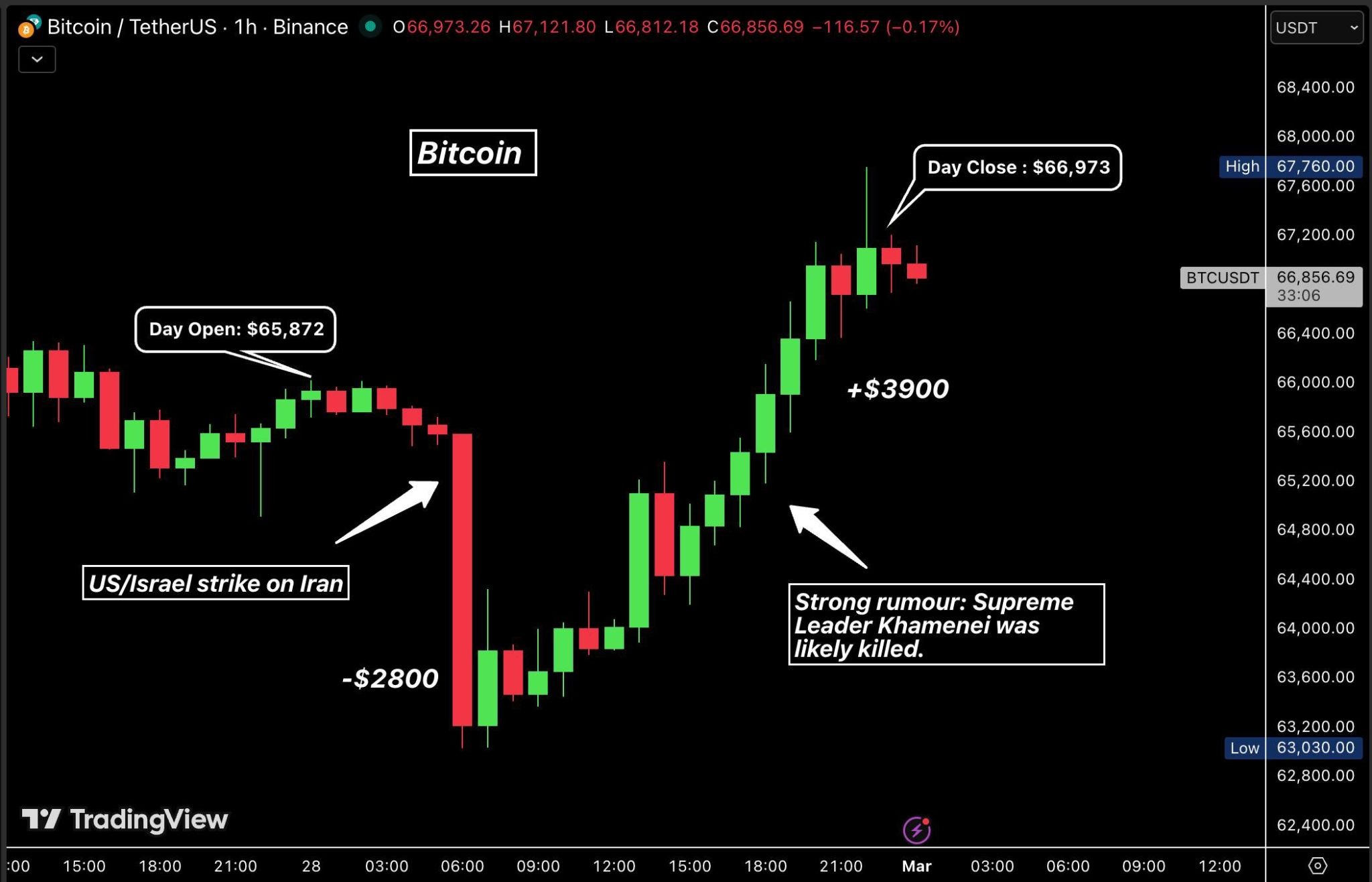
The digital asset market experienced a significant wave of volatility over the weekend as geopolitical tensions in the Middle East reached a fever pitch, resulting in a rapid "V-shaped" recovery for Bitcoin. After plunging to a local low of $63,000 on Saturday following news of coordinated US-Israeli air strikes against Iranian targets, Bitcoin (BTC) surged back to the $68,000 level by Sunday morning. The recovery coincided with unconfirmed reports regarding the death of Iran’s Supreme Leader, Ayatollah Ali Khamenei, which some market participants interpreted as a potential, albeit violent, catalyst for a shift in the regional conflict. At the time of writing, Bitcoin is trading near $67,350, effectively erasing the losses incurred during the initial shock of the military escalation while remaining within a broader three-week range-bound channel.
A Chronology of Escalation and Market Response
The sequence of events began late Friday and early Saturday when reports emerged that the United States and Israel had commenced targeted air strikes across various strategic locations in Iran. The immediate reaction in the cryptocurrency markets—which trade 24/7 and often serve as a real-time barometer for global anxiety—was a sharp sell-off. Bitcoin, which had been hovering in the high $60,000s, dropped approximately $5,000 in a matter of hours, bottoming out at $63,000. This "risk-off" move mirrored traditional flight-to-safety behavior, though unlike gold, which often spikes during the onset of conflict, Bitcoin initially suffered from a liquidity-driven retreat.
The narrative shifted early Sunday morning. Reports surfaced via the BBC, citing Iran’s Supreme National Security Council, stating that Ayatollah Khamenei had been killed at his office on Saturday. The strikes also reportedly claimed the lives of several high-ranking Iranian military and security officials, including Mohammad Pakpour, the commander-in-chief of the Islamic Revolutionary Guard Corps (IRGC) Ground Forces, and Ali Shamkhani, the secretary of Iran’s Defense Council.
As news of the leadership vacuum in Tehran spread, Bitcoin prices began a rapid ascent. By early Sunday, BTC reached a peak of $68,200 on Coinbase. Analysts noted that the market appeared to be pricing in the possibility of a definitive end to the current cycle of US-Iran hostilities, or at least a significant disruption to Iran’s military command structure that might preclude immediate large-scale retaliation.
Massive Liquidations and Market Mechanics
The extreme price swings resulted in one of the most significant liquidation events of the quarter. Data from CoinGlass indicates that in the 24-hour period spanning the height of the volatility, approximately 157,000 traders were liquidated. Total liquidations reached $657 million, a figure that was remarkably evenly split between leveraged long positions and short positions.
The initial drop to $63,000 wiped out over $300 million in long positions as traders who had bet on a weekend breakout were caught off guard by the military news. Conversely, as the price aggressively rebounded toward $68,000, short-sellers—who had anticipated a deeper correction following the strikes—were forced to cover their positions, adding further upward momentum to the recovery. This "short squeeze" helped propel Bitcoin back to its Friday levels, illustrating the high-risk environment currently facing leveraged participants in the crypto space.
Official Reactions and Geopolitical Implications
The geopolitical fallout from the strikes has been met with polarized responses from the international community. On his social media platform, Truth Social, former US President Donald Trump commented extensively on the reported death of the Iranian leader. Trump described the hardline Islamist cleric as “one of the most evil people in history,” framing the military action as a moment of justice.
“This is not only justice for the people of Iran, but for all great Americans, and those people from many countries throughout the world, that have been killed or mutilated by Khamenei and his gang of bloodthirsty thugs,” Trump stated. His comments reflect a significant portion of the political discourse in Washington, which has increasingly favored a "maximum pressure" campaign against the Iranian regime.
From a market perspective, the removal of top-tier Iranian leadership is being viewed through a lens of "regime uncertainty." While the immediate reaction was a price "pump," institutional analysts remain cautious. The death of a head of state, particularly in a nation as central to global energy markets as Iran, typically introduces a period of extreme unpredictability. However, crypto-native analysts like Ash Crypto suggested that the market is currently optimistic. "The market pumped because people are taking it as the end of the US-Iran war," he commented on Sunday, adding that if the conflict shows signs of resolution before the traditional markets open on Monday, Bitcoin could potentially sustain its gains and move higher.
Historical Context: Bitcoin’s Challenging First Quarter
Despite the impressive 24-hour recovery, the broader technical and historical picture for Bitcoin remains somber. The asset has just concluded its third-worst February in history. Since 2013, it has been rare for Bitcoin to end February in the red, but this year the asset shed nearly 15% of its value over the month.
Historical data from CoinGlass highlights that the only Februarys with worse performances were in 2014, when the asset plummeted by 31%, and 2025, when it saw a 17.4% decline. The current performance contributes to a broader trend of weakness in early 2026. Bitcoin is currently on track to close its worst-performing first quarter since 2018. Year-to-date, the asset has lost almost 23% of its value, struggling to find a firm footing amid shifting macroeconomic policies in the United States and escalating global conflicts.
The current "range-bound" behavior—where Bitcoin fluctuates between $60,000 and $70,000 without a clear breakout—suggests that investors are waiting for more definitive signals from both the Federal Reserve and the geopolitical arena. While the weekend’s events provided a temporary boost, the long-term trend for Q1 remains bearish compared to previous halving-cycle expectations.
Analyzing the "Safe Haven" vs. "Risk Asset" Narrative
The weekend’s price action once again brings to the forefront the debate over Bitcoin’s role as "digital gold." During the initial hours of the US-Israeli strikes, Bitcoin behaved like a classic risk asset, selling off alongside equity futures as investors sought the liquidity of the US dollar. This initial reaction suggests that in moments of extreme military uncertainty, Bitcoin is still viewed by many institutional desks as a volatile asset that should be trimmed during a "flight to safety."
However, the subsequent recovery as news of the Iranian leadership’s demise broke suggests a secondary narrative: Bitcoin as a hedge against systemic geopolitical shifts. If the market believes that a change in leadership could lead to a more stable Middle East or a reduction in state-sponsored conflict, Bitcoin serves as a vehicle for betting on that future "peace dividend."
Furthermore, the decentralized nature of Bitcoin makes it an attractive asset in regions facing total government collapse or severe economic sanctions. If the Iranian domestic situation destabilizes further, local demand for censorship-resistant assets could theoretically provide a floor for prices, though this remains speculative.
Future Outlook: Eyes on Monday’s Market Open
As the dust settles on a historic weekend, the focus now shifts to how traditional finance (TradFi) will react when global stock exchanges and commodities markets open on Monday morning. The crypto market has provided a preliminary "green" signal, but the sustainability of this rally depends on several factors:
- Confirmation of Iranian Succession: The process by which Iran appoints a new Supreme Leader and the subsequent rhetoric from the IRGC will be critical. Any signs of immediate and violent retaliation against US or Israeli assets could quickly reverse Bitcoin’s gains.
- Oil Market Reaction: Since Iran is a major oil producer, any disruption to the Strait of Hormuz or Iranian oil infrastructure would likely send crude prices skyrocketing. Historically, sharp rises in energy costs are inflationary, which can lead to higher interest rates—a traditional headwind for Bitcoin.
- US Policy Shifts: The official stance of the current US administration regarding the strikes and the future of diplomatic relations with a post-Khamenei Iran will dictate market sentiment for the remainder of the quarter.
While Bitcoin has successfully recovered the $67,000 level, it remains trapped in a consolidation zone that has defined its price action for the last three weeks. Technical analysts are watching the $69,000 resistance level closely; a clean break above this could signal that the geopolitical bottom is in. Conversely, a failure to hold $65,000 upon the Monday open could suggest that the weekend "pump" was merely a reactionary bounce in a larger downward trend.
As the digital asset landscape continues to mature, its sensitivity to global events only intensifies. The events of this weekend serve as a stark reminder that while Bitcoin operates on a decentralized protocol, its valuation remains deeply intertwined with the stability—or instability—of the physical world.