 James Watt
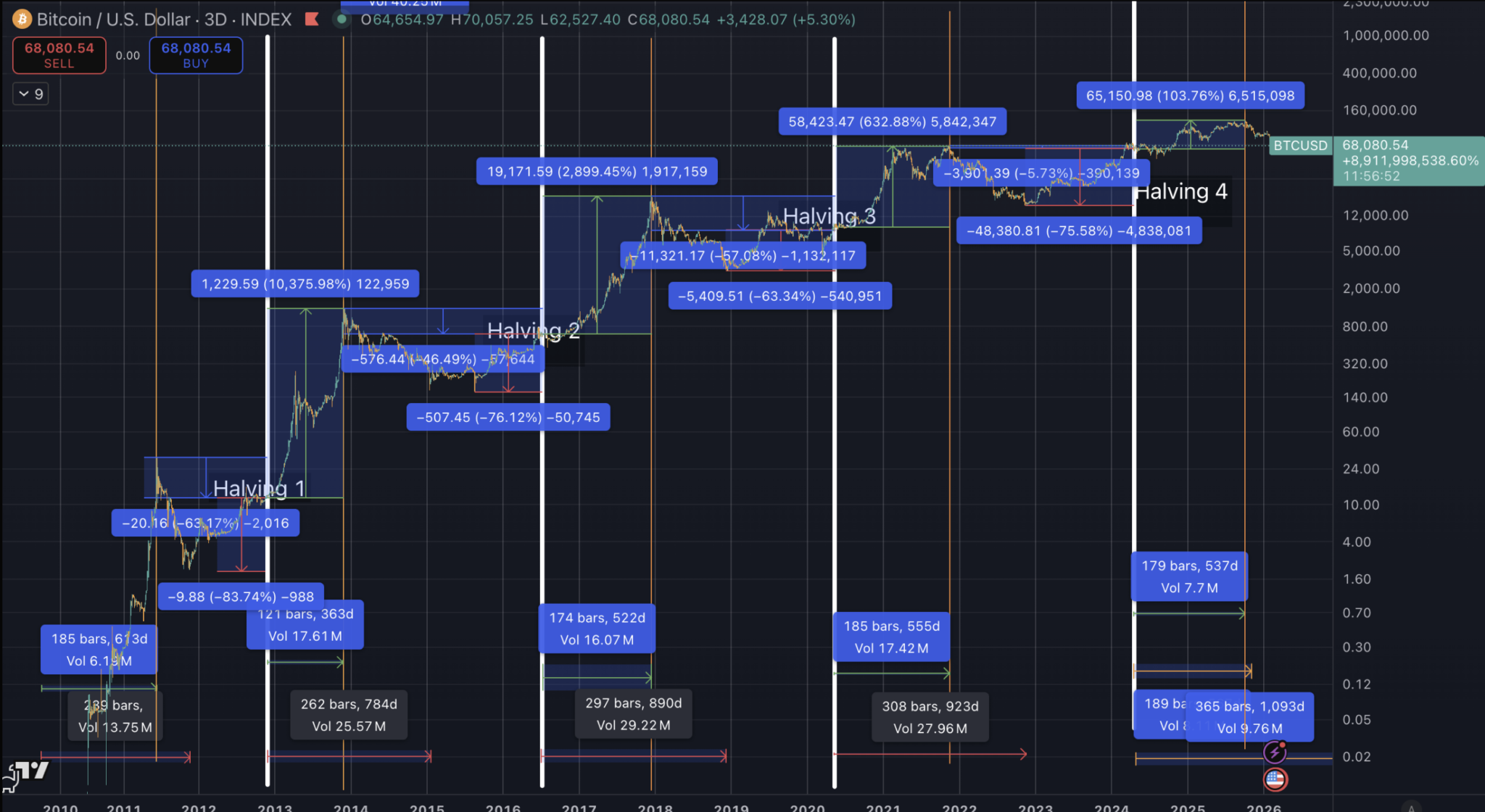
The digital asset market experienced a period of intense volatility on Feb. 25, as Bitcoin (BTC) staged a significant recovery toward the $69,000 mark. This price action followed a sharp intraday "flush" that saw the cryptocurrency plunge into the low-$60,000s across major global exchanges. The rapid descent and subsequent reversal triggered a massive liquidation event, wiping out nearly $500 million in short positions within a matter of hours. While the bounce provided immediate relief to bullish traders, blockchain analytics firm Glassnode suggests that the move remains corrective rather than a definitive reversal of the prevailing downtrend.
According to the latest market data, this recovery has kept Bitcoin’s price firmly within the $60,000 to $69,000 range, a corridor that has characterized much of the trading activity throughout February. However, analysts warn that the recent price jump does not yet resolve the underlying structural weaknesses that have plagued the market since Bitcoin began its 47% drawdown from its previous all-time highs. The current market environment appears to be defined by a "risk-on" rebound and a mechanical reset of leveraged positions rather than a sustained macro breakout driven by new demand.
The Mechanics of the February 25 Recovery
The resurgence in Bitcoin’s price can be attributed to a confluence of three primary drivers: a shift in global risk appetite, a temporary reversal in exchange-traded fund (ETF) flows, and a technical normalization of market positioning.
First, the broader financial landscape saw a return of risk-on sentiment. Global equities rallied on Feb. 25, with technology stocks leading the charge in anticipation of Nvidia’s highly anticipated earnings report. As a high-beta asset, Bitcoin historically exhibits a strong correlation with the Nasdaq and other tech-heavy indices. When traditional investors increased their exposure to risk assets, Bitcoin followed suit, reclaiming lost ground as liquidity flowed back into the speculative sectors of the market.

Second, the impact of U.S.-based spot Bitcoin ETFs proved pivotal. Following a day of significant outflows totaling $203.8 million, the trend reversed on Feb. 24. Data from Farside Investors revealed net inflows of $257.7 million, signaling that institutional and retail appetite via regulated vehicles remains sensitive to price dips. While Glassnode points out that the year-to-date trend for ETF flows remains net negative, the emergence of a "marginal buyer" at the $60,000 level provided the necessary capital to power a sharp bounce after the intraday flush.
Third, the technical structure of the derivatives market underwent a necessary "cleansing." Prior to the bounce, Glassnode observed that perpetual futures funding rates had become stretched, but the subsequent volatility normalized these rates toward neutral levels. This indicates that excessive leverage has been flushed out of the system. Similarly, in the options market, short-dated volatility spiked as Bitcoin approached the $62,000 support level, only to compress again as the price reclaimed the mid-$60,000s. This behavior suggests that the rally was fueled by the unwinding of panic hedges rather than a surge in organic, long-term buying interest.
Assessing Structural Vulnerabilities
Despite the optical strength of the $69,000 surge, Glassnode’s technical analysis remains cautious. The firm’s "Week Onchain" report characterizes the current phase as "stabilizing, not yet recovering." The distinction is critical for investors looking to gauge the longevity of the current price levels.
One of the most significant headwinds facing the market is the volume of "underwater" supply. With Bitcoin sitting nearly 50% below its all-time high, approximately 9.2 million BTC are currently held at a realized loss. This massive cohort of holders creates a "sell-on-rally" mentality; as prices approach the levels where these investors originally purchased their coins, they are often inclined to exit their positions to break even, thereby creating a ceiling of overhead resistance.
On-chain metrics further illustrate this fragility. The Accumulation Trend Score, a measure of the relative size of entities that are actively accumulating or distributing Bitcoin, currently sits below 0.5. This suggests that large-scale "whales" and institutional entities are showing limited conviction in the current rally. Furthermore, the 90-day Realized Profit/Loss (P/L) Ratio has dropped below 1.0. Historically, a ratio below this threshold indicates a "loss regime," where the market is struggling with impaired liquidity and a lack of profitable exits.

The Spot Cumulative Volume Delta (CVD) also remains sharply negative. This metric tracks the net difference between buying and selling volume in the spot market. A negative CVD indicates that sell-side flow continues to dominate the major exchanges, including Coinbase and Binance, suggesting that the recent price increase was driven more by derivatives liquidations than by aggressive spot buying.
Critical Support and Resistance Tiers
To understand where Bitcoin goes next, analysts are focusing on several key valuation anchors that define the current range. The $60,000 to $69,000 zone is currently the primary battleground for bulls and bears.
The Floor ($60,000 – $62,500):
The $62,000 to $62,500 range is viewed as a critical "must-hold" area. During the Feb. 25 flush, Bitcoin tested this level and successfully bounced. Glassnode explicitly noted that a failure to hold $62,000 could have opened the door for a deeper correction into the high-$50,000s. Below that sits the psychological and technical "floor" of $60,000. If this level is breached, the market may look toward the "Realized Price" at approximately $55,000, which serves as a long-term structural anchor based on the average price at which all coins last moved.
The Mid-Range and Ceiling ($65,000 – $72,000):
The $65,000 level has emerged as a mid-range pivot point where short-dated fear tends to dissipate. However, the $69,000 to $70,000 area represents the top of the current demand zone. Glassnode states that Bitcoin must not only touch these levels but reclaim them on a daily and weekly closing basis to signal a shift in momentum. A failure to move decisively above $70,000 keeps the risk of further downside contraction elevated.
The True Market Mean ($79,200):
Looking further ahead, the "True Market Mean" sits at approximately $79,200. In Glassnode’s valuation framework, this level represents the average price paid by active market participants. Reclaiming this level would be a major signal of a regime shift from a bear-market stabilization phase to a genuine bull-market recovery. However, even if this is achieved, heavy supply clusters exist between $82,000 and $97,000, and again from $100,000 up to $117,000, where previous buyers are likely to distribute their holdings.

Signs of a Genuine Regime Shift
For the market to transition from a "mechanical relief" phase to a "structural recovery," three specific conditions likely need to be met:
- Sustained ETF Inflows: A single day of $257 million in inflows is insufficient to reverse a multi-month trend. Market participants are looking for consecutive weeks of net positive flows into U.S. spot ETFs to demonstrate that institutional demand is returning in a durable way.
- Spot Market Absorption: The Spot CVD must flip from negative to positive. This would indicate that buyers are no longer just reacting to liquidations but are actively absorbing the sell-side pressure and taking coins off exchanges.
- Breaching Valuation Anchors: Bitcoin needs to clear the $72,000 corridor ceiling and ultimately the $79,200 True Market Mean. Moving above these levels would invalidate the "bear market rally" thesis and suggest that the 47% drawdown has found a definitive bottom.
The Bottom Line for Investors
The jump toward $69,000 on Feb. 25 serves as a reminder of Bitcoin’s inherent volatility and its ability to punish over-leveraged short sellers. However, the data provided by Glassnode suggests that the celebration may be premature. The move appears to be a byproduct of external factors—such as the rally in technology stocks—and internal technical resets rather than a fundamental change in the supply-demand equilibrium.
With 9.2 million BTC held at a loss and spot selling pressure still evident on major exchanges, the path of least resistance remains murky. While the $62,000 level held firm during the most recent test, the lack of aggressive accumulation from large holders suggests that the market is still in a fragile state of "stabilization." Bulls will need to demonstrate significantly more strength by reclaiming and holding the $70,000 level before the recent period of weakness can be considered resolved. Until then, the market remains trapped in a wide range, waiting for a catalyst strong enough to break the structural deadlock.