 Nila Kartika Wati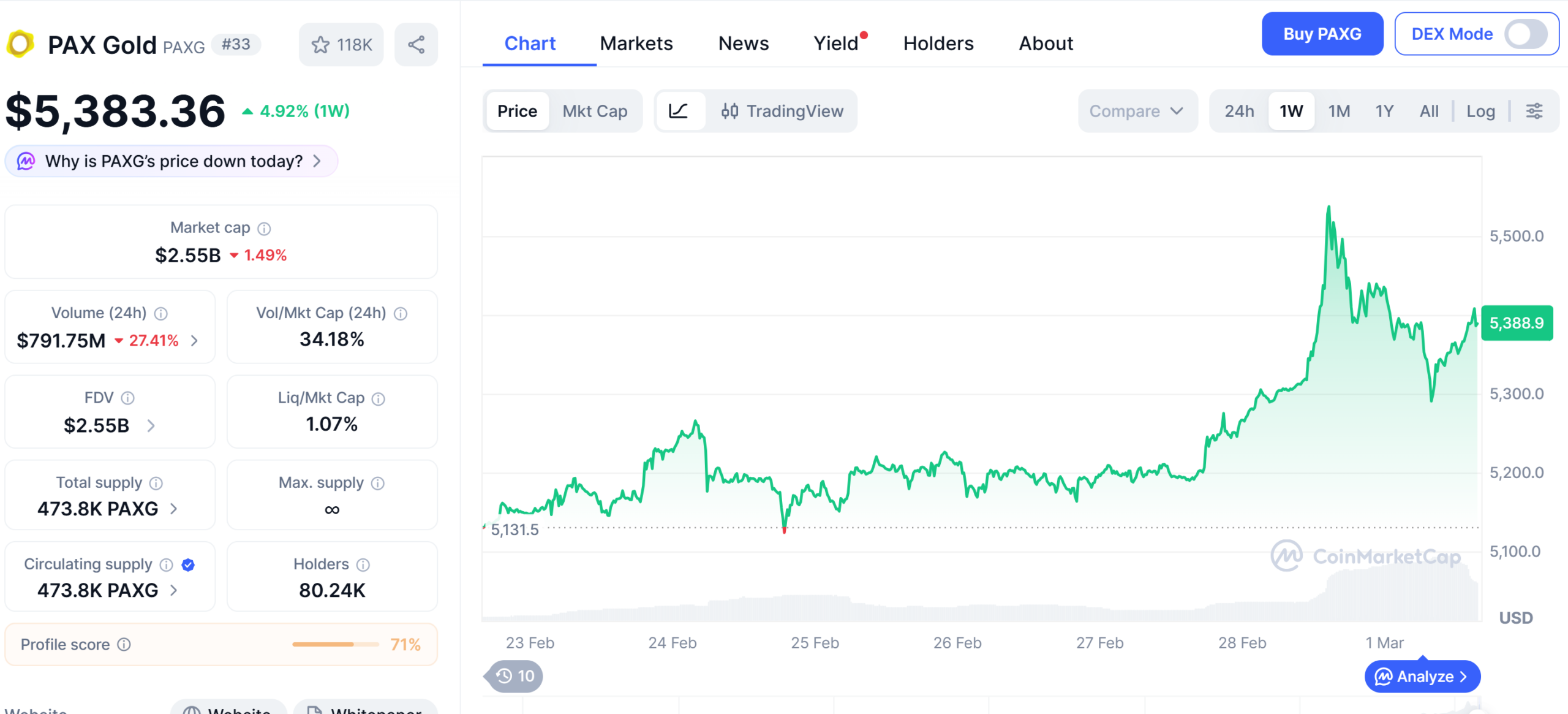
Gold pricing undergoes a significant and increasingly influential shift onto blockchain networks once the U.S. futures markets close for the weekend, a phenomenon that highlights the growing maturity and integration of digital assets within the broader financial landscape. According to Iggy Ioppe, formerly a chief investment officer at Credit Suisse and now the CIO at liquidity infrastructure firm Theo, this transition means that for substantial periods, tokenized gold assets are the sole public arbiters of the precious metal’s value.
The Chicago Mercantile Exchange (CME) gold futures, a global benchmark, halt trading at 5:00 PM Eastern Time on Friday and do not reopen until 6:00 PM ET on Sunday. This 49-hour interval traditionally created a vacuum in transparent, regulated gold price discovery. Historically, any significant activity during this period largely transpired through private, over-the-counter (OTC) deals, particularly in Asian markets, which are not publicly reported and therefore offer limited visibility into real-time price formation. Consequently, publicly visible price formation during these critical weekend hours now largely defaults to on-chain markets, where tokenized gold assets such as PAX Gold (PAXG) and Tether Gold (XAUt) provide continuous, 24/7 trading venues. Ioppe articulated this paradigm shift concisely, stating to Cointelegraph that, "In terms of publicly visible price formation, onchain markets are responsible for virtually 100% of weekend price discovery." He further observed a direct correlation, noting that when futures trading eventually resumes, prices frequently align with the movements that have already occurred on these blockchain-based markets, indicating that "We are seeing weekend moves reflected when CME reopens."
The Evolution of Gold Trading: From Vaults to Blocks
For centuries, gold has served as a quintessential safe-haven asset, a store of value revered across cultures and economic systems. Its trading mechanisms, however, have largely remained rooted in traditional financial infrastructure: physical delivery, spot markets, and futures contracts. The advent of tokenized gold marks a profound evolution in this landscape, offering a digital representation of physical gold, typically held in secure vaults by regulated custodians. Each token represents a specific quantity of gold, often one troy ounce, and is backed by an equivalent physical reserve. This innovation bridges the gap between the immutable value of gold and the efficiency, transparency, and accessibility of blockchain technology.
The traditional gold market, despite its vastness, has inherent limitations. The fragmented nature of OTC trading, particularly during off-hours, contributes to opacity and potential price discrepancies. Furthermore, the settlement cycles for physical gold or even some traditional ETFs can be cumbersome. Tokenized gold, by contrast, offers near-instantaneous settlement, fractional ownership, and, crucially, continuous trading. This accessibility has been a key driver in its recent, explosive growth.
Tokenized Gold Market Cap Surges to $4.4 Billion Amidst RWA Boom
The ascendancy of tokenized gold as a primary price discovery mechanism during weekends is underscored by its remarkable growth trajectory. The sector has witnessed an extraordinary expansion over the past year, adding nearly $2.8 billion in value and soaring from approximately $1.6 billion to a robust $4.4 billion in market capitalization. This represents a staggering 177% increase, a pace that has significantly outstripped the broader gold market and the performance of most major spot gold Exchange Traded Funds (ETFs).
Beyond market capitalization, the adoption metrics paint an equally compelling picture. The number of unique holders of tokenized gold nearly tripled, with more than 115,000 new wallets entering the ecosystem. This rapid expansion positions tokenized gold as a significant contributor to the burgeoning real-world asset (RWA) sector within decentralized finance. Its growth alone accounted for roughly a quarter of all net inflows into the RWA category, surpassing the combined expansion of tokenized stocks, corporate bonds, and non-U.S. Treasuries. This data, particularly highlighted by analyses from platforms like Cex.io, illustrates a clear trend of increasing investor confidence and utility for digital representations of physical commodities.

The surge in market capitalization has been paralleled by an unprecedented spike in trading activity. Tokenized gold recorded an estimated $178 billion in volume in 2025, with a peak above $126 billion occurring in the fourth quarter alone. Such a volume level would position tokenized gold as the second-largest gold investment product globally by trading volume, trailing only the venerable SPDR Gold Shares (GLD), which has long dominated the ETF landscape. This astonishing rise in liquidity and trading interest solidifies its position as a serious contender in the gold investment arena.
The Dynamics of On-Chain Price Formation
The mechanics behind this weekend price discovery are driven by a sophisticated interplay of market participants. Iggy Ioppe explains that market makers and cross-venue liquidity providers are dominant players, actively engaging in arbitrage strategies to exploit and normalize price differences between the digital and traditional markets. These entities leverage the 24/7 nature of blockchain markets to ensure that prices remain relatively consistent across different trading platforms, even when major regulated markets are closed.
Furthermore, crypto-native macro traders play a crucial role. These sophisticated investors utilize tokenized gold not merely for direct exposure to bullion prices but also for a range of advanced financial strategies. This includes using tokenized gold as collateral in decentralized finance (DeFi) protocols, employing it for hedging against broader market volatility, and integrating it into various yield-generating strategies. Such activities become particularly pronounced during periods of heightened geopolitical or macroeconomic uncertainty, where the demand for a readily accessible, liquid, and stable asset like gold surges.
Even traditional institutions, while not always actively positioning themselves, are increasingly monitoring these weekend on-chain gold markets. "Some institutions are monitoring weekend onchain gold markets, particularly macro and cross-asset desks that track gap risk ahead of the CME reopen," Ioppe noted. This suggests that while active trading might be limited for some traditional players due to regulatory or operational constraints, the informational value derived from blockchain markets is undeniable. Observing these movements allows institutions to gauge potential "gap risk" – the difference between the closing price on Friday and the reopening price on Sunday – and to inform their trading strategies once traditional markets resume.
24/7 Trading: A Strategic Advantage for Risk Management
One of the most compelling advantages offered by tokenized gold markets is the ability for continuous, 24/7 trading. This feature provides a practical and significant edge in risk management, particularly in an increasingly volatile global landscape. In traditional futures markets, if a major geopolitical event or economic shock occurs while markets are closed – say, over a weekend – participants are left unable to adjust their positions. This can lead to substantial losses or missed opportunities when markets reopen, often with a significant price gap.
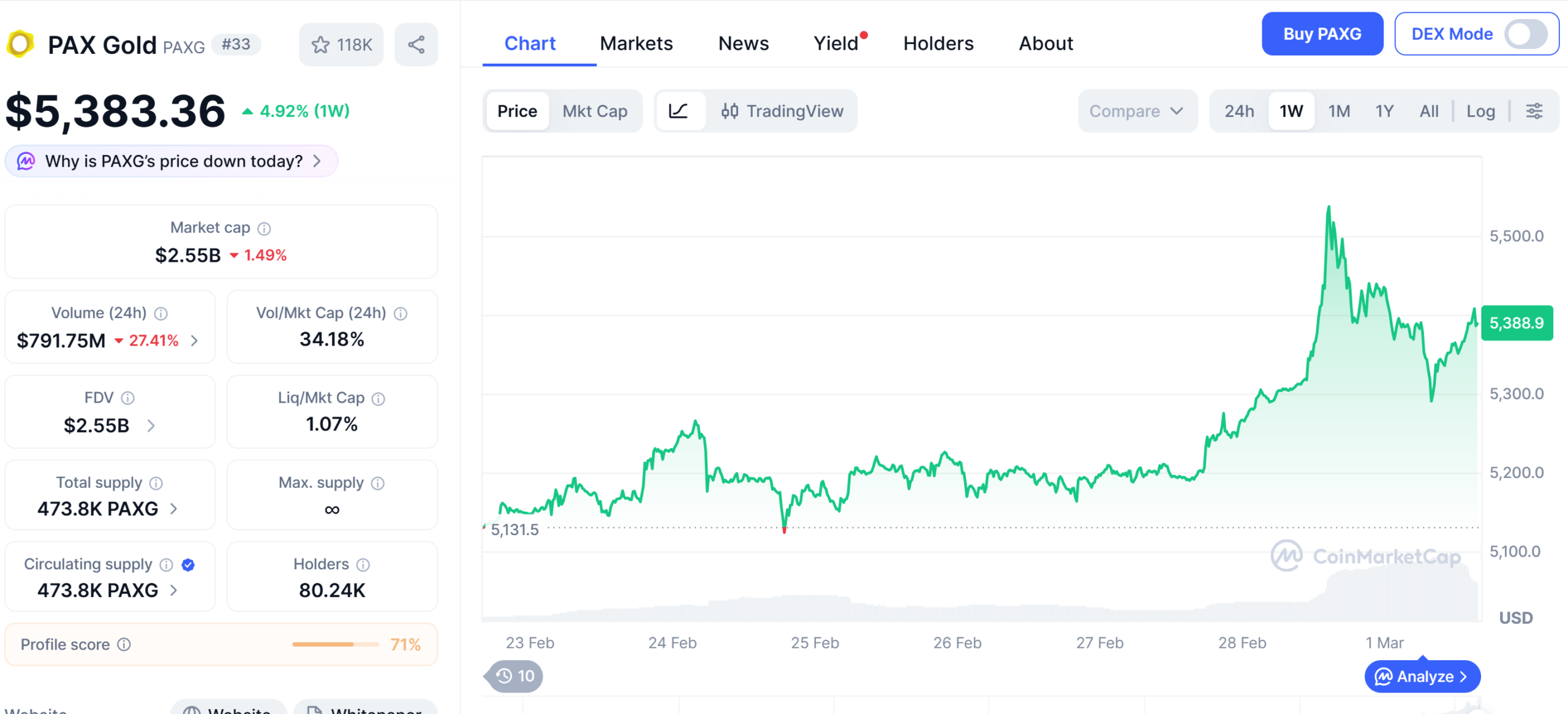
Tokenized markets, however, allow for immediate rebalancing. Investors can react instantly to breaking news, shifting capital into or out of gold as circumstances dictate, without having to wait for the next trading week. This capability was vividly demonstrated recently. On a particular Saturday, tokenized gold experienced a notable rally as geopolitical tensions escalated following reports of US and Israeli strikes on Iran. In response to this heightened uncertainty, investors swiftly moved into safe-haven assets, with XAUT and PAXG seeing significant inflows, even as major cryptocurrencies like Bitcoin (BTC) and Ether (ETH) experienced declines. During this event, XAUT briefly climbed above $5,450, and PAXG neared $5,536, according to data from CoinMarketCap, before trimming some of those gains later in the day. This real-time response capability underscores the critical role tokenized gold can play in modern risk management strategies, offering unparalleled flexibility and immediacy in turbulent times.
Obstacles and the Path Forward for Tokenized Gold
Despite the undeniable momentum and strategic advantages, the broader adoption of tokenized gold still faces several significant hurdles. Ioppe highlighted that liquidity, while rapidly growing, remains smaller than in the well-established futures markets or traditional gold ETFs. This difference in liquidity can make executing very large trades challenging, potentially leading to greater price impact for institutional-sized orders compared to their traditional counterparts.

Regulatory clarity also presents a complex challenge. While improving, the regulatory landscape for digital assets remains fragmented across different jurisdictions. "Regulatory clarity is improving, but fragmentation across jurisdictions slows institutional deployment. Custody, accounting, and capital rules still vary widely," Ioppe explained. This patchwork of regulations creates operational complexities for institutional investors who operate globally, requiring them to navigate diverse legal frameworks for custody, reporting, and capital allocation, thereby slowing widespread institutional adoption. The absence of a unified global regulatory approach means that the full potential of tokenized assets is yet to be unlocked.
Furthermore, the technological infrastructure required for seamless integration between traditional financial systems and blockchain networks is still evolving. While significant progress has been made, ensuring robust, secure, and scalable solutions for institutional-grade participation remains an ongoing development. This includes advancements in areas such as interoperability, oracle reliability, and advanced smart contract functionalities.
Coexistence, Not Replacement: The Future Landscape
Looking ahead, the most probable near-term evolution is not one of outright replacement but rather of coexistence. Ioppe concluded that "The most likely near-term evolution is that of tokenized and traditional markets existing in parallel, each serving a different function." This perspective suggests a future where tokenized gold complements, rather than supplants, traditional gold investment products.
Traditional gold markets, with their deep liquidity and long-established regulatory frameworks, will likely continue to serve as the primary venues for large-scale institutional investment and hedging during regular trading hours. Tokenized gold, on the other hand, will increasingly dominate off-hours trading, providing continuous price discovery, enhanced liquidity for retail and crypto-native investors, and an agile tool for risk management during periods of market closure or heightened volatility.
This dual-market structure offers several benefits. It democratizes access to gold, allowing a broader range of investors to participate with smaller denominations and greater flexibility. It also injects new levels of transparency and efficiency into the market, potentially reducing arbitrage opportunities and ensuring more consistent pricing across different venues. The growing prominence of tokenized gold is a testament to the transformative power of blockchain technology, extending its utility beyond native cryptocurrencies to traditional assets, fundamentally reshaping how value is perceived, exchanged, and discovered in the global financial system. As regulatory frameworks mature and institutional comfort grows, tokenized gold is poised to become an indispensable component of a modern, interconnected financial ecosystem.