 admin
admin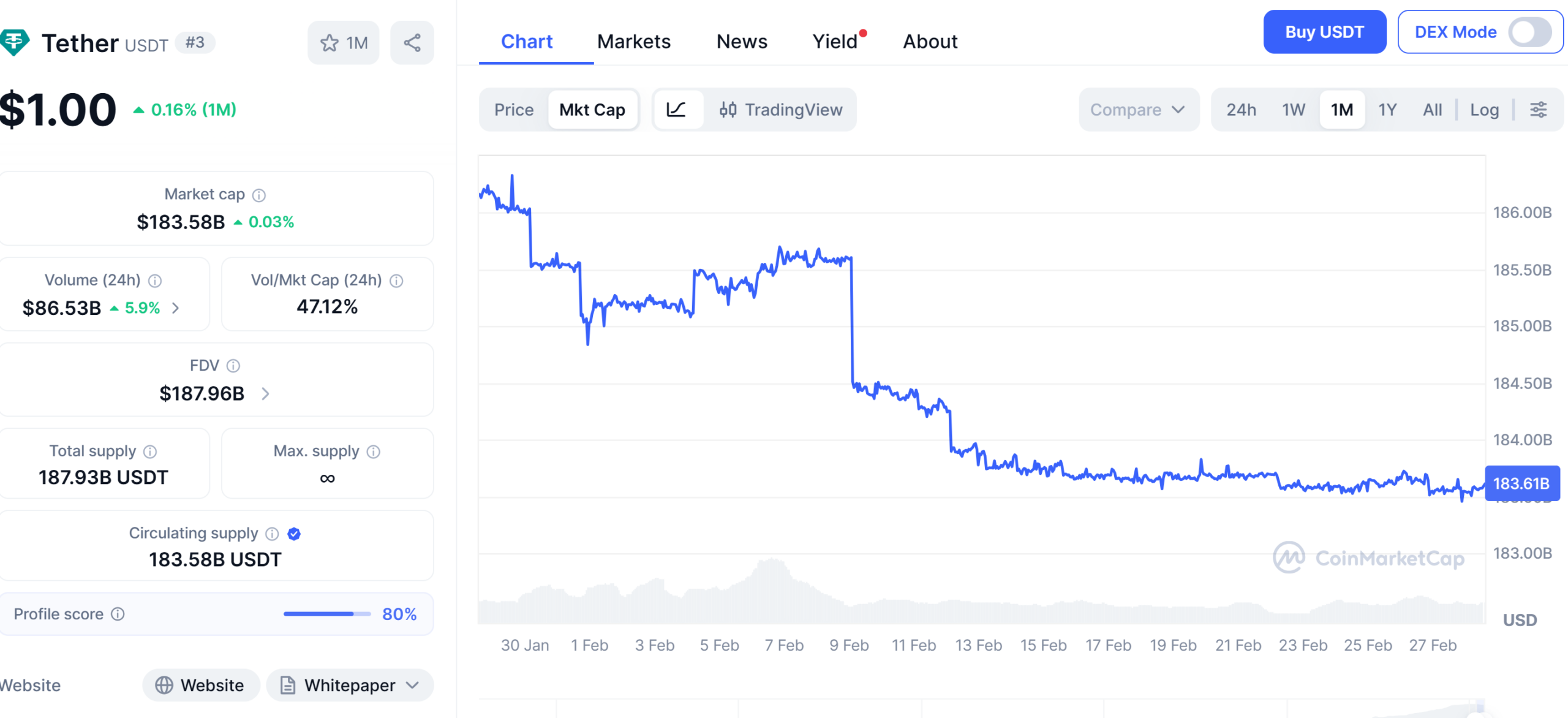
Tether, the issuer of the world’s most widely used stablecoin, has frozen approximately $4.2 billion worth of its USDt tokens over the past three years due to their alleged connections to illicit activities, including money laundering, fraud, and sanctions evasion. The company, which is based in El Salvador and operates as a critical pillar of the global cryptocurrency infrastructure, confirmed that the majority of these restrictions were implemented since the beginning of 2023. This surge in enforcement actions reflects a significant shift in the operational landscape for stablecoin issuers, who are increasingly functioning as de facto extensions of international law enforcement agencies.
The scale of these freezes highlights the growing intersection between decentralized finance and traditional regulatory oversight. Tether’s USDt, which is pegged one-to-one with the U.S. dollar, currently boasts a market capitalization exceeding $180 billion. This represents a staggering increase from the approximately $70 billion in circulation just three years ago. As the token’s dominance has grown, so too has the scrutiny from global regulators, prompting Tether to adopt more aggressive measures to monitor and halt the flow of suspicious funds across its network.
The Mechanics of On-Chain Enforcement
Unlike truly decentralized cryptocurrencies like Bitcoin, which operate without a central authority capable of reversing transactions, Tether functions as a centralized issuer. This structure allows the company to maintain a "blacklist" of wallet addresses. When an address is added to this list, any USDt tokens held within it are effectively rendered immobile and unusable. Tether can execute these freezes directly on the blockchain, often acting upon formal requests from the U.S. Department of Justice (DOJ), the Federal Bureau of Investigation (FBI), or international police organizations.
The ability to freeze assets on the secondary market—meaning tokens that have already left the issuer’s hands and are circulating on public blockchains like Ethereum or TRON—is a powerful tool for law enforcement. It allows authorities to "follow the money" in real-time and secure assets before they can be off-ramped into fiat currency or obfuscated through privacy-enhancing technologies. According to blockchain analytics firm Elliptic, by the end of 2025, stablecoin issuers including Tether and its primary competitor, Circle, had collectively blacklisted approximately 5,700 wallets. These wallets held roughly $2.5 billion at the time of freezing, with USDT being the asset involved in nearly 75% of those cases.
Recent Major Seizures and Global Cooperation
Tether’s recent activities underscore its deepening relationship with state actors. On Tuesday, the company announced its participation in a major operation with the U.S. Department of Justice, resulting in the seizure of nearly $61 million in USDt. These funds were linked to "pig-butchering" scams—a sophisticated form of long-term social engineering where criminals build romantic or professional relationships with victims over months before persuading them to "invest" in fraudulent cryptocurrency platforms. This specific seizure is part of a broader effort by U.S. authorities to dismantle the transnational organized crime syndicates, often based in Southeast Asia, that orchestrate these multi-billion-dollar schemes.
Beyond the United States, Tether has demonstrated a willingness to comply with local enforcement mandates in other strategic regions. Earlier this month, the company froze approximately $544 million in cryptocurrency at the request of Turkish authorities. These funds were allegedly tied to an expansive illegal online betting network and money-laundering operation. The scale of this single freeze indicates that Tether’s compliance department is processing requests that involve massive amounts of capital, often exceeding the total value of many smaller cryptocurrency projects.
A Chronology of Tether’s Compliance Evolution
The trajectory of Tether’s enforcement actions reveals a clear timeline of increasing cooperation with authorities. In the early years of its existence, Tether was often criticized for a perceived lack of transparency regarding its reserves and its "wild west" approach to user activity. However, the period between 2021 and 2024 marked a turning point.
In 2021, the company began standardizing its reporting and started working more closely with the U.S. Commodity Futures Trading Commission (CFTC) and the New York Attorney General’s office. By 2022, as the "pig-butchering" epidemic began to garner international headlines, Tether significantly expanded its internal compliance team, hiring former law enforcement officials to bridge the gap between the crypto industry and regulatory bodies.

The year 2023 saw a record number of wallet blacklistings. This was driven by the implementation of more sophisticated blockchain monitoring tools and a proactive stance toward OFAC (Office of Foreign Assets Control) sanctions. Tether’s decision to freeze wallets associated with sanctioned entities, even when not strictly required by its jurisdiction, signaled a desire to remain integrated with the global financial system. By 2024, the $4.2 billion figure stands as a testament to this aggressive compliance-first strategy.
Market Dynamics and the Contraction of USDt Supply
While Tether continues to act against illicit finance, the broader market for USDt is experiencing its own set of challenges. Recent blockchain data indicates that the circulating supply of USDt is on track for its largest monthly decline since the collapse of the FTX exchange in late 2022. In February, the supply fell by approximately $1.5 billion, following a $1.2 billion reduction in January.
This contraction has sparked discussions among market analysts regarding liquidity in the broader crypto ecosystem. Typically, a shrinking stablecoin supply suggests that investors are moving out of the market or that there is less demand for trading pairs. However, Tether has dismissed concerns that this indicates a fundamental weakening of demand. The company stated that these fluctuations reflect "short-term distribution changes" rather than a loss of confidence.
It is worth noting that Tether’s primary competitor, Circle’s USDC, also experienced a multibillion-dollar reduction during the same period. This suggests a macro trend in the digital asset space where capital is being reshuffled, perhaps in response to changing interest rate environments or the emergence of spot Bitcoin ETFs, which offer institutional investors a way to gain exposure to crypto without necessarily holding stablecoins.
Broader Implications for the Stablecoin Industry
The $4.2 billion in frozen funds represents a double-edged sword for the cryptocurrency industry. On one hand, it demonstrates that stablecoins are not a "safe haven" for criminals and that the transparency of the blockchain allows for more effective policing than the opaque world of traditional cash. This helps legitimize the industry in the eyes of institutional investors and cautious regulators.
On the other hand, the centralized power to freeze assets raises questions about the "censorship resistance" of digital assets. For many early adopters, the appeal of cryptocurrency was the ability to hold wealth outside the control of any single entity. Tether’s willingness to act as an enforcement arm for governments highlights the reality that major stablecoins are fundamentally different from decentralized assets like Bitcoin. They are hybrid instruments—digital representations of fiat currency that carry both the benefits of blockchain technology and the regulatory burdens of the traditional banking system.
Future Outlook: Regulation and Transparency
As Tether approaches a market cap of $200 billion, the pressure for even greater transparency will likely intensify. The company has made strides in providing quarterly attestations of its reserves, which are currently managed in large part by the Wall Street firm Cantor Fitzgerald. However, the sheer volume of assets being frozen—$4.2 billion—suggests that the volume of illicit activity attempting to move through the network remains substantial.
Looking ahead, the regulatory landscape is set to become even more structured. In the European Union, the Markets in Crypto-Assets (MiCA) regulation is beginning to take effect, placing strict requirements on stablecoin issuers regarding reserves, governance, and compliance. In the United States, several bills aimed at regulating stablecoins are moving through Congress, which could eventually mandate specific standards for how and when an issuer must freeze funds.
The data provided by Tether and third-party firms like Elliptic serves as a clear indicator that the era of anonymous, unregulated stablecoin usage is coming to an end. For Tether, the path forward involves a delicate balancing act: maintaining the liquidity and utility that has made USDt the dominant market leader, while satisfying the increasingly stringent demands of global law enforcement and regulatory agencies. The $4.2 billion in blocked funds is not just a statistic; it is a signal that the "on-chain" economy is being integrated into the global financial order, one frozen wallet at a time.