
 admin
admin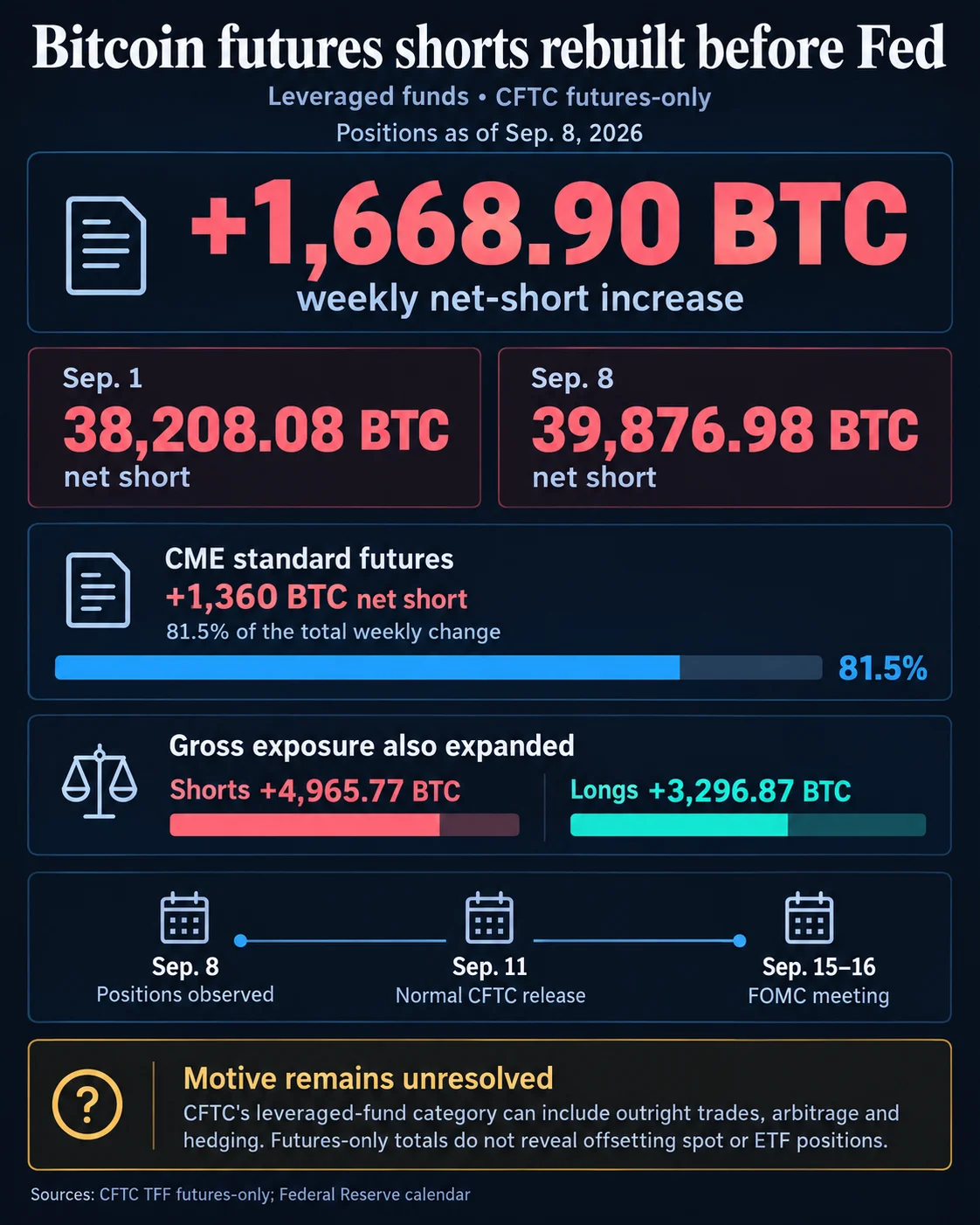
Leveraged funds, a classification encompassing sophisticated financial entities such as hedge funds and money managers, significantly increased their net short positions in regulated Bitcoin futures markets in the week concluding September 8th. This strategic maneuver saw a net addition of approximately 1,669 Bitcoin (BTC) to their bearish bets across four key futures contracts. This substantial shift in sentiment among these influential market participants occurred against a backdrop of ongoing regulatory oversight and the looming September 15th-16th Federal Open Market Committee (FOMC) meeting, a critical juncture for monetary policy and broader market sentiment.
The aggregate net short position held by leveraged funds expanded to 39,876 BTC, a notable increase from the 38,208 BTC recorded the previous week. This data, derived from the Commodity Futures Trading Commission’s (CFTC) futures-only reporting, provides a granular view of how these market players are positioning themselves in the nascent cryptocurrency derivatives landscape. The analysis encompasses Bitcoin futures contracts traded on the CME (Chicago Mercantile Exchange), including both its standard five-contract and micro-sized offerings, as well as nano and nano perpetual-style contracts available on Coinbase Derivatives. The calculation method standardizes these positions by applying each market’s stated Bitcoin multiplier, offering a unified metric for exposure. It is crucial to note that this aggregate figure solely reflects futures market activity, and therefore, it remains challenging to definitively distinguish between outright speculative bets and positions established as hedges against existing spot market holdings or other related financial instruments.
Delving deeper into the data, the CME’s standard five-BTC futures contract was the primary driver of this increased shorting activity. Leveraged funds not only added a considerable 888 short contracts but also simultaneously increased their long positions by 616 contracts within this specific market. This dual action resulted in a widening of the net short position by 272 contracts, translating to an additional 1,360 BTC in net bearish exposure. This single contract accounted for a substantial 81.5% of the total weekly change in net short positions observed across all four tracked markets, underscoring its significance in the overall market sentiment of leveraged players.
Beyond the net change, both outright long and short exposures within the CFTC’s reporting framework, excluding the separate category designated for spreading strategies, saw significant expansion on both sides of the market. Across the four contracts, total short exposure increased by approximately 4,965 BTC, while long exposure simultaneously grew by 3,296 BTC. This concurrent increase in both long and short positions suggests a more complex market dynamic at play than a simple directional bet. While the imbalance undeniably widened the net short position, the parallel growth in long positions indicates that some traders may be employing more sophisticated strategies, potentially involving arbitrage or hedging against other market positions.

Unpacking the Motivations: A Complex Picture
The interpretation of leveraged fund positioning in cryptocurrency markets, particularly Bitcoin futures, is often nuanced. The CFTC’s own explanatory notes accompanying its Commitment of Traders (COT) reports clarify that the "leveraged funds" category is a broad classification. It typically includes entities such as hedge funds, commodity trading advisors (CTAs), commodity pool operators (CPOs), and other professional money managers. These entities engage in a wide array of trading strategies, which can include outright speculative bets on price direction, as well as intricate arbitrage strategies executed both within and across different markets. The CFTC categorizes these traders based on their predominant trading activity, rather than the specific intent or purpose of each individual position they hold.
This distinction is particularly significant for Bitcoin. A short futures position, for instance, can serve a dual purpose. It might represent a bearish outlook on the future price of Bitcoin, or it could be a strategic hedge designed to offset potential losses on a long position held in the spot market or through a Bitcoin Exchange-Traded Fund (ETF). The CME itself has previously highlighted the emergence of "basis trading" strategies in the crypto market, where participants aim to profit from the spread between Bitcoin futures prices and spot prices. These strategies often involve establishing offsetting long and short positions to capture this difference, rather than making a directional bet on Bitcoin’s overall price trajectory. Because the public CFTC totals do not explicitly disclose the existence or nature of these offsetting legs, it becomes challenging to definitively ascertain whether the increased shorting activity represents a genuine unhedged wager on a future price decline, a component of a basis trade, or a combination of both.
Pre-FOMC Positioning and Market Data
At the time of this reporting, specifically on September 12th, Bitcoin’s market price hovered around the $77,300 mark, according to CryptoSlate’s comprehensive Bitcoin market data. The increased short exposure reported by the CFTC was thus established in the immediate lead-up to the crucial FOMC meeting scheduled for September 15th-16th. This meeting is a pivotal event, as it typically involves discussions and decisions regarding the Federal Reserve’s monetary policy, including interest rate adjustments, which can have profound ripple effects across all financial markets, including cryptocurrencies.
The typical reporting schedule for CFTC COT reports adds a layer of temporal context. These reports are generally released on Fridays at 3:30 p.m. Eastern Time, detailing positions held as of the preceding Tuesday. This schedule creates a gap of approximately four days between the publication of the data and the commencement of the FOMC meeting. While the explicit decision of the Fed was still forthcoming, market participants are often forward-looking, and expectations surrounding the meeting’s outcomes can significantly influence trading behavior and risk appetite in the preceding days. The 1,669 BTC increase in leveraged fund shorts clearly indicates that these sophisticated traders were adjusting their futures exposure in anticipation of potential market movements stemming from the Fed’s deliberations.
Broader Implications and Future Outlook
The build-up of short positions by leveraged funds ahead of a major economic event like an FOMC meeting is not uncommon. However, the specific context of Bitcoin, with its inherent volatility and increasing integration into mainstream financial products like ETFs, adds a layer of complexity. The data from the CFTC, while informative, falls short of providing definitive proof of a bearish conviction regarding Bitcoin’s future price without considering the potential hedging strategies employed by these funds.

The implications of this increased shorting activity are multifaceted. If these positions are indeed unhedged speculative bets, they could signal a belief among a segment of sophisticated investors that Bitcoin is poised for a price correction in the near term, possibly influenced by the Fed’s policy decisions. Conversely, if these shorts are part of broader hedging strategies, they might serve to protect existing long positions from potential downside risk, rather than indicating a directional bearish outlook. This is particularly relevant in the context of basis trading, where traders aim to profit from the premium of futures contracts over spot prices, a strategy that can involve shorting futures to hedge a long spot position.
The ongoing scrutiny from regulatory bodies like the CFTC and the Securities and Exchange Commission (SEC) in the United States also plays a crucial role. Regulatory uncertainty has historically been a significant factor influencing institutional adoption and market sentiment in the cryptocurrency space. Any pronouncements or actions from these agencies, especially in relation to Bitcoin ETFs or other digital asset regulations, can trigger substantial price movements and influence the positioning of leveraged funds.
As the market digests the latest CFTC data and looks ahead to the Federal Reserve’s policy decisions, several key questions remain. Will the FOMC meeting lead to significant shifts in monetary policy that impact risk assets like Bitcoin? Will the leveraged funds maintain or further expand their short positions, or will they reverse course based on new information? And critically, to what extent do these futures positions reflect genuine bearish sentiment versus sophisticated hedging strategies? The dynamic interplay between regulatory developments, macroeconomic factors, and the evolving strategies of sophisticated market participants will continue to shape the trajectory of Bitcoin and the broader cryptocurrency market in the coming weeks and months. The current data suggests a cautious, and perhaps strategically hedged, stance from a significant cohort of leveraged traders, but the ultimate direction will likely be determined by a confluence of events yet to unfold.








