
 admin
admin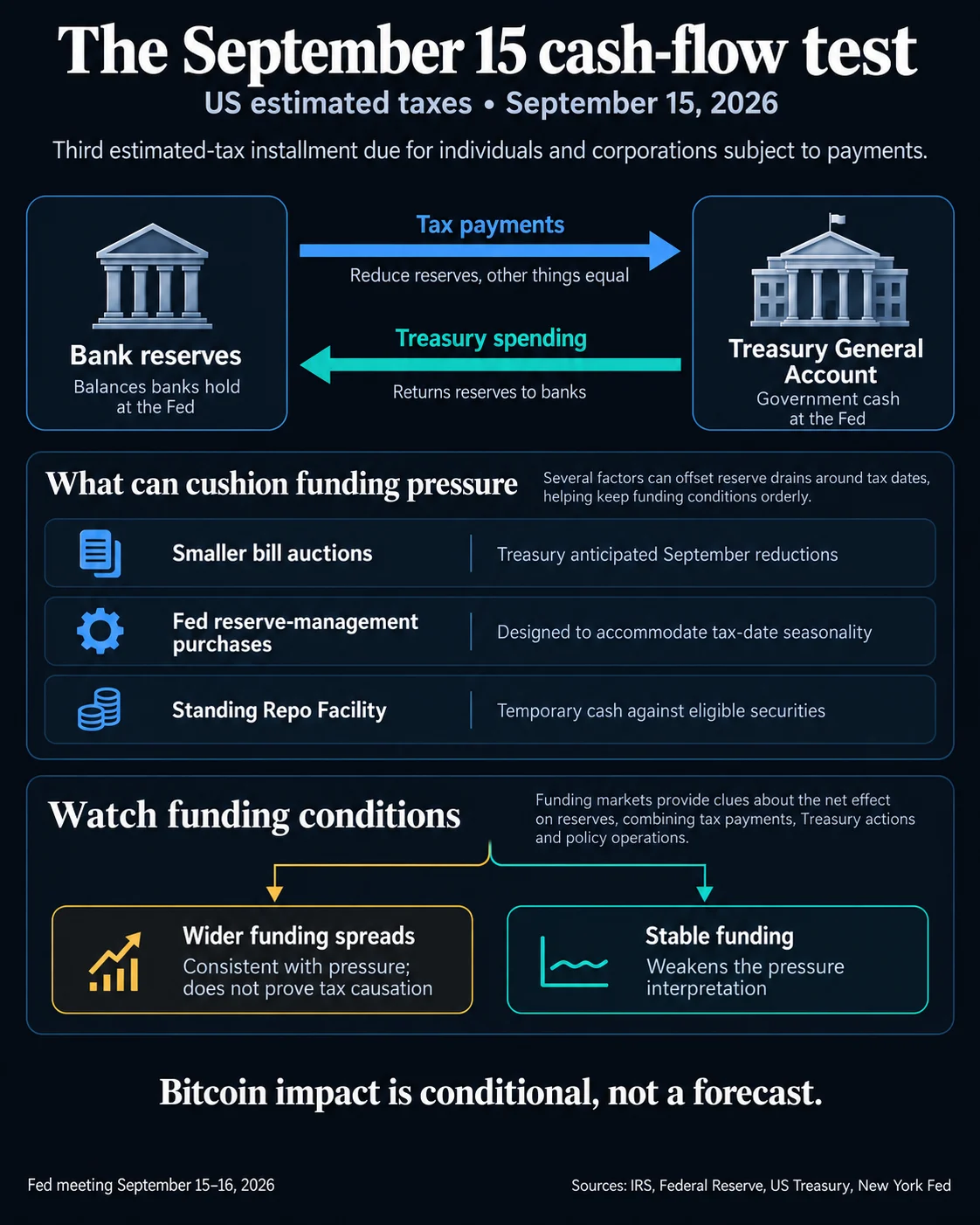
Tuesday’s U.S. estimated-tax deadline will shift cash toward the Treasury, testing whether last week’s improvement in bank reserves can hold through the Federal Reserve’s meeting. Bitcoin liquidity could come under pressure if the transfer tightens dollar funding and limits risk-taking before policymakers conclude their September 15–16 meeting. The Internal Revenue Service (IRS) calendar designates September 15, 2026, as the third installment deadline for individuals and corporations subject to estimated-tax payments. This crucial date coincides with the opening day of the Federal Reserve’s policy meeting, strategically placing a scheduled outflow of funds alongside the anticipation of monetary policy decisions due the following day.
Understanding Bank Reserves and Treasury Cash Flows
Bank reserves, defined as the balances commercial banks maintain at the Federal Reserve, are foundational to the smooth functioning of payment systems and financial markets. They serve as a buffer, ensuring liquidity and facilitating transactions rather than directly representing the readily available cash held by traders. The starting point for assessing this liquidity situation is more robust than it was a week prior. According to the Federal Reserve’s balance sheet release on September 10, 2026, weekly-average bank reserves saw an increase of $96.779 billion, reaching approximately $2.991 trillion for the week ending September 9. Concurrently, the Treasury General Account (TGA), the U.S. government’s primary operating account at the Fed, experienced a weekly-average decrease of $84.6 billion, settling at $883.3 billion. It is important to note that these figures represent weekly averages, and the specific levels on Wednesday, September 16, could diverge. As of the close of business on September 9, reserves stood at approximately $3.037 trillion, while the Treasury’s cash balance was around $843.705 billion.
The Mechanism of Tax Payments and Their Impact on Liquidity
The accounting mechanism by which tax payments affect financial markets is relatively straightforward. When individuals and corporations remit their estimated tax payments, these funds are transferred from the reserve accounts of commercial banks to the Treasury’s account at the Federal Reserve. Subsequently, when the Treasury disbues funds through government spending, these monies are returned to the accounts of recipient banks. Therefore, all other factors being equal, an influx of tax receipts into the Treasury inherently reduces the total amount of reserves held by commercial banks, while government disbursements serve to replenish them.
This dynamic can have a significant impact on short-term financing markets, including the repurchase agreement (repo) market, where entities borrow cash against securities. Historical precedent offers a cautionary tale. An account from the New York Fed detailing events in September 2019 describes a scenario where a confluence of factors, including a temporary decline in bank reserves, Treasury settlements, and a corporate tax date, contributed to a sharp spike in repo rates. While this historical instance illustrates the potential for such a mechanism to tighten funding conditions, it does not definitively predict a repeat performance on the upcoming Tuesday.
Cushioning Factors and Federal Reserve Tools
Fortunately, several economic forces are in place to mitigate the potential liquidity strain caused by the mid-September tax payments. In its August 5 refunding statement, the Treasury Department had anticipated a reduction in the sizes of shorter-dated Treasury bill auctions. This adjustment was specifically planned to account for the anticipated inflow of mid-month tax receipts, thereby absorbing some of the cash from the market. A smaller volume of Treasury bill issuance could, in theory, partially offset the cash absorption resulting from tax payments, assuming other factors, such as government spending, remain constant. The actual magnitude of this offset will depend on the precise levels of Treasury borrowing and government expenditure in the coming days.
The Federal Reserve also actively manages its balance sheet to accommodate seasonal fluctuations in reserve demand. The central bank’s May 2026 balance sheet report explicitly states that reserve management purchases are designed to accommodate such fluctuations, including those associated with tax payment dates, and to adjust to the evolving reserve outlook. Furthermore, the New York Fed has established the Standing Repo Facility (SRF) as a crucial backstop. This facility provides eligible institutions with temporary liquidity against collateral, acting as a safeguard to limit upward pressure on short-term funding rates. The SRF’s availability is intended to ensure that even during periods of potential stress, the market has access to necessary funding.
The Bitcoin Connection: Risk Appetite and Funding Conditions
For investors in Bitcoin and the broader cryptocurrency market, the potential ripple effects of these financial maneuvers are primarily transmitted through changes in financing conditions and the prevailing risk appetite. Research from the Bank for International Settlements (BIS) has indicated a correlation between U.S. monetary tightening and a decline in the market capitalization of stablecoins. This finding suggests a broader sensitivity of digital asset markets to shifts in monetary policy. However, it does not establish a direct, measured Bitcoin response solely attributable to this specific tax deadline.
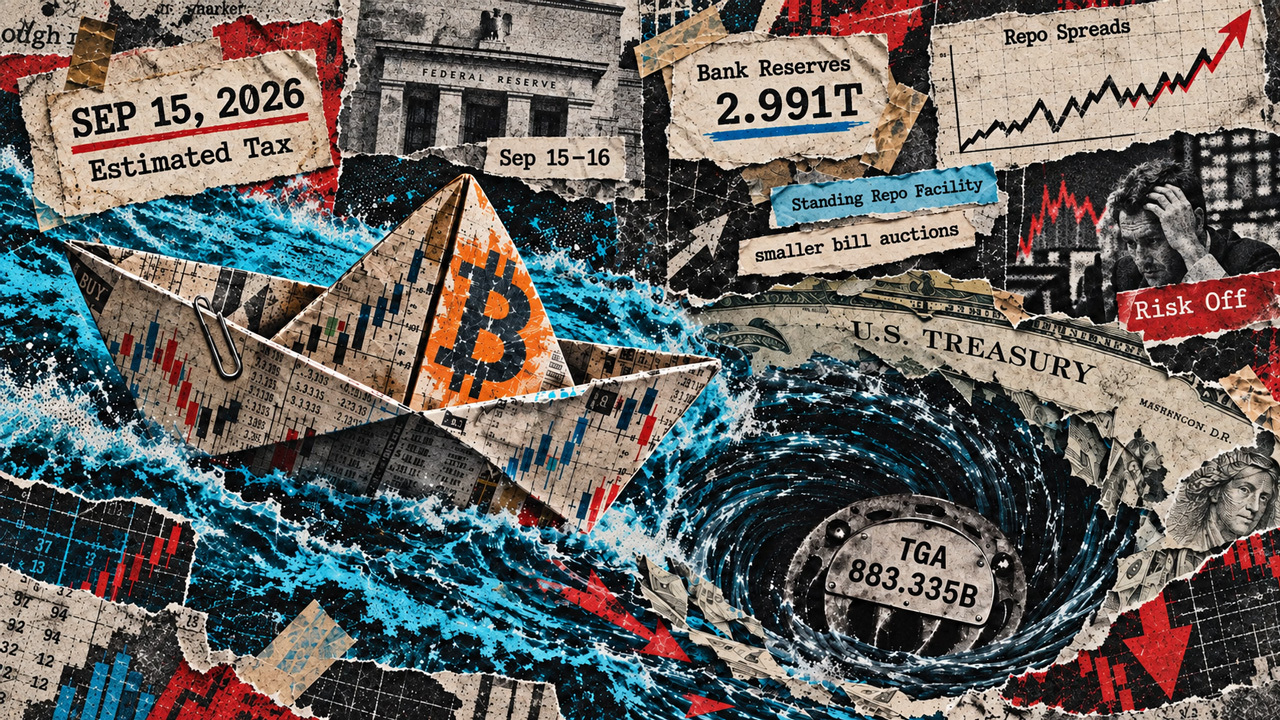
The most pertinent indicator for Bitcoin investors to monitor will be any widening of short-term funding spreads relative to the Federal Reserve’s administered rates as tax payments are settled. An observed increase in these spreads would be consistent with tightening funding conditions, although it would not, in isolation, prove that the tax payments were the sole causative factor. Conversely, stable funding conditions would weaken the interpretation that the tax deadline is creating significant market pressure. Ultimately, Tuesday’s calendar presents a clear test of market resilience, with the interplay of government spending, Treasury bill supply, and the Federal Reserve’s liquidity management tools poised to determine the outcome.
A Deeper Dive into Historical Context and Market Dynamics
The convergence of a major tax deadline and a Federal Reserve policy meeting is not an unprecedented event, but its specific implications can vary significantly based on the prevailing economic climate. The year 2019, as alluded to, serves as a potent example of how these seemingly disparate financial events can intertwine to create market stress. In that instance, a confluence of factors, including a substantial Treasury settlement operation, the aforementioned corporate tax payments, and a reduction in the Fed’s balance sheet, led to significant volatility in the repo market. Overnight borrowing rates, which typically trade within a narrow band, surged to unexpected highs, highlighting the delicate balance of liquidity in the financial system.
The current environment, while sharing some superficial similarities, is also characterized by distinct features. The Federal Reserve’s balance sheet operations have evolved, and its toolkit for managing liquidity has been refined. The introduction and utilization of facilities like the Standing Repo Facility are designed precisely to prevent a recurrence of the extreme rate spikes seen in 2019. Furthermore, the Treasury’s own cash management strategies have become more sophisticated, with improved forecasting and auction management aimed at smoothing out the impact of large cash flows.
The Role of Quantitative Tightening and Reserve Levels
It is crucial to contextualize the current reserve levels within the broader framework of monetary policy. For years, central banks, including the Federal Reserve, engaged in quantitative easing (QE), which injected vast amounts of liquidity into the financial system and significantly expanded bank reserves. More recently, the Fed has been engaged in quantitative tightening (QT), a process of gradually reducing the size of its balance sheet. This QT process, while designed to be gradual and predictable, inherently drains liquidity from the financial system.
The September tax deadline occurs against this backdrop of ongoing QT. The withdrawal of funds into the Treasury’s coffers during this period can, therefore, be seen as an additional layer of liquidity reduction. The question remains whether the existing level of bank reserves is sufficiently ample to absorb this combined pressure without significant market dislocations. The Federal Reserve has consistently stated its intention to maintain ample reserves, but the precise definition of "ample" can be a subject of ongoing debate among economists. If reserves were to fall below a critical threshold, even moderate outflows could trigger a more pronounced tightening of funding conditions.
Implications for Bitcoin and Digital Assets
The relationship between traditional financial market liquidity and the cryptocurrency market is increasingly intertwined. As institutional investors allocate more capital to digital assets, and as stablecoins become more integrated into the broader financial ecosystem, events in traditional finance can have more direct and immediate spillover effects.
For Bitcoin, a tightening of dollar funding conditions in the broader market can lead to a reduced appetite for riskier assets. When borrowing becomes more expensive or difficult, investors may be less inclined to allocate capital to assets perceived as volatile, such as cryptocurrencies. This can manifest as decreased trading volumes, lower asset prices, and a general cooling of speculative interest.

Moreover, the stability of stablecoins, which are often pegged to the U.S. dollar and play a crucial role in facilitating crypto trading, can be indirectly affected by broader dollar liquidity conditions. If dollar funding becomes scarce, it can put pressure on the reserves backing stablecoins, potentially leading to de-pegging events, although this is a more extreme scenario. The BIS research suggesting a link between monetary tightening and stablecoin market capitalization declines underscores this interconnectedness.
Forward-Looking Analysis and Potential Scenarios
As Tuesday’s tax deadline approaches, market participants will be closely observing several key indicators. The behavior of the repo market, particularly the spread between secured and unsecured borrowing rates, will be a primary focus. Any significant upward movement in these spreads would signal increasing stress. Additionally, the Federal Reserve’s communication following its September 15–16 meeting will be critical. Any hints of a more hawkish stance or concerns about inflation could further influence risk appetite and liquidity conditions.
Scenario 1: Smooth Absorption: If Treasury spending remains robust, the reduction in bill issuance proves substantial, and the Fed’s liquidity tools function as intended, the tax payment outflow might be largely absorbed without significant market disruption. In this scenario, bank reserves would likely remain at ample levels, and funding markets would continue to function smoothly. Bitcoin and other cryptocurrencies might experience minimal impact, with price action driven by other fundamental factors.
Scenario 2: Moderate Pressure: A less optimal scenario could involve a slightly tighter liquidity environment. This might manifest as a modest widening of repo spreads and a more cautious approach from risk-asset investors. Bitcoin could see some downward pressure as investors de-risk, but significant sell-offs would likely be avoided if the Federal Reserve signals its readiness to intervene with liquidity provisions.
Scenario 3: Significant Strain: In a more extreme, though less probable, scenario, a combination of unexpected Treasury outflows, limited government spending, and a less accommodative Fed stance could lead to more pronounced liquidity pressures. This could trigger a more significant decline in risk asset prices, including Bitcoin, as funding markets experience notable stress.
The confluence of the tax deadline and the Fed meeting creates a complex interplay of forces that will test the current liquidity landscape. While historical precedents offer cautionary insights, the proactive measures implemented by both the Treasury and the Federal Reserve are designed to mitigate potential disruptions. The coming days will provide valuable data points on the resilience of the financial system and its downstream effects on digital assets like Bitcoin.








