
 James Watt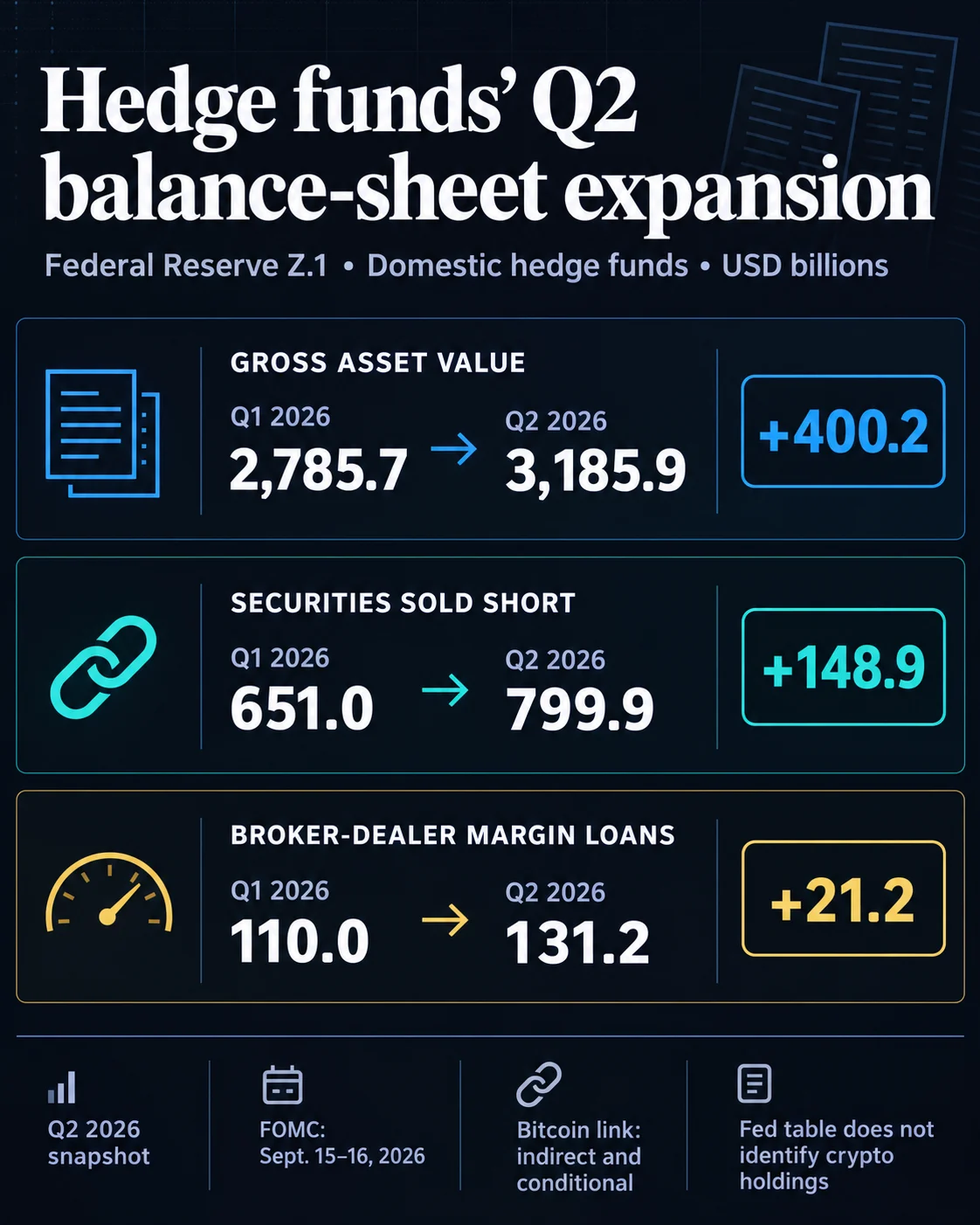
The Federal Reserve data indicates that the gross asset value of domestic hedge funds rose from $2.7857 trillion in the first quarter of 2026 to $3.1859 trillion by the end of the second quarter. This $400 billion jump represents a significant scaling of positions, though the report clarifies that this figure refers to total assets rather than gross notional exposure, which would include the full value of derivative contracts and could be substantially higher. Simultaneously, securities sold short—a key indicator of leveraged strategies such as the "basis trade"—surged from $651 billion to $799 billion, a $148 billion increase. Furthermore, margin loans due to U.S. security brokers and dealers climbed by $21 billion, reaching a total of $131 billion. These metrics collectively paint a picture of a hedge fund sector that is leaning heavily into leveraged positions exactly as the Federal Reserve prepares to issue its latest interest rate decision and Summary of Economic Projections.
The Mechanics of Hedge Fund Leverage and Market Stability
To understand why a $400 billion expansion in hedge fund balance sheets poses a risk to Bitcoin, one must look at the "plumbing" of the global financial system. Hedge funds often employ leverage to amplify returns on relatively low-yield trades, such as the gap between Treasury cash prices and Treasury futures. This "basis trade" requires massive amounts of short-term borrowing, typically through the repurchase agreement (repo) market. In a repo transaction, a fund borrows cash by providing securities—usually U.S. Treasuries—as collateral, with the agreement to buy them back at a slightly higher price the next day.
When the Federal Reserve changes interest rates or signals a shift in the future path of policy, it directly affects the cost of this borrowing. If the FOMC delivers a "hawkish surprise"—either by keeping rates higher than expected or by signaling fewer cuts in the future—the cost of funding these leveraged positions can spike. If the Secured Overnight Financing Rate (SOFR), which measures the cost of borrowing cash overnight collateralized by Treasury securities, moves higher, hedge funds may find their trades becoming unprofitable or their collateral insufficient.
The risk to Bitcoin is indirect but potent. In a scenario where funding costs rise sharply or collateral values fluctuate due to interest rate volatility, hedge funds may face margin calls. To meet these calls, they must quickly raise cash. Bitcoin, being one of the most liquid and 24/7 tradable assets in the world, is often among the first items sold during a "dash for cash." This phenomenon was observed during the liquidity crunch of March 2020, where nearly all asset classes, including gold and Bitcoin, were sold off simultaneously as investors scrambled to cover losses and margin requirements in the Treasury and equity markets.
A Chronology of Increasing Financial Vulnerability
The current expansion of hedge fund balance sheets is not an isolated event but the latest chapter in a multi-year trend of increasing leverage. According to the Federal Reserve’s May 2026 Financial Stability Report, comprehensive Form PF data through the latter half of 2025 indicated that hedge fund leverage was hovering at or near all-time highs. A separate study by Fed economists estimated that large qualifying hedge funds held approximately $4 trillion in gross Treasury exposure and relied on $3 trillion in repo cash borrowing as of September 2025.
As the market moved into 2026, the anticipation of a "pivot" or a significant easing cycle by the Federal Reserve encouraged funds to maintain and even expand these leveraged postures. The Q2 Z.1 data suggests that rather than de-risking ahead of the September FOMC meeting, funds doubled down. The timeline leading up to this point shows a steady buildup:
- Late 2025: Fed reports highlight record leverage levels and massive Treasury basis trade positions.
- Q1 2026: Hedge fund gross asset value sits at $2.78 trillion; the market begins pricing in aggressive rate cuts for the second half of the year.
- Q2 2026: Gross assets jump to $3.18 trillion. Short positions and margin loans see double-digit percentage increases.
- September 2026: Markets enter the "test" period. As of September 10, SOFR stood at 3.62%, indicating relatively stable but non-negligible funding costs.
The upcoming FOMC meeting on September 15–16 is particularly significant because it includes the Summary of Economic Projections (SEP). This "Dot Plot" provides the market with the Fed’s internal expectations for interest rates over the next several years. Any discrepancy between the Fed’s projections and the market’s expectations could lead to a violent repricing of the Treasury curve, putting immediate pressure on the $3.18 trillion in hedge fund assets.
Bitcoin as the "Liquidity Chimney"
The relationship between Bitcoin and traditional finance (TradFi) has shifted from one of total independence to one of high sensitivity to macro-liquidity. As institutional adoption has grown—facilitated by the launch of spot Bitcoin ETFs and the entry of major Wall Street players—Bitcoin has increasingly behaved like a "high-beta" play on global liquidity.
When hedge funds are forced to de-lever, the impact spreads through a process known as cross-asset contagion. Because Bitcoin is a "pure" liquidity play—unburdened by earnings reports or physical supply chain constraints—it serves as a real-time barometer for the availability of cash in the system. If the Fed’s September decision leads to a tightening of secured funding markets, the "spillover" into Bitcoin would likely manifest as a sharp, high-volume sell-off, regardless of the cryptocurrency’s fundamental narrative as "digital gold."
Industry analysts point out that the $400 billion expansion in hedge fund books acts as a potential amplifier for volatility. If the market is "positioned for a soft landing" and the Fed instead signals a "higher-for-longer" stance, the unwinding of the $799 billion in short positions could cause a spike in Treasury yields. This, in turn, would strengthen the U.S. Dollar and put downward pressure on Bitcoin, which is priced in dollars and inversely correlated with real yields.
Indicators to Watch: SOFR, Basis Spreads, and Margin Demands
To gauge the likelihood of a Bitcoin spillover, market participants are closely monitoring several technical indicators. The first is the Secured Overnight Financing Rate (SOFR). While the September 10 reading of 3.62% was within normal parameters, any spike above the Fed’s target range would indicate that dealers are struggling to provide enough cash to satisfy hedge fund demand.

The second indicator is the Treasury cash-futures basis spread. If the gap between these two related instruments widens or narrows too rapidly, it suggests that the basis trade is being forced into a "disorderly unwind." Historically, such unwinds have required Federal Reserve intervention to prevent a total freeze-up of the Treasury market.
Thirdly, margin requirements set by central clearinghouses (CCPs) for futures contracts are a critical "tripwire." If volatility increases, CCPs often raise the amount of cash (initial margin) that traders must post to maintain their positions. A sudden hike in margin requirements can force even well-capitalized funds to liquidate other assets—like Bitcoin—to remain solvent.
Analysis of Implications for the Broader Market
The $400 billion expansion in hedge fund gross assets suggests that the "smart money" is heavily positioned for a specific outcome from the September FOMC meeting. However, the history of financial markets is replete with examples of "crowded trades" leading to systemic shocks. The fact that margin loans rose by $21 billion in a single quarter indicates that funds are not just using their own capital, but are increasingly reliant on broker-dealer credit to maintain their market footprint.
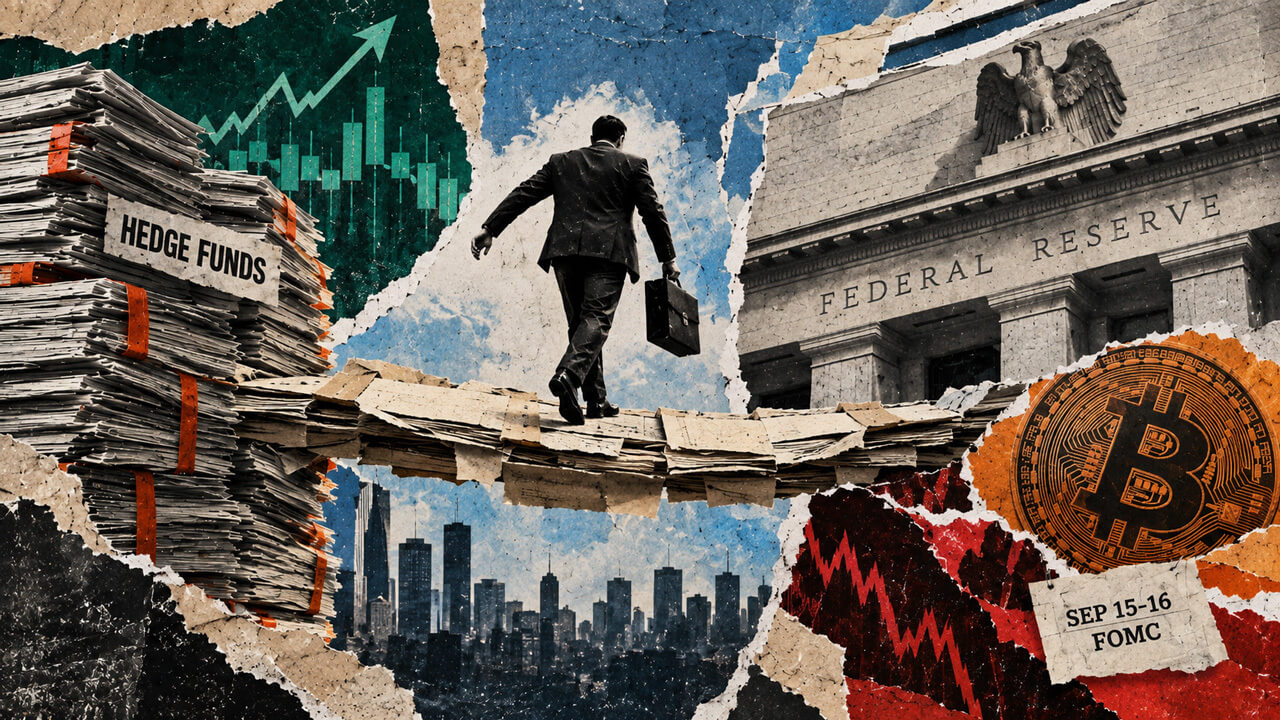
For Bitcoin investors, the Fed data serves as a warning that the cryptocurrency’s price action in mid-September may have very little to do with the blockchain’s internal metrics and everything to do with the solvency and liquidity of domestic hedge funds. If the Fed window brings stable funding and no visible selling across risk assets, the "amplification capacity" shown in the Q2 data will remain just that—potential energy that was never released. However, if the "money bridge" depicted in market metaphors begins to fracture, the $1.58 trillion Bitcoin market cap could face its sternest test of the year.
The Federal Reserve’s dual mandate of price stability and maximum employment does not explicitly include protecting the valuations of crypto-assets. However, the Fed is acutely aware of financial stability risks. If the deleveraging of hedge funds threatens the functioning of the Treasury market, the Fed may be forced to provide liquidity, which, ironically, could eventually be bullish for Bitcoin. But the path to that eventual liquidity injection often involves a painful "liquidity hole" where prices of all risk assets crater first.
As the September 15–16 FOMC meeting approaches, the financial world is watching more than just the interest rate percentage. It is watching the $3.18 trillion hedge fund balance sheet and the $400 billion of "new money" that has entered the fray, waiting to see if it will act as a stabilizer or a catalyst for a broader market correction. For now, the data confirms that the stakes for Bitcoin’s September rate test have been raised by nearly half a trillion dollars.









