
 James Watt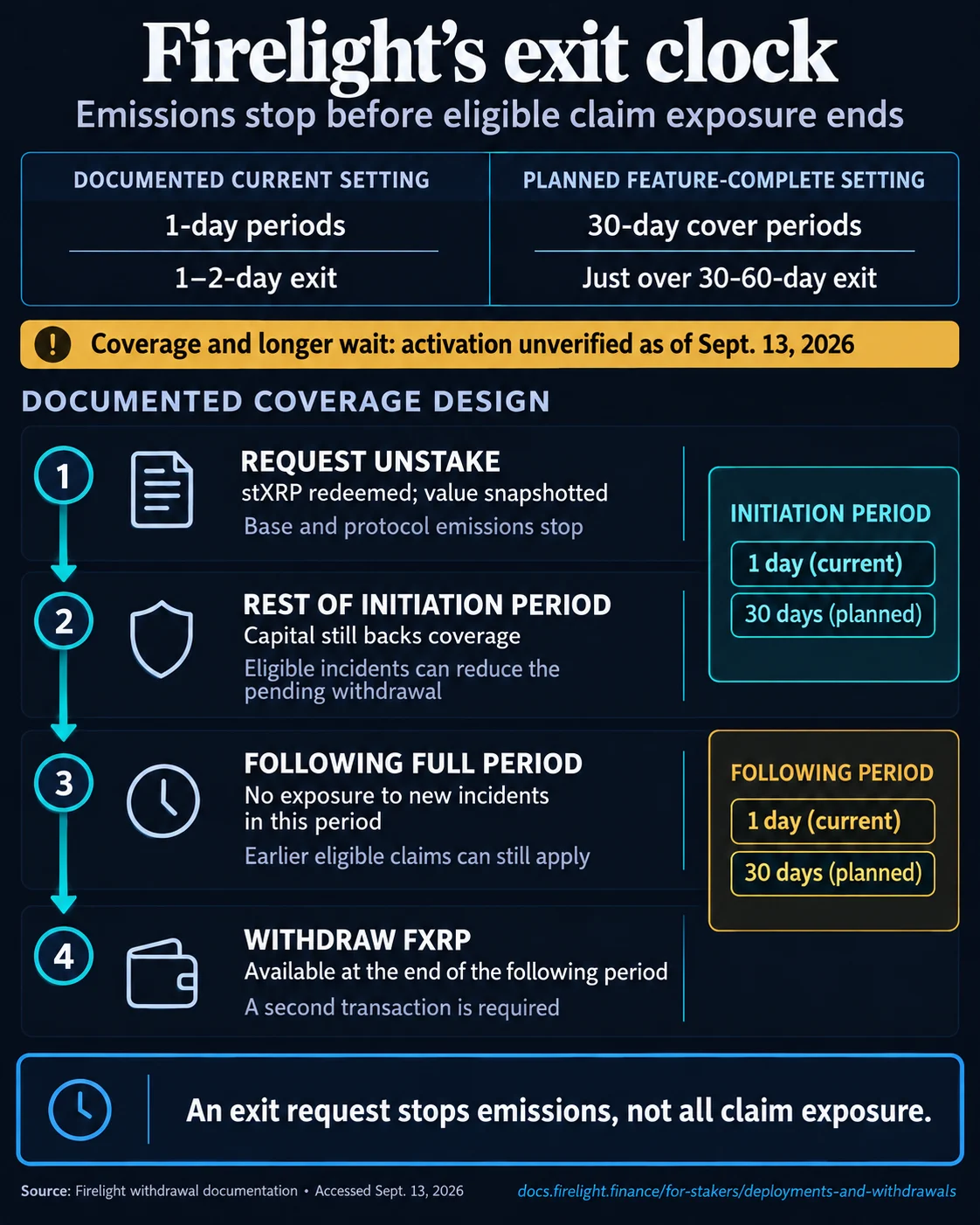
The Firelight protocol is fundamentally altering the utility of XRP-linked assets on the Flare Network by transitioning from a passive storage model to an active capital deployment system. By turning idle collateral into a backstop for decentralized finance (DeFi) protection, the protocol offers holders a novel source of yield in exchange for assuming the risks associated with insurance underwriting. This shift represents a significant evolution for the Flare ecosystem, which has long sought to integrate non-smart-contract assets like XRP into the broader DeFi landscape.
As of a September 13, 2026, snapshot, Firelight has already attracted approximately $71.74 million in Total Value Locked (TVL), according to data from DefiLlama. This figure represents FXRP—a bridged version of XRP—held within the protocol’s vaults. However, the protocol is now moving into a more complex phase where this capital will no longer simply sit in a vault but will instead serve as the financial foundation for coverage sold to other DeFi protocols. While this move promises higher yields through premium payments, it introduces significant trade-offs regarding liquidity and capital preservation.
The Architecture of Firelight: FXRP and stXRP
To understand the Firelight model, one must first look at the underlying infrastructure provided by the Flare Network. Flare’s FAssets system allows for the creation of trustless representations of assets that do not natively support smart contracts. FXRP is the representation of XRP on the Flare blockchain, enabling it to interact with decentralized applications (dApps).
Firelight operates as a specialized layer on top of this infrastructure. When a user deposits FXRP into the Firelight vault, they receive stXRP. This token represents the holder’s proportional share of the vault’s total assets. In the protocol’s initial phase, these assets were largely static. However, the transition to "Phase 2" converts these positions into active capital.
The economic engine of Phase 2 is the sale of protection to DeFi protocols. These "customers" pay premiums to Firelight to secure their own operations against smart contract failures or other technical risks. These premiums, often paid in stablecoins, are then converted back into FXRP and added to the vault’s total value. Consequently, the value of stXRP increases relative to FXRP, creating a yield for the stakers. This mechanism effectively turns XRP holders into decentralized insurers.
The Liquidity Trade-off: Analyzing the Withdrawal Window
The most immediate impact of Firelight’s transition to active coverage is the significant extension of withdrawal timelines. In the protocol’s early, low-risk stages, withdrawal periods were set at one day, resulting in an actual wait time of approximately one to two days for users to reclaim their FXRP.
Under the new 30-day coverage period framework, the liquidity profile changes drastically. Firelight’s documented process requires a holder to initiate an "unstaking" request during one period and then wait until the conclusion of the following full period before the assets become available. This means:
- If a holder requests a withdrawal near the end of a 30-day period, they must wait through the next 30-day period, totaling roughly 31 to 35 days.
- If a holder requests a withdrawal near the beginning of a 30-day period, they may be forced to wait nearly 60 days before their collateral is released.
Furthermore, the financial incentive structure changes the moment a withdrawal is requested. Once a user initiates the unstaking process, their rewards stop accumulating immediately. The pending withdrawal earns no further premiums or incentives while it sits in the queue. Despite this lack of earnings, the capital remains at risk. If a claimable event occurs during the period in which the holder asked to leave, their collateral is still liable for a proportional share of the loss. This creates a "risk-on, yield-off" window that depositors must carefully navigate.
Risk Management: The First-Loss Buffer and Capital Adequacy
To protect stakers from immediate losses, Firelight incorporates a multi-tiered risk waterfall. The protocol does not immediately slash depositor collateral when a claim is filed. Instead, it utilizes a "First-Loss Buffer," which is a protocol-owned reserve typically denominated in stablecoins.
The loss waterfall functions as follows:
- First-Loss Buffer: Validated claims are first paid out from this dedicated reserve.
- Staked Collateral: Only after the First-Loss Buffer is exhausted does the loss reach the FXRP vault. At this point, the loss is distributed proportionally across all stXRP holders.
While this structure provides a cushion, the actual efficacy of the protection depends entirely on the size of the buffer relative to the total coverage sold. Firelight utilizes a capital-adequacy framework to manage this balance. The protocol targets a capital-to-obligation ratio of 1.75 to 2.0. If the value of the available assets (including the buffer and the staked FXRP) falls below a 1.2 ratio relative to its coverage commitments, the protocol is designed to stop issuing new coverage.
This framework highlights a secondary risk for holders: market volatility. Because the "capital" backing the coverage is largely comprised of FXRP, a sharp decline in the market price of XRP could cause the capital-adequacy ratio to plummet even if no insurance claims are filed. In such a scenario, a holder might find their assets locked in a 60-day withdrawal queue while the value of their collateral is declining, unable to liquidate their position to mitigate market losses.
Chronology of Development and Funding
The path to Firelight’s current state has been marked by several key milestones in the Flare and XRP ecosystems.
- September 1, 2025: Firelight announced an $8 million funding round aimed at building the "cover infrastructure" for the DeFi sector. This funding was intended to transition the protocol from a simple staking vault to a functional insurance provider.
- September 24, 2025: Flare Network announced the mainnet launch of FXRP v1.2. This update was critical for Firelight as it improved the stability and trustlessness of the XRP-linked assets that serve as the protocol’s primary collateral.
- July 23, 2026: Firelight released its "Phase 2" explanation, detailing how existing vault positions would be automatically migrated into active coverage-backing positions. This "auto-migration" feature meant that passive holders would suddenly become active risk-takers unless they opted out before the transition.
- September 13, 2026: Snapshot data confirmed a TVL of $71.74 million, indicating strong interest from the XRP community in finding yield-bearing opportunities for their assets.
Despite these milestones, the protocol’s documentation as of mid-September 2026 still referred to one-day withdrawal periods as "current," suggesting that the full transition to 30-day coverage cycles and the associated premium-generation business was in the final stages of activation rather than fully operational.
Economic Implications for the XRP Ledger and Flare
The Firelight model is often discussed in the context of "XRP demand," but the reality is more nuanced. While the protocol creates a productive use for XRP-linked assets, it does not necessarily create a direct, 1-to-1 demand for native XRP on the XRP Ledger (XRPL).
FXRP exists as a representation of XRP. While an increase in the popularity of Firelight could lead to more XRP being bridged to Flare to create FXRP, the "yield" generated by the protocol is often internal to the Flare ecosystem. When customers pay premiums, those funds are used to purchase FXRP on the secondary market to distribute to stakers. This creates "buy pressure" for FXRP, but since FXRP can be traded among users without minting new tokens from native XRP, the impact on the original XRPL asset is indirect.
Market analysts also warn against "double counting" the capital. Between native XRP, FXRP, and stXRP, there are three different tokens representing the same underlying value. For the purposes of measuring economic health, only the original XRP locked in the bridging smart contracts represents a net removal of supply from the open market.
The Sustainability Test: Premiums vs. Incentives
The long-term success of Firelight hinges on its ability to transition from a protocol fueled by "points" and incentives to one fueled by genuine commercial demand. Firelight currently utilizes a points system to track participation, but these points are distinct from the income generated by coverage premiums.
For the model to be sustainable, the premiums paid by DeFi protocols must be high enough to:
- Compensate stakers for the 30-to-60-day liquidity lock-up.
- Offset the occasional losses from validated claims.
- Provide a competitive return compared to other DeFi yield strategies.
If the yield is primarily driven by protocol incentives (emissions of a native Firelight token or points), the TVL may prove mercenary, leaving the protocol as soon as the incentives dry up. Conversely, if Firelight can establish itself as a primary provider of safety for the Flare DeFi ecosystem, it could create a permanent, income-producing sink for XRP-linked capital.
Conclusion: A New Frontier for Decentralized Insurance
Firelight represents a bold experiment in the "insurance-as-a-service" niche of the blockchain industry. By tapping into the massive market cap of XRP, it has secured a significant capital base. However, the protocol is now entering its most challenging phase.
The transition to active coverage turns stakers into underwriters, a role that carries significant responsibilities and risks. For XRP holders, the proposition is a balance of opportunism and patience. They can finally put their assets to work, but they must accept that their capital is no longer "theirs" to move at a moment’s notice. As the protocol activates its 30-day coverage periods, the industry will be watching to see if the demand for DeFi protection is robust enough to justify the risks taken by the $71 million already committed to the vaults. The true test of Firelight will not be its TVL, but its ability to pay out claims while remaining profitable for the holders who provide its foundation.









