
 James Watt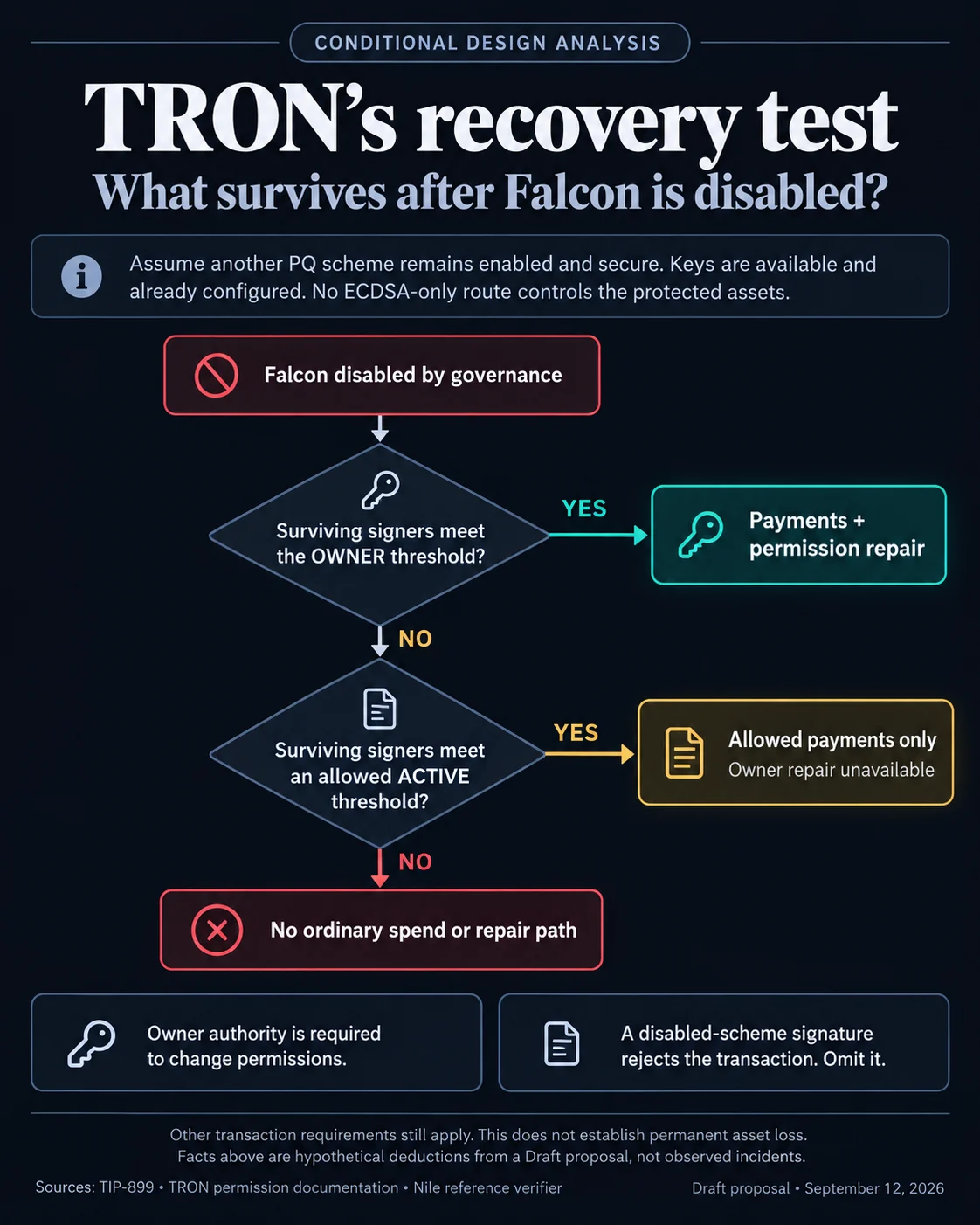
The TRON network’s proposed transition toward quantum-resistant cryptography has introduced a complex set of technical challenges that could potentially leave certain migrated accounts unable to manage their keys or permissions. Under the current draft design of TRON Improvement Proposal 899 (TIP-899), the network’s governance mechanism—controlled by 27 elected Super Representatives—retains the authority to enable or disable specific signing schemes. If a signing scheme is disabled due to security concerns or protocol updates, accounts that rely heavily on that scheme may find themselves in a state of partial or total lockout, depending on how their internal permission thresholds are configured. While some of these accounts might retain the ability to perform basic transactions through secondary "active" permissions, the fundamental "owner" authority required to repair or rotate keys could become permanently inaccessible without further protocol intervention.
Technical Framework of TIP-899 and Post-Quantum Cryptography
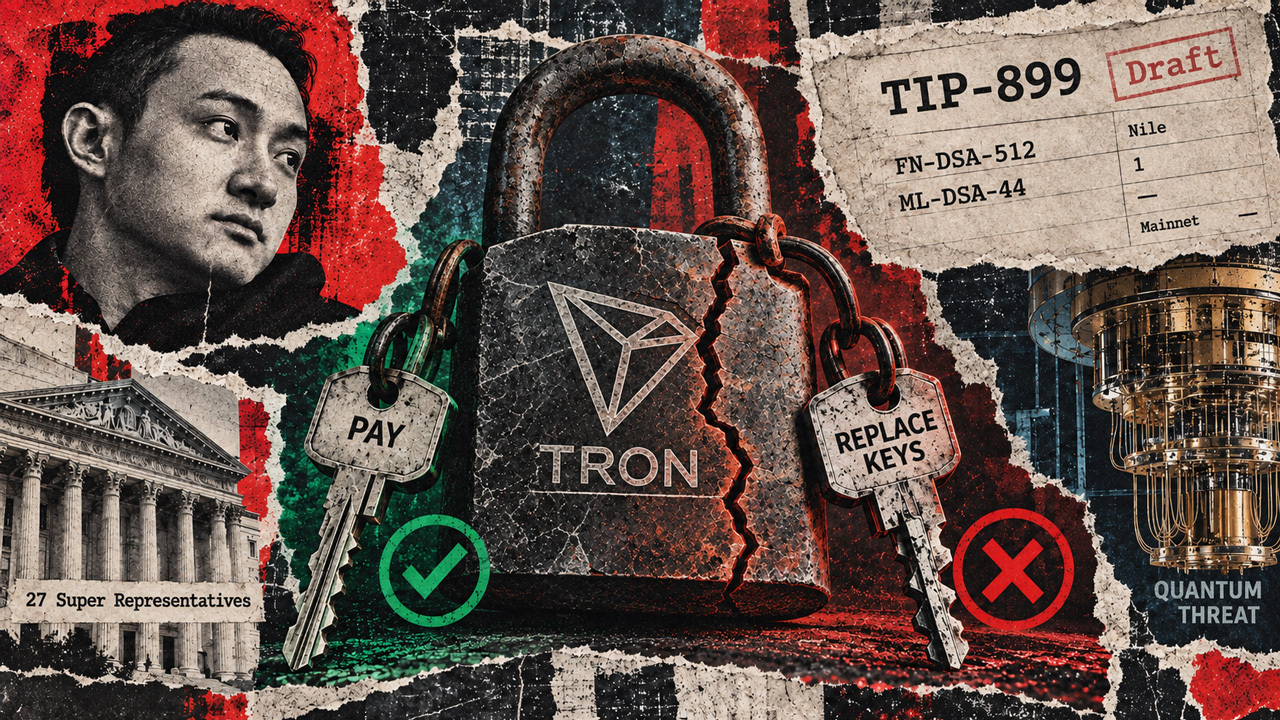
The core of TRON’s quantum ambition lies in the integration of post-quantum cryptography (PQC) algorithms designed to withstand potential attacks from future quantum computers. On August 8, 2026, TRON founder Justin Sun articulated a vision for the network to become the first quantum-resistant blockchain, a statement that has since driven the development of TIP-899. This proposal introduces two primary signature schemes: Falcon-based FN-DSA-512 and ML-DSA-44 (formerly known as Dilithium).
The selection of these algorithms aligns with global cryptographic trends. The National Institute of Standards and Technology (NIST) finalized the standards for ML-DSA (FIPS 204) on August 13, 2024, positioning it as a primary standard for general-purpose digital signatures. Falcon, while noted for its compact signature size and efficiency, is still undergoing the final stages of NIST standardization. TIP-899 includes both to provide redundancy, but this redundancy creates a sophisticated web of dependencies for account holders who choose to migrate their security models.
The Role of Network Governance and the Kill Switch Mechanism
Governance on the TRON network is an on-chain process where Super Representatives vote on "chain parameters." TIP-899 introduces specific parameters to control the activation of quantum signatures. Specifically, parameters identified as 1000 and 1001 (renumbered from earlier drafts to avoid mainnet conflicts) act as binary switches for FN-DSA-512 and ML-DSA-44.
If a vulnerability is discovered in one of these schemes, the Super Representatives can vote to disable it. Once a scheme is disabled, the network’s reference transaction verifier is programmed to reject any signature originating from that scheme. This is a critical security feature intended to protect the network from compromised algorithms, but it carries significant implications for account-level autonomy. Unlike traditional ECDSA (Elliptic Curve Digital Signature Algorithm) keys, which are the current standard, these new schemes are subject to the collective will of the network’s governing nodes.
Account Permission Thresholds and the Risk of Lockout
The most significant risk identified in the draft design involves the interaction between signature rejection and account permission thresholds. TRON uses a weighted multi-signature system where every account has an "Owner" permission and can have multiple "Active" permissions. Each permission has a "threshold"—a total weight of valid signatures required to authorize an action.
If an account’s "Owner" permission is configured such that it requires a signature from a scheme that is subsequently disabled, the account may lose the ability to change its own permissions. For example, if an account owner sets a threshold of 2 and provides one Falcon key (weight 1) and one ECDSA key (weight 1), both signatures are required for any "Owner" level action. If the Super Representatives disable Falcon, the Falcon signature is no longer "valid" in the eyes of the network. Even if the user still possesses the Falcon private key, they cannot meet the threshold of 2 using only the remaining ECDSA key.
This creates a "zombie account" scenario:
- Owner Authority Lost: The user cannot update the account to remove the disabled Falcon key or add a new ML-DSA key.
- Limited Spending: If the user has a separate "Active" permission for payments that only requires an ECDSA key with a threshold of 1, they can still move funds.
- Recovery Failure: However, they cannot perform administrative tasks, such as voting for Super Representatives or changing the account’s security settings, effectively leaving the account’s long-term management in a state of paralysis.
Chronology of TRON’s Quantum Development
The path toward quantum resistance on TRON has followed a structured timeline of research and testnet implementation:
- August 13, 2024: NIST finalizes FIPS 204 (ML-DSA), providing the first official standard for the algorithms TRON would later adopt.
- June 30, 2026: The Nile testnet, one of TRON’s primary testing environments, releases software implementing FN-DSA-512 and ML-DSA-44.
- July 1, 2026: TRON Core Developers Meeting 65 discusses the renumbering of activation codes to ensure compatibility with future mainnet upgrades.
- July 15, 2026: Core Dev Meeting 66 addresses the undecided nature of mainnet activation timing, emphasizing that the current priority remains testnet stability and auditing.
- August 8, 2026: Justin Sun publicly declares the goal for TRON to lead the industry in quantum resistance, highlighting ongoing tests on the Nile network.
- September 12, 2026: TIP-899 remains in "Draft" status. Technical checks on the Nile parameter endpoint show that
getAllowFnDsa512is active (value of 1), while ML-DSA settings remain unpopulated or in flux. Mainnet checks confirm that neither quantum setting has been activated for the broader public.
Supporting Data and Implementation Realities
The current implementation on the Nile testnet serves as a proof of concept for the proposed migration. Data from the Nile parameter endpoint suggests that developers are prioritizing the Falcon implementation for initial testing, despite ML-DSA having a more established regulatory standing via NIST.
However, the technical documentation for TIP-899 and the July developer calls reveal that the ecosystem is not yet fully prepared for a mainnet rollout. Several critical components remain in the "work-in-progress" phase:
- Wallet Derivation and Keystores: Standard methods for generating and storing quantum-resistant keys (BIP-32/BIP-44 equivalents) are not yet fully standardized for Falcon and ML-DSA within the TRON ecosystem.
- SDK and Hardware Support: Major hardware wallet providers and software SDKs (Software Development Kits) must be updated to handle the significantly larger signature sizes associated with PQC. Falcon signatures are approximately 666 bytes, and ML-DSA signatures can exceed 2,400 bytes—orders of magnitude larger than the 65-byte signatures used in ECDSA.
- Audit Status: As of September 2026, no completed independent cryptographic or implementation audit report has been made public for the TIP-899 codebase.
Broader Impact and Industry Implications
TRON’s move toward quantum resistance is a proactive response to the theoretical threat posed by Shor’s algorithm, which could eventually allow quantum computers to derive private keys from public keys on current blockchains. However, the "early adopter" approach taken by TRON highlights a fundamental tension in blockchain architecture: the balance between security and user-controlled recovery.
For institutional custodians and high-net-worth individuals, the migration design necessitates a radical rethink of cold storage and multi-signature setups. If a migration is performed incorrectly—for instance, by failing to provide an "either-or" threshold between different quantum schemes—the user becomes dependent on the long-term viability of a single algorithm.
The industry at large is watching TRON’s experiment closely. If successful, it could provide a roadmap for other major networks like Ethereum or Bitcoin to implement PQC. If the migration results in widespread account lockouts or governance-related friction, it may serve as a cautionary tale about the risks of "on-chain" algorithm management.
Fact-Based Analysis of Recovery Prospects
The draft proposal does not currently include an "emergency recovery" channel that bypasses standard permission thresholds. While some researchers have suggested zero-knowledge (ZK) recovery paths or social recovery mechanisms, these remain outside the scope of TIP-899.
Consequently, the only viable strategy for users during the migration phase is "redundant authorization." A secure configuration, based on the documented rules, would involve an Owner permission that allows for multiple independent signing routes. For example, an account with a threshold of 1 that permits an ML-DSA signature or a Falcon signature or an ECDSA signature would be resilient to the disablement of any single scheme. However, this configuration reduces the overall security of the account to the level of its weakest link—the ECDSA key—defeating the primary purpose of quantum resistance until the ECDSA key is eventually removed.
As the TRON Core Developers move toward a potential mainnet activation date, the focus is expected to shift toward user education and the development of "safe migration" tools. These tools will need to ensure that when a user adds a quantum key, they do not inadvertently create a configuration that could lead to a permanent loss of account control during a future governance-led protocol shift. Until then, the Nile testnet remains the primary staging ground for a transition that could redefine the security parameters of the third-largest blockchain by Total Value Locked (TVL).









