
 James Watt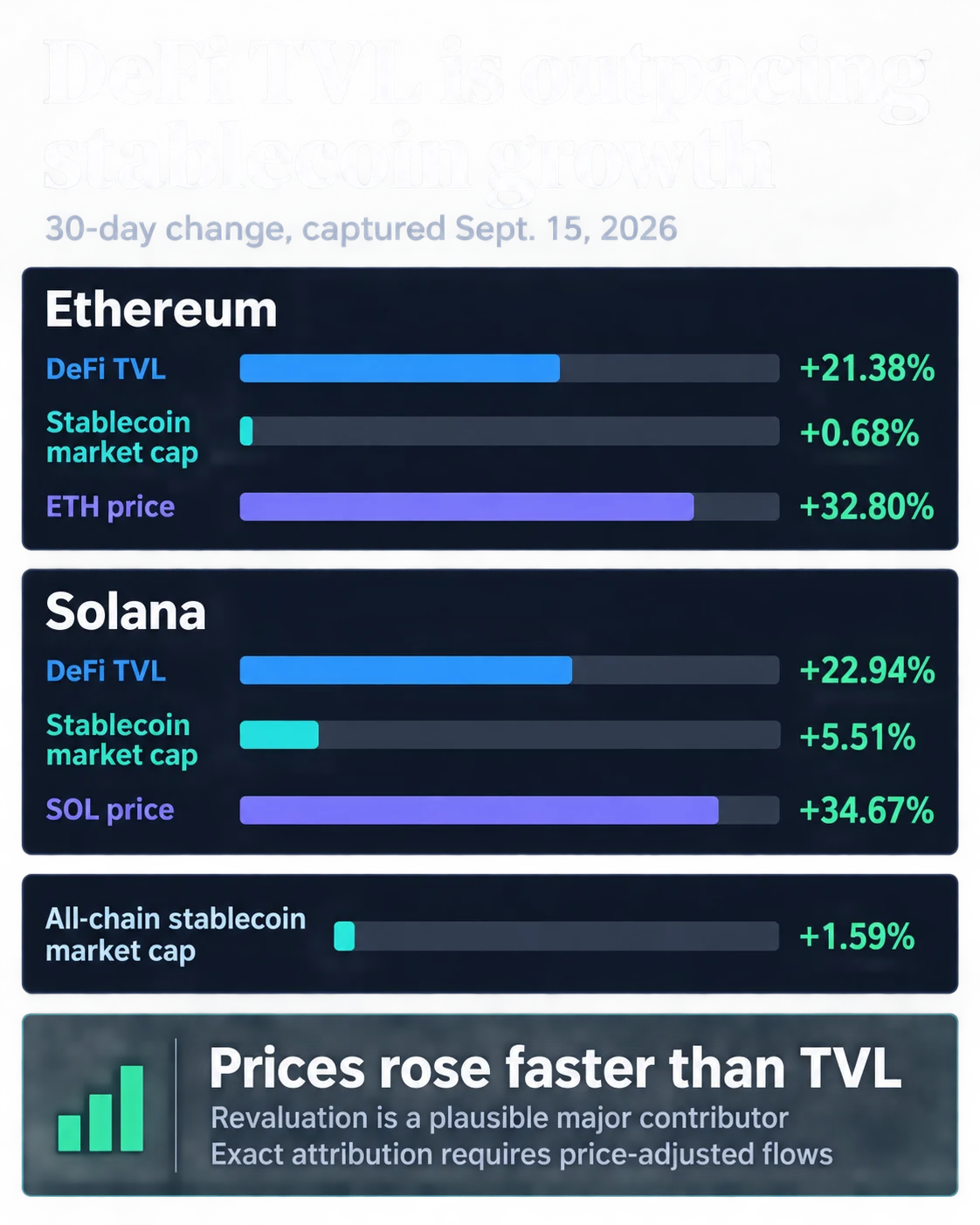
The decentralized finance (DeFi) sector has experienced a notable surge in total value locked (TVL) over the past 30 days, yet a granular analysis of on-chain data suggests that this recovery may be driven more by the rising market prices of underlying assets than by the arrival of fresh, deployable capital. As of September 15, data from the decentralized finance aggregator DeFiLlama indicates a sharp divergence between the growth of dollar-denominated TVL and the expansion of stablecoin liquidity. While Ethereum and Solana have both seen double-digit increases in the dollar value of assets held within their protocols, the growth of stablecoin market caps—often considered a proxy for "dry powder" or new external investment—has lagged significantly behind.
This phenomenon raises a critical question for investors and protocol developers: is the current rebound a sign of fundamental ecosystem expansion, or is it merely a reflection of a broader market rally in native assets like Ether (ETH) and Solana (SOL)? By examining the relationship between asset prices, stablecoin flows, and protocol-level mechanics, a clearer picture emerges of a market currently supported by asset revaluation rather than a massive influx of new liquidity.
The Divergence in TVL and Asset Performance
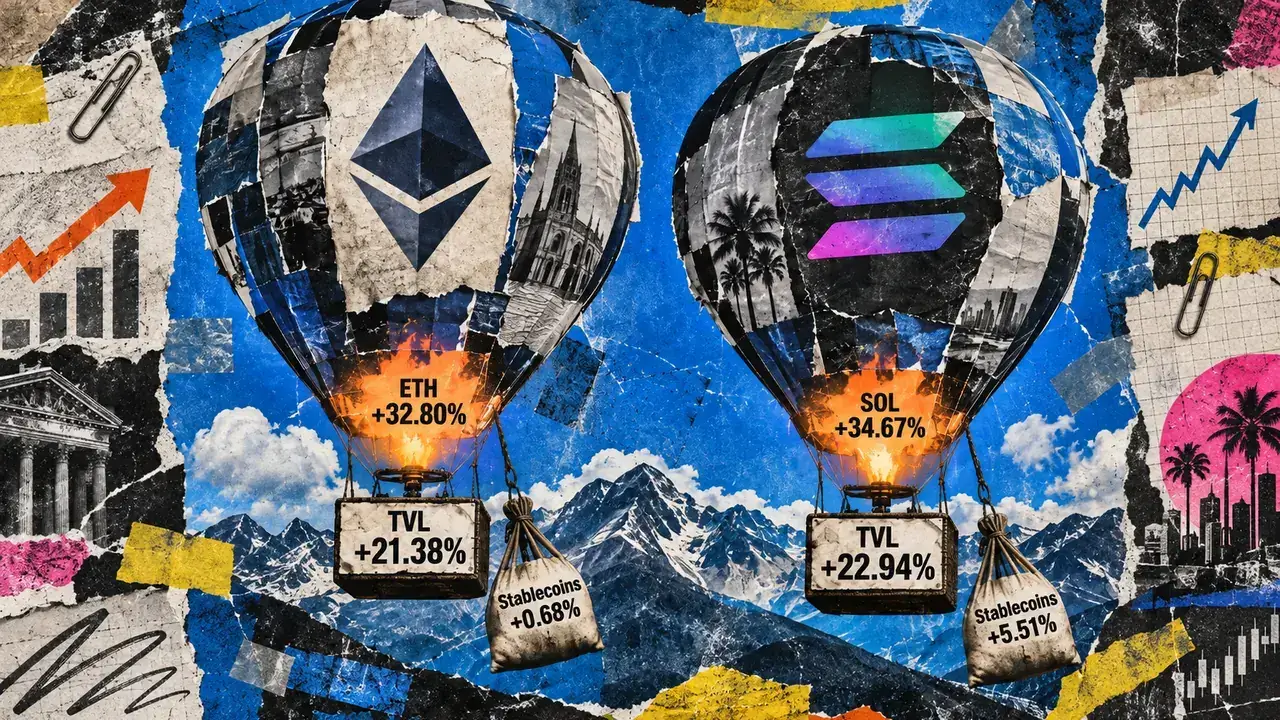
A snapshot of market data taken on September 15 reveals the scale of the recent TVL expansion. On the Ethereum network, the dollar-denominated DeFi TVL rose by 21.38% over a 30-day period. Simultaneously, Solana’s DeFi TVL grew by 22.94%. Under normal circumstances, these figures would suggest a robust period of growth for decentralized applications. However, when compared against the price performance of the native tokens used as collateral within these ecosystems, the narrative shifts.
During the same 30-day window, the price of Ether gained 32.80%, while Solana’s native token rose by 34.67%. In both instances, the price appreciation of the native asset exceeded the growth of the TVL by more than 11 percentage points. Because TVL is a dollar-denominated metric that counts the current market value of deposited tokens, a rise in the price of those tokens will naturally inflate the TVL even if no new tokens are deposited into the smart contracts. The fact that price gains outpaced TVL growth suggests that, in net terms, some capital may have actually exited these protocols, or at the very least, the "real" growth in token balances was minimal compared to the impact of market volatility.
Stablecoin Growth as a Metric of New Capital
Stablecoins serve as the lifeblood of the DeFi ecosystem, providing a non-volatile medium of exchange and a reliable source of liquidity for lending and borrowing. Unlike ETH or SOL, the value of stablecoins remains constant, making their market capitalization a more accurate barometer for the entry of new value into a blockchain’s ecosystem.
The data from mid-September shows a stark contrast between stablecoin growth and TVL expansion. Ethereum’s stablecoin market cap increased by a marginal 0.68% over the 30-day period. Solana performed slightly better, with its stablecoin footprint growing by 5.51%. On an aggregate level across all monitored blockchains, the stablecoin market cap gained only 1.59%.
When these figures are placed alongside the 20%+ gains in TVL, it becomes evident that the "liquidity base" of these networks is not expanding at a rate commensurate with the reported dollar value of their DeFi sectors. The reliance on asset revaluation means that the current rebound is highly sensitive to market corrections; should the prices of ETH and SOL retract, the TVL would likely see an equally rapid decline, as there is insufficient stablecoin liquidity to act as a floor for the valuation.
Understanding the Mechanics of Total Value Locked
To interpret these findings, it is necessary to understand how metrics like TVL are calculated and what they are intended to represent. DeFiLlama defines TVL as the dollar value of assets held in protocol contracts. This figure is influenced by two primary variables: the quantity of deposited assets (the "inventory") and the market price assigned to those assets (the "valuation").
When the market enters a bullish phase, the valuation component does the majority of the heavy lifting. To counter this, some analysts prefer to look at "USD Inflows," a metric that values changes in token balances at current market prices while filtering out the impact of pure price fluctuations between daily observations. This provides a more accurate view of net asset movement—essentially measuring whether users are actually moving more tokens into the system.
Furthermore, the role of stablecoins must be assessed through the lens of deployment. While a growing stablecoin market cap indicates that more value is present on a chain, that value only contributes to DeFi TVL if it is deposited into a protocol. Stablecoins sitting in private wallets or used for simple transfers do not count toward TVL. The current data suggests that while some new stablecoins are entering the Solana ecosystem, they are not arriving in volumes large enough to explain the nearly 23% jump in TVL.
The Role of Lending Markets and Capital Reuse
Another factor contributing to the complexity of DeFi metrics is the "reuse" of capital through lending and borrowing protocols. In ecosystems like Ethereum and Solana, protocols such as Aave and Kamino allow users to deposit assets as collateral and then borrow other assets against that collateral.
For example, on Solana, Kamino Finance offers a "Multiply" product that allows users to construct leveraged yield positions. A user might deposit SOL, borrow a stablecoin, swap that stablecoin for more SOL, and deposit it again. This process, often referred to as "looping," can artificially inflate TVL because the same underlying economic exposure is counted multiple times across different protocol balances.
While DeFiLlama employs a "Doublecount" filter to mitigate the impact of receipt tokens or liquidity provider tokens being deposited into secondary protocols, the inherent composability of DeFi means that a single dollar of external capital can appear as several dollars of TVL. During periods of rising prices, the incentive to leverage positions increases, which may account for some of the TVL growth that isn’t explained by simple asset revaluation or stablecoin inflows.
Chronology of the Rebound: A Market in Transition
The 30-day window leading up to September 15 was characterized by a broader recovery in the cryptocurrency markets, following a period of stagnation and localized volatility. Several factors likely contributed to the price surges in ETH and SOL:
- Institutional Sentiment: The continued integration of Ethereum into traditional financial products, including the launch and seasoning of spot ETH ETFs, has provided a steady backdrop of institutional interest.
- Network Upgrades and Ecosystem Events: Solana’s ecosystem has seen a flurry of activity surrounding its developer conferences and the rollout of new scaling solutions, which often act as catalysts for price action.
- Macroeconomic Factors: Anticipation of shifts in global monetary policy, particularly regarding interest rates in the United States, has historically driven capital toward risk-on assets, including major cryptocurrencies.
However, the timeline shows that this interest has manifested primarily as price appreciation for the "blue-chip" assets of the DeFi world rather than a broad-based move into decentralized applications by new retail or institutional users. The lack of significant stablecoin growth during this period suggests that investors are holding onto their existing positions or speculating on price movements rather than deploying new cash into the DeFi stack.
Technical Nuances: Bridges and Wrapped Assets
The movement of capital between chains also complicates the assessment of TVL. Cross-chain bridges like Wormhole and services like Circle’s Cross-Chain Transfer Protocol (CCTP) play a vital role in how liquidity is distributed.
Wormhole operates by locking an original asset on a source chain and minting a backed, wrapped representation on the destination chain. If a user moves $1 million in ETH from Ethereum to Solana, the TVL on Ethereum may remain stable (as the asset is locked in a bridge contract) while the TVL on Solana increases. Conversely, Circle’s CCTP burns native USDC on the source and mints it on the destination, shifting the stablecoin market cap from one chain to another.
The fact that aggregate stablecoin growth across all chains was only 1.59% indicates that we are not seeing a significant amount of new "minting" of stablecoins. Instead, the liquidity is largely being shuffled between networks or remains stagnant, further supporting the conclusion that the TVL gains are a byproduct of the valuation of existing native assets.
Analysis of Implications: Risks and Future Outlook
The current data suggests that the DeFi market is in a "valuation-led" recovery. While this is a positive sign for the wealth of current token holders, it presents a different risk profile than a "liquidity-led" recovery.
In a liquidity-led recovery, the foundation of the market is built on non-volatile assets like USDC or USDT. This creates a stable base that can support lending and borrowing even if the prices of ETH or SOL fluctuate. In a valuation-led recovery, the collateral base is itself volatile. If the price of SOL or ETH were to drop by 20%, the TVL would likely drop by a similar or even greater percentage due to liquidations in leveraged positions.
For the rebound to be considered sustainable and fundamental, market analysts look for several key indicators:
- Price-Adjusted Inflows: A consistent increase in the actual number of tokens being deposited, regardless of their dollar value.
- Stablecoin Velocity: An increase in the circulation and deployment of stablecoins within DeFi protocols, indicating that "dry powder" is being put to work.
- Net Bridge Inflows: Evidence that capital is moving onto a chain and staying there, rather than just passing through for short-term yield farming.
Conclusion: Prices Doing the Heavy Lifting
The September 15 snapshot provides a clear hierarchy of explanations for the recent DeFi surge. With ETH and SOL prices rising significantly faster than the TVL of their respective ecosystems, and with stablecoin growth remaining anemic, it is evident that market prices are currently doing the heavy lifting.
While the increase in dollar value is a welcome sight for the industry, it does not yet signal a return to the explosive, liquidity-driven growth seen in previous DeFi cycles. Until there is a meaningful expansion in the stablecoin supply and a rise in price-adjusted token balances, the DeFi sector remains tethered to the price action of its primary collateral assets. The "harder test" for this recovery will be its ability to maintain these valuations and attract new, non-volatile capital if and when the current price momentum cools. For now, the data suggests that while the house is becoming more valuable, the number of people moving in has yet to see a significant increase.









