
 James Watt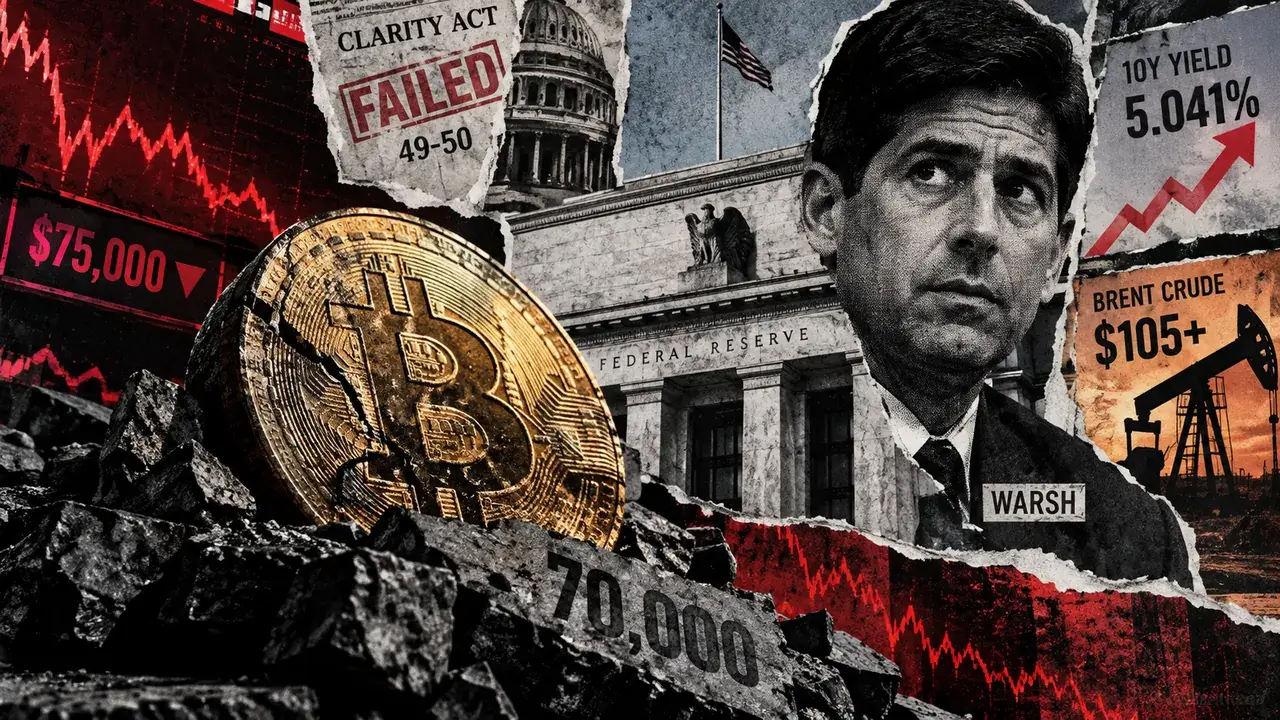
Bitcoin fell to an intraday low below $75,000 on September 15, extending a sharp selloff that began in the hours leading up to a pivotal Senate vote on the CLARITY Act. The digital asset, which had been attempting to consolidate gains following a robust August recovery, faced a multi-pronged assault from legislative disappointment, a spike in sovereign bond yields, and escalating energy costs. The convergence of these factors has fundamentally altered the short-term technical outlook for the cryptocurrency market, placing renewed focus on the Federal Open Market Committee (FOMC) meeting scheduled for September 16.
The immediate catalyst for the price decline was the Senate’s failure to invoke cloture on a motion to proceed to the CLARITY Act. The vote concluded with a 49-50 split, falling significantly short of the 60-vote threshold required to overcome a filibuster and move the legislation toward a final vote. The bill, which aimed to provide a comprehensive regulatory framework for digital assets and stablecoins in the United States, was viewed by many institutional investors as a necessary precursor for sustained mainstream adoption and the expansion of domestic crypto services.
Legislative Gridlock and Market Repricing
The failure of the CLARITY Act was not entirely unexpected by political observers, yet the market’s reaction suggests that a "pathway to passage" had been partially priced into asset valuations. Data from the decentralized prediction market Polymarket showed that the odds for the act’s passage plummeted from 31% to 19% in the 24 hours preceding the vote. Bitcoin responded to this shifting sentiment by slipping below the $77,000 mark during the pre-vote repricing phase. Once the final tally was confirmed on the Senate floor, the selloff intensified, pushing the asset to its intraday low.
The political defeat was reportedly exacerbated by an ethics-related dispute involving former President Donald Trump’s business interests, which became a late-stage sticking point for several key senators. This internal friction effectively stalled a bill that had previously seen bipartisan support in committee stages. For the cryptocurrency industry, the failure represents a significant setback in the multi-year effort to establish federal oversight that distinguishes digital assets from traditional securities.
The impact of the vote was felt most acutely by US-based cryptocurrency firms that are directly exposed to the domestic regulatory environment. Coinbase Global Inc. (COIN) saw its share price tumble by approximately 10%, while Circle, the issuer of the USDC stablecoin, faced losses exceeding 11%. These sharp declines underscore the market’s sensitivity to the lack of legislative progress; without a federal framework, these companies remain subject to "regulation by enforcement" from the Securities and Exchange Commission (SEC) and other federal agencies.
Macroeconomic Headwinds: Yields and Oil
While the political theater in Washington provided the catalyst, the broader macroeconomic environment provided the fuel for the decline. The yield on the 10-year US Treasury note reached 5.041% on September 15, its highest level since 2007. This surge in "risk-free" rates has traditionally placed downward pressure on speculative and risk-on assets like Bitcoin. When Treasury yields rise, the opportunity cost of holding non-yielding assets increases, prompting institutional desks to rebalance portfolios in favor of debt instruments.
Simultaneously, the energy market introduced a new layer of inflationary pressure. Brent crude oil traded above $105 per barrel, driven by supply constraints and geopolitical tensions. For the Federal Reserve, sustained high oil prices complicate the task of cooling inflation, leading to expectations of a "higher-for-longer" interest rate environment. This "macro-energy shock" has tightened financial conditions globally, leaving Bitcoin vulnerable at a time when its internal market structure was already showing signs of fatigue.
The combination of 5% Treasury yields and $100-plus oil has shifted the narrative from a potential "soft landing" to a period of "stagflationary" concern. This shift is particularly damaging for Bitcoin, which has struggled to maintain its status as an inflation hedge when inflation is driven by supply-side shocks that simultaneously trigger aggressive central bank tightening.
Technical Breakdown and Support Levels
From a technical perspective, the decline below $75,000 is significant because it resulted in the loss of the $76,300–$76,600 support cluster. This area had served as a critical floor for the market throughout early September. Analysts at CryptoQuant have noted that the breach of this level opens the door for a test of the 200-day moving average, which currently sits near $70,000.
A move toward the $70,000 level would represent an additional 7.8% decline from the $75,900 mark. If that level fails to hold, the market structure points toward a deeper "accumulation zone" between $62,000 and $65,000. According to CryptoQuant data, long-term holders (LTHs) accumulated approximately 476,000 BTC within this price band earlier this year. This zone is considered the primary line of defense for the bullish trend that began after the August lows.
Conversely, any recovery effort faces a formidable "supply zone" between $77,100 and $80,200. Historical data indicates that long-term holders liquidated roughly 539,000 BTC in this region over a 30-day period this year. This suggests that as the price approaches the $80,000 ceiling, significant sell-side pressure is likely to emerge, making a rapid V-shaped recovery difficult without a major positive catalyst.
The FOMC Factor: September 16 and Beyond
The market’s attention now shifts to the September 16 FOMC meeting. Investors are bracing for the Federal Reserve’s decision on interest rates and, perhaps more importantly, the release of the Summary of Economic Projections (SEP), often referred to as the "dot plot."
A Reuters poll conducted ahead of the meeting found that 85% of economists expect a 25-basis-point increase, bringing the federal funds rate to a range of 3.75% to 4.00%. While this hike is largely priced in, the "bull case" for Bitcoin relies on a restrained message from Fed officials. If the Fed signals that it is nearing the end of its tightening cycle, Bitcoin could find the room necessary to stabilize between $72,000 and $76,000.
Market participants are also closely watching the commentary of Kevin Warsh, a former Fed Governor whose views on the path of monetary policy carry significant weight with institutional investors. Warsh has recently emphasized the need for transparency regarding the Fed’s long-term balance sheet reduction plans. A hawkish surprise—either through the SEP or Chair Jerome Powell’s press conference—could push Bitcoin through the $70,000 support level and toward the deeper $60,000 range.
Industry Implications and Long-Term Outlook
The failure of the CLARITY Act highlights a growing divergence between the US regulatory landscape and other global jurisdictions, such as the European Union with its Markets in Crypto-Assets (MiCA) regulation. Industry leaders have expressed concern that continued legislative gridlock will drive innovation and capital away from the United States.
In a statement following the vote, various advocacy groups noted that the lack of a clear framework leaves the industry in a state of "permanent uncertainty." This uncertainty is reflected in the heavy losses sustained by Coinbase and Circle, companies that have invested heavily in compliance and have advocated for federal standards.
For Bitcoin, the immediate future is tied to the interplay between institutional selling and the resilience of long-term holders. While the political and macro news of September 15 was undeniably bearish, the asset remains well above its yearly lows. The coming days will determine whether the current correction is a necessary consolidation following the August rebound or the beginning of a more protracted move toward the $62,000 floor.
As the market digests the legislative failure and prepares for the Fed’s next move, the volatility seen on September 15 serves as a reminder of Bitcoin’s sensitivity to the broader financial ecosystem. The "digital gold" narrative continues to be tested by the realities of 5% interest rates and a divided Washington. Whether the $70,000 level holds will likely depend on whether the Federal Reserve provides a glimmer of hope for a pause in its aggressive tightening campaign.









