
 admin
admin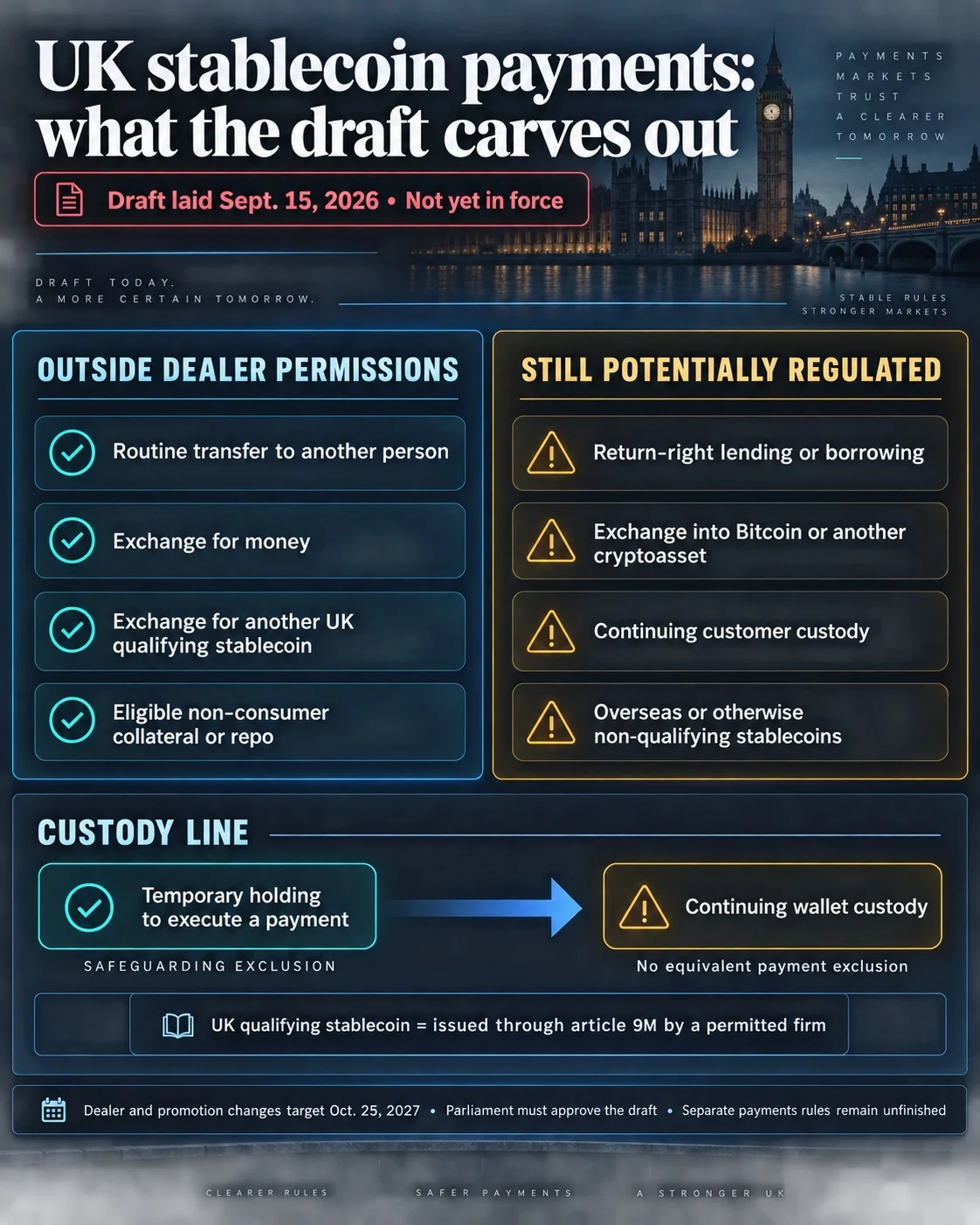
HM Treasury has introduced a significant recalibration of its forthcoming regulatory framework for cryptoassets, particularly impacting stablecoins. The recently unveiled Financial Services and Markets Act 2000 (Cryptoassets) (Miscellaneous Amendments) Regulations 2026, laid before Parliament on September 15, carves out specific payment-related activities involving UK qualifying stablecoins from stringent dealer regulations. This move aims to foster innovation in payment systems while simultaneously reinforcing oversight on more complex crypto financial activities like lending and trading. The proposed amendments, if enacted, represent a nuanced approach, distinguishing between routine stablecoin transactions and those that resemble traditional financial services.
The core of the amendment lies in its modification of the rules governing "dealing as principal," "dealing as agent," and "arranging deals" under the UK’s financial services regime. Under the proposed regulations, routine transfers and direct exchanges of UK qualifying stablecoins for fiat currency or other qualifying stablecoins could be exempt from these dealer permissions. This suggests a legislative intent to facilitate the use of stablecoins as a payment mechanism, akin to existing digital payment rails, without imposing the full burden of regulated financial intermediation on every transaction.
However, this broad exclusion is subject to crucial caveats. For a stablecoin to benefit from this carve-out, it must first meet the stringent definition of a "UK qualifying stablecoin." This classification requires the stablecoin to be issued by a firm authorized under the regulated Article 9M activity, demonstrating a robust compliance and operational framework. Consequently, stablecoins issued by overseas entities or those that merely track the sterling’s value without meeting the specific issuance criteria will not automatically qualify for the proposed regulatory relief. This ensures that the benefits are primarily directed towards tokens operating within the UK’s established regulatory purview.
The distinction between payment facilitation and financial intermediation becomes sharper when the nature of the stablecoin transaction shifts. If a stablecoin transfer involves a right or obligation for the recipient to return the stablecoin at a later date, it moves beyond the scope of a simple payment exclusion. Such arrangements, which echo traditional lending or borrowing practices, could remain subject to regulation, particularly if they meet the established criteria for regulated financial activities. This effectively means that crypto lending platforms utilizing stablecoins, where the underlying asset is not immediately exchanged for ownership but rather held with an obligation for return, will likely continue to fall under the purview of financial regulators.
Similarly, the exchange of a UK qualifying stablecoin for another type of qualifying cryptoasset, such as Bitcoin or Ether, is not covered by the payment carve-out. This indicates a clear regulatory intent to differentiate between stablecoins used for payment and those used for speculative trading or as a store of value within the broader crypto market. The Treasury’s approach appears to be one of fostering a regulated environment for crypto payments while maintaining a firm stance on activities that could introduce systemic risks or consumer protection concerns akin to those in traditional finance.
A Deeper Dive into the Regulatory Landscape
The regulatory landscape for cryptoassets in the UK has been evolving rapidly, with a concerted effort to integrate digital assets into the existing financial services framework. The Financial Services and Markets Act 2000 (Regulated Activities) (Amendment) Order 2023, which came into force on October 8, 2023, marked a significant step by bringing a range of cryptoasset activities under the regulatory umbrella. This included the promotion of cryptoassets, the operation of cryptoasset exchange facilities, and the custody of cryptoassets. The subsequent amendments, including the draft instrument laid before Parliament, represent a refinement of this broader regulatory strategy.
HM Treasury’s April proposal for these amendments had initially suggested that payment firms would still require safeguarding permission, even for temporary settlements. The final draft, however, introduces a more specific distinction between temporary holding for payment execution and ongoing custody. The new safeguarding provision excludes the temporary holding of a UK qualifying stablecoin when it is directly linked to the execution of a payment. This is a crucial clarification, recognizing that the operational mechanics of payment processing often involve brief holding periods.
In contrast, longer-term custody arrangements, such as maintaining customer wallets where stablecoins are stored for extended periods, do not benefit from this payment exception and could remain within the scope of safeguarding activities. This differentiation is vital for firms operating in the payments space, offering them greater clarity and potentially reducing the regulatory burden for core payment functions. It acknowledges that the risks and regulatory considerations for holding an asset for immediate payment differ significantly from those associated with long-term safekeeping.
The implications for financial promotion rules, which govern how cryptoassets can be marketed, are also noteworthy. These rules broadly align with the exclusions made for transfers, exchanges, collateral, and repo arrangements involving qualifying stablecoins. However, the coverage is not identical, and arrangements that necessitate the return of the stablecoin, as previously mentioned in the context of lending, will not receive the basic promotion exemption. This ensures that marketing efforts for such products are subject to appropriate scrutiny and consumer protection measures.
Timeline and Future Outlook
The proposed amendments to the dealing, arranging, and financial promotion rules are slated to take effect on October 25, 2027. This date coincides with the Financial Conduct Authority’s (FCA) projected commencement of its new regime for crypto firms. This coordinated timeline suggests a deliberate effort by UK regulators to present a comprehensive and unified regulatory environment for the crypto sector. Amendments made through Regulation 4 of the draft instrument would become effective upon the instrument’s formal enactment.
However, it is important to note that Parliament must first approve the draft instrument. Following parliamentary approval, HM Treasury’s separate consultation on modernizing payment services regulation will play a crucial role in defining the longer-term rules for stablecoins used in payments. This indicates that while the current amendments provide immediate clarity on certain aspects, the overarching regulatory framework for stablecoin payments is still under development and subject to further refinement.

Broader Economic and Industry Impact
The Treasury’s measured approach to stablecoin regulation reflects a delicate balancing act. On one hand, the intention to facilitate stablecoin payments signals an embrace of digital currencies as a viable component of the future financial infrastructure. By removing regulatory hurdles for routine transfers and exchanges, the UK aims to position itself as an attractive hub for stablecoin innovation and adoption, potentially boosting efficiency and reducing costs in payment systems. This could encourage businesses and consumers to explore stablecoins for remittances, e-commerce, and cross-border transactions.
On the other hand, the stringent oversight of crypto lending and trading activities underscores a commitment to financial stability and consumer protection. The distinction drawn between payment functions and financial intermediation is critical. It acknowledges that while stablecoins can offer efficiency as a medium of exchange, their use in more complex financial products carries risks that require robust regulatory supervision, similar to traditional financial instruments. This careful distinction is designed to prevent regulatory arbitrage and ensure that risks are appropriately managed.
Industry reactions to these proposals are likely to be mixed, with payment-focused firms potentially welcoming the clarity and reduced burden for transactional activities. Conversely, firms heavily involved in crypto lending, derivatives, or speculative trading may face continued regulatory scrutiny and compliance challenges. The emphasis on "UK qualifying stablecoins" also places a premium on robust issuance and governance frameworks, encouraging greater transparency and accountability from stablecoin issuers operating within the UK.
The ongoing evolution of these regulations highlights the dynamic nature of the crypto landscape and the continuous efforts of policymakers to adapt. As the UK navigates the integration of digital assets, its nuanced regulatory approach aims to foster innovation while safeguarding the integrity of the financial system. The coming years will be crucial in observing how these regulations are implemented and their impact on the broader adoption and utility of stablecoins within the UK economy. The clarity provided by the draft instrument regarding payment exceptions, coupled with the ongoing work on broader payment reforms, suggests a strategic vision for incorporating stablecoins into a modernized financial ecosystem.








