
 James Watt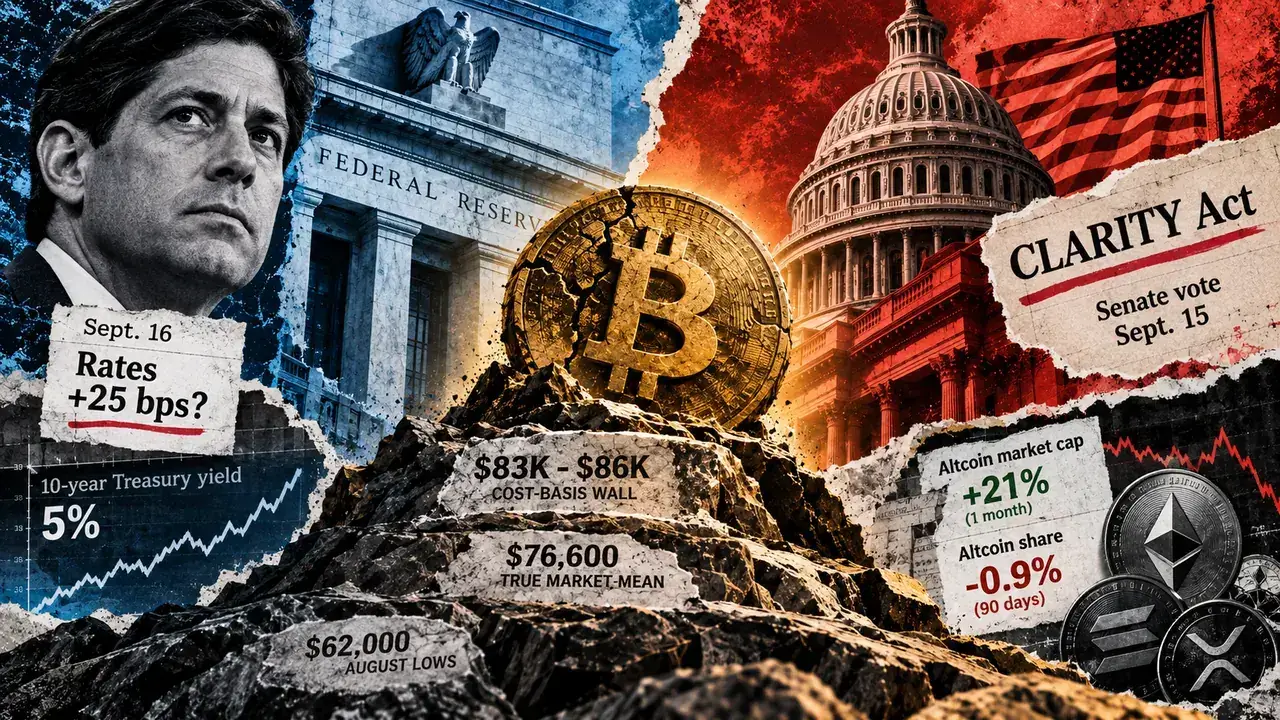
The digital asset market stands at a critical juncture as Bitcoin attempts to solidify its recent recovery while the broader altcoin sector struggles to reclaim lost market share. According to recent data from Glassnode, while the altcoin market capitalization surged by 21% over the past month, the relative share of altcoins within the combined Bitcoin-and-altcoin market fell by 0.9 percentage points over a 90-day period ending September 7. This divergence highlights a concentrated flow of capital into Bitcoin, the market’s primary "ladder" asset, while higher-beta tokens have largely remained stagnant in terms of relative dominance. As the third quarter draws to a close, the market prepares for a pivotal week defined by high-stakes developments at the Federal Reserve and within the United States Senate, both of which will determine if the current rally can evolve into a sustained, market-wide uptrend.
Bitcoin Leads the Recovery Amid Formidable Technical Resistance
Bitcoin has demonstrated significant resilience since the volatility of early August, climbing approximately 27% from its monthly lows near $62,000. As of September 15, the leading cryptocurrency was trading near the $79,000 mark. Despite this impressive rebound, technical analysis suggests that Bitcoin has yet to clear its most significant hurdle. Glassnode identifies a "genuine cost-basis wall" situated between the $83,000 and $86,000 price bands. This range represents a massive concentration of supply, with roughly 1.07 million BTC acquired within these levels.
Data indicates that this supply is held almost exclusively by long-term holders (LTHs), with the highest concentration of purchase activity occurring near $85,000. For the market to move higher, it must absorb the selling pressure from these holders, many of whom may seek to exit their positions at their original entry points to defend their cost basis. This creates a psychological and liquidity barrier that far outweighs simple round-number resistance. Conversely, on the downside, the Glassnode "True Market Mean" currently sits near $76,600. This level is functioning as a critical support floor; as long as Bitcoin remains above this mean, the current recovery structure is considered technically intact.
Federal Reserve Policy and the 5% Treasury Hurdle
The macroeconomic environment is providing a complex backdrop for risk assets. On September 16, the Federal Reserve is scheduled to meet, with approximately 85% of economists surveyed expecting a 25 basis point hike, bringing the benchmark interest rate to a range of 3.75% to 4%. This expectation marks a shift in sentiment following a series of inflation reports that came in higher than anticipated. Major financial institutions, including Goldman Sachs, JPMorgan, HSBC, and Deutsche Bank, have revised their outlooks to align with a more hawkish Fed stance.
The impact of tightened monetary policy is already visible in the fixed-income markets. On September 14, the 10-year Treasury yield briefly touched 5% for the first time since 2023. This move is significant because the 10-year yield represents the "global hurdle rate"—the baseline return investors expect from a risk-free asset. When Treasury yields rise, the opportunity cost of holding volatile assets like Bitcoin increases. A 5% yield on government debt provides a compelling alternative for institutional capital, potentially siphoning liquidity away from the crypto markets just as Bitcoin attempts to break through its $86,000 resistance wall.
The Federal Reserve’s communication during this meeting will be as important as the rate decision itself. Market participants are looking for clues as to whether this hike is a "one-and-done" adjustment to combat sticky inflation or the beginning of a more prolonged tightening cycle extending into 2027. Futures markets have already begun pricing in the possibility of multiple increases over the next 18 to 24 months, a scenario that would keep the cost of capital high and potentially cap the upside for high-beta risk assets.
The Senate Vote and the Quest for Regulatory Clarity
While the Federal Reserve manages the cost of money, the United States Senate is addressing the regulatory bottlenecks that have long hindered the broader crypto ecosystem. On September 15, the Senate is scheduled to face a cloture vote on the motion to proceed to the CLARITY Act. This legislation requires 60 votes to advance and represents one of the most serious attempts to date to establish clear boundaries between the Securities and Exchange Commission (SEC) and the Commodity Futures Trading Commission (CFTC).
The CLARITY Act seeks to expand the CFTC’s authority over digital commodities while maintaining SEC jurisdiction over primary-market activities that resemble traditional securities offerings. Republican proponents of the bill have noted that the current substitute incorporates 126 substantive changes requested by Democrats, suggesting a bipartisan effort to reach a compromise.
For Bitcoin, the immediate impact of the CLARITY Act may be limited, as the asset already enjoys a relatively settled regulatory identity and a robust institutional infrastructure, including spot ETFs and regulated derivatives. However, for the rest of the "crypto ladder," the bill is transformative. Altcoins, DeFi platforms, and digital asset exchanges currently trade at a "regulatory discount" due to the ongoing uncertainty regarding American policy. If the Senate passes cloture, it would signal an easing of this bottleneck, potentially allowing capital to flow more freely into Ethereum and other high-beta assets that have underperformed Bitcoin in recent months.
Institutional Sentiment and ETF Flow Reversals
The role of institutional investors remains a central pillar of the current market cycle. Spot Bitcoin ETFs experienced a period of turbulence between September 8 and September 11, posting four consecutive days of net outflows totaling approximately $463 million. This brief exodus snapped a three-week streak of positive inflows, reflecting institutional caution ahead of the Fed meeting and the Senate vote.
However, sentiment appeared to shift toward the end of the week. Farside data showed that flows turned positive again on September 14, with $159.9 million in net inflows. This return of institutional buying suggests that despite the looming macroeconomic hurdles, there remains a strong underlying demand for Bitcoin as a strategic asset. Analysts are closely watching whether these inflows can be sustained if the Fed adopts a hawkish tone. A continuation of ETF inflows in the face of rising interest rates would provide a strong signal of Bitcoin’s "decoupling" from traditional risk-on correlations.
Historical Context: The Missing Late-Cycle Rotation Signal
One of the most notable findings in the Glassnode report is the absence of a traditional late-cycle rotation signal. Historically, in three out of the last four Bitcoin market peaks, the altcoin share of the total market increased by at least 2.8 percentage points over a 90-day period. This rotation usually occurs as investors, having realized gains in Bitcoin, move down the risk curve into higher-volatility altcoins.
As of the September 7 reading, this signal was not only absent but negative, with altcoin market share falling by 0.9 percentage points. This suggests that the current market is not in a "mania" phase or a late-cycle blow-off top. Instead, it reflects a disciplined, Bitcoin-centric recovery. For a broader altcoin rally to materialize in the fourth quarter, market analysts believe two conditions must be met: a softer-than-expected stance from the Federal Reserve and the successful advancement of regulatory legislation like the CLARITY Act. Without these dual catalysts, Bitcoin is likely to continue its dominance while the rest of the market remains burdened by policy uncertainty and high borrowing costs.
Analysis of Potential Q4 Scenarios
The convergence of the Fed decision and the Senate vote sets up four distinct scenarios for the remainder of the year:
-
The Bull Case (Soft Fed + CLARITY Success): If the Federal Reserve signals that the current hike is a singular adjustment and the Senate advances the CLARITY Act, Bitcoin would have its strongest opportunity to clear the $86,000 resistance wall. In this environment, the "regulatory discount" on altcoins would narrow, likely leading to an improvement in the ETH/BTC ratio and a long-awaited increase in altcoin market share. This would confirm that the August bounce was the start of a genuine, broad-based cycle.
-
The Divergent Case (Hawkish Fed + CLARITY Success): In a scenario where the Fed signals a long hiking cycle but the Senate provides regulatory clarity, Bitcoin might struggle to break past its cost-basis wall due to the high hurdle rate of 5% Treasuries. However, altcoins could still see localized gains as the legal environment improves, though liquidity would remain expensive.
-
The Liquidity Case (Soft Fed + CLARITY Stalls): If the Fed is dovish but the CLARITY Act fails to advance, Bitcoin would likely rally on the back of cheaper money and increased liquidity. However, the broader altcoin market would likely continue to lag behind, as the lack of legal certainty would keep institutional capital concentrated in the "safe haven" of Bitcoin.
-
The Bear Case (Hawkish Fed + CLARITY Stalls): This is the most challenging scenario for the market. A hawkish Fed combined with a regulatory stalemate would put immense pressure on the $76,600 support floor. In this instance, the market might look toward Glassnode’s deeper accumulation zones between $62,000 and $65,000. High-beta assets would likely absorb the brunt of the selloff, reinforcing Bitcoin’s dominance even in a declining market.
Conclusion: A Defining Week for Digital Assets
The upcoming week represents a fundamental test of the market’s underlying strength. While Bitcoin has successfully reclaimed much of the ground lost in August, the "cost-basis wall" of long-term holders stands as a formidable barrier to new all-time highs. Simultaneously, the altcoin market remains in a state of suspended animation, awaiting a signal that the regulatory and macroeconomic headwinds are beginning to subside.
Whether the market can transition from a Bitcoin-led recovery to a broad-based expansion depends on the outcomes in Washington D.C. over the next few days. Investors will be watching the 10-year Treasury yield, ETF flow data, and the specific language of the Federal Reserve to determine if the digital asset sector is ready to stretch its rally into the final months of 2024. For now, the "late-cycle rotation" remains elusive, leaving Bitcoin as the sole captain of the current recovery.









