
 James Watt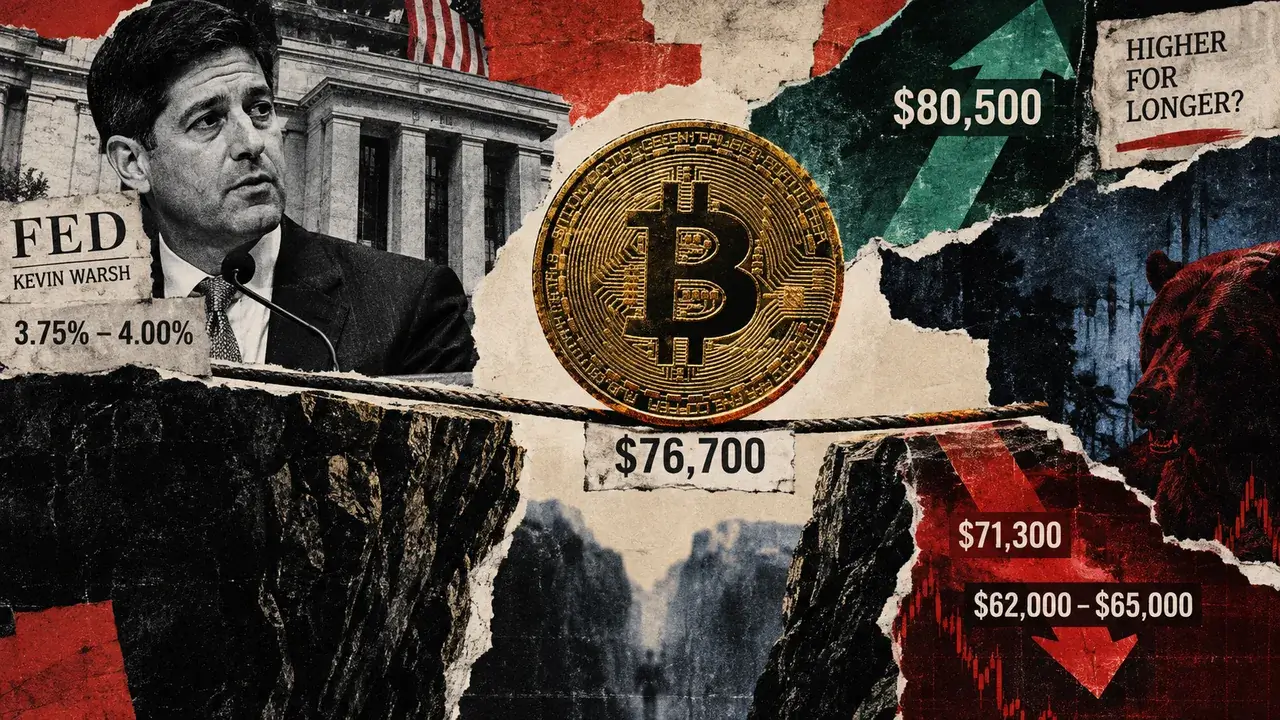
The global financial landscape underwent a period of significant volatility on September 16, 2026, as the Federal Reserve concluded its highly anticipated policy meeting. Bitcoin, the world’s largest cryptocurrency by market capitalization, demonstrated a unique pattern of resilience, briefly dipping to an intraday low of $75,064.82 before recovering to reclaim the $76,000 zone. This price action occurred in direct contrast to traditional equity markets, which faced a sharp selloff following the press conference held by Federal Reserve Chair Kevin Warsh. While the S&P 500 retreated by approximately 0.7% and the Dow Jones Industrial Average plummeted by 1.2%, Bitcoin managed to hold its ground, signaling a potential decoupling or, at the very least, a robust absorption of macroeconomic shocks.
The central bank’s decision to raise the benchmark interest rate by 25 basis points—bringing the target range to 3.75% to 4.00%—was largely expected by market participants. Fixed-income derivatives had already priced in a 90% probability of this move well before the 12-0 unanimous vote was announced. However, the true market catalyst was not the rate hike itself, but the forward-looking guidance provided by Chair Warsh and the accompanying "dot plot" of economic projections.
The Federal Reserve’s Hawkish Stance and the Warsh Signal
During the post-meeting press conference, Chair Kevin Warsh delivered a message that many analysts interpreted as unexpectedly hawkish. Despite the recent tightening cycle, Warsh remarked that he would be “hard pressed” to categorize current broad financial conditions as restrictive. This statement suggested that the Federal Reserve does not believe its efforts to cool the economy have yet reached a terminal point of efficacy.
The release of the Fed’s "dot plot" further solidified this sentiment. The data revealed that 16 of the 18 policymakers project at least one additional rate hike before the conclusion of the calendar year. This collective outlook shifted the market’s focus from the immediate quarter-point increase to the long-term path of interest rates. For liquidity-sensitive assets like Bitcoin, the prospect of a "higher-for-longer" interest rate environment raises the hurdle for sustained capital appreciation.
The 2-year Treasury yield, which is particularly sensitive to changes in monetary policy, climbed to 4.734% during the session. Higher yields on government debt typically increase the opportunity cost of holding non-yielding assets like Bitcoin and gold, yet the cryptocurrency’s ability to maintain the $76,000 level surprised several observers. Markus Levin, the co-founder of XYO, noted that the rate hike was essentially a secondary concern for the digital asset market. According to Levin, Bitcoin had already absorbed the majority of the higher-rate expectations leading up to the meeting. He emphasized that the stabilization of yields and broader liquidity conditions are now more critical than the headline federal funds rate.
A Comprehensive Breakdown of Market Reactions
The divergence between digital assets and traditional equities on September 16 provides a window into the current psychological state of investors. The following table illustrates the immediate reactions across various asset classes and indicators:
| Asset / Indicator | Sept. 16 Reaction | Strategic Significance for Bitcoin |
|---|---|---|
| Bitcoin | Recovered from $75,064.82 to over $76,000 | Demonstrated short-term resilience against macro headwinds |
| S&P 500 | Declined roughly 0.7% | Risk-off sentiment dominated traditional equity markets |
| Dow Jones | Dropped approximately 1.2% | Clear signal of institutional selloff in blue-chip stocks |
| 2-year Treasury Yield | Rose to 4.734% | Increased the "risk-free" hurdle for speculative assets |
| Fed Target Range | Increased to 3.75%–4.00% | Confirmed the continuation of a tight monetary regime |
| Dot Plot Projection | 16 of 18 members see another hike | Indicated a prolonged path of restrictive policy |
The selloff in the Dow Jones and S&P 500 suggests that equity investors are concerned about the impact of sustained high interest rates on corporate earnings and consumer spending. Bitcoin, conversely, appears to be navigating a different set of supply and demand dynamics, though underlying data suggests this resilience may be fragile.
Weakening Demand Gauges and On-Chain Realities
Despite Bitcoin’s price stability during the Fed announcement, several critical demand indicators have begun to flash warning signs. Data from Glassnode’s latest on-chain report indicates that Bitcoin is currently trading just below its "True Market Mean" of $76,700. This metric represents the average price paid by active investors and serves as a vital psychological and technical benchmark.
For the first time in 27 days, Bitcoin’s Realized Cap posted a negative daily reading, indicating that capital inflows into the network have stalled. This stagnation is mirrored in the institutional sector. On September 15, U.S. spot Bitcoin ETFs recorded a massive net outflow of $450.4 million. This exit was led by Fidelity’s Wise Origin Bitcoin Trust (FBTC), which saw $214.8 million in redemptions, and BlackRock’s iShares Bitcoin Trust (IBIT), which lost $161.7 million.
Furthermore, the supply of stablecoins—often viewed as the "dry powder" of the crypto-native ecosystem—has remained flat at approximately $301 billion. This figure is roughly 4% below the peak reached in April, suggesting that crypto-native liquidity is not expanding to support a sustained breakout.
Corporate interest has also cooled significantly. Over the past three months, corporate treasury purchases totaled only 5,900 BTC. To put this in perspective, in July 2025 alone, corporations acquired 89,000 BTC. The average cost basis for these corporate buyers now sits at $80,500, creating a significant level of overhead resistance that may hinder future price rallies.
The Structural Question of Liquidity
Fabian Dori, the Chief Investment Officer at Sygnum Bank, argues that the market should look beyond the immediate results of Federal Reserve meetings to understand the structural health of the asset. Dori posits that treasury cash balances, private credit creation, and stablecoin supply are governed by a "longer clock" than the monthly cycles of central bank policy.
In Dori’s view, the overarching concern is whether broader liquidity channels will continue to tighten in tandem with monetary policy. If private credit creation slows and stablecoin issuance remains stagnant, Bitcoin may struggle to find the necessary momentum to breach its overhead resistance levels, regardless of its short-term resilience to rate hikes.
Technical Support and the $76,700 Pivot Point
Market analysts are now focusing on the $76,700 level as the ultimate arbiter of Bitcoin’s near-term trajectory. According to Glassnode’s criteria, a single intraday print is insufficient to confirm a trend; instead, the market requires consecutive daily closes to establish a new range.
If Bitcoin fails to secure two daily closes above the $76,700 True Market Mean, it could confirm a genuine range break to the downside. This would likely open a path toward the $71,300 level, which represents the cost basis for short-term holders. A failure at that level could see the price slide further into the $62,000 to $65,000 zone, an area where deep accumulation occurred earlier this year.
Martin Lee, the market insights lead at DWF Labs, warned that a sustained hawkish stance from the Fed would force all "risk-on" assets to reprice according to a "higher-for-longer" reality. Lee specifically pointed to a concentration of vulnerable long positions between the $75,000 and $76,000 marks. If these positions are liquidated, it could accelerate a downward move.
Inflationary Pressures and the Fed’s Potential Overstep
Adding to the complexity of the macro environment is the current state of inflation. While core annual inflation hit a five-year low on September 11, the headline figure remains pressured by energy costs. Gasoline prices rose 3.9% in a single month, while diesel prices have surged by more than 60% over the last year.
Lewis Huang, an analyst at Bitget, suggests that these energy-driven pressures can reverse more quickly than underlying core inflation. There is a palpable risk that the Federal Reserve may continue to tighten policy based on headline numbers that are temporarily inflated by an energy shock that is already beginning to fade. Historically, Bitcoin has absorbed roughly four times the volatility of the S&P 500 on major rate-driven days. If the Fed over-tightens and triggers a broader economic slowdown, the impact on Bitcoin could be amplified.
Future Scenarios: The Path to $100,000 vs. Distribution
The current market state can be summarized into four primary scenarios, each with its own confirmation triggers and target levels:
| Scenario | Confirmation Trigger | Target Level | Market Interpretation |
|---|---|---|---|
| Bull Case | Two daily closes above $76,700 | $80,500 – $86,000 | Resilience transitions into new accumulation |
| Neutral Case | BTC holds between $75K–$76.7K | $76,700 | Market remains in a state of indecision |
| Bear Case | Second daily close below $76,700 | $71,300 | Resilience is re-evaluated as "quiet distribution" |
| Deep Breakdown | Failure of $71,300 support | $62,000 – $65,000 | Accumulation floor becomes the ultimate test |
Despite the current headwinds, some analysts remain staunchly optimistic. Matt Mena, a senior crypto research strategist at 21Shares, maintains a year-end target of $100,000 for Bitcoin. Mena’s thesis relies on the historical precedent of Bitcoin finding a firm floor following periods of macro uncertainty. He points to the $3 billion in ETF inflows recorded over the previous two months as evidence of a sustained institutional appetite that may return once the immediate shock of the Fed’s hawkishness dissipates.
However, for Mena’s $100,000 target to remain viable, demand data must undergo a rapid reversal. The "bear case" suggests that if ETF redemptions continue and stablecoin supply remains flat, the "resilience" observed on September 16 might actually be a period of "quiet distribution"—where large holders sell into a stabilizing market before a more significant drop occurs.
Conclusion: A Test of Genuine Strength
Bitcoin’s performance following the September 16 Federal Reserve meeting was a testament to its maturing role in the global financial system. By holding its ground while traditional markets faltered, it provided a glimpse of its potential as a non-correlated asset. However, the underlying on-chain data paints a more cautious picture, characterized by stalling capital inflows and waning institutional enthusiasm.
The coming days will be pivotal. Whether Bitcoin’s current stability is a foundation for a run toward $100,000 or merely a temporary pause before a deeper correction depends on the return of fresh capital. As liquidity channels remain under pressure from a hawkish Federal Reserve, the digital asset market finds itself at a crossroads, waiting for a definitive signal that the "higher-for-longer" era can be weathered without a loss of structural momentum.









