
 James Watt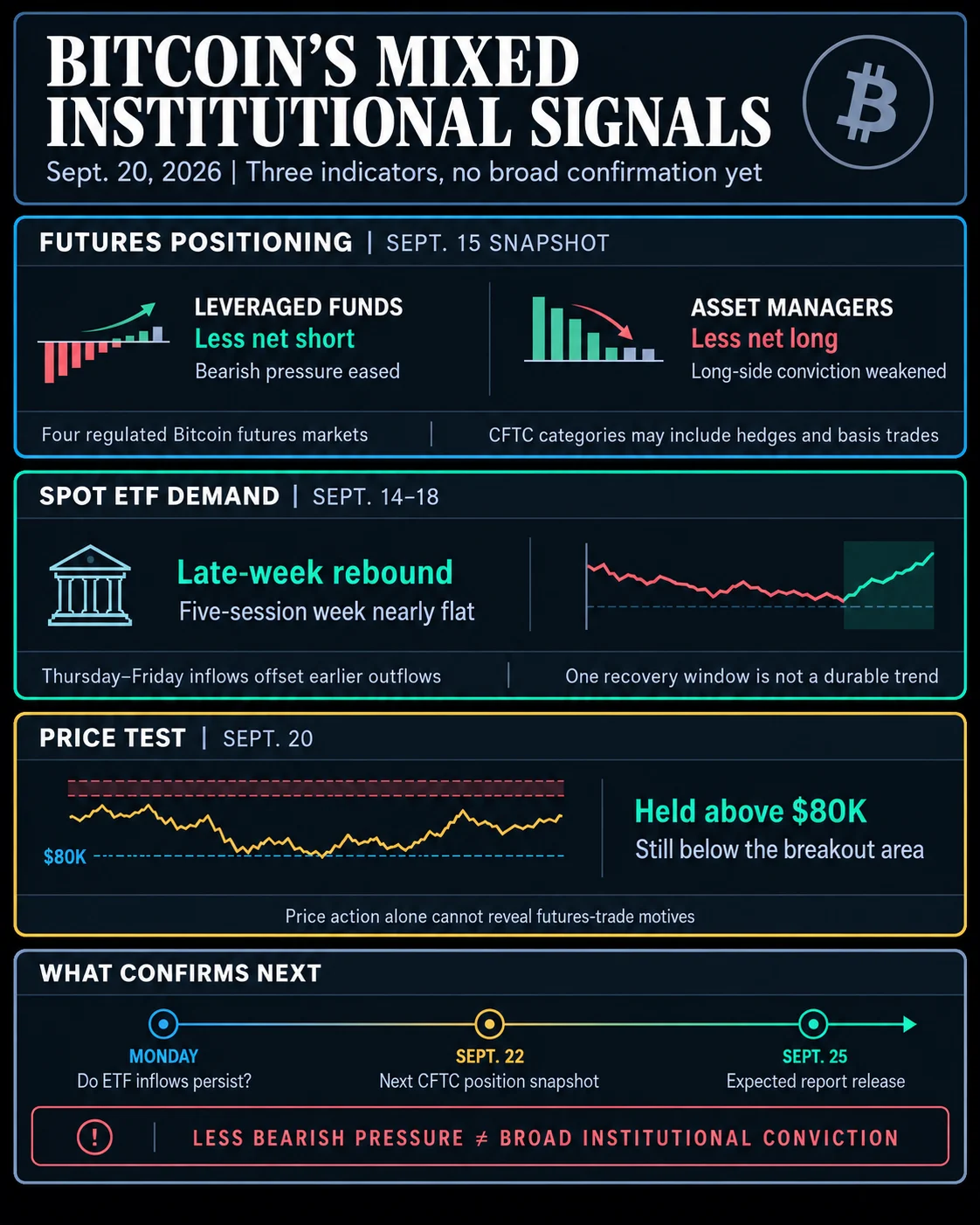
Bitcoin maintained a critical support level above $80,000 over the most recent weekend, even as institutional data points from the futures and spot exchange-traded fund (ETF) markets presented a complex and often contradictory picture of professional sentiment. While the headline price remained resilient, underlying metrics from the Commodity Futures Trading Commission (CFTC) and US-listed spot ETFs suggest a period of transition rather than a unified bullish breakout. The market currently finds itself in a state of flux, characterized by a reduction in bearish bets from leveraged funds, a simultaneous cooling of long-side conviction among asset managers, and a spot ETF market that narrowly avoided a net-negative week through a late-session surge in liquidity.
As of the Sept. 20 market refresh, Bitcoin was trading at approximately $80,338.71, supported by a 24-hour trading volume of $22.38 billion. Despite the psychological victory of holding the $80,000 handle, the digital asset continues to face significant technical overhead. Market analysts have identified a stubborn resistance zone between $82,000 and $82,200, an area that has historically capped recent upward momentum. The inability to breach this ceiling, despite the easing of short pressure in the futures market, suggests that institutional "wait-and-see" sentiment remains the prevailing theme.
Deciphering the CFTC Commitments of Traders Data
The most recent snapshot from the CFTC, covering positions as of Sept. 15, provides a granular look at how different classes of institutional participants are navigating the current price environment. This data encompasses four regulated products: the CME Group’s standard Bitcoin futures, CME micro Bitcoin futures, and Coinbase Derivatives’ nano and nano-perpetual contracts. Because these instruments vary significantly in size—ranging from five BTC per contract for standard CME futures to fractions of a coin for nano products—analysts must normalize the data into "BTC-equivalent" units to understand the aggregate exposure.
According to the Sept. 15 report, leveraged funds—a category that typically includes hedge funds and commodity trading advisors (CTAs) often engaged in speculative or arbitrage strategies—became notably less net short. Their aggregate net-short exposure fell to approximately 32,602 BTC-equivalent, a decrease of 7,275 BTC from the 39,877 BTC-equivalent net short recorded on Sept. 8. This narrowing of the net-short position was driven by a dual action: an increase in aggregate long exposure and a reduction in aggregate short exposure. While this represents a retreat from aggressive bearish positioning, it is important to note that this group remains materially net short in the aggregate.
In contrast, the "asset manager" category—which includes pension funds, endowments, and insurance companies—saw a reduction in their bullish conviction. This group remains net long across the four regulated products, but their aggregate position dropped to 14,133 BTC-equivalent from the previous week’s 18,866 BTC-equivalent. This decline of 4,733 BTC suggests that some of the largest institutional players may be taking profits or de-risking their portfolios following Bitcoin’s recent approach toward the $80,000 milestone.
The Tale of Two Halves: US Spot ETF Inflows
While the futures market showed a convergence toward more neutral territory, the US spot Bitcoin ETF market experienced a week of extreme volatility in demand. Data from Farside Investors reveals that the week of Sept. 14 through Sept. 18 was nearly a wash, finishing with a meager $6.1 million in net inflows across all products. However, the weekly total masks a significant shift in momentum that occurred mid-week.
The first three sessions of the week were characterized by substantial outflows, reflecting broader market anxiety ahead of macroeconomic updates. However, the trend reversed sharply on Sept. 17 and Sept. 18. On Sept. 17, the ETFs recorded $159.5 million in net inflows, followed by a massive $433.0 million surge on Sept. 18. Combined, these two sessions brought in $592.5 million, effectively erasing the losses from earlier in the week.
This late-week recovery is viewed by some analysts as a "relief rally" in institutional demand, likely triggered by increased clarity regarding Federal Reserve policy. Nevertheless, the fact that the week ended almost flat suggests that the "buy-the-dip" mentality is being balanced by an equal desire to exit positions during periods of price strength. The upcoming US trading sessions will be critical in determining whether the $592.5 million surge was a momentary anomaly or the start of a sustained trend of institutional allocation.

Chronology of Market Moves and Institutional Response
The current market state is the result of a specific sequence of events that began in early September. To understand the divergence in indicators, one must look at the timeline of price action and reporting:
- Sept. 8 – Sept. 14: Bitcoin experienced volatility as leveraged funds initially added to their net-short positions, as seen in the previous CFTC report. During this window, spot ETFs faced consistent selling pressure, reflecting a cautious stance ahead of the Federal Reserve’s interest rate decision.
- Sept. 15: The CFTC snapshot date. At this point, Bitcoin was consolidating, and leveraged funds began covering shorts, possibly in anticipation of a "dovish" pivot from the Fed or as part of a basis-trade adjustment.
- Sept. 17 – Sept. 18: The Federal Reserve’s policy shift catalyzed a surge in risk-on sentiment. This is reflected in the $592.5 million ETF inflow over these two days. Bitcoin’s price began its climb back toward the $80,000 level.
- Sept. 20 (The Weekend): Bitcoin successfully held above $80,000, but failed to challenge the $82,000 resistance. The market is now waiting for the next CFTC report (expected Sept. 25) to see how the post-Fed move altered institutional positioning.
Structural Differences in Reporting and Market Implications
It is vital for market participants to distinguish between the various data sources, as they measure different aspects of the market and operate on different timeframes. The CFTC’s Commitments of Traders (COT) report classifies traders based on their primary business activity rather than the intent of a specific trade. A "leveraged fund" might hold a short position not because it expects Bitcoin to crash, but as part of a "basis trade"—buying spot Bitcoin and selling futures to capture the premium (contango).
Furthermore, the CFTC data is retrospective. The Sept. 15 report was released on Sept. 18, and it reflects positions held on the preceding Tuesday. Therefore, it does not account for the dramatic shifts in sentiment that may have occurred during the high-volume ETF sessions of Sept. 17 and 18.
The ETF data, while more current, measures net fund flows (creations and redemptions) rather than open interest or specific directional bets. When these two datasets are viewed together, they show two institutional groups moving closer to a neutral stance from opposite directions. The reduction in shorts by leveraged funds removes a primary bearish headwind, but the reduction in longs by asset managers suggests a lack of aggressive "chasing" at current price levels.
Analysis of the $82,000 Resistance and Future Outlook
The immediate future of Bitcoin’s price action appears tied to the $82,000 to $82,200 resistance zone. Technical analysts note that this area represents a "confluence of supply," where previous buyers who were "trapped" during earlier price drops may be looking to break even. A clean break above this level, supported by rising volume, would likely require a more synchronized bullish signal from both the futures and spot markets.
For a durable-demand case to emerge, the market would need to see:
- Sustained ETF Inflows: A continuation of the Sept. 17-18 trend into the following week, proving that institutional "dry powder" is being deployed.
- Asset Manager Re-accumulation: Future CFTC reports showing that asset managers are rebuilding their net-long positions, signaling long-term confidence.
- Short Capitulation: A further decline in leveraged net shorts, which could trigger a "short squeeze" if the price breaks the $82,200 barrier.
Conversely, the bullish thesis would weaken if ETF flows turn negative again or if leveraged funds begin aggressively rebuilding short positions at the $82,000 resistance.
Conclusion: A Market in Search of Conviction
The data from the past week highlights the complexity of Bitcoin’s transition into a mature institutional asset. The days of uniform market movements are being replaced by sophisticated strategies where one group’s selling is another’s hedging. While Bitcoin holding $80,000 is a significant milestone, the divergence between the CFTC and ETF data suggests that institutional conviction is not yet unanimous.
The next critical data point will be the Sept. 22 CFTC snapshot, scheduled for release on Sept. 25. This will be the first report to capture the institutional reaction to the post-Fed environment and the move back above $80,000. Until then, the market remains in a state of high-level consolidation, with price action serving as the ultimate arbiter of sentiment. For now, the evidence is narrower than the headline price might suggest: the "bears" are retreating, but the "bulls" are not yet charging with full force.









