
 James Watt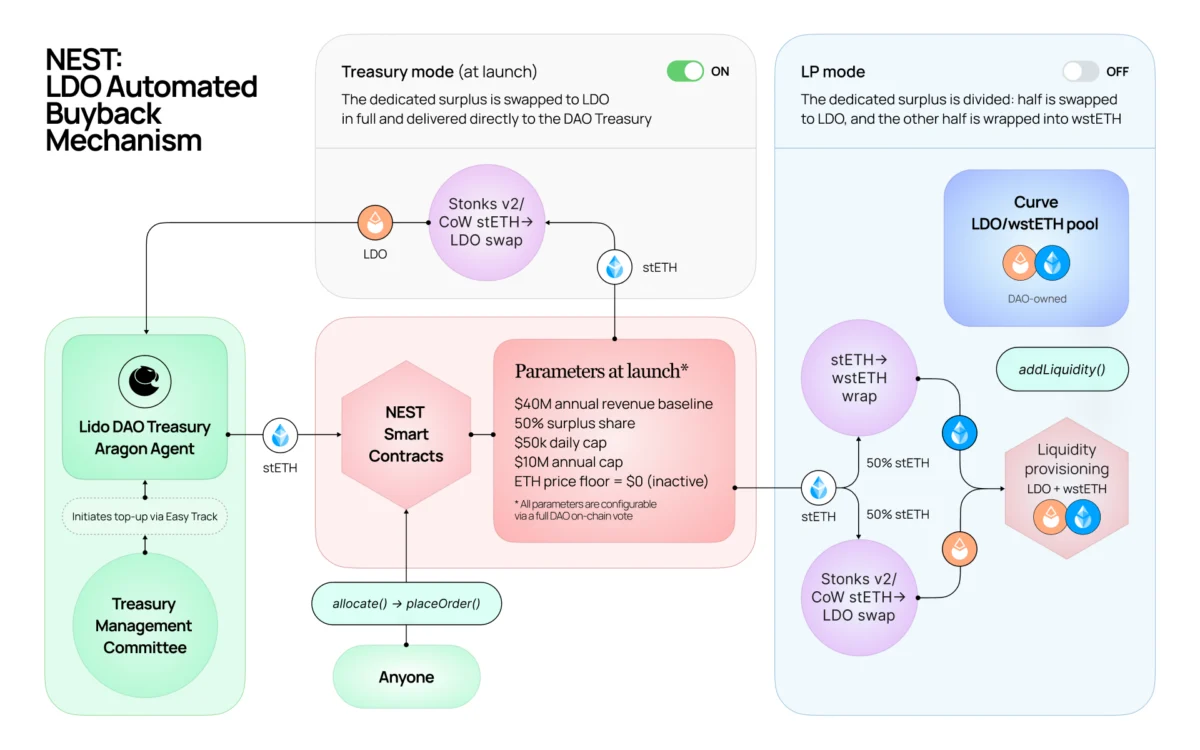
The Lido DAO, a vanguard in the decentralized finance (DeFi) landscape, has officially launched its Network Economic Support Tokenomics (NEST) mechanism, a sophisticated onchain system designed to directly link the success of the Lido protocol to the utility and acquisition of its native governance token, LDO. This initiative, a core strategic objective articulated for 2025 and reaffirmed for 2026, represents a significant evolution in decentralized autonomous organization (DAO) treasury management and tokenomics, aiming to foster greater economic alignment and sustainability.
At its essence, NEST operates as a programmatic framework that intelligently allocates a portion of Lido protocol revenue to acquire LDO tokens. This acquisition process is financed by surpluses generated within the DAO treasury, establishing a direct, transparent, and permissionless economic feedback loop. The introduction of NEST is the culmination of extensive internal discussions, research, and community votes, reflecting Lido DAO’s commitment to robust, decentralized governance and long-term value creation for its stakeholders. This article delves into the intricate design choices, operational mechanics, initial parameters, and comprehensive security measures underpinning the NEST mechanism.
Background and Strategic Imperative: The Drive for LDO Alignment
Lido DAO stands as the preeminent liquid staking solution for Ethereum and other proof-of-stake blockchains, enabling users to stake their assets while retaining liquidity through derivative tokens like stETH. Its operational philosophy is rooted in open strategic cycles, where goals are publicly set, and the Lido Foundations are tasked with their delivery. For years, a central theme within these strategic deliberations has been the concept of "LDO alignment"—the imperative to forge a stronger, more direct economic nexus between the LDO token and the intrinsic performance and growth of the Lido protocol itself.
The LDO token, while serving as the governance backbone, traditionally derived its economic utility primarily from voting power and the potential for future fee distributions. However, as the liquid staking market matured and Lido solidified its market leadership, the community recognized the need for a more dynamic and automated mechanism to translate protocol success directly into LDO’s economic value proposition. This vision was formally enshrined as a key strategic goal for 2025 and subsequently carried forward into the 2026 roadmap, underscoring its foundational importance to Lido’s long-term health and decentralization. The aim was not merely to conduct discretionary buybacks but to embed an immutable, programmatic system that would automatically respond to the protocol’s financial performance, thereby enhancing the LDO token’s utility and economic stability without requiring constant manual intervention or subjective decision-making.
The Genesis of Automated Buybacks: A Commitment to Decentralization
The journey to NEST was marked by a rigorous adherence to Lido DAO’s foundational principles: transparency, security, and decentralization. Unlike many centralized entities that might employ opaque or discretionary treasury management strategies, Lido DAO mandates that all significant protocol upgrades and financial allocations pass through fully onchain votes. Furthermore, its innovative Dual Governance model provides stETH holders with built-in oversight of crucial DAO decisions, while routine treasury allocations are managed through optimistic Easy Track motions, ensuring efficiency without compromising security.
In the context of LDO buybacks, this commitment meant rejecting simpler, less transparent alternatives. Early proposals that might have involved manual execution or reliance on a single committee were carefully weighed and ultimately dismissed. The DAO sought a mechanism that would be entirely permissionless, auditable onchain, and perpetually under the collective control of LDO holders. This meticulous approach led to the development and eventual approval of the technical infrastructure and mechanism design via two critical Snapshot votes. The first vote, passed with overwhelming community support, established the underlying technical rails, ensuring the smart contract architecture was robust and secure. The second vote formally approved the mechanism design, cementing the programmatic rules that would govern NEST’s operation. These approvals underscored the community’s collective endorsement of a transparent, automated, and fully decentralized approach to LDO economic alignment.
How NEST Operates: A Deep Dive into the Mechanism
NEST is engineered as a sophisticated programmatic system designed to leverage Lido protocol revenue for LDO acquisition. The core operational logic, meticulously detailed in Lido Improvement Proposal (LIP-36), dictates that when the protocol’s staking revenue surpasses a predefined operating baseline, a bounded share of this surplus is systematically converted into LDO tokens. This conversion is executed through CoW Swap, a decentralized exchange aggregator known for its MEV protection and efficient order execution, ensuring optimal pricing and minimal market impact. The direct correlation is clear: as the protocol’s earnings grow, so too does the volume of LDO acquired through NEST, creating a virtuous cycle that economically links token performance to protocol success.
The mechanism is designed to be fully onchain and permissionless, meaning once activated, it operates autonomously based on its coded parameters. The Lido DAO retains sovereign control, however, as it can adjust these key parameters through subsequent onchain votes, allowing the mechanism to adapt to evolving market conditions and protocol economics. While NEST currently tracks only Lido protocol staking revenue, its architectural design is forward-compatible, built to seamlessly integrate additional revenue sources from Lido’s expanding product line through future governance decisions.
Modes of NEST: Optimizing for Market Conditions
Recognizing the dynamic nature of onchain liquidity, particularly for tokens like LDO, NEST’s buyback mechanism incorporates two distinct operational modes to optimize performance and minimize market impact:
-
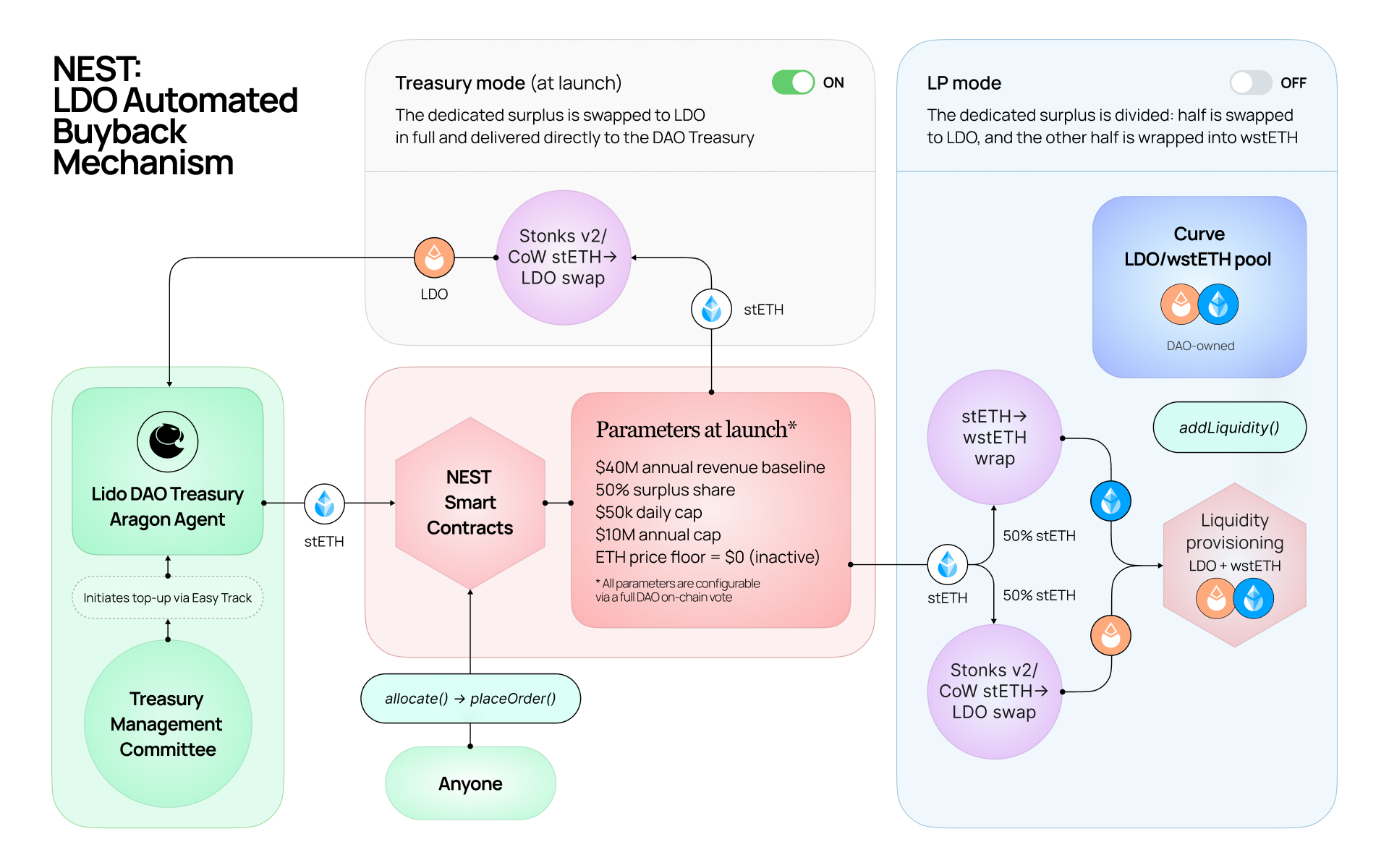
Treasury-only Mode: In this default and currently active mode, the daily allocation designated for LDO acquisition is converted in full. The acquired LDO tokens are then directly transferred to the DAO treasury via an Aragon Agent contract (e.g.,
0x3e40D73EB977Dc6a537aF587D48316feE66E9C8c). This mode is particularly suitable for initial deployment, especially when onchain LDO liquidity might be relatively shallow, ensuring that buybacks are efficient and directly contribute to the DAO’s strategic LDO holdings. -
LP Mode: This mode offers a more nuanced approach to LDO acquisition and liquidity provision. When activated, the daily allocation is bifurcated: half is utilized to purchase LDO, while the other half is wrapped into wstETH (wrapped liquid staked Ether). Both components—LDO and wstETH—are then deposited as DAO-owned liquidity into a dedicated Curve v2 NG pool. The resulting LP tokens, representing the DAO’s share of liquidity, remain under direct DAO ownership. LP mode is designed to deliver its benefits under specific market conditions, particularly when the market can absorb larger, more consistent liquidity injections without significant slippage. The underlying Curve pool has already been deployed in anticipation of this mode, allowing for a seamless transition from Treasury-only mode to LP mode with a simple onchain governance vote when conditions warrant.
The strategic decision to launch NEST in Treasury-only mode reflects a pragmatic approach, prioritizing efficient LDO accumulation for the DAO while preserving the option to enhance market liquidity via LP mode in the future.
NEST Parameters: Precision and Safety
The initial configuration of NEST, rigorously approved by the DAO, incorporates several critical parameters designed to balance efficient LDO acquisition with robust risk management:
- Revenue Baseline: A pre-defined operational baseline for Lido protocol staking revenue. Only revenue exceeding this baseline contributes to the surplus.
- Surplus Allocation Share: At launch, 50% of the daily surplus (the difference between actual revenue and the baseline) is added to a running NEST balance.
- Daily Purchase Cap: A hard cap of $50,000 on the value of LDO that can be purchased in any single day.
- Cumulative Model: NEST employs a cumulative balance model rather than a simple daily spend. If the running NEST balance is positive, LDO is purchased daily within the specified caps. If the balance turns negative (e.g., due to lower revenue days), purchases are paused until new surplus revenue replenishes the balance.
This cumulative model was a deliberate design choice, crafted to mitigate two critical failure modes inherent in a purely daily-spend approach: preventing overspending during consecutive periods of exceptionally high revenue and ensuring that unused capacity from leaner days can be carried forward, optimizing long-term efficiency. The $50,000 daily cap serves as the primary safety guardrail, effectively bounding the protocol’s exposure to approximately $300,000 over a typical six-day governance response window, providing ample time for the DAO to react to unforeseen circumstances if necessary.
To validate its efficacy, the NEST model underwent extensive backtesting using historical revenue data from 2024–2025. The results were compelling: the model would have precisely delivered its target spend of $7.09 million from a total of $94.18 million in rewards generated during that period. This robust backtesting provides strong empirical evidence of the mechanism’s predictability and efficiency in achieving its stated objectives. Detailed calculations, alongside comprehensive comparisons against alternative designs, are publicly documented in LIP-36 and accessible through the Lido Research forum discussions, upholding the DAO’s commitment to transparency. All parameter values, including the surplus allocation share and daily cap, are fully adjustable through a full DAO vote, empowering the community to fine-tune NEST as the protocol’s economic landscape evolves.
Mitigating Risks: A Multi-layered Security Approach
Implementing a programmatic mechanism that autonomously spends treasury assets daily inherently introduces specific risks. The design of NEST has meticulously addressed these concerns through a multi-layered security approach:
- Transparency and Auditability: Every transaction executed by NEST is recorded on the blockchain, making all operations fully transparent and auditable by anyone. This public ledger ensures accountability and prevents hidden activity.
- Decentralized Control: All critical parameters are adjustable solely through a full Lido DAO vote. This prevents any single entity or small group from unilaterally altering the mechanism’s behavior, reinforcing decentralization.
- Hard Caps and Circuit Breakers: The $50,000 daily purchase cap acts as a fundamental safety guardrail, limiting the potential financial exposure in any given 24-hour period. The cumulative balance model also functions as a circuit breaker, pausing purchases if revenue surpluses are insufficient, preventing depletion of the treasury during sustained periods of lower revenue.
- DAO-Owned Assets: Crucially, all LDO acquired through the NEST mechanism remains under the direct ownership of the Lido DAO. Any movement of these assets outside the predefined operational paths of NEST requires explicit and separate DAO authorization, ensuring that funds are never at risk of unauthorized dissipation.
- Smart Contract Audits: While not explicitly stated in the provided text, a mechanism of this criticality would undoubtedly undergo rigorous smart contract audits by leading blockchain security firms. These audits would identify and mitigate potential vulnerabilities before deployment, adding another layer of security.
Expert Reactions and Broader Implications
The launch of NEST has garnered significant attention within the DeFi community, with many hailing it as a pioneering step in DAO tokenomics.
"NEST represents a significant step in aligning the LDO token with the core value generated by the Lido protocol," stated Dr. Alistair Finch, a representative of the Lido Foundation. "This mechanism underscores our unwavering commitment to transparent, decentralized governance and long-term value creation for all stakeholders. It’s an embodiment of our strategic vision to make LDO’s economic utility as robust as its governance utility."
Prominent DeFi analyst, Isabella "CryptoMaven" Rossi, commented, "This move by Lido DAO could set a new standard for tokenomics in the decentralized finance space. By programmatically linking protocol revenue to LDO acquisition, Lido is not only strengthening its token’s economic utility but also reinforcing confidence in its decentralized governance model. It provides a clear, verifiable mechanism for LDO holders to participate in the protocol’s success, moving beyond mere speculative value."
The broader implications of NEST are far-reaching:
- For LDO Holders: NEST provides a tangible, onchain mechanism for LDO to benefit directly from the protocol’s operational success. This enhanced economic utility has the potential to increase demand for LDO, contributing to its stability and value proposition, and fostering a stronger alignment of interests between the protocol’s performance and token holders.
- For the Lido Protocol: By strengthening LDO’s tokenomics, NEST bolsters the overall economic stability of the Lido protocol. It demonstrates a sophisticated approach to treasury management and token value accrual, which can further attract stakers and reinforce Lido’s dominant position in the liquid staking market.
- For the DeFi Ecosystem: NEST offers a robust, transparent, and decentralized model for other DAOs contemplating similar token utility and revenue distribution mechanisms. It exemplifies how automated, onchain systems can manage complex financial flows within a decentralized framework, pushing the boundaries of what is possible in DeFi governance and tokenomics.
- Future Growth Potential: With its flexible architecture, NEST is well-positioned to integrate future revenue streams from Lido’s expanding product line, including potential multi-chain liquid staking derivatives or new service offerings. This ensures that the mechanism can evolve alongside the protocol, maintaining its relevance and effectiveness in a dynamic ecosystem.
Distinguishing NEST from the LDO Accumulation Program
It is crucial to differentiate NEST from the LDO Accumulation Program, a separate, distinct treasury operation approved by the Lido DAO on April 13, 2026. While both involve LDO acquisition, the LDO Accumulation Program is a discretionary, one-time initiative executed by a committee, designed to capitalize on specific market opportunities for strategic LDO accumulation. It is fundamentally unrelated to NEST in its design, governance, and operational methodology. Details regarding the batch parameters, execution updates, and further specifics of the LDO Accumulation Program are published on the Lido Research forum, ensuring clarity and transparency for the community. NEST, by contrast, is a structural, automated, and continuous mechanism embedded directly into the protocol’s economic flow.
In conclusion, the launch of the Network Economic Support Tokenomics (NEST) mechanism marks a pivotal moment for the Lido DAO. It embodies a sophisticated, transparent, and robust approach to tokenomics, designed to deeply align the LDO token with the enduring success of the Lido protocol. By establishing an automated, onchain link between protocol revenue and LDO acquisition, NEST reinforces Lido’s commitment to decentralized governance, long-term sustainability, and enhanced economic utility for its thriving community.









