James Watt
The Lido DAO, a vanguard in decentralized autonomous organizations, has officially launched its Network Economic Support Tokenomics (NEST) mechanism, marking a significant milestone in its ongoing commitment to LDO alignment. This innovative on-chain system is designed to directly tie the success and revenue generation of the Lido protocol to the intrinsic value and acquisition of its native governance token, LDO, funded strategically from DAO treasury surpluses. This initiative, a core strategic goal identified for 2025 and reaffirmed for 2026, represents a sophisticated evolution in decentralized finance (DeFi) tokenomics, emphasizing transparency, automation, and long-term sustainability for one of the largest liquid staking protocols.
A Strategic Imperative: LDO Alignment and Protocol Growth
Lido Finance has cemented its position as a dominant force in the liquid staking landscape, particularly within the Ethereum ecosystem, where its stETH token plays a crucial role. As a decentralized autonomous organization, the Lido DAO operates through open strategic cycles, meticulously outlining goals and delegating their execution to the Lido Foundations. Among these foundational objectives, the imperative of "LDO alignment" has consistently stood out. This principle underscores the need to ensure that the LDO token, primarily a governance asset, also directly reflects and benefits from the operational success and growth of the underlying Lido protocol. The launch of NEST is the culmination of extensive research, community deliberation, and technical development aimed at achieving this critical alignment.
The rationale behind LDO alignment is multi-faceted. In the rapidly evolving DeFi space, a robust tokenomic model is paramount for sustained growth, security, and community engagement. By linking LDO acquisition directly to protocol revenue, NEST aims to create a symbiotic relationship where increased adoption and profitability of Lido translate into tangible value for LDO holders. This mechanism is anticipated to foster greater participation, incentivize long-term holding, and fortify the economic security of the DAO, thereby reinforcing Lido’s leadership in decentralized staking.
Chronology of a Vision: From Goal Setting to Mechanism Launch
The journey to NEST has been a deliberate and transparent process, characteristic of the Lido DAO’s operational ethos. The initial groundwork for enhanced LDO alignment was laid in 2025, with strategic discussions and proposals emerging from the Lido research forum. These early conversations, encapsulated in submissions like "Hasu’s Goose 2: A Product Line Approach to Grow Lido’s Staking Ecosystem," highlighted the strategic importance of deepening the connection between the LDO token and the protocol’s performance. The commitment was further solidified and carried into the 2026 strategic cycle, as detailed in "Lido Labs: Goose 3 – Lido’s Next Chapter," which continued to prioritize LDO tokenomics alignment.
Following these strategic directives, the DAO proceeded with the detailed design and implementation phases. On March 29, 2026, the Lido DAO approved the technical infrastructure necessary for automated buybacks via a comprehensive on-chain vote (Proposal 0x4267fe277e52a3550e82286af96948a258392ddd303df6b479c4d8f4664acdd0 on Snapshot). Subsequently, on May 24, 2026, the specific mechanism design for these buybacks was formally endorsed by the DAO (Proposal 0x022e901a6368573d18b150eecda563dd2ee17ad2aa6a0ef9772151cc7ba55187 on Snapshot). These approvals paved the way for the eventual deployment of NEST, ensuring that the entire process adhered to the DAO’s stringent standards for transparency, security, and decentralized governance. The official launch of NEST marks the successful culmination of these efforts, transitioning a strategic vision into a live, operational protocol feature.
It is crucial to distinguish NEST from another recent Lido DAO initiative, the LDO Accumulation Program. Approved on April 13, 2026, this program is a separate, one-time treasury operation, managed discretionally by a committee, and designed to capitalize on specific market opportunities. Unlike NEST, which is a structural, automated, and continuous mechanism, the Accumulation Program is an ad-hoc initiative, distinct in its design, governance, and purpose. Further details on its execution and batch parameters are available on the Lido Research forum, underscoring the DAO’s commitment to public information sharing.
NEST: An Automated Engine for LDO Acquisition
At its core, NEST is an elegant, programmatic system designed to leverage Lido protocol revenue for LDO acquisition. The mechanism operates under clearly defined thresholds and conditions, meticulously outlined in Lido Improvement Proposal (LIP-36). In essence, when the staking revenue generated by the Lido protocol surpasses an established operating baseline, a predetermined and bounded share of this surplus revenue is automatically converted into LDO tokens. This conversion is executed via CoW Swap, a decentralized exchange aggregator renowned for its ability to provide optimal trade execution and mitigate Maximal Extractable Value (MEV) exploits, ensuring fair and efficient LDO acquisition for the DAO treasury. The principle is straightforward: as the Lido protocol’s earnings grow, so does the volume of LDO acquired through NEST, creating a direct and transparent link between protocol performance and token value.
The design of NEST incorporates two distinct operational modes to optimize its performance and adaptability within varying market conditions, particularly concerning on-chain LDO liquidity:
-
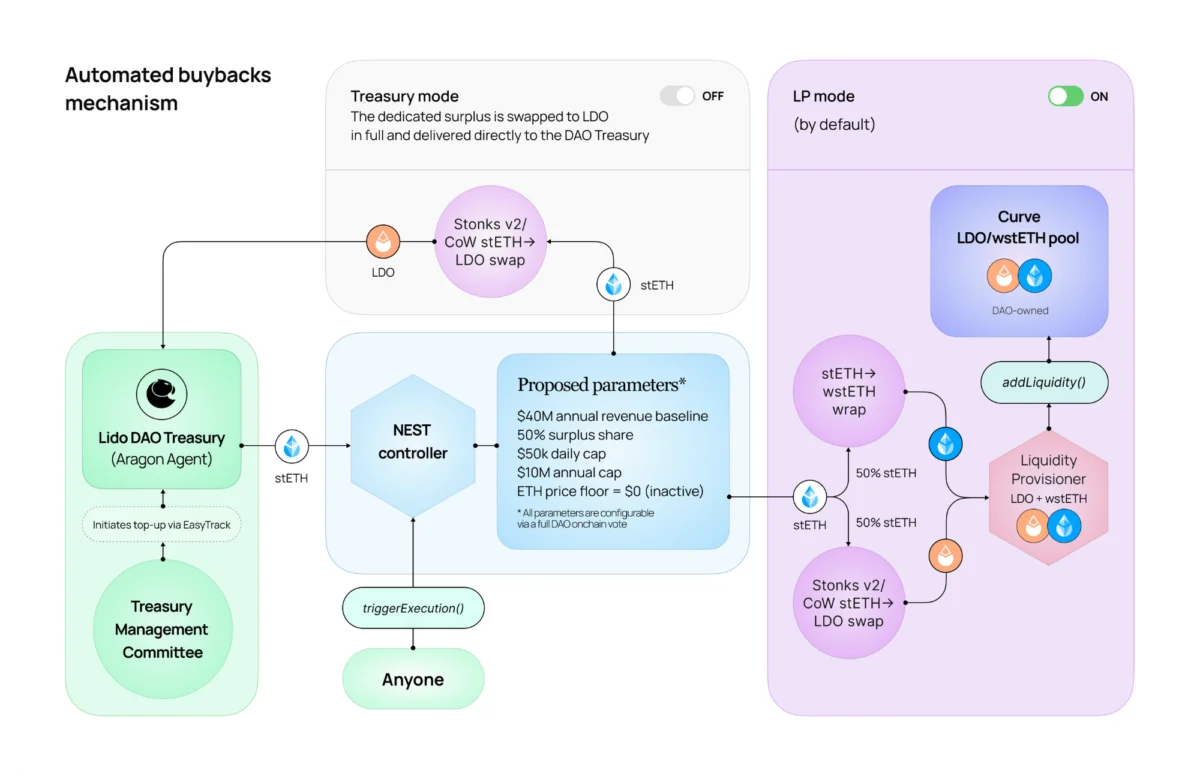
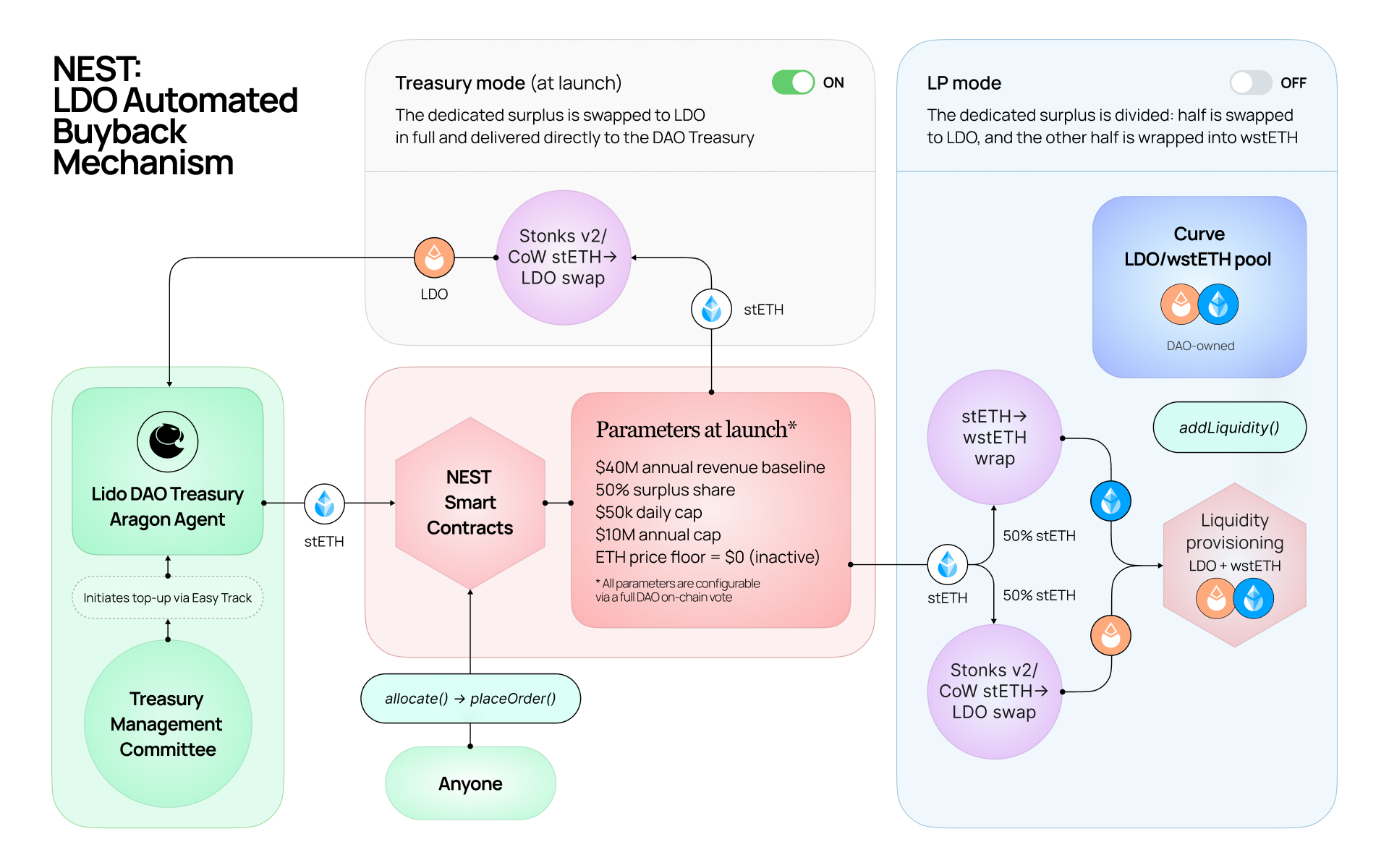
Treasury-only Mode: This is the default mode activated at launch. In this configuration, the daily allocation of surplus revenue is entirely converted into LDO. These acquired LDO tokens are then directly transferred to the DAO treasury via a dedicated Aragon Agent contract (0x3e40D73EB977Dc6a537aF587D48316feE66E9C8c). This mode prioritizes direct accumulation of LDO into the DAO’s reserves, strengthening its balance sheet and providing a straightforward mechanism for token alignment.
-
LP Mode (Liquidity Provision Mode): While not active at launch, NEST is engineered to seamlessly transition into LP mode with a simple on-chain vote from the DAO. In this mode, the daily allocation of surplus revenue is bifurcated. Half of the funds are used to purchase LDO, similar to the Treasury-only mode. The other half is wrapped into wstETH (wrapped liquid staked ETH). Both the newly acquired LDO and the wstETH are then deposited as DAO-owned liquidity into a specially deployed Curve v2 NG pool. The LP tokens generated from this deposit remain under the full ownership and control of the DAO. This mode is designed to deliver benefits under specific market conditions, primarily by enhancing on-chain LDO liquidity, reducing potential price volatility during buybacks, and potentially generating additional fee revenue for the DAO through its participation in the liquidity pool. The Curve pool is already established, streamlining a future activation of this mode.
The entire NEST mechanism is designed to be fully on-chain and permissionless, embodying the ethos of decentralization. The Lido DAO retains ultimate control over NEST’s operational parameters, with any adjustments requiring a formal on-chain vote. Furthermore, while NEST initially focuses solely on Lido protocol staking revenue, its architecture is forward-compatible. This foresight allows the DAO to integrate additional revenue sources from Lido’s expanding product line through future governance votes, ensuring NEST remains a dynamic and adaptable component of Lido’s tokenomics strategy as the protocol diversifies its offerings.
Operational Parameters and Financial Projections
At its genesis, NEST operates under a carefully calibrated set of parameters approved by the Lido DAO, designed to ensure both efficacy and safety:
- Revenue Baseline Comparison: Each day, NEST meticulously compares the DAO’s share of Lido’s staking revenue against a predefined revenue baseline. This baseline acts as a threshold, ensuring that LDO acquisition only occurs when the protocol is generating sufficient surplus.
- Surplus Allocation: Fifty percent (50%) of the difference between the actual revenue and the baseline (i.e., the surplus) is added to a running NEST balance. This percentage, set at launch, can be adjusted by the DAO in the future.
- Daily LDO Acquisition: As long as the running NEST balance remains positive, the mechanism initiates daily LDO purchases. These purchases are executed within specified daily and cumulative caps, acting as critical safety guardrails.
- Pause Mechanism: Should the running NEST balance turn negative, indicating insufficient surplus revenue, LDO purchases are automatically paused. This ensures that the DAO treasury is not over-extended and that acquisitions are only made from genuine surpluses. Purchases resume once new surplus revenue restores the balance.
A crucial design choice within NEST is the implementation of a cumulative model for managing the buyback balance. This approach was deliberately selected to circumvent two common pitfalls of a purely daily-spend model: the risk of overspending during periods of consecutively high revenue and the inability to carry forward unused capacity from days with lower surplus. By maintaining a running balance, NEST ensures a more consistent and predictable LDO acquisition strategy, smoothing out market impact and optimizing treasury utilization.
A primary safety feature is the $50,000 daily cap on LDO purchases. This limit is strategically set to bound the DAO’s exposure over a typical six-day governance response window to approximately $300,000. This conservative cap provides ample time for the DAO to react to any unforeseen market conditions or operational anomalies, demonstrating a proactive approach to risk management.
To validate its design and project its potential impact, the NEST model underwent rigorous backtesting using historical Lido protocol revenue data from 2024 to 2025. The results were compelling: the model indicated that NEST would have successfully delivered $7.09 million in LDO acquisition, precisely hitting its target spend from a total of $94.18 million in rewards generated during that period. This translates to approximately 7.5% of total rewards being directed towards LDO acquisition through the NEST mechanism under those historical conditions, providing a clear illustration of its potential for consistent value alignment. Comprehensive calculations and detailed comparisons with alternative design proposals are thoroughly documented in LIP-36 and accessible through the Lido Research forum discussion, upholding the DAO’s commitment to transparent decision-making.
All of NEST’s parameter values are dynamic and can be adjusted through a full DAO vote, allowing the Lido community to fine-tune the mechanism in response to evolving protocol economics, market dynamics, and strategic priorities.
Mitigating Risks: A Multi-Layered Security Approach
Implementing a programmatic mechanism that regularly interacts with treasury assets introduces specific risks, which the NEST design meticulously addresses through a multi-layered security framework:
- Smart Contract Risk: Given the on-chain nature of NEST, smart contract vulnerabilities represent a critical concern. While not explicitly detailed in the provided text, it is standard practice for the Lido DAO to subject all critical protocol upgrades and new mechanisms to rigorous, independent security audits by leading blockchain security firms. These audits typically involve static analysis, dynamic testing, and formal verification where appropriate, aiming to identify and rectify any potential exploits before deployment. The robustness of Lido’s existing codebase and governance mechanisms (like Aragon Agent) further contributes to the overall security posture.
- Market Impact and Price Volatility: Automated daily buybacks, if not carefully managed, could inadvertently create market instability or be susceptible to front-running. NEST mitigates this through several design choices:
- Daily Cap: The $50,000 daily purchase limit significantly restricts the immediate market impact, preventing large, sudden spikes in demand that could be exploited.
- CoW Swap Integration: Utilizing CoW Swap for LDO acquisition is a strategic choice. CoW Swap leverages batch auctions and uniform clearing prices, which inherently protect against MEV and front-running. This ensures that the DAO acquires LDO at the fairest possible price without causing undue market disruption. The batching process also creates a time-weighted average price (TWAP)-like effect over the daily execution window, further smoothing market impact.
- Treasury Drain and Fund Mismanagement: A persistent, automated spending mechanism carries the risk of depleting treasury assets without proper safeguards. NEST counters this through:
- Cumulative Model and Pause Mechanism: The cumulative balance model ensures that LDO acquisition is strictly tied to actual protocol surpluses. The automatic pause mechanism, activated when the balance is negative, acts as a hard stop, preventing any spending beyond available surplus and protecting the DAO’s financial health.
- DAO Ownership and Control: All LDO assets acquired through NEST remain under the direct, irrevocable ownership of the Lido DAO. Any movement or utilization of these assets outside of NEST’s defined operational pathways requires explicit and transparent authorization through a full DAO vote, ensuring complete accountability and preventing unauthorized access or diversion of funds.
- Governance Attacks and Malicious Control: As a decentralized protocol, Lido must constantly guard against attempts to compromise its governance. The NEST mechanism is integrated within Lido’s established robust governance framework:
- Dual Governance: This innovative system provides stETH holders with built-in oversight, allowing them to veto or influence critical DAO decisions, adding an extra layer of security.
- Easy Track Motions: For routine treasury allocations and operational adjustments, Lido utilizes optimistic Easy Track motions, which streamline processes while maintaining transparency and allowing for challenge periods.
- Full On-Chain Votes: Major protocol upgrades and parameter changes, including those for NEST, necessitate full on-chain votes, ensuring broad community consensus and preventing centralized control.
Broader Impact and Future Implications
The launch of NEST by the Lido DAO is more than just a new feature; it represents a significant advancement in the architecture of decentralized autonomous organizations and tokenomics.
For LDO Holders: The direct link between protocol revenue and LDO acquisition is expected to create a sustained, organic buying pressure for the LDO token. This mechanism aims to enhance LDO’s fundamental value proposition, aligning the financial interests of token holders more closely with the operational success of the Lido protocol. It could lead to increased stability, predictability, and potentially long-term appreciation for LDO, rewarding active participation and belief in Lido’s mission.
For the Lido Protocol: NEST strengthens Lido’s overall economic model. By systematically acquiring LDO, the DAO can enhance its treasury reserves of its native token, which can be strategically deployed for future initiatives, protocol development, or further decentralization efforts. This proactive treasury management through an automated system reduces reliance on discretionary, often less predictable, manual interventions. It also signals a mature approach to tokenomics, which can attract more users and institutional partners to the Lido ecosystem.
For the DeFi Ecosystem: Lido’s implementation of NEST sets a precedent for transparent, automated, and robust tokenomic models. As the DeFi space matures, the demand for sustainable and well-governed protocols grows. NEST demonstrates how a large-scale DAO can implement sophisticated financial mechanisms that are both efficient and aligned with decentralized principles. This could inspire other DAOs to explore similar models, contributing to the overall stability and innovation of the broader decentralized finance landscape. The strategic use of CoW Swap for MEV resistance in buybacks is also a notable best practice that other protocols may emulate.
Future Growth and Expansion: The architectural foresight to allow NEST to integrate additional revenue sources from Lido’s "expanding product line" is particularly impactful. This suggests that as Lido ventures into new liquid staking derivatives, layer-2 solutions, or other DeFi services, NEST can evolve to capture these new revenue streams, further compounding its effect on LDO alignment and ensuring the mechanism remains relevant and powerful as Lido’s ecosystem diversifies and grows.
In conclusion, the launch of the Network Economic Support Tokenomics (NEST) mechanism is a testament to the Lido DAO’s progressive vision and commitment to its community. By forging a direct, automated link between protocol success and LDO value, NEST not only reinforces the economic foundations of Lido but also sets a new benchmark for transparent, secure, and sustainable tokenomics in the decentralized world. As Lido continues to innovate and expand, NEST stands as a cornerstone of its strategy, ensuring that the LDO token and its holders are intrinsically aligned with the protocol’s ongoing prosperity.