
 James Watt
July 09, 2026 – Lido Finance, a leading entity in the liquid staking ecosystem, today announced a significant suite of updates to its Lido V3 stVaults platform, marking a pivotal moment in its evolution towards a more modular, secure, and institution-friendly staking infrastructure. These advancements, detailed in recent releases, encompass critical improvements to the Web UI, expanded product offerings, enhanced security protocols, and strategic solutions for navigating the fluctuating Ethereum validator entry queue. The updates are poised to significantly improve the experience for institutional stakers, vault builders, and node operators, reinforcing Lido’s commitment to fostering a robust and accessible decentralized finance (DeFi) environment.
Background: The Rise of Liquid Staking and Lido V3
The transition of Ethereum to a Proof-of-Stake (PoS) consensus mechanism with the Merge in 2022 fundamentally reshaped the landscape of blockchain security and participation. Staking Ether (ETH) became central to network validation, offering participants rewards for securing the chain. However, direct ETH staking presents inherent challenges, including a high capital requirement (32 ETH per validator), technical complexity in running a node, and the illiquidity of staked assets.
Lido Finance emerged as a pioneering solution to these challenges, offering liquid staking derivatives (LSDs) like stETH. By pooling users’ ETH and distributing it across a network of professional node operators, Lido allows users to stake any amount of ETH and receive stETH in return. This stETH token represents their staked ETH plus accumulated rewards, while remaining liquid and composable across the broader DeFi ecosystem. This innovation unlocked significant capital efficiency and participation for retail and institutional users alike.
Lido V3, introduced to further decentralize and modularize its staking services, represents a strategic evolution. Its core innovation, stVaults, is designed to provide a highly flexible staking primitive, moving beyond a one-size-fits-all approach. StVaults offer a customizable infrastructure that caters specifically to the complex needs of institutions, large enterprises, and sophisticated DeFi protocols. Key to this modularity is the optionality of stETH minting, allowing users greater control over their staked assets and liabilities, distinguishing it from traditional Lido staking. This architectural shift empowers users with bespoke staking solutions, enhancing security, operational efficiency, and integration capabilities within existing financial frameworks.
Navigating the Ethereum Validator Entry Queue
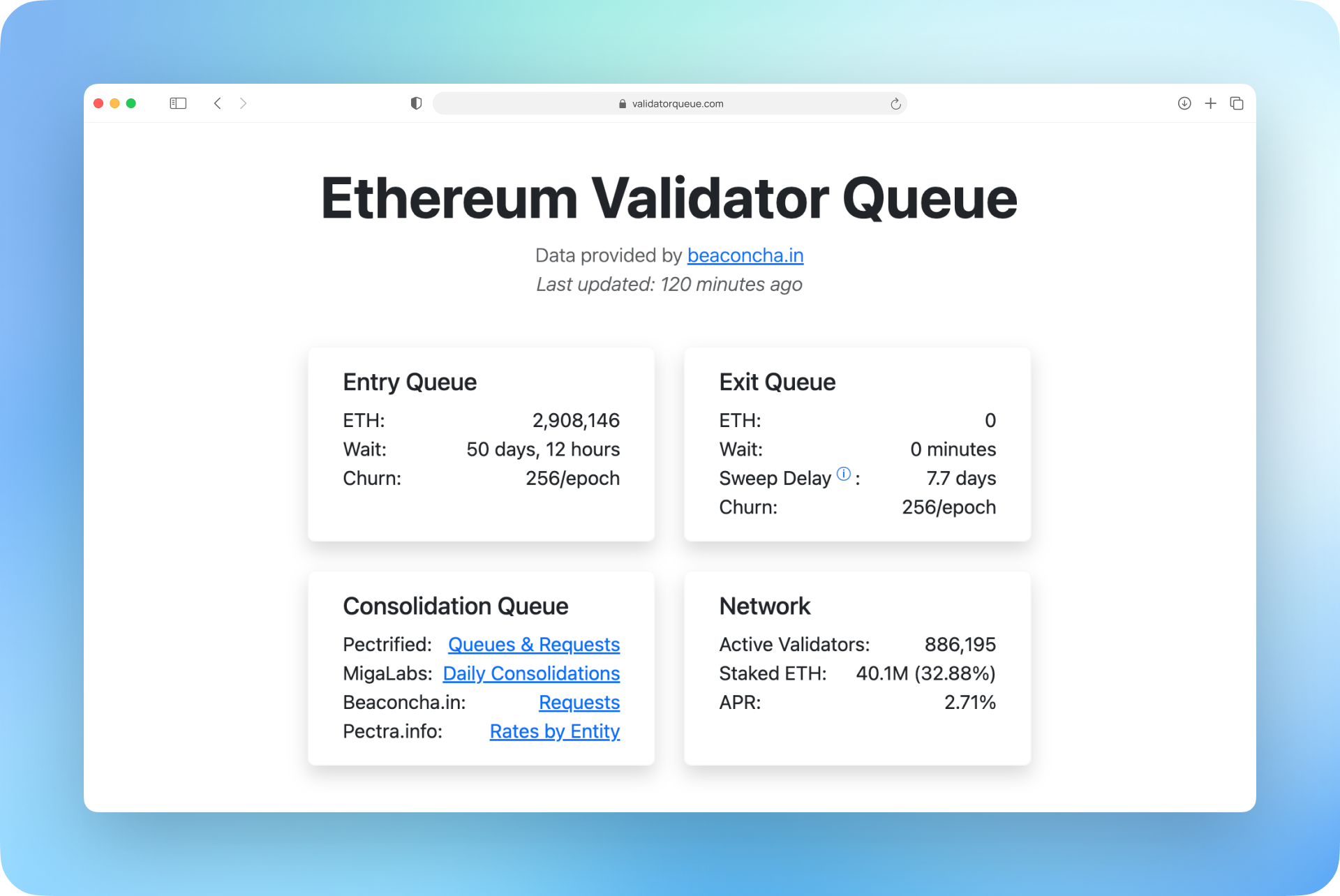
A persistent challenge for anyone looking to stake new ETH on the Ethereum network has been the validator entry queue. This queue forms when the rate of new validator deposits exceeds the network’s capacity to activate them, which is capped to maintain network stability. In recent months, this queue has seen considerable fluctuations, impacting staking yields and capital deployment strategies.
Throughout May 2026, the Ethereum validator entry queue experienced a notable surge, extending beyond 60 days. This lengthening indicated a strong interest in staking ETH, potentially driven by favorable market conditions, increased confidence in Ethereum’s long-term prospects, or specific yield-generating opportunities within DeFi. A 60-day waiting period means that newly deposited ETH would remain unstaked and non-earning for two months, representing a significant opportunity cost for stakers, particularly those managing large sums. The delay also ties up capital, hindering immediate liquidity and compounding potential.
However, June 2026 saw a modest easing of this pressure, with the average queue duration stabilizing around 50 days. This reduction could be attributed to a combination of factors, including a temporary slowdown in new deposits, an increase in validator exits, or subtle adjustments in the network’s processing capabilities. While an improvement, a 50-day queue still presents a substantial hurdle for efficient capital allocation. For institutions and professional stakers, such delays necessitate meticulous planning and often lead to suboptimal capital utilization. The longer the queue, the greater the drag on potential returns and the higher the risk of market volatility affecting the value of unstaked ETH.
Validator Consolidation: A Strategic Bypass
To mitigate the impact of the prolonged entry queue, Lido V3’s stVaults offers a compelling solution through validator consolidation. This innovative mechanism allows existing validators to migrate to the stVaults framework without re-entering the general Ethereum entry queue. This is particularly advantageous for large-scale operators and institutions already running validators who wish to transition to the more flexible and feature-rich stVaults environment.
The process of validator consolidation ensures that source validators continue to accrue rewards throughout the migration period. This continuity is critical, as it eliminates the downtime and lost yield associated with traditional unstaking and re-staking processes. Once consolidation is complete, stakers gain immediate access to stETH, unlocking a spectrum of advanced functionalities. The immediate availability of stETH provides unparalleled DeFi composability, allowing users to leverage their staked assets as collateral for loans, participate in liquidity pools, or explore other yield-generating strategies. This significantly enhances the capital efficiency of large staking positions, turning illiquid staked ETH into a dynamic asset within the DeFi ecosystem. Furthermore, stETH provides much-needed liquidity, enabling large stakers to manage their positions more flexibly without being subjected to the Ethereum withdrawal queue, which can also experience delays.
As an additional incentive, Lido has announced the extension of the stVaults infrastructure fee waiver through the end of August. This waiver further reduces the operational costs for early adopters and those migrating to stVaults, making the transition even more attractive for institutions and large stakers seeking to optimize their staking operations and integrate with the Lido V3 ecosystem. The fee waiver directly addresses a common concern for large-scale operations regarding the cost burden of new infrastructure, demonstrating Lido’s commitment to facilitating broad adoption.
Expanding the Ecosystem: The stVaults Products Overview Hub
The growth of the stVaults ecosystem is a central pillar of Lido V3’s strategy. To highlight the diverse applications and innovations built atop its modular infrastructure, Lido has established the stVaults Products Overview Hub. This centralized resource showcases various products and use cases developed by third parties, leveraging the flexibility and power of stVaults. The hub serves as a testament to the platform’s versatility and its potential to foster a vibrant developer community.
The types of products featured on the hub are diverse, ranging from bespoke institutional staking solutions tailored to specific regulatory requirements, to advanced DeFi protocols that utilize stVaults for unique yield generation strategies, and specialized custody solutions integrating directly with the modular framework. For instance, a financial institution might develop a white-label staking service for its clients using an stVault, offering custom fee structures and reporting. Similarly, a DeFi lending protocol could build a collateral mechanism that accepts stVault-backed assets, providing novel liquidity solutions.
Lido actively encourages vault builders and developers to feature their innovations on the Products Overview page. This initiative is not merely a directory but a strategic move to foster collaboration, inspire further development, and accelerate the adoption of stVaults across various sectors. Teams interested in showcasing their products are encouraged to reach out to the Lido team, who provide support and guidance to integrate and publicize these new offerings, further solidifying the stVaults ecosystem as a hub for innovation in institutional DeFi. This collaborative approach helps create a network effect, where each new product adds value and utility to the overall platform, attracting more users and developers.
Enhanced User Experience: Innovations in the stVaults Web UI
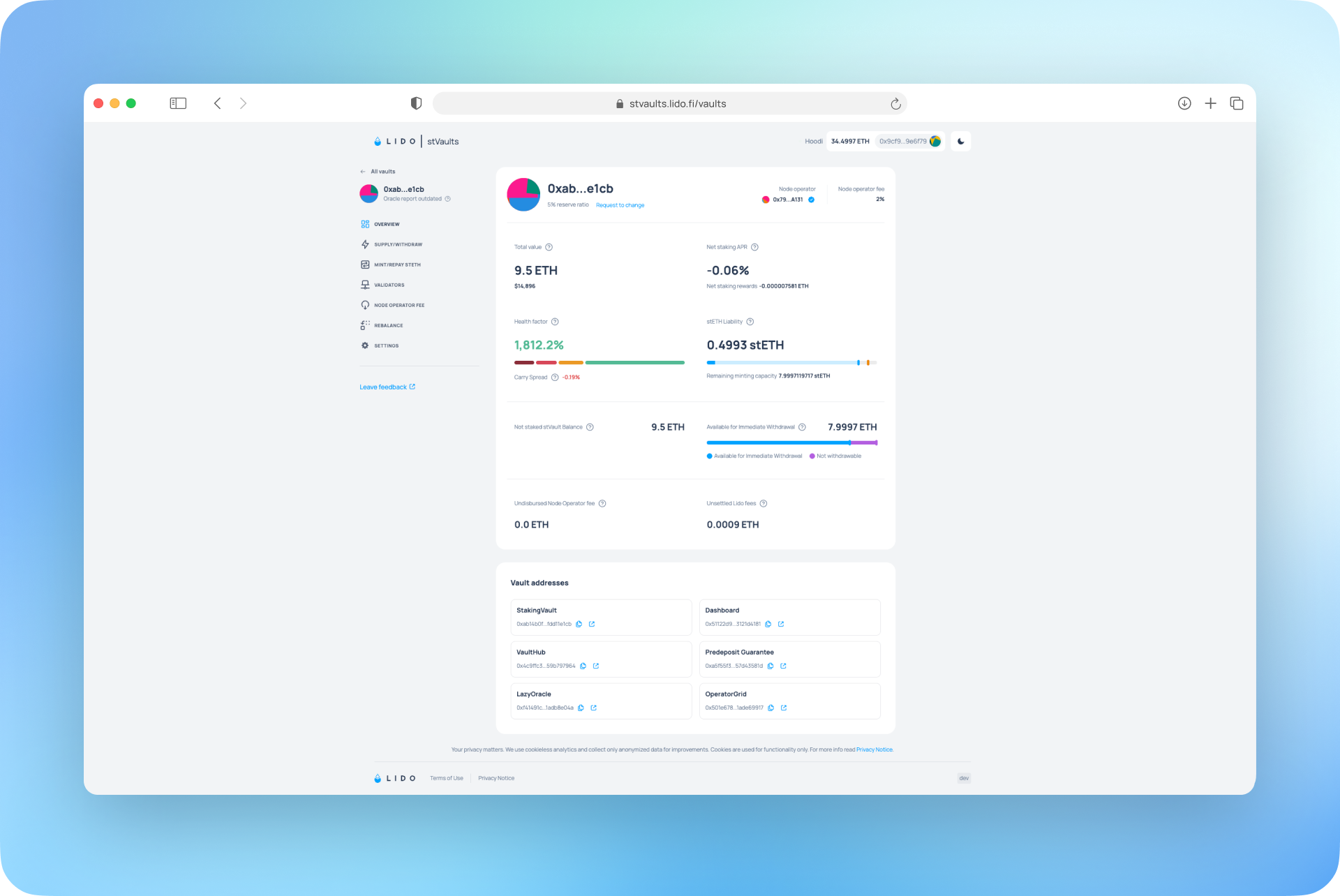
A critical aspect of broadening stVaults adoption, particularly among institutional clients, is providing a robust, intuitive, and secure user interface. The stVaults Web UI has received several key updates designed to simplify vault setup, monitoring, and management, moving complex operations from command-line interfaces (CLI) to a user-friendly graphical environment.
Anti-Scam Protections for Stakers: In the often-fraught landscape of cryptocurrency, security against scams is paramount. The updated Web UI now integrates sophisticated anti-scam protections, proactively warning stakers about potentially risky transactions and blocking certain operations if the stVault’s configuration could expose stakers to malicious third-party actors. These protections might include alerts for unauthorized address changes, suspicious withdrawal requests, or attempts to modify vault parameters in ways that could compromise staked assets. This proactive security layer significantly enhances user confidence and reduces the likelihood of financial loss due to phishing attempts, compromised keys, or misconfigured vaults, aligning with the stringent security requirements of institutional participants.
Settling Lido Fees in the UI: Previously, settling Lido fees, a prerequisite for certain vault actions, often required direct interaction with smart contracts or using command-line tools. This presented a technical barrier for some users and added complexity to operational workflows. The latest update introduces the ability for Vault Owners and Node Operators to review and settle Lido fees directly within the Web UI. This permissionless settlement mechanism streamlines operations, making fee management more transparent and accessible. By integrating this function into the UI, Lido significantly reduces the technical overhead for managing stVaults, enabling a broader range of users to operate their vaults efficiently and without needing specialized developer skills. This is particularly beneficial for institutional custodians who prefer a GUI-driven, auditable workflow.
Rebalancing in the Web UI: One of the most impactful additions to the stVaults Web UI is the native support for rebalancing. This feature addresses a crucial operational challenge for institutions managing redemptions and maintaining optimal asset allocations within their vaults. Rebalancing allows vault owners to repay stETH liability using native ETH from the vault’s own balance.
For institutions, the redemption fulfillment process often involves minting new stETH from the stVault and swapping it for ETH to meet withdrawal requests. This process creates an stETH liability within the vault, which needs to be covered to maintain the vault’s financial integrity. Previously, managing this liability required complex interactions via the command-line interface or directly with the underlying smart contracts—a process that was cumbersome, prone to error, and often required specialized technical expertise. With the Web UI integration, vault owners can now perform the rebalancing operation themselves, within their established approval and custody setups. This significantly simplifies the operational workflow, reduces execution risk, and enhances the overall efficiency of managing institutional-grade staking positions. The ability to rebalance seamlessly through a familiar interface represents a major step forward in making stVaults a truly enterprise-ready solution. It ensures that institutions can manage their liquidity and liabilities with greater ease and confidence, reducing the operational burden and increasing the attractiveness of stVaults for large-scale deployments.
Empowering Institutions: The stVaults Doc Center
Further supporting institutional adoption and operational clarity, the stVaults Doc Center has been significantly expanded with new custodian guides. These guides are crucial for institutions working with qualified custodians, as they detail the specific integration steps, security protocols, and compliance considerations for each custodian. Institutions typically operate under strict regulatory frameworks and require detailed instructions on how to securely interact with decentralized protocols while adhering to their internal policies.
The Doc Center now provides comprehensive documentation for various custodial setups, ensuring that institutions can seamlessly integrate their stVaults operations with their existing custody solutions. This eliminates guesswork and reduces the time and resources required for integration. Moreover, the Qualified Custodians overview within the Doc Center has been updated to include a consolidated list of all stVaults smart-contract addresses that require whitelisting. Whitelisting smart contract addresses is a standard and critical security practice for institutions, preventing funds from being sent to unauthorized addresses. By centralizing this information, Lido streamlines the security setup process, making it easier for custodians and institutional clients to ensure the integrity and security of their stVaults. This level of detailed, accessible documentation is indispensable for bridging the gap between traditional finance and the decentralized world, fostering greater trust and adoption among risk-averse institutional players.
Broader Impact and Future Outlook
The comprehensive updates to Lido V3’s stVaults mark a significant stride in Lido Finance’s strategy to expand its reach beyond retail participants and firmly establish itself as a primary choice for institutional-grade Ethereum staking. By prioritizing modularity, security, and user experience, Lido is directly addressing the core concerns that have historically hindered large-scale institutional engagement with DeFi.
The ability to navigate the Ethereum validator queue efficiently through consolidation, coupled with the enhanced operational flexibility provided by the Web UI, positions stVaults as a highly competitive solution in the liquid staking derivative (LSD) market. These improvements are likely to accelerate the inflow of institutional capital into Ethereum staking, further decentralizing the network and strengthening its economic security. The commitment to fostering a vibrant ecosystem through the Products Overview Hub also suggests a future where stVaults become a foundational layer for a new generation of institutional DeFi applications, extending the utility and reach of staked ETH.
Lido’s continuous innovation, particularly in areas like anti-scam protections and streamlined operational workflows, underscores its leadership in creating a more secure and accessible decentralized financial infrastructure. As the DeFi landscape matures, solutions like stVaults will be instrumental in bridging the gap between traditional finance and blockchain technology, paving the way for broader adoption and integration of digital assets into global financial systems. The strategic focus on institutional needs, combined with ongoing improvements, suggests a robust future for Lido V3 and its role in shaping the future of Ethereum staking.
For entities interested in exploring the capabilities of stVaults for their specific needs, product development, or strategic roadmap, the Lido team encourages direct engagement to discuss potential integrations and bespoke solutions.









