
 admin
admin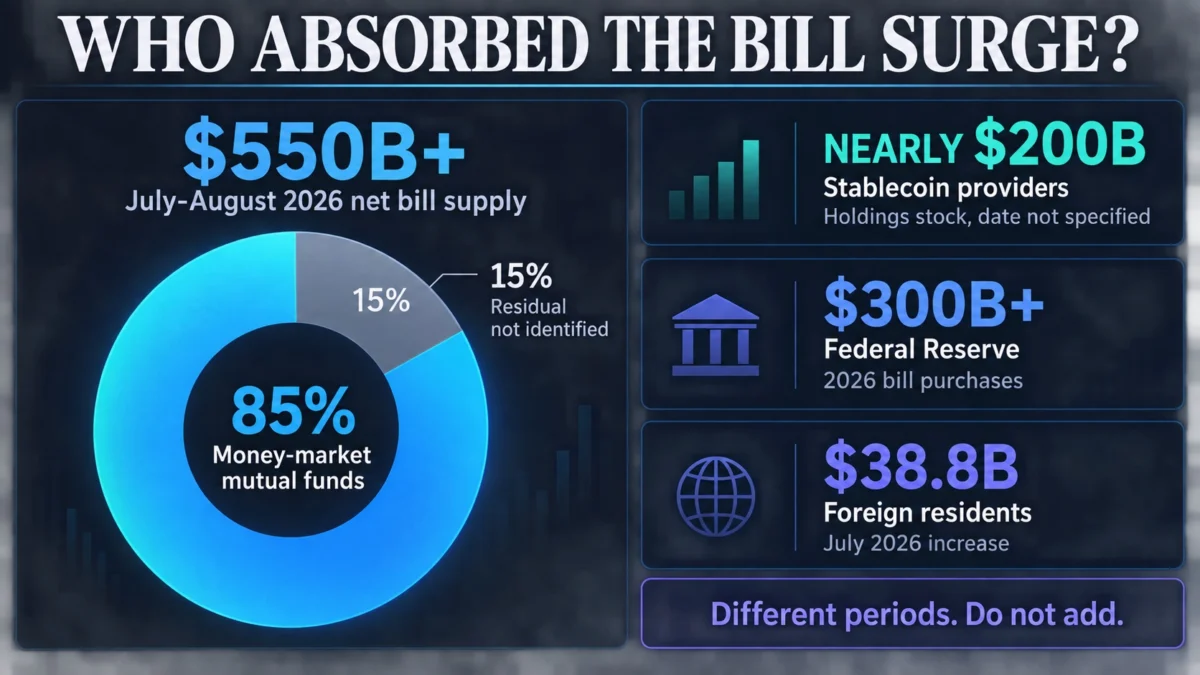
The U.S. Treasury Department’s substantial issuance of Treasury bills over the summer months saw an overwhelming majority of the new supply absorbed by money-market mutual funds, according to recent disclosures. This influx of capital from money funds highlights their pivotal role in financing the government’s short-term debt needs, offering the clearest indication of demand for the marginal issuance. While other entities, including stablecoin providers, the Federal Reserve, and foreign investors, also participate in the Treasury market, money funds emerged as the primary recipients of the approximately $550 billion in net bill supply that grew between July and August. This period marked a significant, roughly 8% increase in the outstanding volume of Treasury bills.
The Treasury’s remarks, delivered by Deputy Treasury Secretary Francis Brooke on September 22, provided a detailed breakdown of the buyers, emphasizing the distinct metrics used to categorize market participants. While stablecoin providers collectively hold nearly $200 billion in short-dated government debt, this figure represents a static stock of holdings and may encompass a broader range of Treasury securities nearing maturity. In contrast, the money-fund data specifically quantifies their absorption of the incremental supply introduced during the two-month period. This distinction is crucial for understanding the dynamic flow of capital in response to new issuance. The potential overlap between these categories, where stablecoin reserves might be managed through government money-market funds or repurchase agreements, underscores the complex interconnectedness of the financial ecosystem.
Understanding the Buyer Landscape: A Multifaceted Approach
To accurately interpret the Treasury’s data, it is essential to recognize that different metrics are employed for various market participants, each providing a unique perspective on their engagement with U.S. government debt. These figures, while related, are not directly additive and serve to illuminate different facets of demand.
- Money-Market Mutual Funds: These funds were the principal buyers of the recent surge in Treasury bills, absorbing approximately 85% of the more than $550 billion in new supply issued in July and August 2026. This metric directly addresses the share of additional bill supply absorbed, offering a precise picture of their incremental purchasing activity during this specific period.
- Stablecoin Providers: These entities maintain a substantial portfolio of short-dated government debt, with holdings estimated at nearly $200 billion. This figure represents the stock of bills and other near-maturity Treasuries owned by stablecoin issuers, though the specific measurement window for this total is not explicitly defined and may not align with the July-August issuance period.
- Federal Reserve: The Federal Reserve has also been a significant purchaser of Treasury bills throughout 2026. The reported figure of over $300 billion represents bill purchases through two portfolio channels – reserve management and reinvestment of principal payments from agency securities – as of September 22, 2026. This figure reflects purchases made over a broader timeframe than the July-August issuance.
- Foreign Residents: In July 2026, foreign residents saw an increase of $38.8 billion in their holdings of Treasury bills. This represents a one-month change in foreign bill holdings, indicating a rebound in overseas investor interest after a period of declines.
The Treasury’s estimate that money-market funds absorbed 85% of the additional supply directly addresses the incremental demand generated by the July-August issuance. This figure is distinct from the overall market share of money funds in the Treasury bill market. The remaining 15% of the newly issued bills were not explicitly accounted for by specific buyer classes in Deputy Secretary Brooke’s remarks, suggesting that other market participants, collectively, filled the remaining demand.
Stablecoin Holdings: A Growing but Distinct Contribution
The nearly $200 billion held by stablecoin providers illustrates their established presence as significant investors in short-term U.S. government debt. However, the nature of this figure, representing a stock of bills and other near-maturity Treasury securities, means it does not isolate the specific purchases made during the July-August issuance wave. This distinction is critical for understanding the precise drivers of demand for newly issued debt.
The financial structures of stablecoin issuers often reveal an intricate relationship with money-market funds. For instance, Circle, a prominent issuer of the USD Coin (USDC) stablecoin, reported in its second-quarter filing that approximately 84% of its USDC reserves were held in the Circle Reserve Fund as of June 30, 2026. This fund is classified as a Rule 2a-7 government money-market fund. Consequently, demand originating from USDC reserves can be reflected within the broader money-fund category. While Circle’s allocation represents one issuer’s strategy, it exemplifies the accounting overlaps that can occur when categorizing market participants.
Further examination of the Circle Reserve Fund’s assets highlights the diversified nature of Treasury exposure beyond direct bill ownership. In its annual shareholder report as of April 30, 2026, the fund listed $19.111 billion in direct Treasury obligations and $46.998 billion in repurchase agreements collateralized by Treasuries. These repurchase agreements, while backed by U.S. government debt, represent a separate asset classification from direct bill holdings. Although the portfolio mix can evolve, these filings provide insight into the structural composition of reserves that may indirectly support Treasury financing.
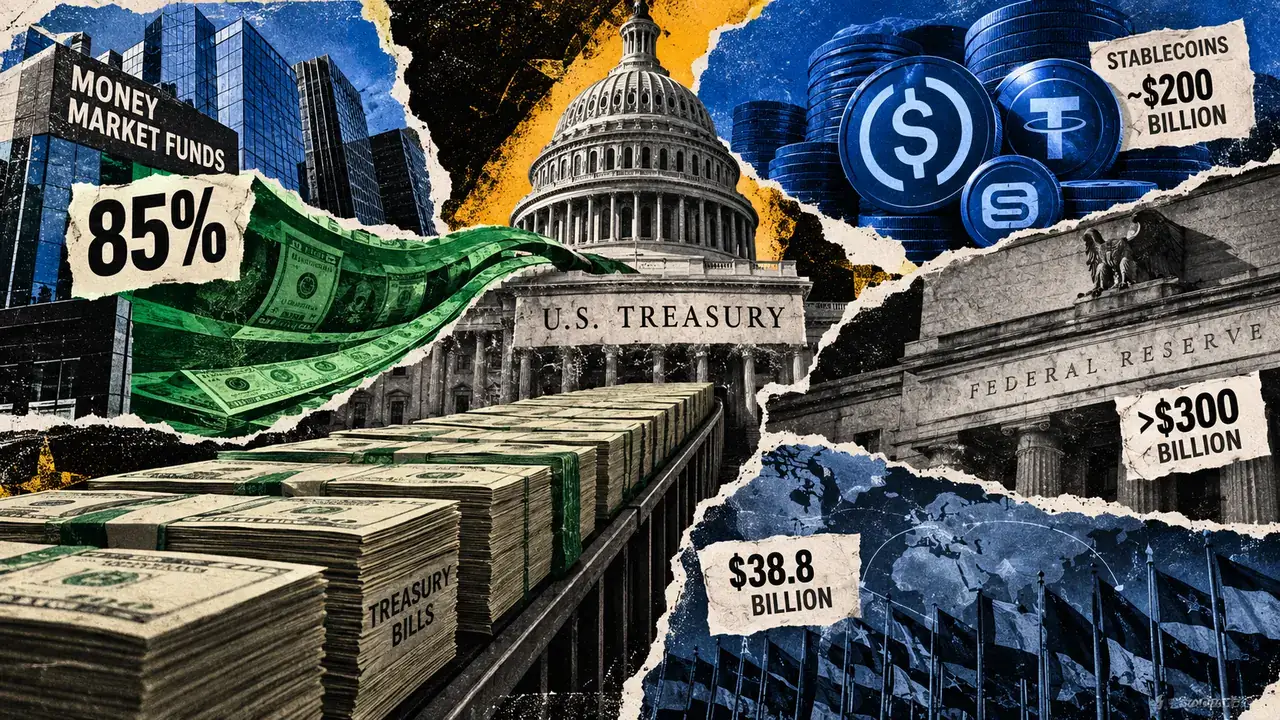
Deputy Secretary Brooke characterized stablecoin demand as a potential growth area, contingent on regulatory developments. He indicated that providers might expand their Treasury holdings as rules implementing the GENIUS Act are finalized. This forward-looking statement positions regulatory clarity as a catalyst for future demand rather than a current explanation for the summer issuance absorption. The implied message is that while stablecoins are material Treasury-linked investors, their full potential as a source of demand has yet to be realized and quantified in the context of recent issuance.
The Federal Reserve and Foreign Investors: Demand on Different Timelines
The Federal Reserve has emerged as a substantial buyer of Treasury bills throughout 2026, with purchases totaling over $300 billion through reserve-management operations and the reinvestment of principal payments from agency securities. These purchases, detailed in the Treasury’s remarks and corroborated by the Fed’s own monetary policy reports, are executed in the secondary market. The Fed’s July monetary policy report, for example, indicated nearly $250 billion in bill purchases through July 1, with approximately $160 billion attributed to reserve management and roughly $90 billion from reinvestment of agency mortgage-backed security principal. The later Treasury figure reflects a more up-to-date tally.
These operations are strategically designed to maintain ample liquidity within the banking system and to manage the composition of the System Open Market Account (SOMA). This approach distinguishes the Fed’s bill purchases from direct government financing or conventional quantitative easing programs. The expansion of the Fed’s bill holdings is evident in its published balance sheet. As of January 2, 2026, the Fed held $233.592 billion in bills, a figure that climbed to $550.482 billion by September 16, 2026. This substantial increase, while representing a net stock movement rather than a gross purchase figure, demonstrates the growing importance of Treasury bills within the Fed’s portfolio over the year.
Foreign demand for U.S. Treasury bills showed a positive trend in July 2026, marking a rebound after several months of outflows. According to the Treasury International Capital (TIC) release, foreign residents increased their bill holdings by $38.8 billion in July. This followed declines of $20.0 billion in April, $43.5 billion in May, and $29.0 billion in June. The July increase was primarily driven by a $45.0 billion rise in private foreign holdings, while foreign official holdings experienced a modest decline of $6.3 billion. This rebound signifies a renewed interest from overseas buyers, though the data for July alone covers a single month and tracks overall foreign holdings rather than specific issuance absorption.
It is important to note that Treasury’s TIC data, which is custody-based, can sometimes obscure the true beneficial owner of securities, particularly when they are held through third countries or managed by international portfolio managers. Despite these nuances, the July rebound suggests a return of foreign investor confidence or a recalibration of portfolio allocations.
Implications and Future Outlook
The cumulative data paints a comprehensive picture of robust demand for short-term U.S. government debt, driven by a diverse set of market participants. Money-market funds stand out as the primary absorbers of the recent surge in Treasury bill supply, underscoring their critical function in facilitating government financing. The Federal Reserve’s consistent secondary market purchases contribute significantly to overall demand, serving broader monetary policy objectives. Foreign investors, after a period of retrenchment, have demonstrated renewed interest, as evidenced by the July rebound in holdings.
Stablecoin issuers, while substantial holders of existing Treasury debt, represent a more nascent and evolving source of demand. Their future role in Treasury financing is likely to be shaped by regulatory frameworks, particularly the implementation of the GENIUS Act. The current analysis indicates that the incremental buying observed during the July-August issuance wave was predominantly driven by money funds and the Federal Reserve, with foreign investors returning in July.
The intricate relationship between stablecoins and money funds, where reserves are often managed through these traditional vehicles, suggests that the distinction between these buyer classes may become more blurred as the market matures and regulatory clarity emerges. The Treasury’s acknowledgment of stablecoins as a potential growth area for demand signals an anticipation of increased participation, contingent on the evolving regulatory landscape. For now, however, traditional money funds remain the most clearly identifiable and significant buyer class for the latest wave of U.S. Treasury bill issuance. The ongoing dynamics of monetary policy, global economic conditions, and regulatory developments will continue to shape the demand for U.S. government debt across all investor segments.








