admin
admin
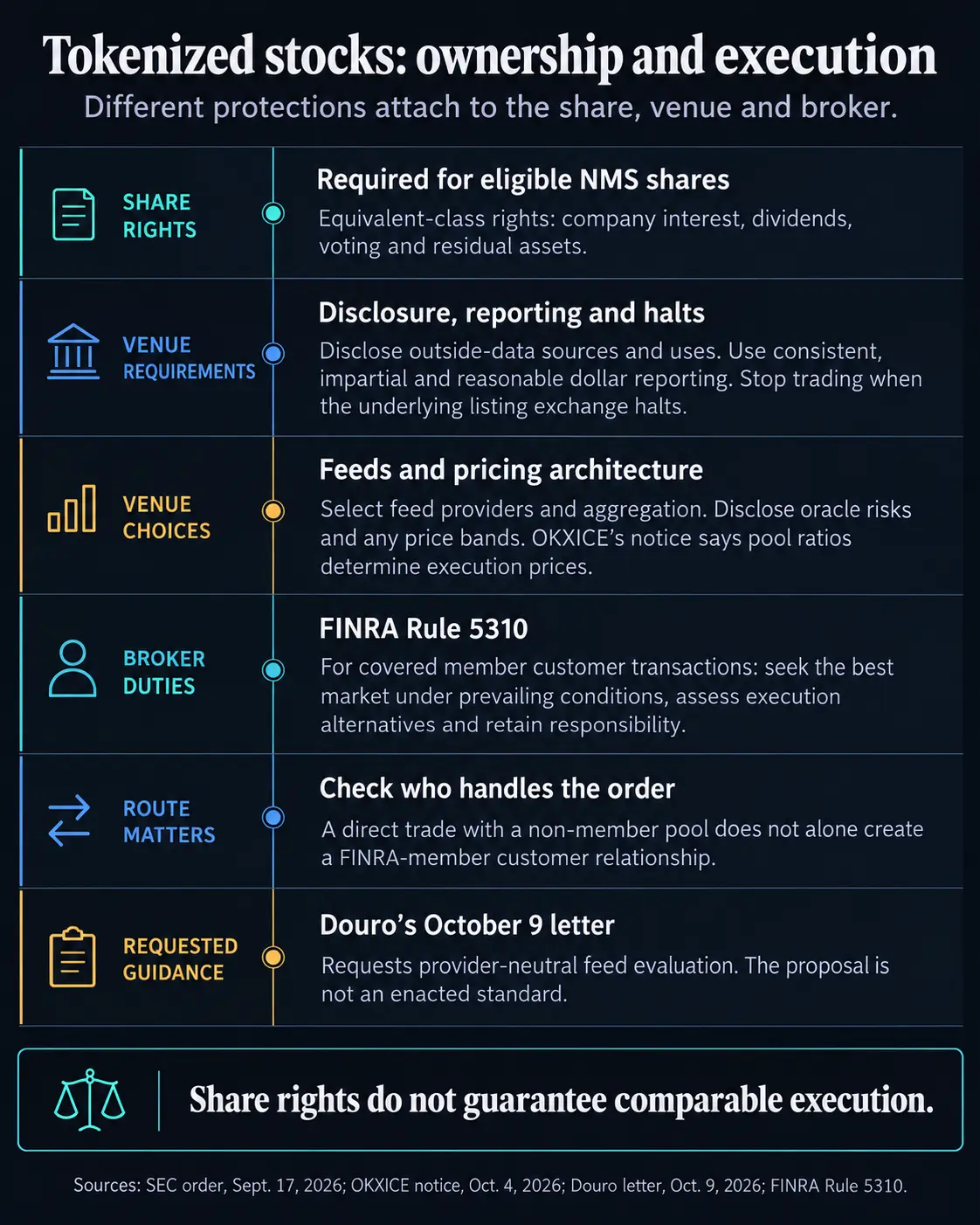
The U.S. Securities and Exchange Commission’s (SEC) September 17 order, granting temporary and conditional relief to certain venues trading tokenized National Market System (NMS) stocks, presents a complex landscape for investors. While these tokenized securities must retain equivalent shareholder rights to their traditional counterparts, the trading venues themselves may operate outside the stringent protections of Regulation NMS. This dichotomy necessitates a thorough examination by investors, not only of the underlying asset’s representation but also of the intricate mechanisms governing order pricing and execution. The regulatory framework, while aiming to foster innovation, introduces novel considerations regarding market data, best execution, and the ultimate safeguarding of investor interests.
The genesis of this regulatory discussion can be traced back to evolving market structures and the increasing integration of digital assets into traditional finance. As tokenization gained traction, the SEC recognized the need to address how these digital representations of securities would be traded and regulated. The September 17 order represents a significant step in this direction, offering a pathway for permissioned automated market maker (AMM) pools to facilitate the trading of eligible tokenized NMS stocks. These pools, powered by software and accessible to approved participants, allow for trading against committed assets, effectively creating a new avenue for liquidity. Simultaneously, the order provides separate relief for certain liquidity providers operating as dealers, allowing them to utilize their own capital in these nascent markets.
However, the scope of this exemption is carefully delineated. It explicitly excludes third-party securities offering synthetic exposure, such as tokenized linked securities and security-based swaps, as well as rights and warrants. Eligibility for these tokenized NMS stocks hinges on the defined security itself and the venue’s adherence to the specific conditions outlined in the SEC’s order. For shares deemed eligible, a critical requirement is that the trading venue must rigorously verify that the token carries the same rights and privileges as its traditional equivalent. This includes fundamental shareholder entitlements such as an interest in the company, the right to receive dividends, voting rights, and a claim to a share of residual assets upon liquidation. Understanding this distinction is paramount: while the token’s claim to these rights addresses what an investor owns, the execution of a trade concerns the terms and conditions under which that ownership is transferred.
A key point of divergence arises from the regulatory status of the exempted venues. A venue that successfully meets the exemption’s criteria operates outside the established framework of exchanges, alternative trading systems (ATSs), and trading centers for the purposes of specific Regulation NMS rules. This exclusion is particularly significant concerning Rule 611, which provides crucial protection against trades executed at prices inferior to protected quotations available on other venues. While these protections are absent within the exempted venue itself, the order emphasizes that applicable anti-fraud and anti-manipulation laws remain in full force, and participants are still bound by their individual regulatory obligations. Furthermore, FINRA-member brokers handling covered customer transactions are explicitly retained under their existing best-execution duties, adding a layer of responsibility for intermediaries.
The Crucial Role of External Price Data in Tokenized Stock Trading
The SEC’s order places a significant emphasis on market data, mandating that exempted venues clearly articulate their reliance on external data feeds, often referred to as "oracles" in the blockchain ecosystem. These oracles are the conduits through which off-chain information is brought onto blockchain applications. The order requires venues to provide public notice detailing the specific providers and sources of this external data, the intended purposes for its use, and a comprehensive description of how oracles are employed. Beyond this, venues must disclose any known material risks associated with these data feeds, including the potential for oracle manipulation, and outline any reference-price bands or other risk controls implemented.
This focus on data integrity is further underscored by additional requirements, including the necessity for concurrent trading stoppages when the underlying NMS stock experiences a halt on its primary listing exchange. Participants must be duly notified of such events, and venues are required to have robust remediation plans for operational disruptions. The accessibility of trading records and the implementation of trading limits and restrictions on venue credit are also mandated, aiming to create a more transparent and controlled trading environment.
Crucially, the SEC’s order does not prescribe a singular approach to market data provision. It refrains from dictating a specific provider, a minimum number of contributors, a standardized aggregation method, a universal confidence threshold, or a uniform protocol for handling stale or unavailable data. This lack of prescriptive standardization has led to calls for clearer guidance, as evidenced by a submission from market-data provider Douro Labs.
In an October 9 submission to the SEC, Douro Labs, a significant contributor to the Pyth Network and developer of Pyth Pro, requested provider-neutral principles for assessing external price feeds and their subsequent use for dollar reporting. With a clear commercial interest in the standards being discussed, Douro Labs’ proposal highlights the need for a framework to evaluate the choices made by venues regarding data feeds. Their proposed criteria emphasize independent contributors involved in price formation, aggregation mechanisms designed to resist manipulation, transparency regarding contributor identities and calculation methodologies, and robust comparisons with external market benchmarks. The submission also advocates for disclosures concerning data confidence levels, the staleness of information, and the specific responses enacted when data becomes uncertain or inaccessible.
The regulatory landscape already includes binding conditions around data reporting. Exempted venues are obligated to publish free, machine-readable, dollar-denominated data that covers transactions within the preceding 30 days, with updates occurring within ten minutes of each transaction. This conversion process must adhere to consistent, impartial, and reasonable methods that are commonly employed by market participants. Transaction records and trading-interest data must also clearly state dollar prices. This requirement for dollar-denominated reporting aligns with existing SEC staff guidance, as noted in a frequently asked questions (FAQ) document that addresses dollar conversion for pairs trading on exchanges and ATSs. Douro Labs’ request, however, hones in on a distinct but related issue: the quality and evaluation of the data feeds themselves, rather than solely their conversion into dollar terms.
Venue Notices Illuminate Diverse Data Feed Roles and Their Implications
The practical application of these data requirements is illustrated by recent venue notices. OKXICE’s October 4 notice, for instance, demonstrates that identifying an external data provider is merely the initial step. This notice delineates how AMM execution prices are determined by pool asset ratios, while external price data serves distinct functions. These functions include displaying stock valuations, identifying trading halts in the underlying market, and facilitating the dollar reporting of stablecoin-paired transactions.
OKXICE identified Massive.com as the source for stock prices and trading-halt data, and an affiliated entity, OKX INC, for stablecoin price indices. Notably, the notice states that OKXICE imposes no additional circuit breakers or reference-price bands beyond the pre-defined stoppages it outlines. Among the payment assets utilized is Circle’s USD Coin (USDC), a stablecoin pegged to the U.S. dollar. The conversion of trades into dollars for reporting purposes relies on stablecoin-price inputs, while the actual execution price is dictated by the pool ratios. The notice further details the use of external volume data submitted to the venue’s smart contracts for the purpose of checking trading limits, illustrating how price information and volume inputs independently govern different facets of a trade.
In contrast, TSV LLC’s September 23 notice offers a different disclosure approach. As of that date, operations had not commenced. The notice outlined the intended uses of external data, including halt detection and price divergence monitoring, while acknowledging that a definitive production market-data provider had not yet been selected. The disclosed functions in this notice are therefore prospective.
Best Execution for Tokenized Stocks Remains a Broker’s Mandate
For FINRA-member brokers involved in handling covered customer transactions, the obligation to ensure best execution remains a critical regulatory requirement. Rule 5310 of the FINRA rulebook mandates that member firms exercise reasonable diligence to ascertain the best market for a security and to obtain a price as favorable as possible under the prevailing market conditions. This duty applies irrespective of whether the firm is acting as an agent or trading as a principal.
The assessment of best execution under Rule 5310 is a multifaceted process that considers various factors. These include the nature of the market, the size and type of the transaction, the markets that were canvassed, the accessibility of quotations, and the specific terms of the customer’s order. The rule’s execution review also encompasses elements such as speed of execution, the probability of executing limit orders, associated costs, and the overall needs of the customer. This framework is considerably broader than simply verifying whether a pool price aligns with a single external reference point.
A critical aspect of this duty is that a member firm cannot delegate its best-execution responsibilities to another party. Even in the case of automated, non-discretionary order routers and internalizers, these entities must conduct regular and rigorous reviews of their execution quality, rather than relying solely on individual order reviews. These reviews, which must occur at least quarterly and be segmented by security and order type, involve a comparison of current routing arrangements with those of competing markets. Any material differences in execution quality necessitate adjustments to routing strategies or a well-documented justification for retaining the existing approach. The scarcity of transparent pricing information in some of these emerging markets amplifies the need for particular diligence, robust written procedures, and meticulously documented compliance with Rule 5310.
The Criticality of Who Handles the Customer’s Order
The ultimate responsibility for best execution is significantly influenced by the customer’s instructions and the firm’s role in the transaction. An unsolicited instruction from a customer to route an order to a specific market can limit the scope of the best-execution determination beyond that explicit instruction. However, the firm still retains the responsibility for prompt processing and strict adherence to the order’s terms. This duty also extends to applicable customer orders that are routed from another broker for handling and execution. It is important to note that simply filling another broker’s customer order against the member’s own quote falls outside the purview of this routed-order duty.
For investors who engage directly with a non-member pool, it is imperative to ascertain whether a FINRA member is handling a covered customer transaction before relying on the protections afforded by best-execution rules. Regardless of the intermediary, the exemption conditions of the venue and the overarching anti-fraud protections remain critical considerations. FINRA’s Regulatory Notice 26-15, which sought public comment on modernizing guidance under its existing principles-based best execution standard, provides further context. The distinction it draws between best execution and trade-through protection helps clarify why venue-specific exemptions and a member broker’s customer duties operate as distinct but interconnected regulatory layers.
Navigating the Tokenized Stock Investment Landscape
For investors venturing into the realm of tokenized stocks, a careful review of venue notices is essential, extending beyond mere identification of data providers. Investors should probe several key questions: Does external data dictate the execution price, or does it merely support a displayed valuation, facilitate transaction reporting, or trigger a trading halt? If a price band is disclosed, does it genuinely constrain trading, and what protocols are in place for scenarios where its reference price becomes stale or unavailable? In instances where a broker handles the order, how does that broker systematically compare the execution quality with alternative market opportunities?
Douro Labs’ October 9 request to the SEC provides a concrete framework for regulators to consider, aiming to establish clearer principles for evaluating external data feeds. For investors evaluating tokenized stocks, the ultimate practical test lies in whether the venue’s disclosed data practices, its pricing controls, and any broker’s diligent execution review collectively support the integrity and fairness of the trades they execute. The evolving regulatory landscape, while fostering innovation, demands a heightened level of scrutiny and understanding from all market participants to ensure that the promise of tokenization is realized without compromising fundamental investor protections. The interplay between token rights, venue operations, and data integrity will continue to be a critical area of focus for regulators and investors alike as this market segment matures.