
 James Watt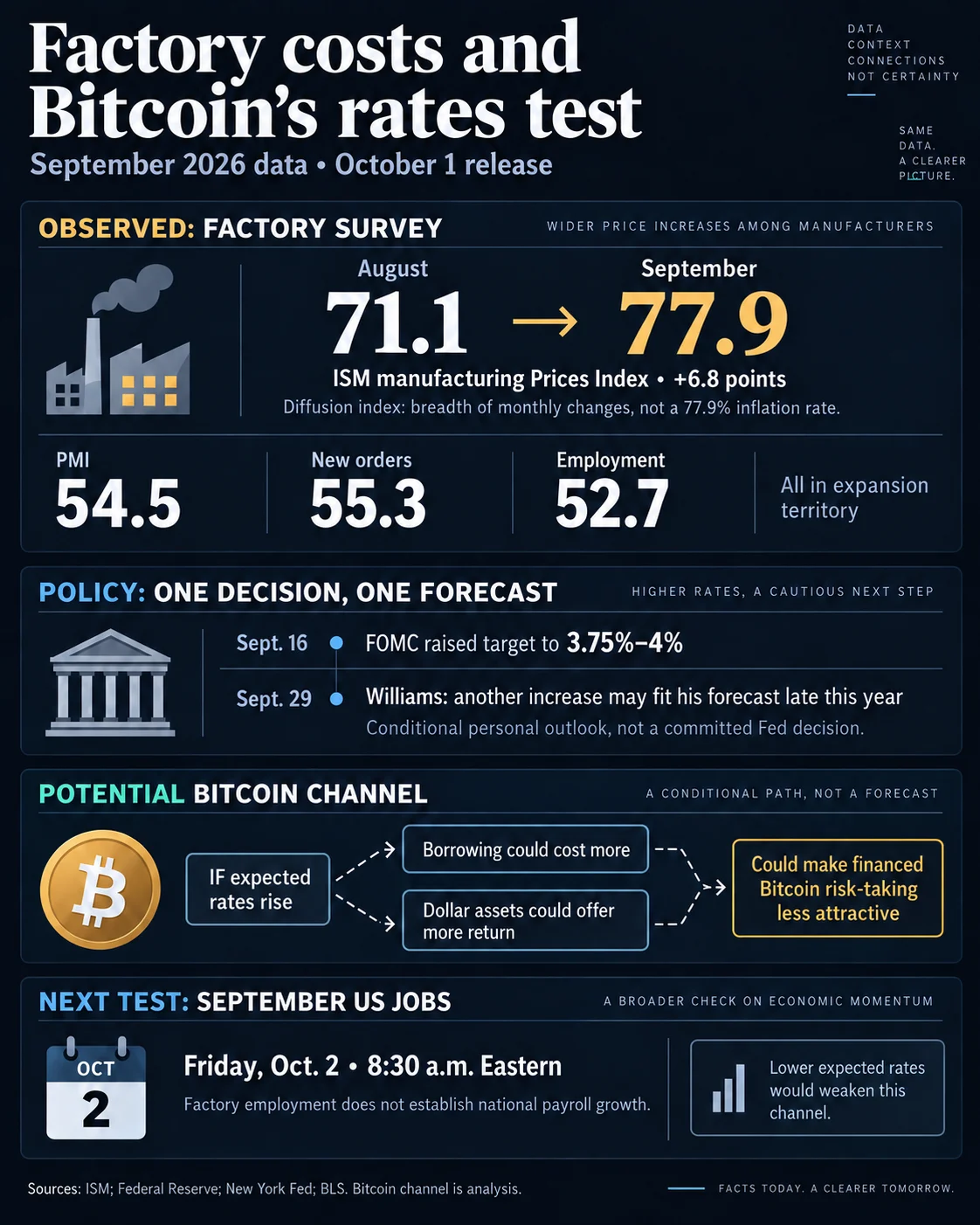
The manufacturing Purchasing Managers’ Index (PMI) registered at 54.5 for the month, while new orders and employment figures stood at 55.3 and 52.7, respectively. These figures indicate that the industrial sector remains in expansionary territory, as any reading above 50 represents growth. However, the combination of resilient economic activity and widening cost pressures is a double-edged sword for the cryptocurrency markets. While a strong economy generally supports risk assets, the resulting "higher-for-longer" interest rate environment tends to strengthen the US dollar and increase the cost of capital, both of which historically exert downward pressure on Bitcoin’s valuation.
The Industrial Catalyst: Analyzing the ISM Manufacturing Report
The ISM Prices Index is a critical metric for economists because it serves as a leading indicator of consumer price inflation. The September reading of 77.9 does not signify a 77.9% inflation rate; rather, it is a diffusion index that reflects the breadth of price increases across the manufacturing sector. According to the report, 58.6% of respondents reported paying higher prices for raw materials and components, a sharp increase from the 46.2% who reported the same in August. The diffusion-index methodology accounts for the percentage of respondents reporting higher prices plus half of those reporting no change, providing a nuanced view of inflationary momentum.
The underlying data suggests that the surge in input costs is not confined to a single sub-sector but is instead becoming a systemic issue within the supply chain. Manufacturers are facing higher expenses for logistics, energy, and raw materials, and the expansion in new orders suggests that demand remains high enough for these costs to potentially be passed down to consumers. If this trend continues, the Federal Reserve may find it difficult to justify any pause or reversal in its current tightening cycle, a scenario that traditional and digital asset investors alike are monitoring with growing concern.
Federal Reserve Policy and the "Higher for Longer" Spectre
The current policy backdrop is defined by the Federal Open Market Committee’s (FOMC) decision on September 16 to raise the target range for the federal funds rate by 25 basis points, bringing it to between 3.75% and 4%. This move was intended to further cool an economy that has shown surprising resilience in the face of previous hikes. Following the release of the ISM data, the remarks made by New York Fed President John Williams on September 29 have taken on renewed significance. Williams suggested that another upward adjustment might be appropriate before the end of the year if the economy continues to follow his current forecast.
While Williams noted that there was no evidence yet of price shocks spilling over into broader, more persistent inflation, the September factory survey provides the first piece of evidence that such a spillover may be occurring. The Fed’s transmission framework dictates that changes in policy affect short-term borrowing costs and Treasury bill returns immediately, while expectations regarding future policy influence longer-term rates and overall financial conditions. If the market begins to price in a higher terminal rate—the peak at which interest rates will settle—the discount rate applied to future earnings of risk assets like Bitcoin will inevitably rise.

A Chronology of Economic Tightening and Market Response
To understand the current tension in the Bitcoin market, it is essential to trace the economic developments over the last several weeks. The transition from August to September marked a shift in market sentiment from cautious optimism to renewed vigilance.
- Late August: Economic data suggested a cooling trend in manufacturing, with the ISM Prices Index at a manageable 71.1. Investors began speculating that the Fed might reach the end of its tightening cycle sooner than expected, fueling a Bitcoin rally toward $80,000.
- September 16: The FOMC raises rates by a quarter percentage point. While expected, the accompanying "dot plot" suggested that members remained hawkish, tempering the crypto rally but not yet reversing it.
- September 29: New York Fed President John Williams delivers a speech emphasizing data-dependence but acknowledging the possibility of a year-end hike. Bitcoin begins to consolidate around the $84,000–$85,000 range as the market awaits fresh data.
- October 1: The ISM Manufacturing report is released, showing the price index spike to 77.9. Treasury yields edge higher as the market reassesses the probability of a November or December rate hike.
- October 2 (Anticipated): The Bureau of Labor Statistics (BLS) is scheduled to release the September Employment Situation report. This "payrolls Friday" is viewed as the ultimate arbiter of the Fed’s next move.
This timeline illustrates how Bitcoin has become increasingly sensitive to macroeconomic indicators. As the asset matures and sees greater institutional adoption, its correlation with traditional financial "macro gears" has tightened, making it a proxy for global liquidity and interest rate expectations.
The Bitcoin Transmission Mechanism: Borrowing Costs and Yield Competition
The potential pressure on Bitcoin resulting from the ISM data runs through two primary channels of the Fed’s transmission framework. The first is the cost of financing. A significant portion of the recent rally to $85,000 has been driven by institutional "basis trades" and leveraged positions. When interest rates rise, the cost of maintaining these positions increases. If the cost of borrowing dollars exceeds the expected near-term return on Bitcoin, investors may choose to deleverage, leading to a localized sell-off.
The second channel is the "opportunity cost" of holding a non-yielding asset. Bitcoin does not pay dividends or interest. When Treasury bill returns and other interest-bearing dollar assets offer higher yields, the relative attractiveness of Bitcoin diminishes. Investors demanding a "risk premium" for holding digital assets may require a lower entry price to justify the volatility risk in an environment where "risk-free" returns are climbing. This competition for capital is a fundamental pillar of modern portfolio theory and remains a primary driver of Bitcoin’s price action during periods of monetary tightening.
The Role of the US Labor Market: Anticipating Friday’s Payrolls
While the ISM manufacturing employment reading of 52.7 suggests that the industrial sector is still hiring, it cannot serve as a substitute for the comprehensive national report provided by the BLS. The upcoming Employment Situation report is expected to provide clarity on whether the broader economy—particularly the services sector—is experiencing the same resilience as manufacturing.
If the jobs report shows robust hiring and wage growth, it will likely solidify the "hawkish" case for the Federal Reserve. A strong labor market gives the Fed the "green light" to continue raising rates to combat the input-price spikes seen in the ISM report, as they would have less fear of triggering an immediate recession. Conversely, a weak jobs report could create a "stagflationary" narrative, where prices are rising but growth is stalling, creating a much more complex and volatile environment for Bitcoin.

Historical Context: The Evolving Relationship Between Macro News and Crypto
It is important to note that the relationship between macroeconomic data and Bitcoin is not always linear. A February 2023 New York Fed staff study (Staff Report 1052) analyzed the intraday response of Bitcoin to monetary and macroeconomic news. Interestingly, the study found no systematic, consistent Bitcoin response to such news in its historical sample. However, the market landscape has changed significantly since early 2023.
The introduction of spot Bitcoin ETFs in early 2024 has brought a new class of investors into the space—pension funds, hedge funds, and corporate treasuries. These participants operate within the same framework as traditional equity and bond traders, often using automated algorithms that react instantaneously to CPI, PMI, and payroll data. Consequently, while historical data might suggest a lack of correlation, the "institutionalization" of Bitcoin has likely made it more reactive to the Federal Reserve’s policy path than it was in its earlier, more retail-driven years.
Institutional Reactions and Market Outlook
Market analysts are currently divided on whether Bitcoin can maintain its footing above $85,000. Some argue that the "digital gold" narrative provides a hedge against the very inflation indicated by the ISM report. From this perspective, rising factory costs are a sign of currency debasement, which should theoretically drive investors toward capped-supply assets like Bitcoin.
However, the prevailing view among institutional desks is one of caution. The "financing pressure" mentioned in recent market circulars suggests that the $85,000 level may act as a ceiling in the short term if Treasury yields continue to climb. As of the latest trading sessions, Bitcoin is up approximately 1.26% over the past 24 hours, maintaining a market capitalization of $1.7 trillion. While the 30-day and 90-day trends remain overwhelmingly positive—up 9.69% and 35.51% respectively—the declining 24-hour volume (down 7.26%) suggests a "wait-and-see" approach from major players ahead of the payrolls data.
The practical test for the cryptocurrency market in the coming days will be whether rate expectations move and Bitcoin responds in kind. If front-end Treasury yields fall or if the Fed signals a more dovish stance despite the ISM data, the path to $90,000 may remain open. If, however, the combination of industrial cost spikes and a strong labor market forces the Fed’s hand, Bitcoin may find itself caught in the "industrial and Federal Reserve gears," leading to a period of consolidation or a retracement of recent gains.









