
 James Watt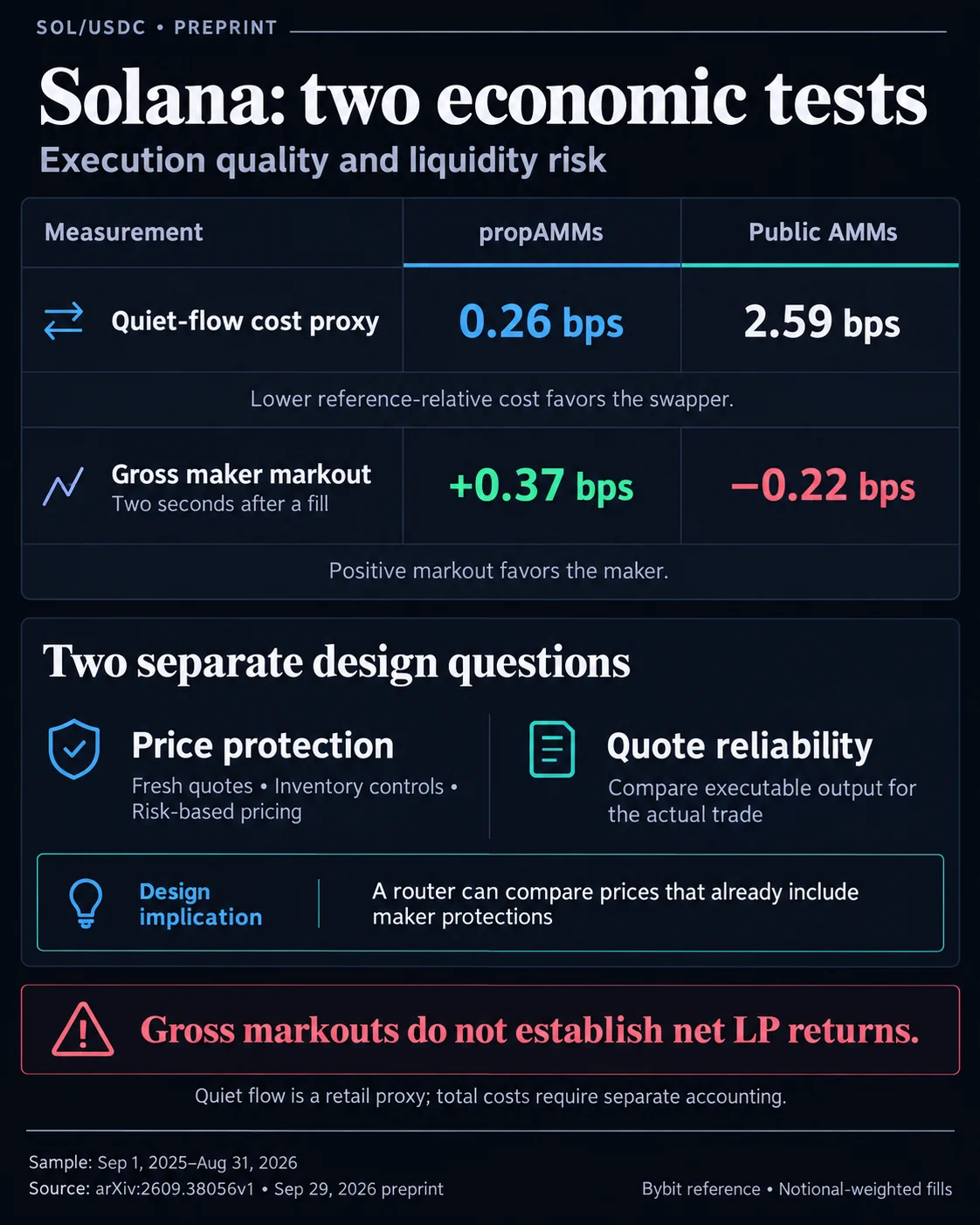
The landscape of decentralized finance (DeFi) is undergoing a significant structural shift as professionalized liquidity provision begins to outperform traditional, passive automated market makers (AMMs), according to a comprehensive study released on September 29. The research, authored by experts affiliated with ETH Zurich and Category Labs, provides a granular look at the execution quality and liquidity dynamics within the Solana ecosystem, alongside comparative data from the Base and Monad networks. The findings suggest a widening divide: while retail swappers can achieve significantly better pricing through professionally managed pools, passive liquidity providers (LPs) continue to face substantial risks from "toxic flow" and stale price quotes.
The study, which spans a longitudinal period from September 1, 2025, through August 31, 2026, utilizes a sophisticated methodology to benchmark decentralized exchange (DEX) performance against centralized counterparts. By weighting fills by notional value against Bybit’s size-weighted top-of-book (SWTOB) microprice, the researchers established a reference-relative execution cost proxy that highlights the efficiency of professionalized operators, often referred to as propAMMs.
Quantifying the Execution Cost Disparity
At the heart of the research is the measurement of execution costs during "quiet-market" conditions. The study defines quiet flow as transactions occurring when the reference price movement is less than one basis point (bps) in the window from five seconds before to one second after a fill. In these stable environments, the performance gap between professional and public pools is stark.
On Solana, propAMMs—pools controlled by professional market-making firms that actively manage their quotes and inventory—recorded a reference-relative execution cost proxy of just 0.26 basis points. In contrast, public AMMs, which rely on passive deposits from a broad range of users and follow static mathematical formulas, showed an execution cost of 2.59 basis points. This nearly tenfold difference suggests that professional operators are leveraging superior technology and active risk management to provide tighter spreads to traders.
For a swapper, the objective is simple: maximize the number of tokens received for a given input. A lower execution cost directly translates to better price realization. However, for the liquidity provider, the equation is more complex. The LP supplies the inventory that others trade against, and they require compensation not just for the service, but for the inherent risks of holding that inventory in a volatile market.
Maker Markouts and the Reality of Adverse Selection
The study delves into "maker markouts," a metric used to evaluate the value of a trade shortly after it has been accepted by a pool. A markout compares the execution price of a fill with a reference price at a later interval—in this case, two seconds. A positive markout indicates that the price moved in favor of the liquidity provider after the trade, while a negative markout suggests the pool was "picked off" by a more informed trader or an arbitrageur.
Across the Solana sample, propAMMs achieved a two-second gross maker markout of +0.37 basis points. Public AMMs, however, saw a negative markout of -0.22 basis points. This data point is critical for understanding the "adverse selection" problem in DeFi. When an external market (such as a centralized exchange) moves first, a passive public pool still offering an "old" price becomes a target for arbitrageurs. These arbitrageurs trade against the pool’s stale quotes, effectively extracting value from the passive LPs to bring the pool back into alignment with the broader market.
The research emphasizes that while low execution costs attract swappers, they do not necessarily constitute a sufficient investment case for depositors. Positive markouts for professional pools suggest they are better at defending against toxic flow, but the authors warn that these figures should not be mistaken for a complete profitability claim. Net LP returns involve a broader balance sheet including trading fees, asset exposure, hedging costs, and operating expenses.
Chronology of Market Structure Evolution
The shift toward professionalized liquidity is not an overnight phenomenon but the result of several years of iterative development in DEX architecture.
- Early AMM Era (2020-2022): Dominated by Constant Product Market Makers (CPMMs) like Uniswap V2, where liquidity was distributed uniformly across a price curve. While revolutionary, these were highly inefficient and prone to massive slippage.
- Concentrated Liquidity (2022-2024): The introduction of Uniswap V3 and similar protocols on Solana allowed LPs to provide liquidity within specific price ranges. This increased capital efficiency but also heightened the risk of "loss-versus-rebalancing" (LVR) as prices moved out of range.
- The Rise of PropAMMs (2024-2025): Firms like Jump Crypto began implementing professional market-making logic within permissionless structures. A Jump Crypto report from April 2025 detailed how their BisonFi protocol adapts prices and liquidity based on quote freshness, inventory levels, and the perceived quality of incoming trade flow.
- The 2025-2026 Study Period: The latest preprint captures a mature market where professional operators have largely optimized their strategies, leading to the 0.26 bps execution costs observed on Solana.
Quote Reliability and the "Spoofing" Allegation
A significant portion of the study focuses on the integrity of advertised quotes, particularly on the Base network. Analyzing Tessera on Base, researchers found that execution averaged 1.08 basis points worse by trade count and 0.56 basis points worse by volume when compared to reconstructed quotes from the end of the previous block.
This discrepancy led researchers to use the term "spoofing" to describe the block-timed fee pattern. In this scenario, a pool might advertise a favorable price to attract a routing engine, but by the time the transaction is processed within a block, the price or fee structure has changed, resulting in worse execution for the user.
This finding aligns with a March 2025 report from 0x, a prominent routing provider. 0x observed that prices on Base frequently deteriorated between the moment a quote was selected and the moment it was settled. While 0x did not name specific operators at the time, they noted a policy of disconnecting liquidity sources that persistently showed a gap between advertised and delivered prices.
Jump Crypto has argued that advanced routing engines can mitigate this "display-to-fill" gap by selecting executable prices in real-time as transactions run. However, the study suggests that if competition is based on advertised numbers that do not match final execution, the market may inadvertently reward venues that use deceptive pricing tactics.
The Role of Aggregators and Routing Engines
In the Solana ecosystem, Jupiter has emerged as a central figure in managing these complexities. Jupiter’s AMM integration documentation reveals a multi-layered approach to routing. A dedicated signer identifies trades originating from Jupiter’s own frontend, labeling them as "retail and non-toxic." This classification allows makers to potentially offer tighter spreads to these users, under the assumption that they are not arbitrageurs.
However, the study notes a distinction between identifying a trade’s origin and proving it is harmless. Professional market-making logic often sits behind public settlement layers, and the ability to defend a price depends on the specific route and counterparty.
Jupiter’s current Swap API includes a mechanism to sideline underperforming liquidity sources. Their integration guide requires "parity tests" to ensure that the quote provided matches the execution within the same pool snapshot. While this helps, the researchers point out that persistence through subsequent updates remains a separate challenge. For a truly meaningful comparison, executable output must reflect identical trade sizes, the specific caller, and all applicable protocol and integrator fees.
Broader Impact and Future Implications
The findings of the Sept. 29 preprint have profound implications for the future of decentralized exchanges. The data suggests that the era of "set and forget" passive liquidity provision may be reaching its limit in terms of competitiveness.
For Traders: The trend toward professionalized pools is a net positive. The ability to trade SOL/USDC with an execution cost of 0.26 bps brings the DEX experience much closer to the efficiency of centralized exchanges like Binance or Coinbase. As routing engines become more adept at filtering out "spoofing" venues, the reliability of these prices is expected to improve.
For Passive Liquidity Providers: The outlook is more cautionary. The negative markouts for public AMMs confirm that passive LPs are often the "losing" party in the arbitrage race. To remain viable, passive protocols may need to implement more sophisticated protections, such as dynamic fees that increase during periods of high volatility or oracle-based pricing that reduces the window for stale-quote exploitation.
For Protocol Designers: The study highlights the need for better transparency in execution reporting. Standardized metrics for "slippage" and "price impact" are often insufficient to capture the nuances of block-timed fee changes or adverse selection. Future protocols may integrate "Loss-versus-rebalancing" (LVR) metrics directly into their dashboards to give LPs a clearer picture of their true economic performance.
As the DeFi market matures through 2026 and beyond, the convergence of private market-making logic and public settlement is likely to continue. The ultimate goal—a market structure that provides deep, reliable liquidity for swappers while offering sustainable, risk-adjusted returns for depositors—remains a work in progress. The data from Solana, Base, and Monad suggests that while the industry is getting closer to that goal, the divide between professional and amateur participants has never been more visible.









