
 admin
admin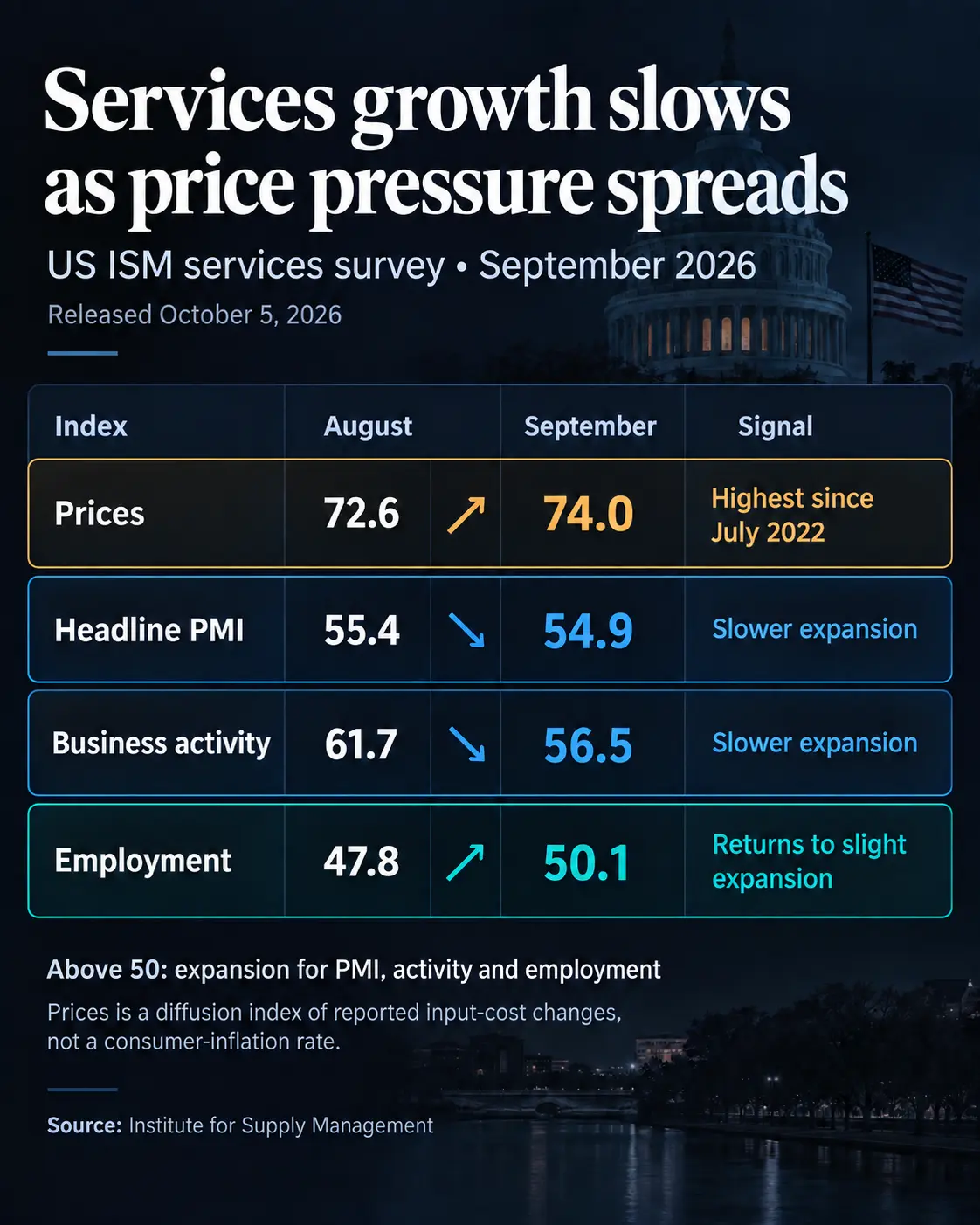
The US services sector experienced a significant uptick in inflationary pressures in September, with its prices index surging to a four-year high. This development, occurring concurrently with a deceleration in overall economic growth, casts a shadow of uncertainty over the prospects of interest rate relief, potentially impacting leveraged positions in Bitcoin and other risk-sensitive assets. The latest findings from the Institute for Supply Management (ISM) paint a complex economic picture: while activity moderates, the cost of doing business is escalating across the services industry.
The ISM’s Services Purchasing Managers’ Index (PMI) report, released on October 5th, revealed that the prices index climbed to 74.0 in September. This represents a notable increase from the 72.6 recorded in August and marks the highest level since July 2022, when the index stood at 74.5. This sustained elevated reading suggests that businesses in the services sector are facing more pronounced input cost pressures.
Simultaneously, the broader services PMI, a key indicator of the health of the sector, saw a slight dip, moving from 55.4 in August to 54.9 in September. While this figure remains comfortably above the 50-point threshold, indicating continued expansion, the deceleration points to a potential cooling of momentum. Digging deeper into the components of the report, business activity within the services sector experienced a more significant slowdown, falling from 61.7 to 56.5. This suggests that while the sector is still growing, the pace of expansion in core business operations has moderated.
In contrast, the employment component of the ISM services report offered a glimmer of positive news. The employment index rose from 47.8 in August to 50.1 in September, crossing back into expansion territory after two consecutive months of contraction. This indicates a stabilization or slight improvement in hiring within the services industry, although it does not offset the broader concerns about inflationary pressures and moderating growth.
It is crucial to understand the nature of the ISM’s prices index. As a diffusion index, it measures the breadth and direction of monthly input-cost changes as reported by survey respondents. A reading of 74.0 signifies that a substantial majority of businesses are reporting increases in their input costs. However, the index does not quantify the magnitude of these price increases, nor should it be directly equated with consumer inflation rates, which are measured by different methodologies. Nonetheless, a sustained high reading in input costs for a significant portion of the economy is a clear signal of inflationary pressures that could influence broader economic policy.
The Federal Reserve’s Tightrope Walk and Bitcoin’s Exposure
The economic data released in early October arrives at a critical juncture for the Federal Reserve, which has been actively working to combat inflation. Federal Reserve Vice Chair Philip Jefferson, in a speech delivered on October 1st, acknowledged that inflation risks were tilted upward. He also highlighted the Fed’s decision to raise the federal funds target range by a quarter percentage point to 3.75%-4.00% in September. Jefferson emphasized that future monetary policy adjustments would be data-dependent, considering the prevailing economic outlook and the balance of risks.
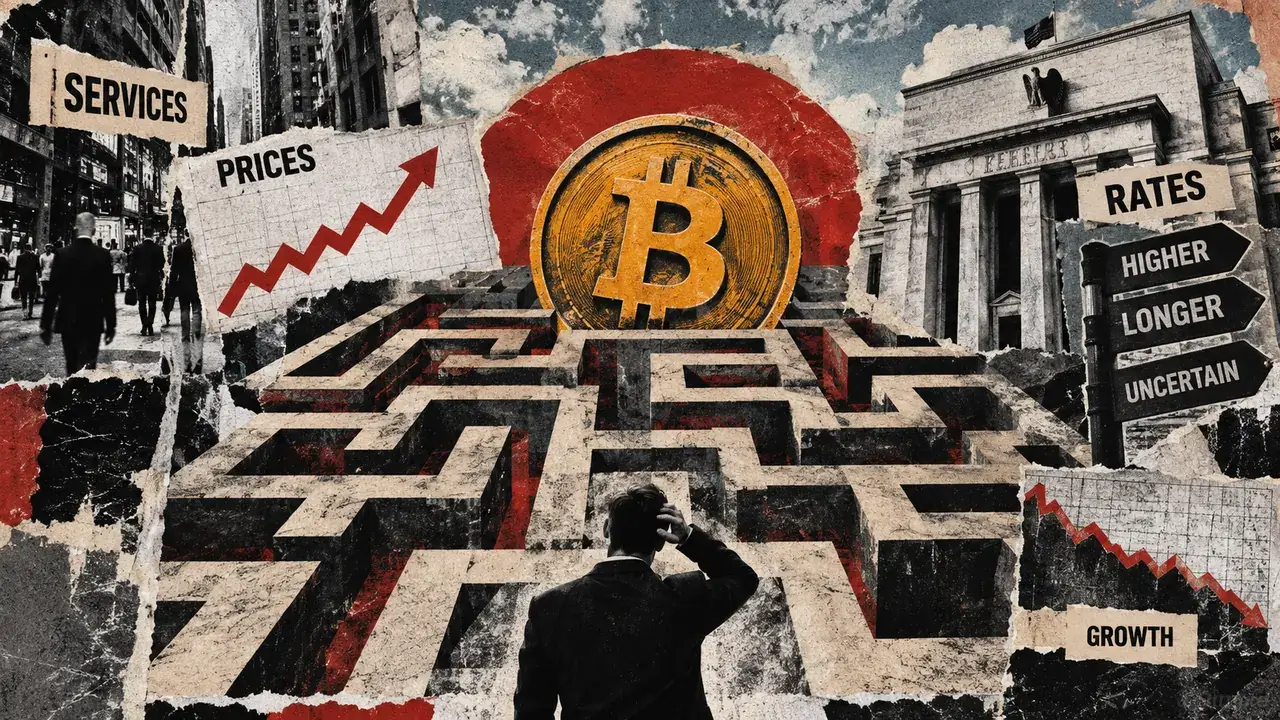
The ISM services report, with its dual narrative of slowing growth and rising input costs, provides further complex data for the Fed to consider. While the moderation in business activity might suggest that demand is cooling, the persistent increase in input costs complicates the inflation outlook. This divergence could lead the Federal Reserve to maintain a more restrictive monetary policy stance for a longer duration than previously anticipated. Such a scenario has significant implications for financial markets, particularly for assets that are sensitive to interest rates and financing costs, such as leveraged Bitcoin positions.
Understanding the Risk for Leveraged Bitcoin Exposure
For investors and traders employing leverage in their Bitcoin positions, the prospect of sustained higher interest rates and the uncertainty surrounding rate relief poses a considerable risk. Leverage amplifies both potential gains and losses. When financing costs are high or expected to remain elevated, the cost of borrowing to maintain leveraged positions increases. This can squeeze profit margins and, in adverse market conditions, can lead to forced liquidations.
The Commodity Futures Trading Commission (CFTC) has previously warned about the risks associated with margined virtual currency futures trading. The core concern is that when markets move unfavorably for a leveraged trader, they may be required to deposit additional collateral to meet margin calls. Failure to do so can result in their positions being closed out by the exchange, potentially at a significant loss. The current economic climate, characterized by persistent inflation and a cautious Federal Reserve, increases the likelihood of market volatility, which can trigger these margin calls.
It is important to differentiate between the Federal Reserve’s policy rate and the funding rates observed in cryptocurrency markets, specifically for perpetual futures. The Federal Reserve’s federal funds rate influences the broader cost of capital in the economy. In contrast, perpetual futures funding rates are payments exchanged between traders holding long and short positions on derivatives platforms. These payments are designed to incentivize traders to keep the perpetual futures contract price closely aligned with the underlying spot market price. While both are related to financing, they operate through different mechanisms and are influenced by distinct market dynamics. Therefore, the Fed’s policy rate does not directly dictate Bitcoin perpetual funding rates, though broader economic sentiment can indirectly affect both.
Historical Context and Market Dynamics
The relationship between macroeconomic data and Bitcoin’s price movements has been a subject of ongoing analysis and debate. While some market participants believe Bitcoin is increasingly correlated with traditional financial assets and macroeconomic news, empirical evidence suggests a more nuanced picture. A February 2023 study by the New York Fed, utilizing intraday data, concluded that Bitcoin appeared largely disconnected from monetary and macroeconomic news within its sample period. This suggests that while broader economic conditions can play a role, other factors, including market sentiment, regulatory developments, and on-chain dynamics, can also significantly influence Bitcoin’s price action.

As of October 6th, Bitcoin was trading around $85,580, reflecting a modest decline of 0.04% over the preceding 24 hours, according to data from CryptoSlate. This slight movement does not provide a clear indication of a direct reaction to the ISM services report. The market’s response to such data often unfolds over time and is influenced by a multitude of factors, including other upcoming economic releases, geopolitical events, and developments within the cryptocurrency ecosystem itself.
Implications for the Future
The persistence of higher input costs in the services sector, coupled with a potential slowdown in business activity, creates a challenging environment for policymakers and investors alike. For leveraged Bitcoin positions, the funding-risk case would strengthen if restrictive monetary policy or a repricing of yields in traditional markets were to coincide with a significant decrease in demand for leveraged crypto trading. Conversely, this risk would be mitigated if cost pressures ease, rate expectations stabilize, or if demand for Bitcoin increases without a commensurate rise in leverage.
The ISM services report alone does not provide a definitive forecast for leveraged Bitcoin positions. While slower services expansion might intuitively suggest a less hawkish Federal Reserve, the simultaneous rise in input costs complicates this narrative. The ultimate impact on financing costs and the willingness of market participants to take on risk will depend on a confluence of factors, including future inflation data, the Federal Reserve’s policy decisions, and the evolving sentiment within both traditional and cryptocurrency markets. Investors will need to closely monitor these developments to navigate the complexities of the current economic landscape and its potential ramifications for Bitcoin.
The services sector, which constitutes a significant portion of the US economy, plays a crucial role in overall economic health and inflation dynamics. The data from September underscores the ongoing battle against inflation and the Federal Reserve’s commitment to achieving price stability. The challenge lies in calibrating monetary policy to curb inflation without triggering an excessive economic downturn. The current data suggests this balancing act remains precarious, leaving the outlook for interest rates, and by extension, the cost of capital for leveraged investments, uncertain.
The implications extend beyond just leveraged traders. For instance, the cost of financial services, which are part of the broader services sector, can be influenced by these input costs. This could indirectly affect the operational costs for financial institutions, including those involved in digital asset markets. Furthermore, a sustained period of high inflation and elevated interest rates can lead to a broader shift in investor sentiment, potentially leading to a decrease in risk appetite across asset classes. This could result in reduced inflows into speculative assets like cryptocurrencies, even for those not employing direct leverage.
The interplay between macroeconomic indicators and the cryptocurrency market is becoming increasingly sophisticated. While historical studies may have indicated a disconnect, the growing institutional involvement and the integration of digital assets into the broader financial system suggest that these correlations could evolve. Therefore, understanding the signals from reports like the ISM services PMI becomes increasingly important for a comprehensive assessment of the risks and opportunities within the cryptocurrency market. The path forward for Bitcoin and other digital assets will likely be shaped by the Federal Reserve’s response to these persistent inflationary pressures and the broader macroeconomic environment it navigates.








