
 James Watt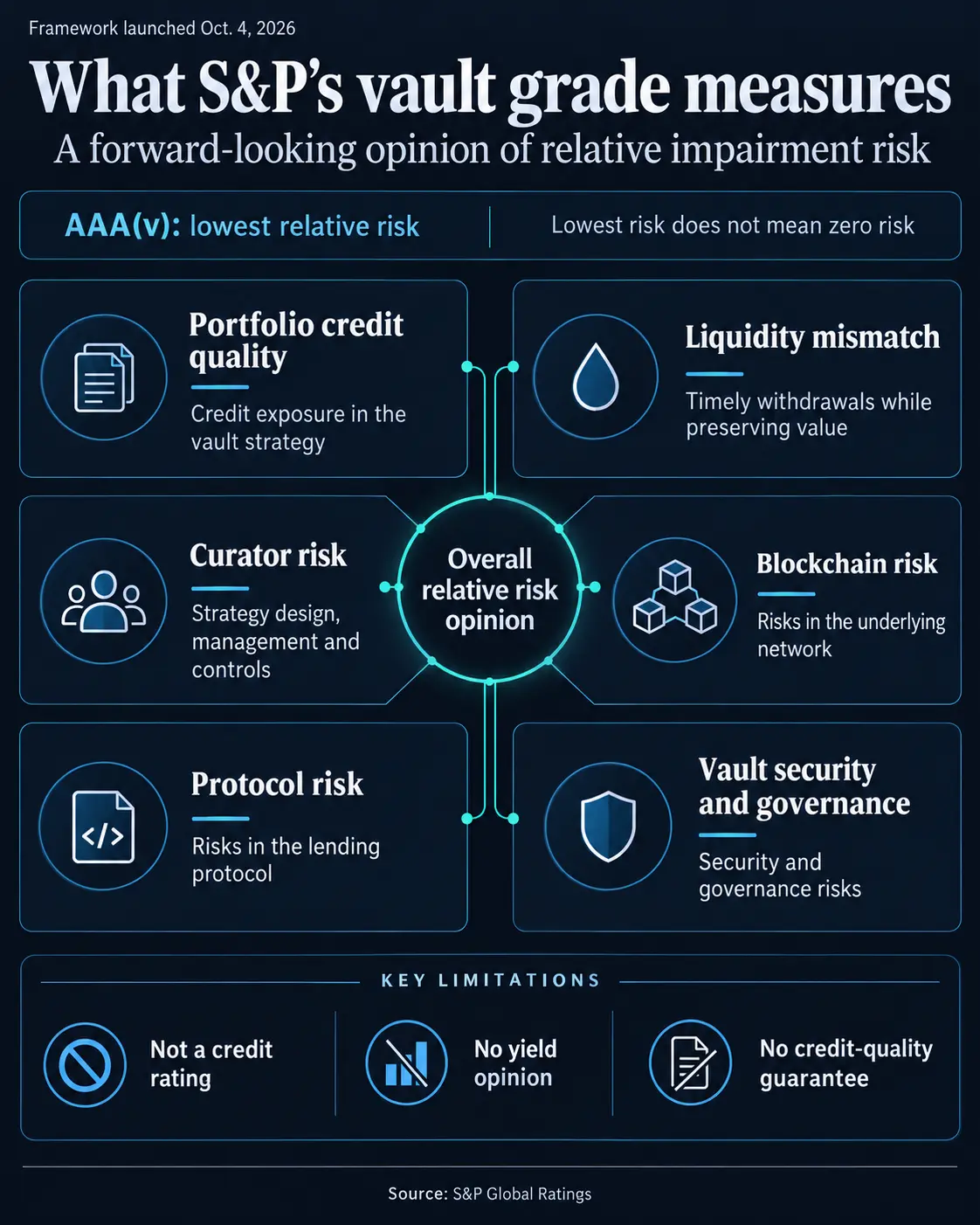
The global financial landscape is witnessing a significant convergence between traditional credit evaluation and decentralized finance as S&P Global Ratings officially introduced its Vault Risk Assessment framework on October 4. This strategic move aims to provide a standardized, institutional-grade lens through which investors can evaluate the burgeoning market of crypto lending vaults. The launch arrives at a critical juncture for the digital asset industry, as the total value locked in these products has surged from approximately $1.5 billion two years ago to an estimated $10 billion in September 2024. This nearly sevenfold increase highlights a growing appetite for on-chain yield-bearing products, yet it simultaneously exposes the market to complex, multi-layered risks that traditional point-in-time blockchain transparency often fails to capture.
The timing of S&P’s announcement was underscored by a real-world demonstration of the risks inherent in these structures. On the same day the framework was unveiled, blockchain security firm CertiK flagged suspicious activity on the Coinbase-backed Base network. An unnamed vault was involved in a series of transactions where a newly deployed proxy contract borrowed approximately 1,783 aBaswstETH—valued at roughly $6 million—before redeeming the tokens through the Aave protocol for wstETH. While the underlying Aave protocol remained secure and unexploited, the incident served as a stark reminder that the "middleware" layer—the smart contracts, permissions, and human managers sitting between the investor and the base protocol—represents a significant and often opaque failure point.
The Architecture of On-Chain Lending Vaults
To understand the necessity of S&P’s new framework, one must first grasp the evolving structure of decentralized lending. Lending vaults function as sophisticated pooling mechanisms. They collect assets from a variety of investors and allocate that capital into diverse strategies, often across multiple lending protocols like Aave, Compound, or Morpho. These allocations can be governed by automated smart contract logic or by human "curators" who make active decisions regarding risk and yield.
In exchange for their deposits, investors receive liquidity provider (LP) tokens or receipt tokens. These tokens represent a claim on the underlying assets and any accrued interest. While this model replicates many functions of traditional finance—specifically money-market funds, private credit vehicles, and hedge funds—it does so with the added complexity of 24/7 global operations and programmatic execution. S&P Global’s framework is designed to move beyond the static "snapshot" of a vault’s current holdings, instead offering a forward-looking opinion on how these structures might behave under stress or changing market conditions.
A Chronology of Institutional Integration and Market Expansion
The journey toward standardized crypto risk assessment has been several years in the making. In 2021 and early 2022, the decentralized finance (DeFi) sector experienced a period of "irrational exuberance," where yield was often prioritized over security. However, the collapse of several high-profile centralized lending platforms in mid-2022 triggered a flight toward on-chain transparency.
By 2023, the industry saw the rise of "curated" vaults, where professional risk managers could build customized lending strategies on top of immutable protocols. This "modular" approach to lending allowed for greater flexibility but introduced new variables. Recognizing this shift, S&P Global began quietly preparing for a future where markets never close. The firm had previously explored stablecoin stability assessments, and the October 4 launch of the Vault Risk Assessment represents a natural evolution of their digital asset strategy.
The chronology of the market’s growth is telling:
- September 2022: Total deposits in lending vaults hovered around $1.5 billion as the market recoiled from the "crypto winter."
- Early 2024: Institutional interest in "tokenized real-world assets" (RWA) and on-chain credit began to accelerate, pushing vault TVL (Total Value Locked) upward.
- September 2024: Deposits reached the $10 billion milestone, driven by the emergence of Layer 2 networks like Base and Arbitrum, which lowered transaction costs for vault interactions.
- October 4, 2024: S&P Global officially launches its framework, coinciding with the $6 million security alert on the Base network.
The Six Pillars of the Vault Risk Assessment Framework
S&P Global’s assessment methodology is built upon six distinct pillars, each designed to address a specific dimension of the risk profile of a digital asset vault. Unlike traditional credit ratings, these assessments carry a "(v)" suffix, signifying that they are "vault risk opinions" rather than standard credit ratings.
1. Portfolio Credit Quality
This pillar examines the creditworthiness of the underlying borrowers or the collateral assets within the vault. If a vault lends to decentralized entities or utilizes volatile assets as collateral, the risk of impairment increases. S&P evaluates the probability of default or loss within the asset pool that the vault interacts with.
2. Liquidity Mismatch
In traditional banking, liquidity mismatch is a primary cause of failure. In the crypto world, if a vault allows for "instant" withdrawals but the underlying assets are locked in long-term lending contracts or illiquid pools, a "bank run" scenario can occur. The framework assesses how well a vault can meet redemption requests during periods of market volatility.
3. Curator Risk
Perhaps the most "human" element of the framework, curator risk focuses on the entities managing the vault’s allocations. S&P analyzes the track record, governance, and potential conflicts of interest of these managers. A curator with the power to change allocation parameters could potentially move assets into riskier strategies without immediate investor consent.
4. Blockchain Risk
The security of the underlying ledger is paramount. S&P considers the decentralization, consensus mechanism, and historical uptime of the blockchain hosting the vault (e.g., Ethereum, Base, or Polygon). Risks such as network congestion or "re-orgs" are factored into this category.
5. Protocol Risk
This involves an assessment of the base lending protocols (like Aave or Maker) that the vault utilizes. Even if the vault’s own code is perfect, a vulnerability in the protocol it feeds into can lead to total loss of funds. S&P examines the maturity, audit history, and governance of these external protocols.
6. Vault Security and Governance
This final pillar looks at the specific smart contracts of the vault itself. It includes an analysis of "permissions"—who has the "keys" to change the code or move funds? It also looks at the quality of the code audits and the presence of "circuit breakers" or "timelocks" that could prevent a malicious actor or a bug from draining funds instantaneously.
Analysis of the Base Network Incident and Its Implications
The incident on the Base network, flagged by CertiK, serves as a perfect case study for why S&P’s multi-pillar approach is necessary. In that specific case, the "Protocol Risk" (Aave) was low, as the protocol functioned exactly as intended. However, the "Vault Security and Governance" and "Curator/Manager Risk" were the likely failure points. The use of a "newly deployed proxy" to borrow and redeem funds suggests a vulnerability in how the vault’s permissions were managed or how its smart contracts were structured to interact with external protocols.
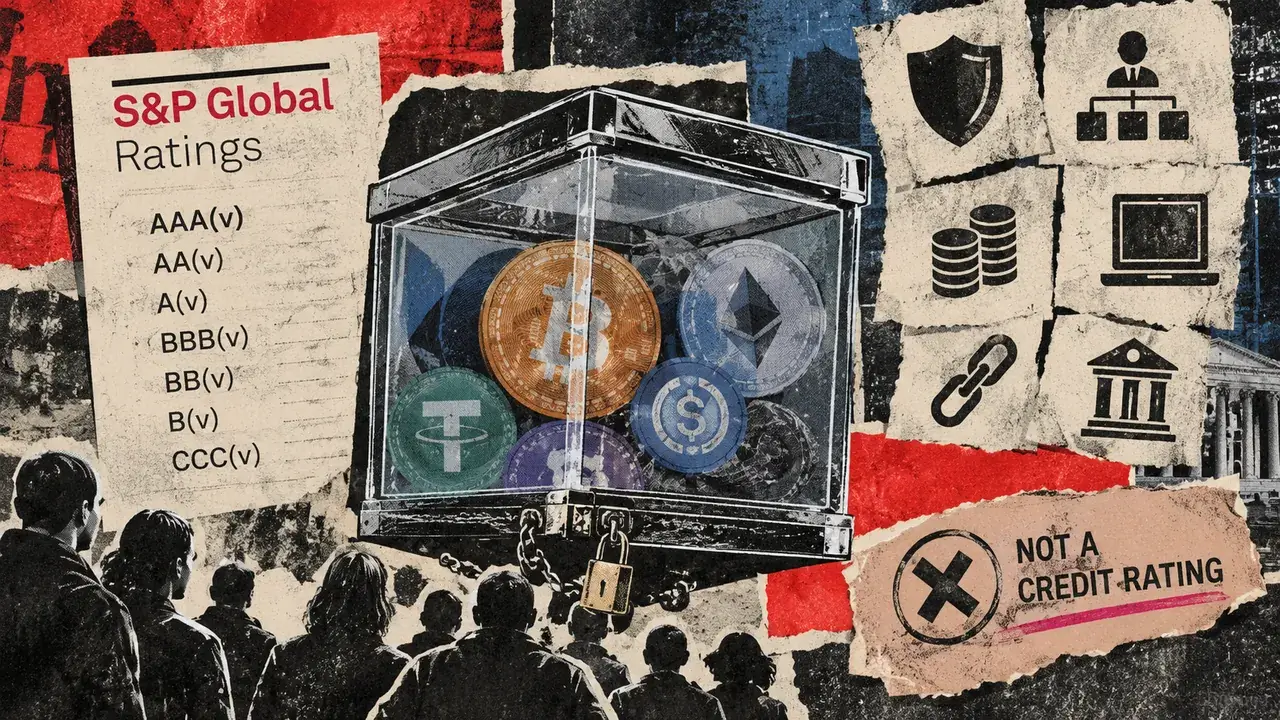
For investors, this highlights the "middleware" trap. Many institutional allocators might feel comfortable with the security of a major protocol like Aave, but they often overlook the fact that their entry point—the vault—introduces a new set of risks. S&P’s framework aims to bridge this gap, providing a "AAA(v)" to "B(v)" scale that accounts for these intermediary layers.
Institutional Reactions and the Path Toward Standardization
While S&P Global is the first "Big Three" rating agency to launch a dedicated vault assessment framework, the move is expected to trigger a ripple effect across the industry. Industry analysts suggest that other major firms like Moody’s or Fitch may soon follow suit with their own methodologies for on-chain finance.
Early reactions from the DeFi community have been mixed but generally positive. Proponents argue that institutional benchmarks are the "missing link" required to attract large-scale pension funds and insurance companies into the space. Without a standardized way to compare a vault on Ethereum with a vault on Base, institutional risk committees have found it difficult to justify allocations.
Conversely, some DeFi purists argue that a centralized agency like S&P cannot fully capture the nuances of decentralized code. However, S&P has clarified that these assessments are not "guarantees" of capital recovery nor are they "yield opinions." They are forward-looking opinions on the relative risk of impairment. This distinction is vital for maintaining a realistic expectation of what these ratings can provide.
Broader Impact on the DeFi Ecosystem
The introduction of these ratings is likely to change the competitive dynamics for vault managers and curators. Currently, vaults often compete solely on "APY" (Annual Percentage Yield). With the introduction of S&P grades, a "flight to quality" may occur.
If a vault with a 5% yield receives a "AAA(v)" rating while a vault with a 10% yield receives a "BB(v)" rating, investors can finally make an informed decision based on risk-adjusted returns. This could force vault managers to prioritize security audits, better governance structures, and more transparent liquidity management to achieve higher ratings.
Furthermore, the framework could influence how developers build future products. To achieve a high rating from a firm like S&P, developers may opt for more "immutable" code and more restrictive permissions, potentially reducing the "move fast and break things" ethos that has characterized much of early DeFi development.
Conclusion: The Maturity of On-Chain Capital Markets
The launch of the Vault Risk Assessment framework by S&P Global marks a significant milestone in the maturation of digital asset markets. By applying the rigors of traditional risk analysis to the world of smart contracts and decentralized lending, S&P is providing the tools necessary for the next phase of institutional adoption.
As the market for lending vaults continues to grow—potentially reaching hundreds of billions of dollars in the coming years—the ability to distinguish between a well-governed, secure pool of capital and a high-risk, experimental structure will be the difference between sustainable growth and catastrophic failure. The incident on the Base network on October 4 was a reminder of the fragility of the current ecosystem; S&P Global’s new framework is a bid to build a more resilient foundation for the future of finance. The next major test for the industry will come as S&P begins to publish individual assessments for specific vaults, effectively naming the leaders and laggards in the quest for institutional-grade decentralized lending.









