
 James Watt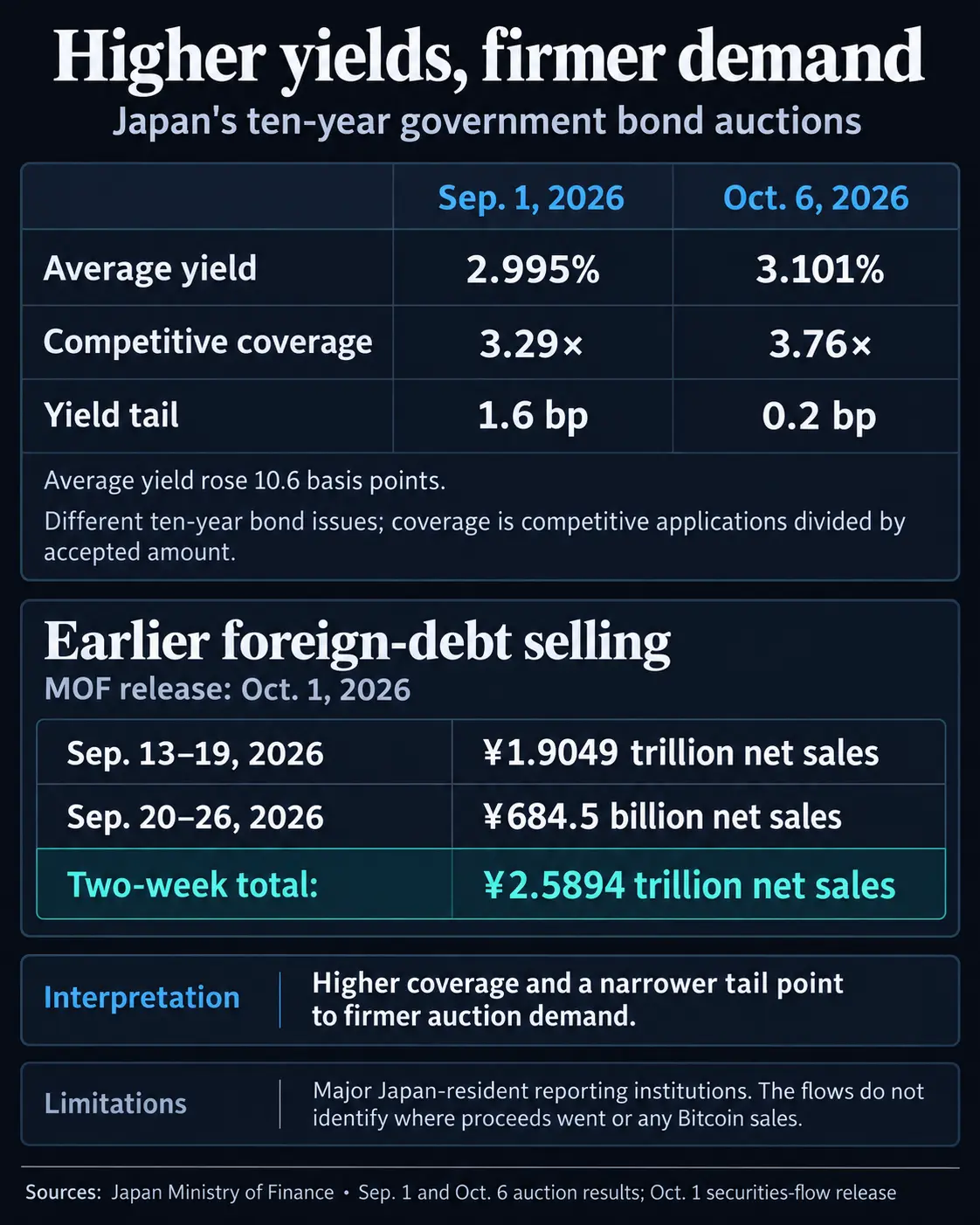
The October 10-Year Auction: Analyzing the Data
The October 6 auction results provided clear evidence of "firmer demand" at these higher yield levels. One of the most critical metrics in bond auctions is the "bid-to-cover" or "competitive auction coverage" ratio. This figure represents the total amount of bids received divided by the amount of debt actually sold. In the October auction, this ratio rose to 3.76 times, a significant jump from the 3.29 times recorded in the September 1 sale. This indicates that despite the higher cost of borrowing for the government, institutional buyers—such as Japanese life insurers and commercial banks—are increasingly eager to lock in these yields.
Furthermore, the "yield tail," which measures the difference between the average yield and the highest accepted yield (lowest price), narrowed dramatically from 1.6 basis points to just 0.2 basis points. A smaller tail suggests that the bidding was highly concentrated near the average price, indicating a strong consensus among market participants regarding the value of the bonds at these levels. When the tail is short, it typically signifies that the market is not demanding a steep discount to absorb the debt, further underscoring the robust demand for domestic fixed-income assets.
The ¥2.6 Trillion Foreign Debt Exodus
The surge in domestic bond demand did not occur in a vacuum. It follows a massive wave of selling in foreign debt markets by Japanese residents. According to data released by the Ministry of Finance on October 1, major Japanese institutional investors were net sellers of ¥2.5894 trillion in foreign long-term debt over a two-week period in late September. Specifically, the week of September 13–19 saw net sales of ¥1.9049 trillion, followed by ¥684.5 billion in sales during the week of September 20–26.
While the Ministry of Finance does not explicitly break down these sales by country or asset type—leaving it unclear how much of this was comprised of US Treasuries versus European or Australian debt—the sheer scale of the divestment is noteworthy. Historically, Japanese investors have been among the largest holders of foreign sovereign debt, driven by decades of near-zero interest rates at home. As JGB yields rise toward and beyond the 3% threshold, the "yield gap" between domestic and foreign bonds narrows, especially when the cost of currency hedging is factored in. This creates a powerful incentive for "repatriation," where capital flows back into Japan, potentially depriving foreign markets of a reliable source of funding.
Chronology of the Shift: September to October 2026
To understand the current pressure on Bitcoin and other risk assets, it is necessary to look at the timeline of events leading up to the October auction:

- September 1, 2026: The Ministry of Finance conducts its monthly 10-year JGB auction. The average yield is 2.995%, and the coverage ratio is a modest 3.29. The yield tail is 1.6 bps, suggesting some hesitation among buyers.
- September 13–19, 2026: A massive liquidation of foreign debt begins. Japanese institutions sell over ¥1.9 trillion in overseas bonds. This period coincides with increasing hawkishness from the Bank of Japan (BoJ) and rising domestic inflation expectations.
- September 20–26, 2026: The selling continues, albeit at a slower pace, with another ¥684.5 billion exiting foreign markets. Total two-week outflows from foreign debt reach nearly ¥2.6 trillion.
- October 1, 2026: The Ministry of Finance releases its weekly flow report, alerting global markets to the scale of the Japanese retreat from foreign bonds.
- October 6, 2026: The 10-year JGB auction takes place. Yields hit 3.101%, and demand surges to 3.76 times coverage. The market interprets this as a confirmation that Japanese capital is successfully pivoting back to domestic assets.
The Financing Channel: Why This Matters for Bitcoin
The connection between Japanese bond yields and Bitcoin may not be immediately obvious, but it is rooted in the mechanics of global liquidity. Research from the Bank for International Settlements (BIS), specifically a working paper titled "Defying Gravity: An Empirical Analysis of Cross-border Bitcoin, Ether, and Stablecoin Flows," highlights that global funding conditions are a primary driver of cryptocurrency movements.
Bitcoin is often viewed as a "high-beta" asset, meaning its price movements are highly sensitive to the availability of cheap credit and excess liquidity in the financial system. When a major global creditor like Japan begins to pull back its capital, it effectively raises the "shadow" cost of borrowing. If Japanese banks and insurers are no longer buying US Treasuries or corporate bonds at the same rate, those issuers must find new buyers, often by offering higher yields. This upward pressure on global interest rates reduces the amount of "cheap money" that eventually finds its way into speculative assets like Bitcoin.
Furthermore, the "yen carry trade" remains a persistent concern. In a carry trade, investors borrow Japanese yen at low interest rates to invest in higher-yielding assets elsewhere—ranging from US stocks to Bitcoin. As JGB yields rise and the yen potentially strengthens due to repatriation, the cost of maintaining these borrowed positions increases. A sudden "unwind" of these trades can lead to forced liquidations across multiple asset classes. While the October 6 auction does not directly measure short-term borrowing costs, it serves as a leading indicator of the rising cost of yen-denominated capital.
Market Implications and Professional Analysis
Financial analysts suggest that the "repatriation trade" is no longer a theoretical risk but a documented reality. The ¥2.6 trillion sale of foreign debt is a signal that Japanese institutions are preparing for a long-term environment of higher domestic rates. For Bitcoin investors, this creates a "liquidity drain" scenario.
If the trend of domestic bond preference continues, we can expect several outcomes:
- Reduced Global Liquidity: As one of the world’s largest exporters of capital, Japan’s shift inward reduces the total pool of liquidity available for international markets.
- Higher Risk Premiums: With the "risk-free" rate in Japan rising, investors globally may demand higher returns on risky assets to justify the volatility, putting downward pressure on Bitcoin’s valuation.
- Increased Correlation with Macro Events: Bitcoin may become even more sensitive to Bank of Japan policy meetings and Japanese Ministry of Finance data releases, as these now directly impact the global cost of capital.
A BIS bulletin from August 2024 previously noted how market turbulence can be amplified by deleveraging and margin increases when financing conditions tighten. While the current market has not yet seen a disorderly unwind, the narrowing yield tail and higher JGB demand suggest that the "cushion" of low Japanese rates is thinning.

Broader Impact on the Crypto Ecosystem
The impact is not limited to Bitcoin alone. Stablecoin flows, which act as the "oil" in the crypto market’s engine, are also tied to global interest rate environments. Most major stablecoins are backed by US Treasury bills. If the demand for Treasuries shifts significantly due to Japanese selling, the resulting volatility in the bond market could affect the stability and yield-generating strategies of stablecoin issuers.
Additionally, institutional crypto adoption relies heavily on the "cost of carry." Large hedge funds that trade Bitcoin often do so by balancing their positions with various fiat-denominated instruments. If the yen—a traditional funding currency—becomes more expensive or more volatile, the cost of hedging Bitcoin positions rises, potentially leading to lower institutional participation and reduced trading volumes.
Conclusion: What to Watch Next
The October 6 auction serves as a clear warning that the era of "free" Japanese capital is coming to an end. For Bitcoin investors, the key metric to monitor over the coming months will be the continued flow of foreign debt sales by Japanese residents. If the Ministry of Finance continues to report trillions of yen in net sales of foreign securities, it will indicate a sustained drain on global liquidity.
Investors should also keep a close eye on the "yield spread" between the 10-year JGB and the 10-year US Treasury. As this spread narrows, the incentive for Japanese capital to stay at home increases, further tightening the belt on the global financial system. While Bitcoin has proven resilient to many localized economic shocks, a structural shift in the world’s largest creditor nation is a macro event of a different magnitude. The "Japanese bond lighthouse" is indeed guiding yen boats back to shore, but for those left in the darker, more volatile waters of the crypto market, the path ahead may become increasingly turbulent as the global tide of liquidity recedes.








