admin
admin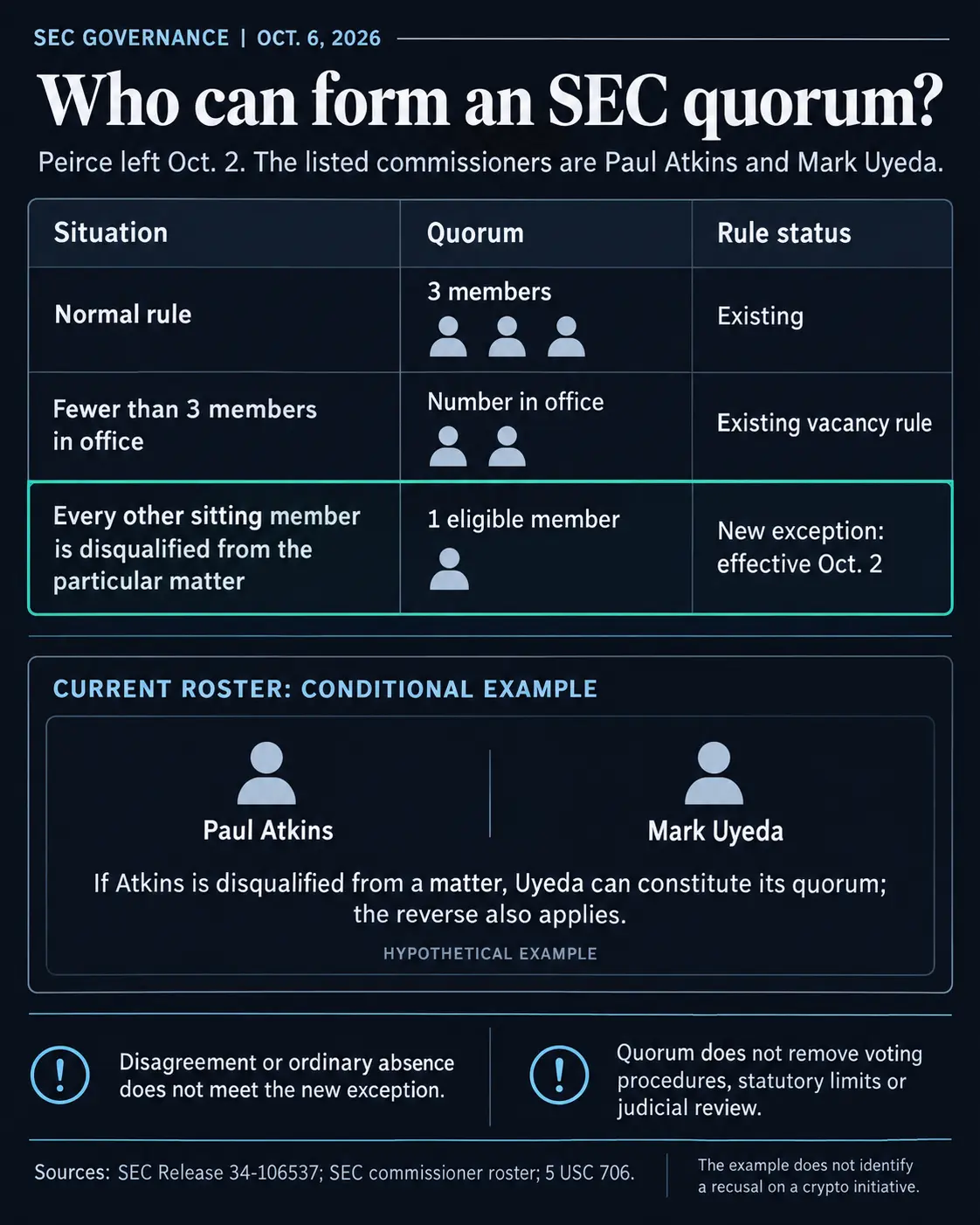
The United States Securities and Exchange Commission (SEC) is navigating a significant shift in its operational framework following Commissioner Hester Peirce’s departure on October 2nd, 2026. This transition has reduced the Commission to two sitting members, Chairman Paul Atkins and Commissioner Mark Uyeda, while simultaneously introducing a revised rule that allows for a single eligible commissioner to constitute a quorum when all other members are disqualified from a particular matter. This adjustment, effective the same day as Peirce’s resignation, has profound implications for the future trajectory of crypto policy and regulatory decisions emanating from the agency.
The newly amended rule, codified under 17 CFR § 200.41, modifies the requirements for conducting Commission business. Previously, the SEC’s rules stipulated that a quorum could be formed by the number of commissioners in office if fewer than three were serving. An existing exception also allowed for two eligible commissioners to proceed when others were disqualified. The recent amendment, however, expands this exception dramatically, empowering a single commissioner to act as the quorum for a specific matter if every other sitting commissioner is deemed disqualified. This change, published in the Federal Register on October 2nd, 2026, is presented by the SEC as an administrative measure aimed at promoting flexibility and finality in the agency’s operations, particularly in situations where disqualifications might otherwise impede progress.
A Streamlined, Yet Concentrated, Decision-Making Process
Hester Peirce’s resignation letter, dated September 21st, 2026, marked the end of her tenure on October 2nd. Her departure leaves Chairman Paul Atkins and Commissioner Mark Uyeda as the sole commissioners. While the SEC has historically managed with fewer than the full complement of five commissioners, the current configuration, combined with the new quorum rule, concentrates significant decision-making power. This means that crucial regulatory actions, particularly those concerning the burgeoning cryptocurrency sector, will now be subject to review and approval by a much smaller body.
The SEC’s rationale for the quorum amendment, as detailed in the published rule, acknowledges the necessity of maintaining operational continuity when commissioners face disqualifications. The agency’s assertion that this change pertains to "internal management and organization rather than substantive regulation" underscores its administrative focus. However, the practical consequences for policy-making, especially in dynamic fields like digital assets, are substantial.
The amended rule explicitly differentiates between vacancies, non-attendance, and recusal, and a formal disqualification from a specific matter. A commissioner’s disagreement with a proposal does not constitute grounds for disqualification under this new provision. This distinction is crucial, ensuring that the exception is invoked only in specific, legally recognized scenarios of disqualification, such as conflicts of interest or impartiality concerns. Under the current two-commissioner roster, if Chairman Atkins were disqualified from a particular crypto-related decision, Commissioner Uyeda could, in theory, constitute the quorum and proceed with the matter. The reverse scenario also holds true.
Chronology of Recent Regulatory Shifts
The timing of Commissioner Peirce’s departure and the quorum rule amendment is noteworthy, coinciding with several key developments in the SEC’s approach to digital assets.
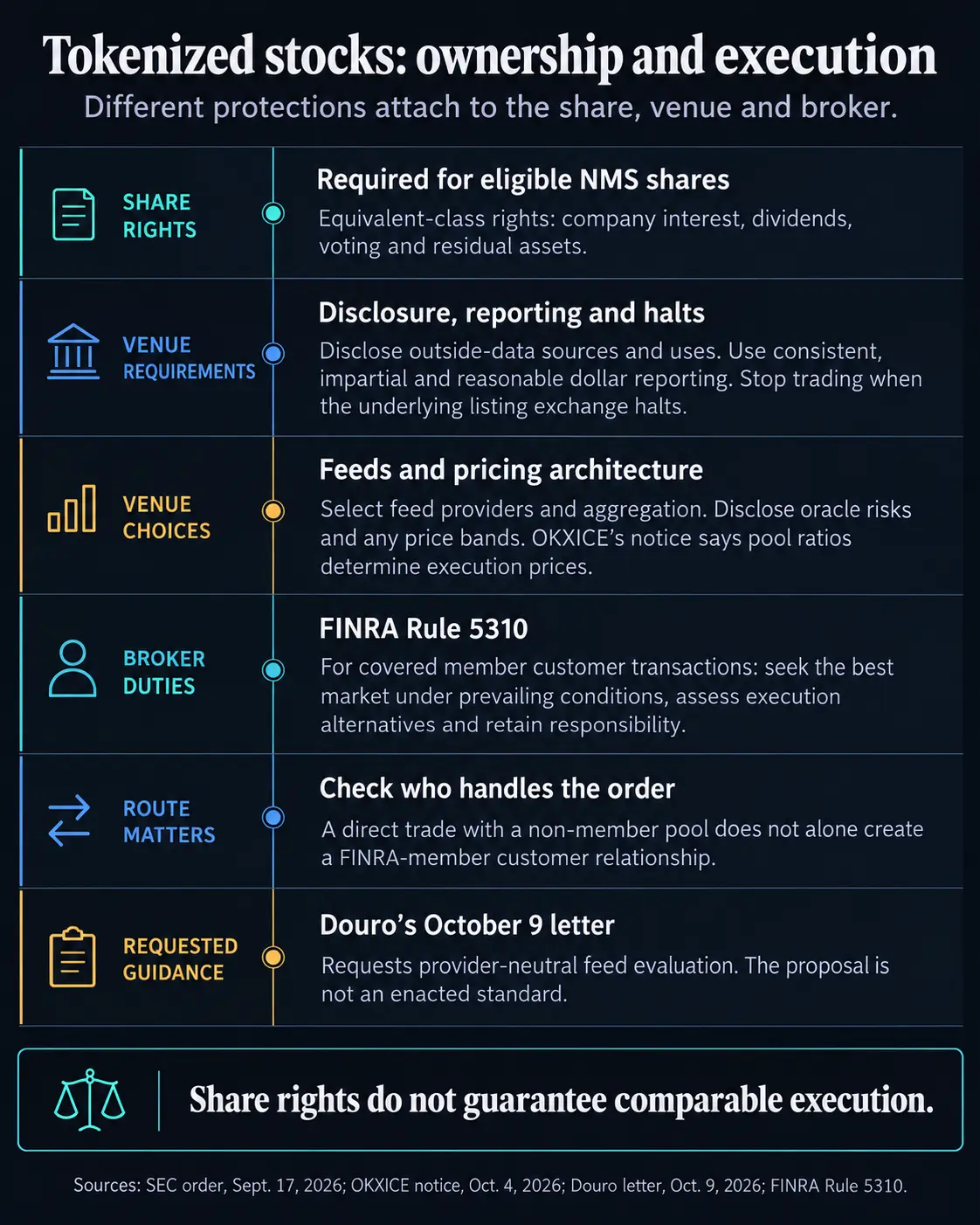
- September 17th, 2026: The SEC issues an Innovation Exemption (4-927), a temporary conditional exemptive order designed to facilitate the trading of tokenized National Market System (NMS) stocks on specified venues and for certain liquidity providers. This order provides a five-year relief period, subject to stringent conditions including limits on stock symbols and volume, assurance of equivalent shareholder rights, and transparency through publicly auditable smart contracts and operating disclosures. For stocks tokenized by unaffiliated third parties, issuer notification and an opportunity to object are also mandated.
- August 18th, 2026: The SEC proposes "Regulation Crypto Assets" (S7-2026-27). This proposal aims to establish offering exemptions for specific investment contracts involving crypto assets, accompanied by disclosure requirements and ongoing anti-fraud and anti-manipulation obligations. It also introduces a proposed conditional safe harbor concerning the determination of investment-contract status for crypto assets.
- October 1st, 2026: The Commission, with all three commissioners then in office – Atkins, Peirce, and Uyeda – approving, releases a significant custody proposal (S7-2026-35). This proposal addresses critical issues surrounding how regulated investment companies can custody crypto securities and similar assets, how registered advisers can safeguard client crypto funds and securities, and mandates related modernization and reporting requirements. Chairman Atkins, in a statement accompanying the proposal, placed custody reform in the context of other ongoing initiatives, including the offering proposal, Commission interpretations, and staff-level tokenization efforts.
- September 21st, 2026: Commissioner Hester Peirce formally submits her resignation letter, making her departure effective October 2nd.
- September 30th, 2026: The SEC publishes the quorum amendment (34-106537), which will become effective on October 2nd, the same day as Commissioner Peirce’s resignation.
- October 2nd, 2026: Commissioner Hester Peirce’s resignation becomes effective. The quorum rule amendment also goes into effect.
- October 3rd, 2026: The SEC’s official commissioner roster is updated, reflecting the reduced number of sitting commissioners.
The approval of the custody proposal on October 1st, with all three commissioners participating, highlights the collaborative efforts that were in place prior to Peirce’s departure. This vote was to propose the rules, initiating the public comment period, which is now scheduled to close on December 7th, 2026. The existence of a smaller commission or the new quorum rule does not retroactively transform a proposed framework into operative policy.
Implications for Crypto Policy and Regulation
The immediate impact of the reduced commission and the new quorum rule is a heightened concentration of authority. For pending proposals like the custody reform and the Regulation Crypto Assets offering exemptions, the process remains subject to established administrative procedures, including public comment periods and subsequent Commission votes. The new quorum rule does not expedite these processes or alter the substantive requirements for adopting new regulations.

The Innovation Exemption for tokenized-stock trading, already issued as a conditional order, remains in effect with its specified limitations and safeguards. Any future Commission decisions regarding modifications or extensions of this relief would operate under the prevailing quorum arrangements. The new rule itself does not expand the scope of this exemption nor does it remove the existing protective conditions.
The SEC’s published rule on quorum adjustments emphasizes that disqualifications arise and that the agency must continue its work. It describes the amendment as promoting flexibility and finality, distinguishing it from substantive regulatory changes. This administrative rationale, however, is paired with a practical consequence: future Commission-level decisions on complex and contentious matters, such as those involving cryptocurrency, will involve fewer voices.
Supporting Data and Context
The SEC is tasked with protecting investors, maintaining fair, orderly, and efficient markets, and facilitating capital formation. The rapid evolution of the digital asset landscape presents significant challenges in fulfilling these mandates. In 2025, the global cryptocurrency market capitalization experienced significant volatility, with estimates from various financial data providers fluctuating between $1 trillion and $2.5 trillion USD at different points in the year. This market dynamism necessitates agile and informed regulatory responses.
The SEC’s historical engagement with crypto has been characterized by a case-by-case approach, often involving enforcement actions against unregistered securities offerings. However, there has been a growing call from industry participants for clearer regulatory guidance and more defined rules of the road. Commissioner Peirce, often referred to as "Crypto Mom" for her more measured and often crypto-sympathetic stance, frequently advocated for a more tailored and less enforcement-driven approach. Her departure represents a potential shift in the internal dynamics of the Commission’s deliberations on these matters.
Broader Impact and Analysis
The new quorum rule, while seemingly an administrative tweak, carries significant weight in the context of potential future regulatory actions. The SEC’s October voting record, for instance, shows three Commissioners participating in the custody proposal vote. While the agency generally posts votes only when a matter is final, this record supports the observation that significant proposals were being handled with a full complement of Commissioners prior to Peirce’s exit.
The Administrative Procedure Act (APA) mandates notice-and-comment rulemaking for most federal agency regulations, a process designed to ensure transparency and public input. The SEC’s assertion that the quorum amendment did not require notice and comment is based on its classification as an internal organizational matter. However, any future crypto-related rules adopted under the new quorum structure will still be subject to the APA’s requirements unless specific exceptions apply. Furthermore, judicial review under the APA allows courts to set aside agency actions found to be unlawful, beyond statutory authority, or procedurally flawed. Reducing the number of eligible commissioners does not grant additional substantive authority nor does it insulate decisions from legal scrutiny.
The delegation provisions within the Securities Exchange Act of 1934 (15 U.S.C. § 78d-1) allow the Commission to delegate certain authorities through published orders or rules. However, general rulemaking authority is excluded from this delegation, preserving the Commission’s core legislative function. Even with delegated authority, a single commissioner can still bring a delegated action before the full Commission for review.
For businesses operating within the digital asset space, the immediate future holds several key regulatory milestones: the October 20th deadline for comments on the offering rules, the December 7th deadline for comments on the custody proposal, and any subsequent Commission decisions on these or other conditional trading relief measures. The legal status of these initiatives, the recorded approvals, and the participating members will provide crucial insights into how the reduced Commission operates.
The new quorum exception, while preserving the agency’s ability to function in the face of commissioner disqualifications, shifts the landscape of crypto policy decision-making. Its ultimate impact will hinge on the specific matters that come before the Commission, the eligibility of each commissioner to consider them, and the decisions they ultimately render. The concentrated authority could lead to swifter decisions in certain circumstances, but it also amplifies the significance of each commissioner’s individual vote and interpretation of securities laws in the evolving digital asset ecosystem. The SEC’s ability to effectively balance investor protection with fostering innovation in this rapidly advancing sector will be closely scrutinized in the months and years to come.