admin
admin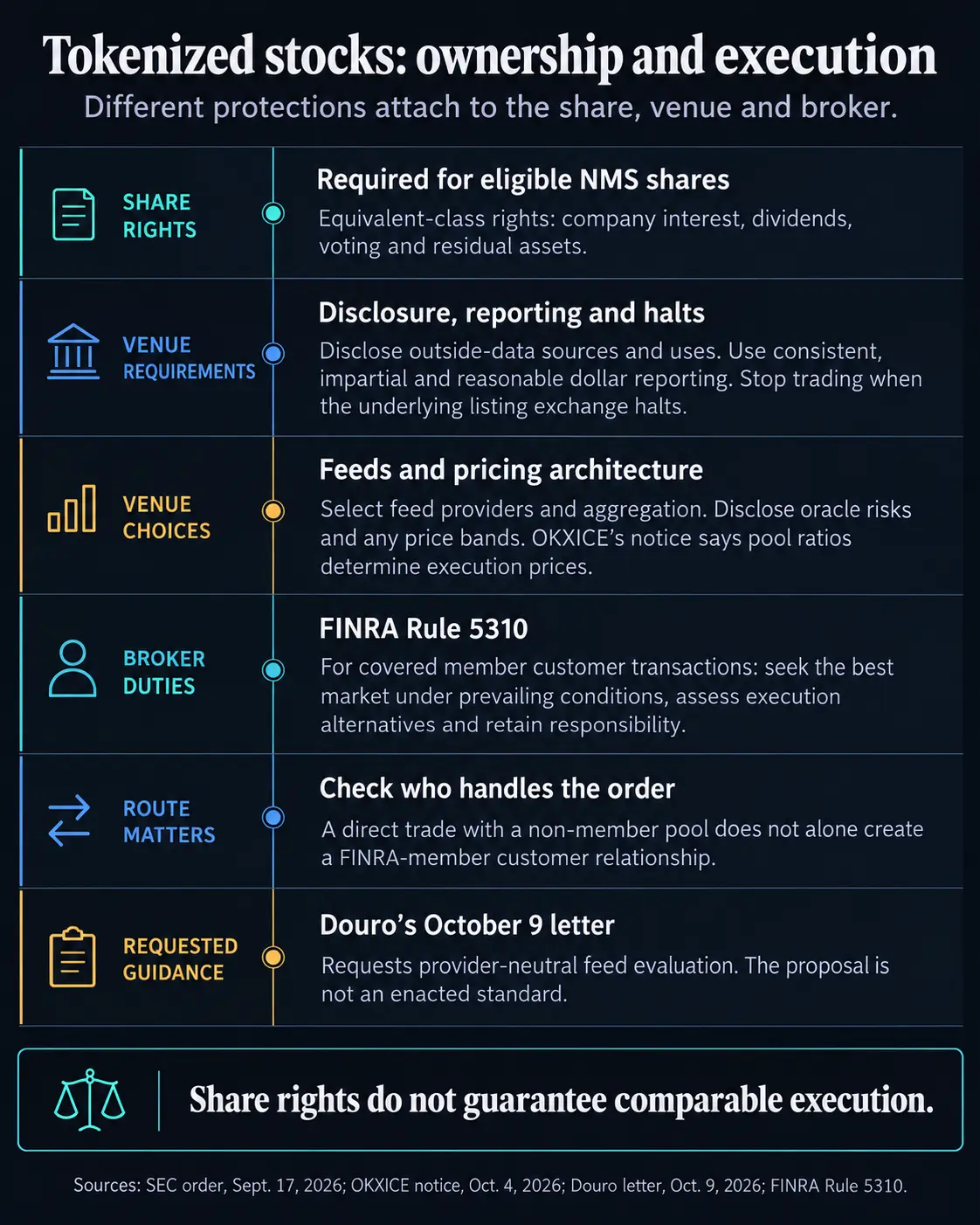
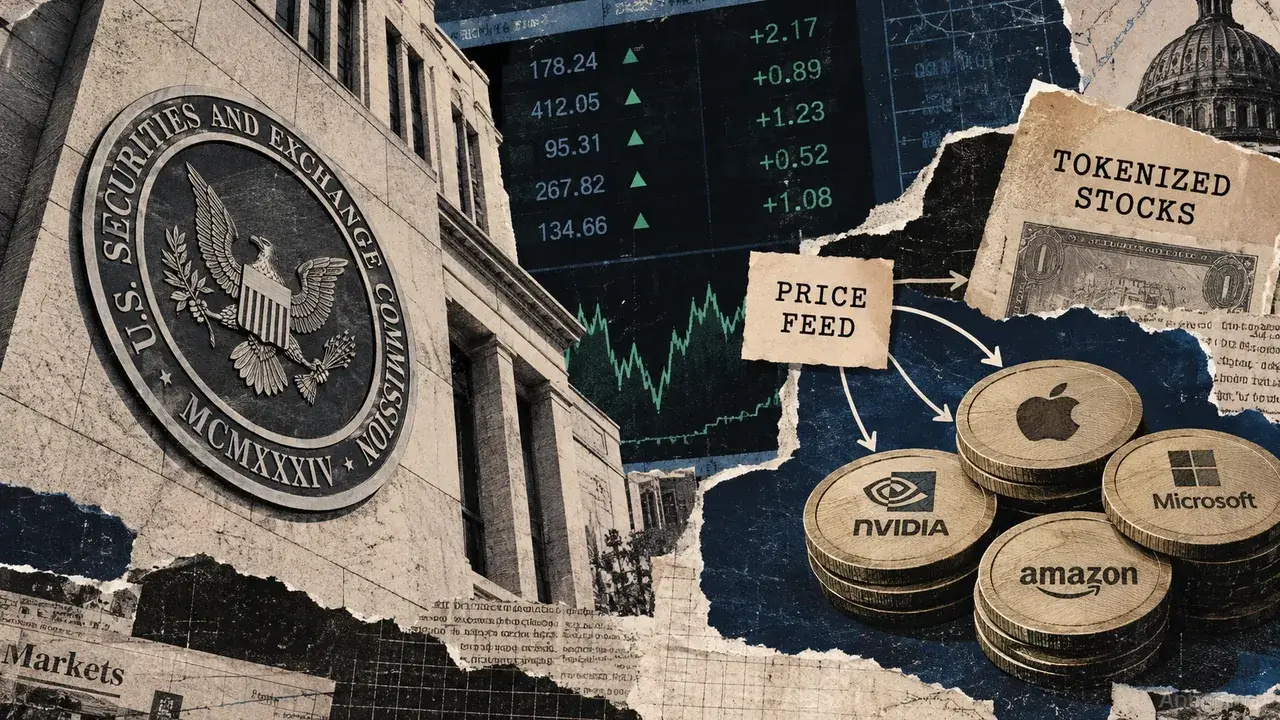
The U.S. Securities and Exchange Commission’s (SEC) September 17 order, granting temporary, conditional relief to certain venues trading tokenized National Market System (NMS) stocks, has opened a new frontier in financial markets. While these tokenized securities must carry equivalent shareholder rights to their traditional counterparts, the trading platforms themselves can operate outside the purview of key Regulation NMS protections, such as the protection against trades at inferior prices compared to protected quotations on other venues. This dichotomy necessitates a thorough examination by investors, who must scrutinize not only the underlying asset but also the mechanisms by which their orders are priced and executed. The complexities are further amplified by ongoing discussions regarding the quality and reliability of external price feeds, a critical component for these nascent trading environments.
Genesis of the Exemption: Addressing Evolving Market Structures
The September 17 order emerged from a growing interest in tokenizing traditional securities, a process that transforms ownership of assets into digital tokens on a blockchain. This innovation promised increased efficiency, fractional ownership, and 24/7 trading potential. However, the existing regulatory framework, designed for traditional exchanges and broker-dealers, presented significant hurdles. The SEC’s order, officially titled "Exemptive Order Regarding the Definition of an Exchange" (34-106402), sought to provide a controlled environment for these innovations to flourish without immediately subjecting them to the full weight of established regulations that might stifle their development.
The relief granted is specific: it exempts venues offering permissioned automated market maker (AMM) pools for eligible tokenized NMS stocks from the definition of an "exchange." These AMM pools leverage software to allow pre-approved participants to trade against pooled assets, creating a more automated and potentially liquid trading environment. Crucially, the order also offers separate relief for certain liquidity providers operating as dealers, allowing them to use their own capital under defined circumstances. This bifurcated approach acknowledges the different roles within these emerging markets.
Equivalence of Rights: The Investor’s Core Ownership Stake
A cornerstone of the SEC’s exemption is the requirement that tokenized stocks eligible for this relief must possess equivalent shareholder rights to their traditional, non-tokenized counterparts. This means that owning a tokenized share of, for instance, Apple Inc. (AAPL) on an exempted venue should confer the same fundamental rights as owning a traditional AAPL share. These rights typically include an economic interest in the company, entitlement to dividends, voting privileges, and a claim on the company’s residual assets in the event of liquidation.
The SEC’s emphasis here is on the substance of ownership. The token is merely a digital representation of a pre-existing security. Therefore, any rights and privileges associated with the underlying class of stock must be faithfully replicated in the tokenized form. This distinction between what an investor owns (the rights) and the terms under which they buy or sell it (execution) is critical for investor protection.
Navigating the Trading Venue: A Departure from Traditional Protections
The significant departure from traditional market structures lies in the regulatory status of the exempted trading venues. By operating outside the definition of an exchange, alternative trading system (ATS), or traditional trading center, these venues are, in relevant aspects, excluded from certain Regulation NMS rules. Most notably, this can include Rule 611, which aims to prevent "trade-throughs" – executing trades at prices inferior to protected quotations available on other venues.
This absence of direct Regulation NMS application means that while a tokenized stock might represent equivalent ownership rights, its trading on an exempted venue might not benefit from the same price discovery and execution quality safeguards found on regulated exchanges. This creates a dual challenge for investors: understanding the value and rights of the asset, and understanding the pricing and execution mechanisms of the platform where it’s traded.
The Crucial Role of External Price Data and Oracles
The operational integrity of these exempted venues heavily relies on external price feeds and oracles. Oracles are essential services that bridge the gap between the blockchain and the real world, bringing off-chain data, such as asset prices, onto the blockchain. The SEC’s order mandates that these venues provide transparency regarding their use of such data. Public notices must detail the providers, sources, intended purposes of the data, and the specific mechanisms of oracle utilization. Furthermore, venues are required to disclose known material risks, including the potential for oracle manipulation, and any reference-price bands or other risk controls implemented.
The market data provider Douro Labs, with a vested commercial interest in the standards governing these data feeds, submitted a significant comment letter to the SEC staff on October 9. Douro Labs, a contributor to the Pyth Network and developer of Pyth Pro, seeks provider-neutral principles to assess external price feeds and their application for dollar reporting. The company’s submission highlights the need for a robust framework to evaluate the reliability and integrity of these data sources, a crucial step in ensuring fair and orderly trading.
Douro Labs’ proposed criteria emphasize several key aspects:
- Independent Contributors: Price feeds should be sourced from independent entities involved in genuine price formation.
- Manipulation Resistance: Aggregation methods for price data should be designed to withstand manipulation attempts.
- Transparency of Sources: The identities of public contributors and their calculation methodologies should be disclosed.
- External Benchmarking: Price data should be regularly compared against established external market benchmarks.
- Data Confidence and Staleness: Disclosures should cover confidence levels, the recency of data, and the venue’s response protocols when data becomes uncertain or unavailable.
The SEC’s order does not dictate a singular provider, a minimum number of contributors, a universal aggregation method, a specific confidence threshold, or a uniform approach to handling stale prices. This leaves significant discretion to the venues, underscoring the importance of Douro Labs’ call for standardized assessment principles.
Vendor Disclosures: A Glimpse into Operational Realities
Notices published by trading venues offer insights into how they are implementing the SEC’s requirements. For instance, OKXICE’s October 4 notice illustrates the multifaceted role of external price data. It clarifies that while AMM execution prices are determined by the ratios of assets within the trading pool, external price data serves distinct functions: displaying stock valuations, monitoring for trading halts in the underlying asset on its primary exchange, and converting stablecoin-paired transactions into dollar terms for reporting purposes.
OKXICE identifies Massive.com as its provider for stock prices and trading-halt data, and an affiliated entity, OKX INC, for stablecoin price indices. The notice also states that OKXICE itself imposes no additional circuit breakers or reference-price bands beyond those inherent in the halt detection mechanisms. The use of Circle’s USD-pegged USDC as a payment asset highlights the need for reliable stablecoin pricing to accurately convert trades into dollar values for reporting.
In contrast, TSV LLC’s September 23 notice provides a more preliminary disclosure, indicating that operations had not yet commenced. It outlines intended uses for external data, including halt detection and price divergence monitoring, while acknowledging that a definitive market data provider had not yet been selected. Such notices serve as essential communication channels for investors to understand the operational frameworks of these novel trading venues.
Best Execution: The Enduring Duty of FINRA-Member Brokers
For FINRA-member brokers handling covered customer transactions involving tokenized stocks, the duty of best execution remains paramount. Rule 5310 of the Financial Industry Regulatory Authority mandates that member firms exercise reasonable diligence to ascertain the best market for a security and obtain the most favorable price for their customers under prevailing market conditions. This obligation applies whether the firm acts as an agent executing trades on behalf of clients or as a principal trading for its own account.
The assessment of best execution is a comprehensive process, taking into account various factors:
- Market Character: The nature and structure of the trading venue.
- Transaction Size and Type: The scale and specifics of the order.
- Markets Checked: The range of venues and quotations surveyed.
- Quotation Accessibility: The ease of accessing available pricing information.
- Customer Order Terms: The specific instructions and parameters provided by the client.
- Speed and Likelihood of Execution: How quickly an order can be filled and the probability of executing limit orders.
- Costs: All explicit and implicit costs associated with the trade.
- Customer Needs: The overall requirements and objectives of the investor.
This rule is designed to ensure that brokers actively seek the best possible outcome for their clients, a standard that extends beyond merely matching a pool price against a single external reference point. Importantly, a member firm cannot delegate this fundamental duty to another entity. Even automated order routing systems and internalizers must undergo regular, rigorous reviews to ensure compliance, comparing their execution quality against competing markets and making adjustments or providing justifications for retaining current arrangements. The existence of sparse pricing information necessitates particularly stringent diligence, documented procedures, and meticulous record-keeping.
Investor Due Diligence: A Call for Enhanced Scrutiny
The evolving landscape of tokenized securities trading presents investors with a new set of considerations. When interacting with these exempted venues, investors must engage in a heightened level of due diligence. Key questions to ask include:
- What is the role of external data? Does it determine the execution price, merely display a valuation, facilitate reporting conversions, or trigger trading halts?
- Are there price bands or other risk controls? If so, how effective are they, and what are the protocols for handling stale or unavailable reference data?
- If a FINRA member broker is involved, how do they ensure best execution? How do they compare the execution quality on the tokenized venue against alternative trading opportunities?
- What are the specific rights associated with the tokenized security? Does it genuinely mirror the rights of the underlying traditional stock?
Douro Labs’ request for SEC staff to provide a concrete framework for assessing external data feeds is a significant development that could offer much-needed clarity. For investors, the ultimate test of these new trading environments will be whether the venue’s data integrity, pricing controls, and any broker’s execution review capabilities genuinely support the trade they anticipate and deserve.
Broader Implications: The Future of Digital Securities Trading
The SEC’s September order represents a pragmatic approach to fostering innovation within a regulated framework. By providing conditional exemptions, the Commission allows for the exploration of new market structures and technologies while retaining oversight and demanding transparency. The ongoing dialogue surrounding external price feeds, as exemplified by Douro Labs’ submission, highlights the critical need for robust data infrastructure and clear assessment methodologies.
The distinction between the rights inherent in a tokenized asset and the execution environment in which it trades is a crucial concept for investors to grasp. While the promise of tokenization is significant, the regulatory complexities and operational nuances demand a cautious and informed approach. As the market matures, continued clarity from regulators and proactive engagement from market participants will be essential to ensure that tokenized securities can achieve their full potential while upholding investor protection principles. The integration of traditional financial instruments onto blockchain technology is a transformative trend, and the SEC’s current actions are shaping the foundational rules for this next chapter in financial markets.