admin
admin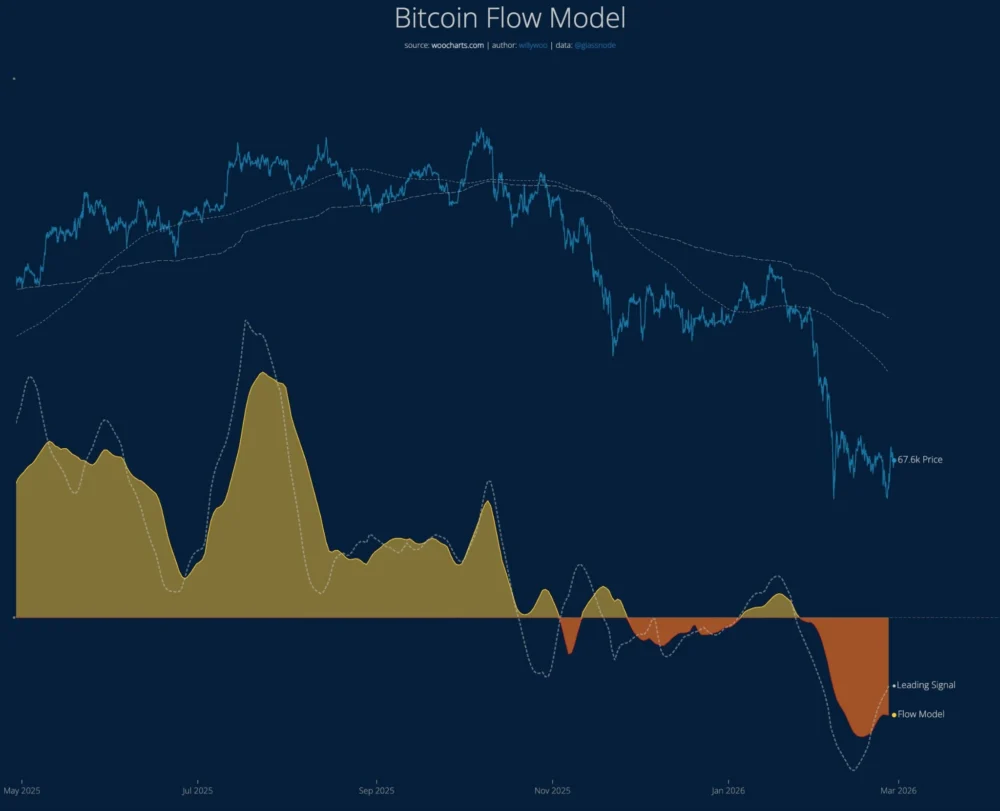
Bitcoin investors may finally be experiencing a reprieve from a period of intense selling pressure, signaling a potential shift in market dynamics, according to recent analysis from prominent industry experts. Willy Woo, a highly regarded on-chain analyst, suggested on Friday that the aggressive bearish sell-down that has characterized recent weeks appears to have reached a point of exhaustion. While this development offers a temporary relief for the world’s largest cryptocurrency by market capitalization, experts caution that the road to a sustained bullish recovery remains long, with several months of sideways consolidation expected before a definitive trend reversal takes hold.
The current market environment has seen Bitcoin (BTC) trapped within a relatively narrow trading range, fluctuating between $60,000 and $70,000 for the past three weeks. A brief dip below the $67,000 mark during late trading on Thursday underscored the fragility of the current price floor, even as long-term indicators suggest that the worst of the immediate selling pressure may be behind us. Woo noted that this exhaustion provides the price with the necessary breathing room to consolidate sideways for approximately a month. He also held out the possibility of a relief rebound toward the mid-$70,000 level, though he warned that such a move would likely face stiff resistance and a potential rejection.
The Dynamics of Liquidity and Market Sentiment
A critical component of the current bearish outlook is the state of market liquidity. Willy Woo’s analysis highlights a concerning trend where both spot and futures liquidity are simultaneously deteriorating. In professional trading circles, liquidity refers to the ease with which an asset can be bought or sold without significantly affecting its price. When liquidity dries up, price movements can become more erratic, and sustained rallies become increasingly difficult to maintain.
Woo observed that the broader market remains "heavily bearish" due to these liquidity constraints. He emphasized the rarity of the current situation, stating that he has historically never seen a Bitcoin rally occur when both spot and futures liquidity sources are trending bearishly. This lack of depth in the order books suggests that while the "selling" may have paused, the "buying" power required to drive a new all-time high is not yet present in the system.
The deterioration of liquidity is often a precursor to extended periods of range-bound trading. Without the influx of significant new capital or a "risk-on" shift in global markets, Bitcoin is likely to continue its "sideways chop." This sentiment is shared by other market observers who look to technical indicators for confirmation of the current trend.
Technical Indicators and the RSI Exhaustion Signal
Supporting the theory of selling exhaustion is the Relative Strength Index (RSI), a momentum oscillator that measures the speed and change of price movements. Andri Fauzan Adziima, the research lead at Bitrue, pointed out that Bitcoin’s historic weekly RSI has reached oversold levels. In technical analysis, an oversold RSI is often interpreted as a sign that an asset has been sold too aggressively and is due for a stabilization or a bounce.
According to Adziima, this reading "strongly confirms that aggressive selling pressure has peaked or is fading." He described this as a "classic exhaustion signal" that explains the recent modest bounces from local lows. However, like Woo, Adziima does not anticipate an immediate vertical climb. Instead, he expects a prolonged period of "sideways chop" and repeated tests of the support levels between $62,000 and $65,000. He believes the market will remain range-bound within the $60,000 to $70,000 zone for weeks or even months, barring a major catalyst such as a surge in Spot Bitcoin Exchange-Traded Fund (ETF) inflows or a favorable shift in macroeconomic policy.
Macroeconomic Risks and Support Levels
The future trajectory of Bitcoin is inextricably linked to the broader global economic landscape. Willy Woo provided a sobering perspective on the potential for further downside if global macroeconomic conditions were to deteriorate significantly. Since its inception in 2009, Bitcoin has largely existed within a "secular global macro bull market." This means that for the majority of its history, the global economy has been in an expansionary phase, characterized by low interest rates and high liquidity.
Woo cautioned that if this long-term macroeconomic trend "breaks down"—perhaps due to a global recession, systemic banking failures, or geopolitical instability—Bitcoin could face much deeper corrections. In such a scenario, he identified $30,000 as a primary fallback level of support. Should that level fail to hold, $16,000 represents the "final line" to maintain the integrity of Bitcoin’s long-term bullish trend. While these figures represent "worst-case" scenarios, they serve as a reminder of the asset’s sensitivity to global financial health.
The Psychology of the Sell-Off: AI, Quantum Fears, and Cycles
Understanding why the recent sell-off occurred is essential for predicting what comes next. Matt Hougan, the Chief Investment Officer at Bitwise, recently addressed the various theories and "conspiracies" regarding the recent market downturn. Rejecting more complex explanations, Hougan stated that the primary reason for the price drop was straightforward: "A bunch of people who were long Bitcoin sold their Bitcoin exposure."

Hougan identified several key drivers behind this divestment. First, many investors are adhering to the "four-year cycle" theory, which suggests that Bitcoin follows a predictable pattern of peaks and troughs tied to the halving events. Some may have felt that the market had reached a local top and chose to take profits. Second, Hougan noted an emerging trend of capital rotation into Artificial Intelligence (AI) startups. As AI continues to dominate the venture capital and tech sectors, some crypto investors have shifted their portfolios toward what they perceive as the next major technological frontier.
Furthermore, "quantum fears"—the concern that future quantum computers could eventually break the cryptographic security of the Bitcoin network—have weighed on the minds of some long-term holders, despite experts’ assurances that quantum-resistant upgrades are feasible. Despite these pressures, Hougan remains optimistic, asserting that the selling pressure is "mostly done" and that the market is currently in a "bottoming" process. He likened the current phase to a "classic crypto winter" that will inevitably be followed by a "classic crypto spring," leading to new all-time highs in the future.
Historical Comparisons and the Recovery Timeline
The current market stagnation is not without precedent. Jeff Ko, the chief analyst at the CoinEx exchange, suggested that the market might take three to six months to fully repair sentiment. He drew a parallel between the current sideways action and the market behavior seen after the collapse of the Terra (LUNA) ecosystem in 2022.
Ko argued that a "V-shaped recovery"—a rapid return to previous highs—is unlikely after a significant drawdown. Instead, the market requires a structural range where price discovery can occur slowly. While recent data shows an improvement in Spot ETF inflows, suggesting that institutional interest remains intact, it is not yet enough to overwhelm the residual bearish sentiment.
The timeline for a full recovery, according to Willy Woo’s "educated guess," points toward the fourth quarter of 2026 as the likely end of the bearish trend. He projected that bullish momentum might not fully return until the first or second quarter of 2027. This long-term view suggests that investors may need to exercise considerable patience as the market works through its current excesses.
Chronology of Recent Market Events
To understand the current state of exhaustion, it is helpful to review the events of the past few months:
- Late Q1 2024: Bitcoin reached new all-time highs, driven largely by the successful launch of Spot ETFs in the United States and anticipation of the halving event.
- April 2024: The Bitcoin halving occurred, reducing the daily supply of new coins. While historically bullish, the immediate aftermath saw a "sell the news" reaction.
- May – June 2024: The market entered a period of high volatility. Capital began rotating out of "risk-on" assets as the Federal Reserve signaled that interest rate cuts might be delayed due to persistent inflation.
- Early July 2024: Reports of significant selling by large entities, including government-held seized assets and defunct exchange distributions (such as Mt. Gox), increased downward pressure.
- Current Phase: Prices have stabilized between $60,000 and $70,000. Analysts now observe "selling exhaustion," where the volume of sell orders is no longer sufficient to drive the price significantly lower, yet buying demand is not strong enough to trigger a breakout.
Broader Implications for the Crypto Ecosystem
The transition from a volatile sell-off to a period of consolidation has several implications for the broader cryptocurrency ecosystem. For retail investors, this phase often leads to "investor fatigue," where the lack of dramatic price movement causes a decline in active trading and social media engagement. For institutional players, however, consolidation is often viewed as an accumulation phase.
The continued inflow into Bitcoin ETFs, even during periods of price stagnation, indicates that institutional "smart money" is looking past short-term volatility. If the $60,000 support level remains firm throughout this consolidation, it will establish a strong foundation for the next cyclical bull run.
Furthermore, the shift in focus toward AI and other technologies might actually benefit Bitcoin in the long run by "cleansing" the market of speculative "hot money." A more stable, less speculative investor base could lead to lower volatility and a more mature market structure.
As the market enters what appears to be a multi-month period of sideways movement, the primary focus for analysts will remain on liquidity metrics and macroeconomic indicators. While the "bearish sell-down" may have exhausted itself, the arrival of the "crypto spring" remains a matter of time, patience, and the eventual return of global liquidity. For now, the consensus among experts is clear: the market is in a process of repair, and while the worst may be over, the best is still several seasons away.