admin
admin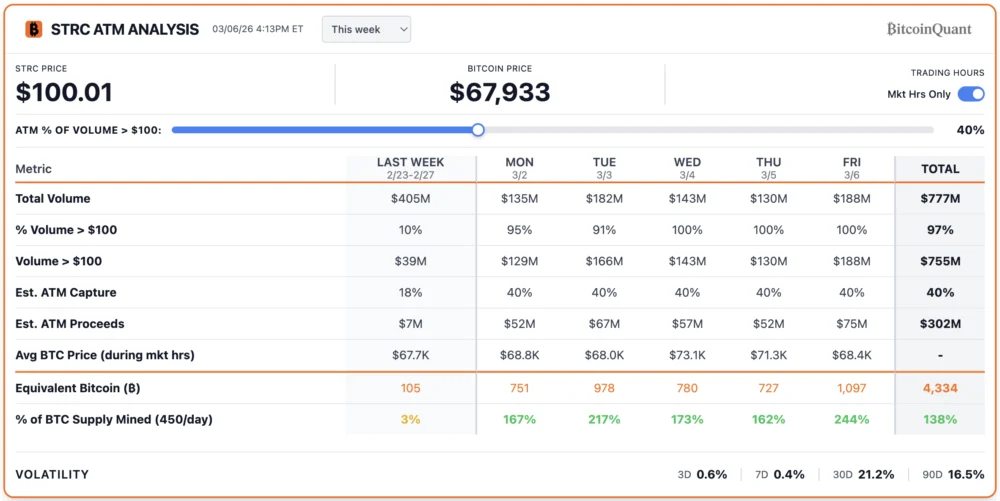
Financial markets are closely monitoring the capital-raising activities of Strategy, the enterprise software firm turned Bitcoin treasury powerhouse led by Executive Chairman Michael Saylor. Based on recent market data and trading volume analysis, the company appears positioned to execute another significant acquisition of Bitcoin (BTC). Projections from industry analysts suggest that Strategy could leverage more than $300 million in net proceeds from its recently launched income-focused preferred stock, known by its ticker STRC, to expand its corporate treasury by approximately 4,300 BTC in the coming weeks.
This potential acquisition follows a period of intense trading activity for STRC shares, which were designed specifically to bridge the gap between traditional fixed-income investors and the volatile digital asset market. As of early March 2026, Strategy’s Bitcoin holdings are valued at approximately $50 billion, representing the largest balance sheet allocation to the cryptocurrency by any publicly traded corporation in history. The anticipated move underscores Saylor’s unwavering commitment to a "Bitcoin Standard," utilizing innovative financial instruments to convert equity market demand into digital scarcity.
The Evolution of the STRC Preferred Stock Mechanism
To understand the current projections, it is necessary to examine the architecture of the STRC instrument. Launched in July 2025, Stretch (STRC) is a specialized class of preferred stock designed to provide investors with a steady income stream while providing Strategy with the liquid capital necessary to continue its aggressive Bitcoin accumulation. Unlike the company’s common stock (MSTR), which often trades at a significant premium to its Net Asset Value (NAV) due to its role as a leveraged Bitcoin proxy, STRC is engineered to trade near a par value of $100 per share.
The primary incentive for STRC investors is a variable monthly yield. Strategy’s treasury department adjusts this yield periodically to ensure the stock remains attractive to income-focused funds and retail investors alike. When the market price of STRC dips below the $100 par value, the company can increase the dividend rate to stimulate demand. Conversely, if the stock trades significantly above par, the yield may be adjusted downward to prevent excessive volatility. For the month of March 2026, Strategy has set the annualized STRC rate at 11.50%, which translates to a monthly distribution of approximately $0.958 per share.
This "yield-for-Bitcoin" swap creates a unique financial feedback loop. Investors seeking double-digit yields provide the cash, and Strategy uses that cash to purchase Bitcoin, which serves as the ultimate backing for the company’s enterprise value. By the end of July 2025, the company had formalized this process by launching a $4.2 billion at-the-market (ATM) program, allowing it to issue new STRC shares directly into the secondary market whenever demand exceeds supply.
Quantitative Projections: The $302 Million Forecast
The latest estimates regarding Strategy’s "dry powder" come from BitcoinQuant, a financial modeling firm that tracks the company’s ATM issuance patterns. According to their analysis of trading activity for the week ending March 6, 2026, STRC saw a massive surge in liquidity. Total trading volume for the week reached $777 million, with a staggering 97% of that volume occurring at prices above the $100 par value.

In the context of an ATM offering, trading above par is a critical signal. It indicates that the market can absorb new share issuances without driving the price below the company’s target threshold. Using a conservative 40% "capture rate"—the ratio of total market volume that is actually comprised of new share issuances by the company—BitcoinQuant estimates that Strategy has successfully raised approximately $302 million in net proceeds this week alone.
Given the prevailing Bitcoin price range of $68,000 to $73,000 during market hours, these proceeds would allow Michael Saylor to authorize the purchase of roughly 4,334 BTC. Friday’s trading session was particularly noteworthy, recording a single-day volume of $188 million. If the capture rate held steady, Friday’s activity alone could have funded the acquisition of over 1,000 BTC.
Chronology of Strategy’s 2025–2026 Bitcoin Accumulation
The current momentum is part of a broader, multi-phase expansion that began in mid-2025. The following timeline outlines the key milestones in Strategy’s recent financial engineering:
- July 2025: Strategy debuts the STRC preferred stock IPO. The offering raises $2.521 billion in gross proceeds ($2.474 billion net). The company immediately deploys these funds to purchase 21,021 BTC at an average price of $117,256.
- July 31, 2025: Recognizing the high demand for yield-bearing instruments, Strategy launches a $4.2 billion STRC at-the-market (ATM) program, allowing for gradual capital raises rather than lump-sum offerings.
- January 2026: Strategy executes a dual-track capital raise. It sells 1.19 million STRC shares for $119.1 million and supplements this with $1.12 billion from MSTR common stock sales. The combined $1.25 billion is used to acquire 13,627 BTC.
- February 2026: The company utilizes $78.4 million in STRC proceeds to purchase an additional 2,486 BTC.
- March 2026: Trading volumes for STRC hit record highs, with projections suggesting a pending purchase of over 4,300 BTC. The company’s 101st recorded Bitcoin purchase, valued at $204 million, is confirmed shortly before the latest volume surge.
Financial Analysis: The Strategic Utility of Preferred Equity
Financial analysts note that Strategy’s shift toward preferred equity represents a sophisticated evolution of corporate finance. Traditionally, companies raise debt or dilute common shareholders to fund acquisitions. By using preferred stock with a variable yield, Strategy manages several risks simultaneously.
First, the STRC shares do not carry the same voting rights as common stock, allowing Saylor and the board to maintain tight control over the company’s direction. Second, because the dividends are variable and adjusted based on market par value, the company avoids the rigid obligations of high-interest fixed-rate bonds. If the Bitcoin market enters a prolonged downturn, the company has the flexibility to adjust its yield strategy to protect its balance sheet.
Furthermore, the STRC model appeals to a different demographic of investors. While MSTR common stock attracts those seeking maximum capital appreciation and Bitcoin beta, STRC attracts "yield-starved" institutional investors, such as pension funds or income ETFs, who are prohibited from holding volatile assets directly but can hold "investment-grade style" preferred equities. This effectively allows Strategy to tap into a massive pool of capital that was previously inaccessible to the Bitcoin ecosystem.
Market Implications and Regulatory Oversight
As Strategy continues to scale its holdings, the broader implications for the Bitcoin market are significant. With nearly $50 billion in BTC under management, Strategy’s buying patterns have become a form of "institutional floor" for Bitcoin’s price. The predictability of the STRC ATM program means that whenever the stock trades above par, the market anticipates a subsequent "Saylor Buy," which can create front-running activity and upward price pressure.

However, this strategy is not without its critics. Some market observers express concern regarding the "reflexivity" of the model. If Bitcoin prices were to drop sharply, the market value of Strategy’s holdings would decline, potentially impacting the perceived safety of the STRC dividends. If investors lose confidence and STRC trades significantly below par, the company’s ability to raise further capital through the ATM program would be curtailed.
Regulatory scrutiny also remains a factor. Strategy’s frequent SEC filings are parsed by analysts for any signs of shifts in the company’s risk profile. The next critical update is expected on March 9, when the company is scheduled to release its latest filing. This document will provide the definitive figures on how much capital was raised during the recent high-volume period and exactly how many Bitcoin were added to the treasury.
Institutional Response and Future Outlook
While Strategy has not issued an official statement regarding the BitcoinQuant projections, the company’s historical behavior suggests a "buy-and-hold" philosophy that is rarely deterred by short-term price fluctuations. In previous investor calls, Michael Saylor has described Bitcoin as "the apex property of the human race," arguing that there is no price too high to acquire it, provided the capital is raised through accretive means.
Other corporations are reportedly watching the STRC experiment with interest. If Strategy successfully maintains its 11.5% yield while continuing to grow its BTC stack, it could serve as a blueprint for other "Bitcoin Treasury" companies. The success of the STRC model demonstrates that there is a robust appetite for hybrid financial products that combine the stability of traditional dividends with the growth potential of digital assets.
As the March 9 filing approaches, the market remains in a state of "informed anticipation." If the projections of a 4,300 BTC buy are confirmed, it will mark one of the most productive months for the company’s STRC-funded strategy. Regardless of the exact final tally, the trend is clear: Strategy has moved beyond being a mere software company and has become a central node in the global financial architecture of Bitcoin, using every tool in the modern financial arsenal to secure its position as the world’s leading corporate holder of digital gold.