admin
admin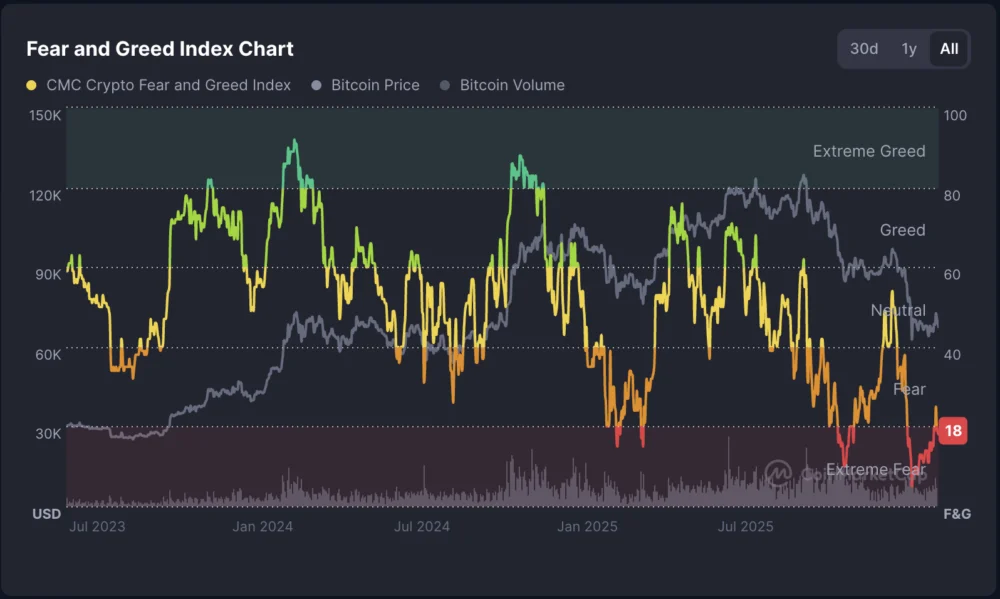
The global cryptocurrency market is currently grappling with a profound crisis of confidence as the Crypto Fear and Greed Index, a cornerstone metric for assessing investor psychology, has regressed into the “extreme fear” zone. According to the latest data from CoinMarketCap, the index fell to a score of 18 out of 100 as of Friday, marking a significant decline from the level of 20 recorded earlier in the week. This shift indicates a deepening atmosphere of caution and pessimism among market participants, effectively erasing a brief and fragile recovery observed on Wednesday when the index momentarily climbed to 25.
The Crypto Fear and Greed Index serves as a multifaceted gauge, aggregating data from various sources including market volatility, trading volume, social media sentiment, Bitcoin dominance, and search engine trends. A score of 18 represents one of the lowest points in recent market history, reflecting a state where investors are more likely to liquidate assets than to seek new entry points. This "extreme fear" designation often precedes periods of prolonged stagnation or further capitulation, particularly when the underlying causes are rooted in systemic macroeconomic and geopolitical instability.
A Chronology of Market Turbulence: From the 2025 Crash to the Present
To understand the current state of "extreme fear," it is essential to trace the trajectory of the market over the past several months. The cryptocurrency sector has been mired in a persistent bear market since the catastrophic crash of October 2025. During that period, Bitcoin (BTC), the market’s bellwether asset, saw its valuation slashed by more than 50% from its previous all-time high. While Bitcoin managed a limited and volatile recovery in the following months, the broader market has struggled to regain its footing.
By February 2026, the Fear and Greed Index hit a yearly low of 5, a level of despair rarely seen since the early days of the industry or the immediate aftermath of the FTX collapse in 2022. This rock-bottom sentiment was driven by a confluence of factors, including the initial escalation of regional conflicts and growing anxiety over the United States’ fiscal health. Although there was a slight uptick in optimism during the early spring of 2026, the current descent to 18 suggests that the market remains trapped in a cycle of "lower highs and lower lows" regarding investor sentiment.
The brief spike to 25 on Wednesday was initially viewed by some technical analysts as a potential "relief rally" or a sign that the market had priced in the worst of the news. However, the subsequent contraction to 18 on Friday underscores the fragility of current market structures. As geopolitical tensions intensified over the weekend, risk appetite evaporated, leading to a sharp withdrawal of capital from both Bitcoin and high-beta altcoins.
Geopolitical Instability and the Erosion of Risk Appetite
The primary catalyst for the most recent dip in sentiment is the deteriorating geopolitical landscape. Ongoing tensions involving the United States, Israel, and Iran have created a climate of profound macroeconomic uncertainty. In times of conflict, traditional investment wisdom dictates a "flight to quality," where investors move capital out of speculative or "risk-on" assets—such as cryptocurrencies and tech stocks—and into "safe-haven" assets like gold, the U.S. dollar, or short-term Treasury bonds.

The threat of a wider regional conflict in the Middle East has specific implications for the crypto market. It introduces the risk of energy supply disruptions, which can lead to inflationary spikes. High inflation typically prompts central banks, most notably the U.S. Federal Reserve, to maintain or increase high interest rates. For the crypto market, high interest rates are a significant headwind, as they increase the cost of borrowing and make non-yielding assets like Bitcoin less attractive compared to interest-bearing government debt.
Market participants are also closely monitoring the liquidity levels within the global financial system. As the U.S. government continues to grapple with rising debt levels—which have become a focal point for macroeconomic critics—there is an increasing fear that the "liquidity tap" that fueled previous bull runs is being tightened. This environment of "macro-uncertainty" has forced many institutional investors to the sidelines, leaving the market driven by retail sentiment, which is currently at a low ebb.
The Altcoin Crisis: Liquidity Voids and Record Lows
While Bitcoin has faced significant pressure, the altcoin market is bearing the brunt of the current downturn. Data provided by CryptoQuant analyst Darkfost reveals a staggering statistic: approximately 38% of all altcoins are currently hovering at or near their all-time low prices. This situation is described as more severe than the period following the FTX bankruptcy in late 2022, which was previously considered the nadir of the modern crypto era.
The collapse in altcoin valuations has been accompanied by a 50% reduction in overall crypto trading volume. This "liquidity desert" makes it difficult for prices to recover, as even small sell orders can have a disproportionate impact on market value. Darkfost noted that altcoins are typically the last sector to receive liquidity in a market cycle. "Altcoins remain the last sector of the crypto market where liquidity typically flows," he stated. "Given the geopolitical and macroeconomic deterioration observed over the past several months, the current stagnation is not surprising. Investors are prioritizing capital preservation over speculative gains."
The lack of interest in altcoins is also reflected in social media metrics. According to Santiment, a leading crypto market sentiment analysis platform, mentions of altcoins on platforms like X (formerly Twitter) and Reddit have plummeted to their lowest levels in two years. This "social silence" indicates a lack of retail engagement, which is often the primary driver of altcoin rallies. When the public stops discussing these assets, it typically suggests that the "hope" phase of the market cycle has been replaced by "apathy" or "disbelief."
The "Bitcoin to Zero" Narrative and Public Sentiment
Further corroborating the "extreme fear" reading is data from Google Trends. In February 2026, worldwide search volume for the phrase "Bitcoin going to zero" reached its highest level since the 2022 market crash. This spike in search interest highlights the return of existential dread among the general public regarding the long-term viability of digital assets.
Historically, peaks in "Bitcoin going to zero" searches have coincided with market bottoms, leading some contrarian investors to argue that the current period of extreme fear might present a buying opportunity. However, unlike previous cycles, the current downturn is occurring against a backdrop of significant global instability and high interest rates, making a V-shaped recovery less certain.

The "Bitcoin going to zero" narrative is often fueled by high-profile critics and mainstream financial media during periods of high volatility. While the underlying technology of the blockchain remains robust, the "price action" often dictates the public’s perception of the asset’s utility. With Bitcoin having erased a substantial portion of its 2024-2025 gains, the skepticism that once dominated the 2018 and 2022 bear markets has returned with renewed vigor.
Broader Implications and the Path Forward
The implications of the current "extreme fear" phase extend beyond mere price fluctuations. For the broader blockchain industry, a prolonged period of low sentiment and low liquidity can stifle innovation. Startups in the decentralized finance (DeFi) and Web3 sectors often rely on token valuations to fund operations and attract talent. When prices remain at all-time lows, the "runway" for these companies shortens, potentially leading to a wave of consolidations or closures.
Furthermore, the institutional adoption narrative, which was a major theme in 2024, is being put to the test. While major financial institutions have integrated Bitcoin into their offerings via Spot ETFs, the current volatility may cause a slowdown in further integration. Institutional investors are generally more sensitive to macroeconomic risks than retail "HODLers," and the current geopolitical climate may lead to a temporary pause in their crypto allocations.
Analysts suggest that for the Fear and Greed Index to move back toward "neutral" or "greed" territories, several conditions must be met:
- Geopolitical De-escalation: A reduction in tensions in the Middle East would likely restore risk appetite and encourage a return to speculative assets.
- Macroeconomic Clarity: Clearer signals from the Federal Reserve regarding interest rate cuts or a stabilizing of U.S. government debt concerns would provide a more favorable environment for crypto.
- Volume Recovery: A sustained increase in trading volume is necessary to prove that the "extreme fear" phase has transitioned into a "consolidation" phase.
In conclusion, the descent of the Crypto Fear and Greed Index to 18 is a sobering reminder of the market’s sensitivity to global events. While the crypto industry has survived numerous "extreme fear" events in the past, the combination of record-low altcoin valuations, dwindling social interest, and significant geopolitical headwinds suggests that the road to recovery may be long and fraught with further volatility. For now, the market remains in a defensive crouch, waiting for a catalyst that can shift the narrative from survival back to growth.