admin
admin
The European Union’s comprehensive Markets in Crypto-Assets (MiCA) regulation, alongside increased regulatory scrutiny in the United States, is significantly impacting the rate of new cryptocurrency exchange listings globally. Data from blockchain analytics firm Kaiko reveals a marked slowdown in the introduction of new trading pairs on centralized exchanges, a trend that began following the peak of the 2021 bull market and has been exacerbated by evolving regulatory landscapes.
The Ascendancy of MiCA and its Global Reach
MiCA, a landmark regulatory framework established by the European Union, aims to create a unified and supervised digital asset market across its member states. This regulation, designed to standardize the issuance, trading, and custody of various digital assets, including stablecoins, represents the EU’s most ambitious effort to date to govern the rapidly expanding decentralized finance (DeFi) sector. Its implications extend far beyond the EU’s borders, owing to its "extraterritorial scope." This means that MiCA applies not only to entities operating within EU member states but also to any business providing services to EU customers or utilizing the Euro in its operations, regardless of their geographical headquarters.
While the full implementation of MiCA is slated for December of this year, its effects are already being felt. The stablecoin legislation component of MiCA went live at the end of June, prompting significant adjustments from companies and exchanges worldwide that cater to the European market. For instance, Kraken, a prominent cryptocurrency exchange, has publicly considered delisting Tether’s USDT stablecoin in Europe due to the impending MiCA rules, highlighting the immediate and tangible impact of this regulation on established market players. This proactive stance by exchanges demonstrates an effort to preemptively comply with the new framework and mitigate potential future liabilities.
US Regulatory Uncertainty Fuels Global Caution
The impact on new exchange listings is not solely attributable to European regulations. The United States has also experienced a surge in regulatory pressure on the digital asset sector. With the 2024 Presidential elections on the horizon, cryptocurrencies have emerged as a significant political topic. This heightened political and regulatory uncertainty has created a cautious environment for companies and exchanges operating within the US. The ongoing debate surrounding crypto policy, including discussions on taxation and market oversight, has placed many industry participants in a state of flux, leading to a more conservative approach to expansion and new product offerings.

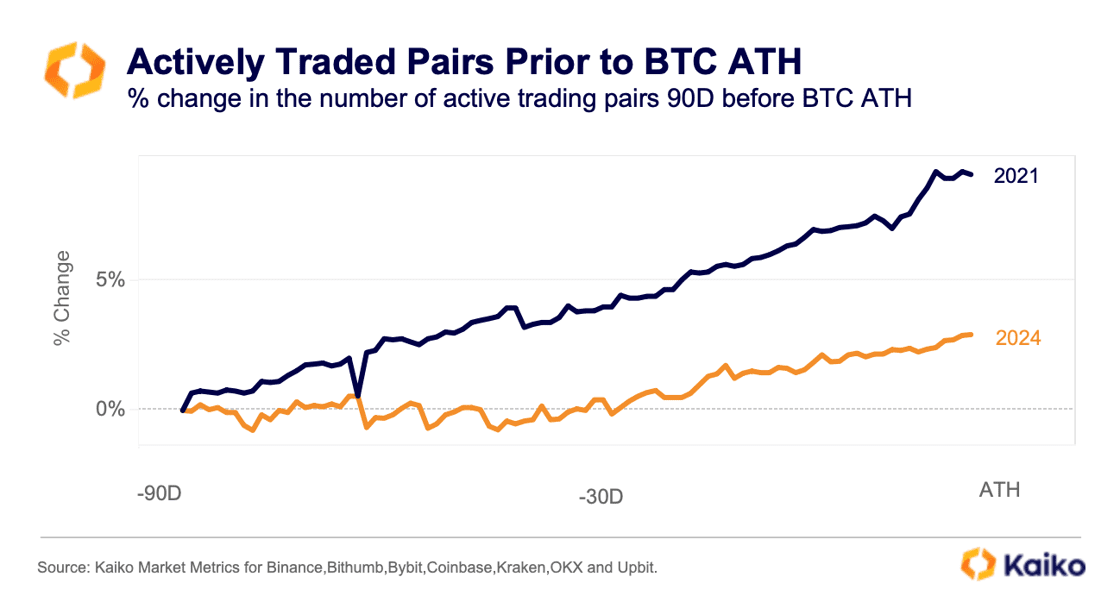
This dual-pronged regulatory pressure from both sides of the Atlantic has contributed to a global deceleration in the pace of new cryptocurrency exchange listings. Kaiko’s analysis of trading data paints a clear picture of this trend. The growth rate of new trading pairs on major exchanges serving EU and US customers has seen a significant decline. Before Bitcoin’s all-time high in 2021, the growth rate for new trading pairs stood at a robust 9%. However, in the lead-up to its 2024 peak, this figure had fallen to a mere 3%. This substantial drop underscores a growing reluctance among exchanges to list new digital assets, a direct consequence of the increased compliance burdens and the inherent risks associated with navigating complex and evolving regulatory environments.
Exchange-Specific Trends and Shifting Market Dynamics
Delving deeper into Kaiko’s data reveals a nuanced picture across different exchanges. Binance, once a dominant force in new listings, has experienced a slower growth rate compared to its peers. The number of active trading pairs on Binance remains 14% below its 2022 peak. While MiCA undoubtedly contributes to this slowdown, Binance has also been grappling with a broader global trend of reduced activity. Furthermore, the exchange has faced significant regulatory challenges in various jurisdictions worldwide, compounded by the legal charges against its founder and former CEO, Changpeng Zhao. The legal battles faced by Binance.US in the past year have also played a substantial role in diminishing its once-unrivaled global dominance.
In stark contrast to Binance’s deceleration, Bybit has witnessed a surge in active trading pairs, reaching an all-time high during the market rally in May. This resilience can be attributed to Bybit’s customer base, a significant portion of which is located in regions outside the EU. Consequently, Bybit appears to be largely insulated from the direct impact of MiCA. A similar trend is observed in South Korean exchanges, particularly Bithumb. These exchanges have experienced rapid growth in new listings, with Bithumb even outpacing Upbit. This surge has drawn increased attention from South Korean authorities, who are still working to establish a comprehensive regulatory framework for the burgeoning digital asset industry. The differing trajectories of these exchanges highlight the uneven impact of global regulations and the importance of regional market dynamics.
Broader Implications for the Crypto Market
The slowdown in new listings and the observed shift towards listing more stablecoin pairs signal a broader deceleration in the overall growth of the cryptocurrency market. This can be interpreted as a maturation of the market, where exchanges are becoming more selective about the assets they list, prioritizing those with clearer regulatory standing or established utility. The emphasis on stablecoins suggests a move towards more predictable and regulated forms of digital currency trading, which aligns with the objectives of regulatory bodies.
However, the narrative is not uniformly one of contraction. Emerging markets are demonstrating notable resilience and a growing demand for cryptocurrencies. Factors such as high inflation, currency volatility, and the absence of stringent regulatory oversight in these regions are driving increased adoption. In these markets, cryptocurrencies are often viewed as a hedge against economic instability and a means of accessing financial services not readily available through traditional channels. This divergence in market behavior underscores the multifaceted nature of the global cryptocurrency landscape, where regulatory pressures in developed economies contrast with grassroots adoption in regions seeking financial alternatives.
The current environment presents a complex interplay between innovation and regulation. While MiCA and other regulatory initiatives aim to enhance investor protection and market integrity, they also introduce compliance costs and operational complexities that can stifle innovation and slow down market expansion. The long-term implications of these regulatory shifts will likely involve a more bifurcated market, with highly regulated and compliant entities operating within established frameworks, while other segments of the market may continue to evolve in less regulated jurisdictions. The data from Kaiko serves as a crucial indicator of these evolving dynamics, providing a quantitative basis for understanding the profound impact of regulatory pressures on the growth and accessibility of digital assets. As the industry matures, the ability of exchanges to adapt to diverse and evolving regulatory requirements will be paramount to their continued success and the broader development of the global cryptocurrency ecosystem.