admin
admin
The European Union’s landmark Markets in Crypto-Assets (MiCA) regulation is significantly reshaping the cryptocurrency landscape, leading to a marked slowdown in new exchange listings globally. While MiCA is designed to standardize and supervise the digital asset market within the EU, its expansive reach and the concurrent increase in regulatory scrutiny in the United States are prompting a more cautious approach from exchanges and crypto projects worldwide. This shift is evident in data showing a substantial decrease in the rate of new trading pair additions on major exchanges, particularly those serving EU and US customers.
MiCA: A New Era of Crypto Regulation in Europe
The Markets in Crypto-Assets (MiCA) regulation, formally adopted by the European Union, represents a comprehensive framework aimed at harmonizing the regulation of digital assets across its member states. Unlike previous regulatory efforts, MiCA places a specific focus on the burgeoning decentralized finance (DeFi) sector, establishing clear rules for the issuance, trading, and custody of various digital assets, including stablecoins.
A key characteristic of MiCA is its "extraterritorial scope." This means the regulation’s influence extends beyond the EU’s borders, applying to any business that offers services to EU citizens or utilizes the Euro in its operations, regardless of the company’s physical location. This broad application has already begun to influence global market practices, even before its full implementation in December. The stablecoin legislation component of MiCA, which went live at the end of June, has compelled many international companies and exchanges to re-evaluate their strategies for engaging with the European market. For instance, reports indicate that exchanges like Kraken are considering delisting Tether (USDT) in Europe due to the compliance burdens imposed by MiCA rules.
Global Regulatory Headwinds and Their Impact on Listings
The impact of MiCA is compounded by the increasing regulatory pressure being exerted in the United States. As digital assets, particularly Bitcoin, emerge as a significant political talking point ahead of the 2024 Presidential elections, the regulatory environment in the US has become increasingly uncertain. This heightened scrutiny has placed both companies and exchanges operating within the US on edge, fostering an atmosphere of caution that extends to their global operations and listing strategies.

Data Reveals a Deceleration in New Exchange Listings
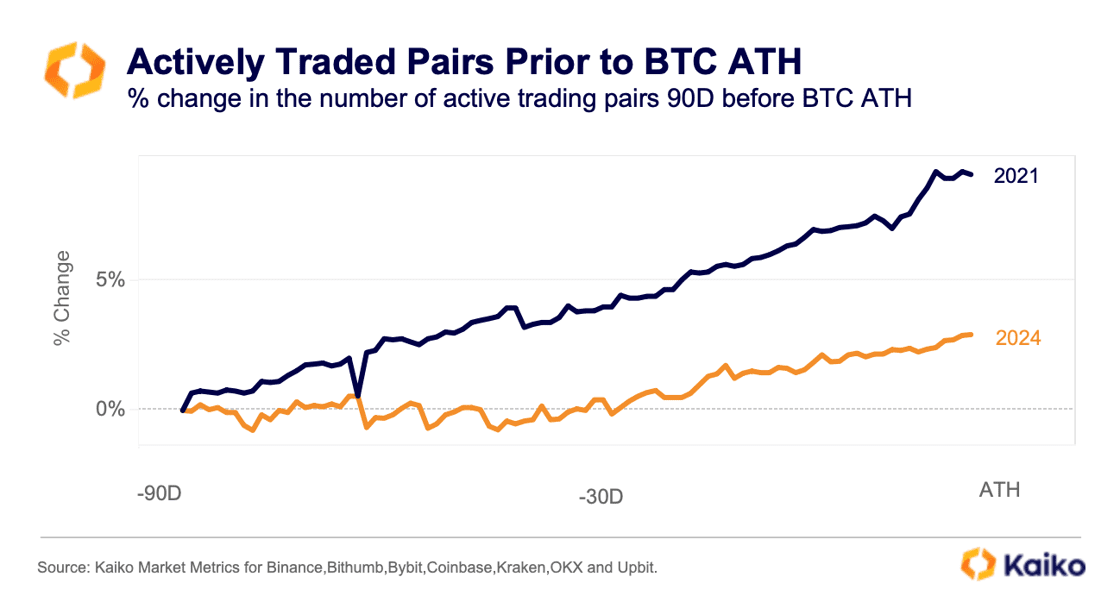
Analysis of market data from Kaiko, a cryptocurrency data provider, reveals a clear trend: the rate of new exchange listings has slowed considerably since the peak of the 2021 bull run. This slowdown is particularly pronounced in the growth of new trading pairs across major exchanges that cater to customers in the EU and the US.
According to Kaiko’s findings, the growth rate in new trading pairs experienced a significant decline. Before Bitcoin’s all-time high in 2021, this growth rate stood at approximately 9%. By contrast, in the period leading up to Bitcoin’s peak in 2024, this figure had fallen to just 3%. This substantial reduction in the pace of new listings indicates a more conservative approach being adopted by exchanges.
Figure 1: Percentage Change in Active Trading Pairs on Centralized Exchanges (2021 vs. 2024)
(Note: A visual representation of Kaiko’s data would be inserted here, illustrating the decline in the growth rate of active trading pairs. This graph typically shows the percentage change in the number of active trading pairs on centralized exchanges, comparing a pre-2021 ATH period with a pre-2024 peak period. The data would demonstrate a clear downward trend, supporting the article’s central thesis.)

The data further illustrates the number of active newly listed trading pairs on centralized exchanges from January 2020 to July 2024. This timeline clearly depicts a surge in new listings during the bull market of 2020-2021, followed by a significant downturn and a subsequent plateauing or slight decline in more recent periods. This visual evidence underscores the market’s adjustment to prevailing regulatory and economic conditions.
Figure 2: Number of Active Newly Listed Trading Pairs on Centralized Exchanges (Jan 2020 – July 2024)
(Note: A visual representation of Kaiko’s data would be inserted here, showing a time-series graph of the number of active newly listed trading pairs on centralized exchanges. This graph would likely exhibit a peak in late 2021 or early 2022 and a subsequent decline, highlighting the slowdown in new listings over time.)
Exchange-Specific Trends: Binance and Bybit Chart Different Paths
Examining individual exchange performance provides a more nuanced understanding of these trends. Binance, the world’s largest cryptocurrency exchange by trading volume, has experienced a more subdued growth in its active trading pairs. Data indicates that Binance’s active trading pairs are currently 14% below their peak levels seen in 2022.

Several factors contribute to Binance’s slowdown. While the broad implications of MiCA are undoubtedly a factor, the exchange has also been grappling with a general global market slowdown. Furthermore, Binance has faced significant regulatory challenges in various jurisdictions worldwide. The legal troubles and charges against its founder and former CEO, Changpeng Zhao (CZ), including a substantial fine and a prison sentence, have cast a long shadow. The legal battles faced by Binance.US in the past year have also played a considerable role in diminishing its previously dominant global market share. These multifaceted pressures have likely contributed to a more conservative approach to listing new assets on the platform.
In stark contrast, Bybit has demonstrated remarkable resilience and growth. The exchange has witnessed a surge in active trading pairs, reaching an all-time high during the market rally observed in May. This divergence in performance can be largely attributed to Bybit’s customer base, which predominantly hails from countries outside the European Union. As a result, Bybit appears to be less directly impacted by the immediate compliance demands of MiCA.
A similar trend is observable in the South Korean market. Exchanges like Bithumb have experienced rapid growth in new listings, with Bithumb notably outpacing its competitor Upbit. This rapid expansion has, in turn, attracted increased regulatory attention from South Korean authorities, who are still in the process of developing a comprehensive regulatory framework for the cryptocurrency industry.
The Broader Implications for the Crypto Market
The deceleration in new exchange listings, coupled with a notable shift towards listing stablecoin trading pairs, has contributed to a broader slowdown in the overall growth of the cryptocurrency market. This trend suggests a maturing market that is becoming more risk-averse and prioritizing regulatory compliance.
However, emerging markets present a different picture. These regions are exhibiting resilience and an increasing demand for cryptocurrencies. This demand is being fueled by a confluence of factors, including high inflation rates, currency volatility, and, in some cases, a less stringent regulatory environment. In these markets, cryptocurrencies are often seen as a hedge against economic instability or as a more accessible alternative to traditional financial services.
Analysis of Implications
The current regulatory climate, characterized by the implementation of MiCA and heightened scrutiny in the US, is likely to have several long-term implications for the cryptocurrency industry:
- Increased Compliance Costs: Exchanges and crypto projects will face higher operational costs associated with meeting stringent regulatory requirements, particularly those related to Know Your Customer (KYC) and Anti-Money Laundering (AML) procedures.
- Consolidation and Market Dominance: Smaller exchanges or those unable to adapt to the new regulatory landscape may struggle to survive, potentially leading to further consolidation within the industry. Larger, well-resourced exchanges that can navigate compliance effectively may further solidify their market dominance.
- Innovation in Compliant Products: The regulatory push may spur innovation in developing compliant crypto products and services, particularly in areas like stablecoins and asset tokenization, which are central to MiCA’s scope.
- Geographic Divergence: The disparity in regulatory approaches between different regions will likely lead to continued geographic divergence in market growth and innovation. Exchanges and projects may strategically focus on regions with more favorable regulatory environments.
- Investor Confidence: While increased regulation can initially create uncertainty, in the long run, a clear and consistent regulatory framework like MiCA could foster greater investor confidence by providing a more predictable and secure environment for digital asset investments.
The evolving regulatory landscape, spearheaded by initiatives like MiCA, is undeniably reshaping the trajectory of the cryptocurrency market. The slowdown in new listings is a direct consequence of this increased regulatory pressure, forcing market participants to prioritize compliance and strategic adaptation. As the industry matures, the ability to navigate these complex regulatory frameworks will be a critical determinant of success for exchanges and crypto projects alike. The continued development and enforcement of these regulations will be closely watched by investors, developers, and regulators worldwide.