admin
admin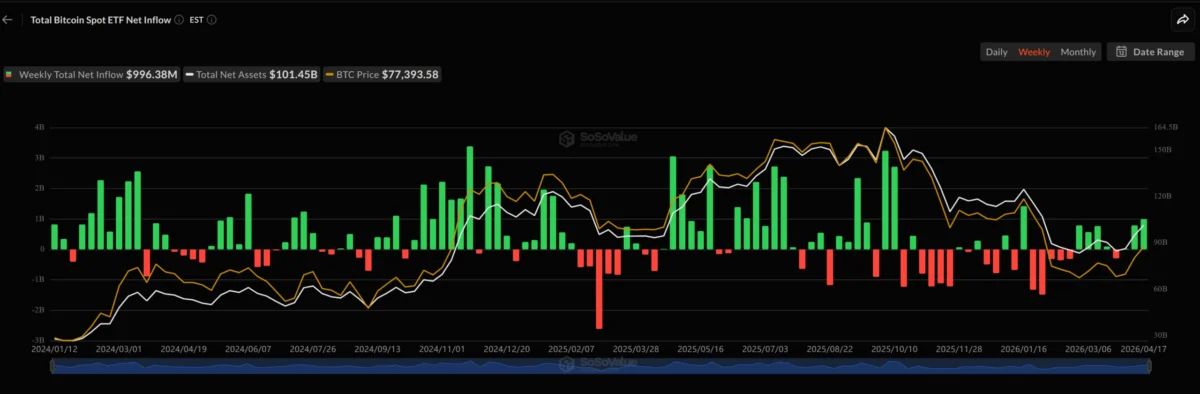
The digital asset investment landscape witnessed a significant resurgence during the first week of April 2026, as United States-based spot Bitcoin exchange-traded funds (ETFs) captured nearly $1 billion in total net inflows. This performance represents the most robust weekly intake for the asset class in more than three months, signaling a decisive shift in market sentiment toward risk-on assets. According to comprehensive data provided by SoSoValue, the group of spot Bitcoin ETFs recorded a collective $996 million in net inflows over the five-day trading period, falling just shy of the historic $1.4 billion weekly record established in early January following the initial launch of these financial instruments.
This surge in capital allocation comes at a critical juncture for the cryptocurrency market, which has faced intermittent volatility driven by macroeconomic uncertainty and international conflict. The total net assets held across all spot Bitcoin ETFs have now ascended past the $101 billion threshold, a milestone that underscores the deepening integration of Bitcoin into the broader institutional financial ecosystem. Simultaneously, trading activity has reached new heights, with daily volumes approaching $4.8 billion as investors react to a rapidly evolving geopolitical landscape and shifting internal market dynamics.
A Chronological Breakdown of Weekly Capital Flows
The week’s trading activity was characterized by an initial period of caution followed by an aggressive accumulation phase. On Monday, the market opened with a notable $291 million in net outflows, as investors appeared to take profits or hedge against lingering uncertainty regarding global supply chains and regional conflicts. However, this bearish sentiment was short-lived. By Tuesday, the tide had turned, with the ETFs attracting $411.5 million in fresh capital. This momentum continued into Wednesday with an additional $186 million in net inflows.
Thursday saw a more measured approach from institutional desks, recording a modest $26 million in inflows, which many analysts interpreted as a consolidation phase. The defining moment of the week occurred on Friday, which saw a staggering $663.9 million in net inflows. This single-day performance was the strongest of the week and one of the highest daily totals since the inception of spot Bitcoin ETFs. The Friday surge was directly correlated with major geopolitical announcements that provided the market with much-needed clarity, triggering a massive influx of liquidity from both retail and institutional participants.
Geopolitical De-escalation and the Reopening of the Strait of Hormuz
The primary catalyst for the late-week rally was a significant reduction in geopolitical friction in the Middle East. On Friday, Iran’s foreign minister announced the reopening of the Strait of Hormuz to commercial shipping for the duration of a negotiated ceasefire. This announcement was almost immediately corroborated by United States President Donald Trump, who confirmed the de-escalation of tensions and the restoration of maritime trade routes.
The Strait of Hormuz is widely regarded as the world’s most critical oil transit chokepoint, with approximately 20% of the global petroleum supply passing through the narrow waterway. The threat of its closure had previously introduced a "war premium" into global energy prices and driven investors toward traditional safe-haven assets like the US dollar and gold. The news of its reopening triggered an immediate and sharp reaction across global markets. Brent crude oil prices plummeted by approximately 10%, falling to around $85 per barrel, as fears of a supply disruption dissipated.
In contrast, Bitcoin reacted as a primary beneficiary of the "risk-on" rotation. The digital asset surged past the $77,000 mark following the news, as capital flowed out of defensive positions and into high-growth alternatives. Analysts at Bitunix noted that the market is increasingly pricing in the nature of how geopolitical tensions evolve rather than merely reacting to their existence. The signs of de-escalation, particularly regarding US-Iran relations, have effectively removed several extreme tail-risk scenarios from the board, weakening the demand for the US dollar and providing a tailwind for Bitcoin.
Macroeconomic Factors and the Weakening "Risk-Free" Narrative
Beyond the immediate impact of geopolitical news, broader macroeconomic trends are playing a pivotal role in the sustained demand for spot Bitcoin ETFs. While the Federal Reserve maintains a cautious stance on monetary policy, with expectations for aggressive interest rate cuts remaining limited, investors are beginning to question the long-term stability of traditional "risk-free" assets, such as US Treasury bonds.
Concerns regarding the rising US national debt and the sustainability of high long-term yields have begun to erode confidence in the traditional bond market. As debt demand fluctuates, the resulting pressure on the US dollar has made alternative stores of value more attractive. Bitcoin, often referred to as "digital gold," is increasingly viewed by institutional allocators as a hedge against fiscal instability and currency debasement.

The Bitunix analysis suggests that the current market structure for Bitcoin is in a "classic liquidity redistribution phase." Despite the volatility, Bitcoin has maintained a well-defined trading range, with strong support forming near the $72,000 level and significant resistance encountered above $75,000. Liquidation heatmaps indicate that the market is currently building a new equilibrium range rather than simply extending a singular directional trend. This redistribution phase is essential for the market to absorb the massive inflows and establish a stable floor for future price discovery.
The Competitive Landscape of Spot Bitcoin ETFs
The massive inflows of the past week have also highlighted the shifting competitive landscape among the various ETF issuers. BlackRock’s iShares Bitcoin Trust (IBIT) and Fidelity’s Wise Origin Bitcoin Fund (FBTC) continue to lead the pack in terms of volume and asset accumulation, but newer developments among major financial institutions are beginning to reshape the hierarchy.
A notable development in the institutional space involves Morgan Stanley, one of the world’s largest wealth management firms. Recent data indicates that Morgan Stanley’s Bitcoin fund has overtaken the WisdomTree Bitcoin Fund in total assets after just six trading days of active promotion to its vast network of clients. This rapid ascent underscores the power of major wirehouses in directing capital into the crypto ecosystem. When large-scale financial advisors begin to actively recommend Bitcoin ETFs to their high-net-worth clients, the potential for sustained, long-term inflows increases exponentially.
The total trading volume of nearly $4.8 billion daily suggests that these ETFs are not merely being used for passive holding but are also serving as highly liquid tools for active traders and institutional hedgers. The depth of liquidity now available in the spot Bitcoin ETF market has made it possible for large-scale players to enter and exit positions with minimal slippage, further encouraging institutional participation.
Technical Analysis and Market Equilibrium
From a technical perspective, the recent price action and inflow data suggest a maturing market. The ability of Bitcoin to hold its ground above the $72,000 support level during Monday’s outflows was a precursor to the strength seen later in the week. Analysts suggest that for Bitcoin to maintain its current highs above $76,000 and $77,000, it must satisfy three key conditions: sustained institutional demand through ETF vehicles, continued stability in the global macroeconomic environment, and a lack of significant "sell-side" pressure from long-term holders.
The current "liquidity redistribution" mentioned by Bitunix analysts implies that the market is currently absorbing the supply being sold by older "whales" or miners, and transferring it into the hands of institutional ETF holders. This transition is generally viewed as a positive development for the asset’s long-term price stability, as institutional holders tend to have longer time horizons and more disciplined risk management strategies compared to retail speculators.
Implications for the Broader Crypto Ecosystem
The success of spot Bitcoin ETFs is also having a ripple effect across the broader cryptocurrency market. As Bitcoin solidifies its position as a legitimate institutional asset, discussions regarding ETFs for other digital assets, such as Solana and Ethereum, are gaining momentum. The infrastructure built to support Bitcoin ETFs—including custody solutions, regulatory frameworks, and trading desks—is now being leveraged to expand the suite of digital asset products available to the public.
Furthermore, the decoupling of Bitcoin from traditional safe-havens during the Strait of Hormuz reopening suggests that Bitcoin is carving out a unique niche in the global financial system. It is simultaneously acting as a "risk-on" asset that thrives on liquidity and de-escalation, and a "macro-hedge" asset that protects against long-term fiscal mismanagement.
Looking ahead, the market will remain focused on the Federal Reserve’s upcoming meetings and any further developments in the Middle East. However, with over $100 billion in assets now housed within the spot Bitcoin ETF wrapper, the "institutionalization" of Bitcoin appears to be an irreversible trend. The nearly $1 billion in weekly inflows serves as a potent reminder that despite the inherent volatility of the crypto markets, the appetite for regulated, accessible exposure to Bitcoin remains at an all-time high.
As the market enters the mid-point of the second quarter, the focus will shift toward whether this $1 billion weekly pace can be sustained. If institutional adoption continues to accelerate at the current rate, and if the geopolitical environment remains relatively stable, the digital asset market may be on the verge of a new era of price discovery and mainstream integration. For now, the reopening of global trade routes and the cooling of international tensions have provided the perfect backdrop for Bitcoin to reaffirm its status as a cornerstone of the modern investment portfolio.