James Watt
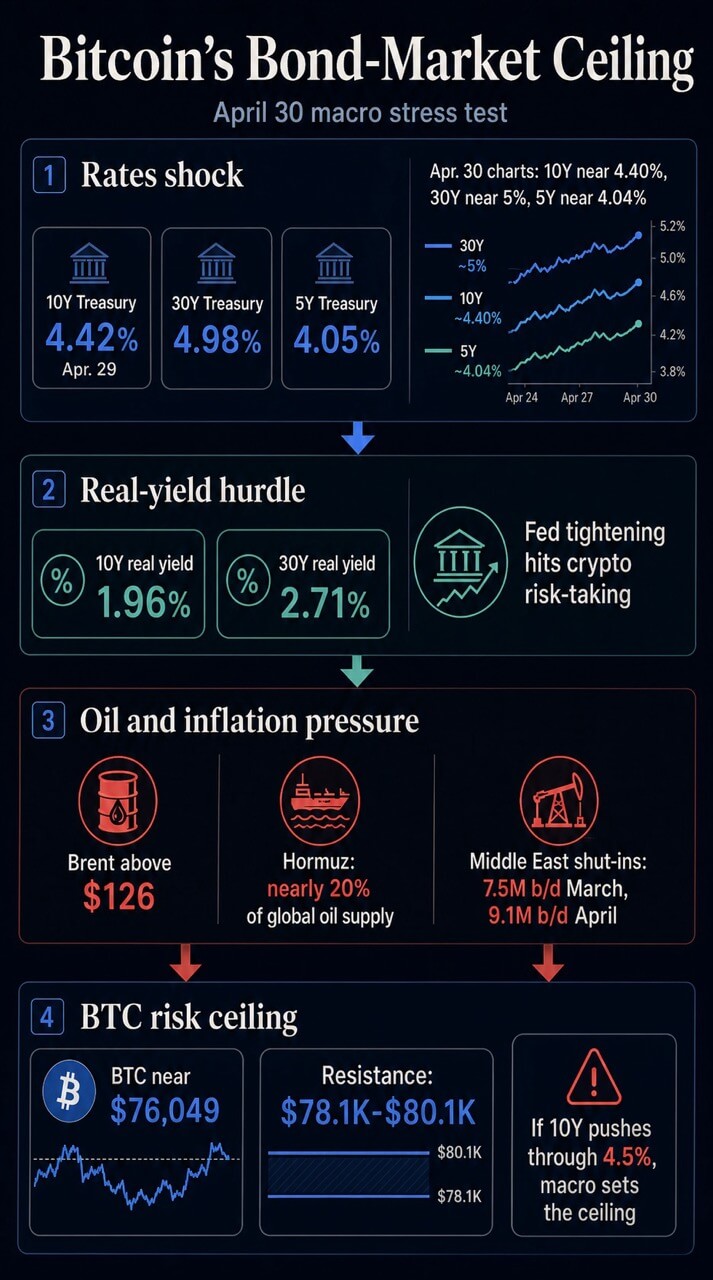
Bitcoin’s attempt to sustain its April rebound is currently being challenged by a formidable two-front macroeconomic environment that threatens to cap the asset’s upward trajectory. As the digital currency trades near $76,049, investors are closely monitoring a volatile intersection of rising U.S. Treasury yields and a significant spike in global energy prices. The convergence of these factors suggests that Bitcoin’s near-term price action may be dictated more by global liquidity and bond market dynamics than by crypto-specific developments.
The Bond Market as the Primary Resistance Zone
The most immediate pressure on Bitcoin originates from the nominal Treasury curve. Official data released by the U.S. Treasury for late April indicates a significant upward shift in yields across several durations. On April 29, the 10-year Treasury yield was recorded at 4.42%, while the 30-year yield reached 4.98%, and the 5-year yield stood at 4.05%. Market charts for the final session of the month show these levels holding firm, with the 10-year yield hovering near 4.40% and the 30-year yield remaining at the critical 5% threshold.
This upward movement in the long end of the curve is particularly impactful for Bitcoin. In financial theory, the long-term Treasury yield represents the "risk-free" rate against which all other assets are measured. When yields rise, the discount rate applied to future cash flows increases, which typically pressures the valuations of high-growth and speculative assets. Since Bitcoin provides no coupon, dividend, or earnings stream, its valuation is highly sensitive to shifts in liquidity and the opportunity cost of capital.
Analysts have identified the 4.35% to 4.6% range on the 10-year yield as a "danger zone" for crypto assets. A sustained move toward or through 4.5% could transform recent inflows into a failed rally, as institutional investors find the 5% risk-free return on long-dated government debt increasingly attractive compared to the volatility of the crypto market.
Real Yields and the Liquidity-Sensitive "Tech Beta"
The pressure is further intensified when examining "real yields"—the nominal yield minus inflation expectations. On April 29, the 10-year real yield was reported at 1.96%, with the 30-year real yield at 2.71%. High real yields act as a direct drag on speculative appetite, as they signify a tightening of financial conditions.
Research from the International Monetary Fund (IMF) on the "crypto cycle" highlights that approximately 80% of crypto price variation can be explained by a common crypto factor, which is heavily influenced by U.S. monetary policy and the risk-taking channel. In the current regime, Bitcoin has increasingly behaved like a "liquidity-sensitive tech beta" rather than a traditional hedge against the dollar or gold. This means that as real yields rise, the hurdle rate for Bitcoin to attract new capital becomes higher. For Bitcoin to break through its current resistance, demand must be deep enough to offset the tightening effect of these elevated yields.

Oil Prices and the Geopolitical Inflation Impulse
The second front of this macro test is the energy market. Brent crude is currently trading above $126 per barrel, marking its highest level since 2022. This price surge is tied directly to escalating geopolitical tensions and the continuation of a U.S.-led blockade of Iranian oil exports. Recent reports indicate that the administration of President Donald Trump is prepared to maintain this blockade for several months, further straining global supply.
The Energy Information Administration (EIA) has underscored the gravity of the situation, noting that the Strait of Hormuz—a vital maritime artery through which nearly 20% of global oil supply flows—has been effectively closed to shipping since February 28. In March, Middle East producers were estimated to have shut in 7.5 million barrels per day, a figure that rose to 9.1 million barrels per day in April.
Oil prices are a critical variable for the Federal Reserve’s interest rate path because energy costs permeate almost every sector of the economy, from manufacturing and freight to consumer goods. Elevated energy prices drive headline inflation higher, complicating the Fed’s efforts to return inflation to its 2% target.
The Federal Reserve’s Policy Constraint
The Federal Reserve’s internal deliberations reflect the tension created by these macro forces. In its April 29 statement, the Federal Open Market Committee (FOMC) maintained the target range for the federal funds rate at 3.50% to 3.75%. However, the decision was not unanimous in its outlook.
While the majority favored a hold, Stephen Miran dissented, advocating for a 25-basis-point cut to address potential downside risks to the economy. Conversely, members such as Beth Hammack, Neel Kashkari, and Lorie Logan supported the hold but expressed opposition to maintaining "easing-bias" language in the statement, citing concerns over persistent inflation.
Federal Reserve Chair Jerome Powell noted that headline inflation, as measured by the Personal Consumption Expenditures (PCE) index, reached 3.5% in March, largely driven by global oil prices. This internal split at the Fed creates a period of uncertainty for Bitcoin. If the central bank is forced to remain hawkish due to energy-driven inflation, the liquidity environment required for a sustained crypto bull market will remain constrained.
Financial Plumbing and Treasury Management
As the market grapples with high yields and oil prices, the focus has shifted to "financial plumbing"—the technical mechanisms by which the U.S. Treasury and the Federal Reserve manage market liquidity. The Treasury’s General Account (TGA) and reserve management tools are now in the spotlight.
The U.S. Treasury has several levers to alleviate market pressure. It can adjust the mix of bill issuance, conduct buybacks to support market liquidity, or manage the TGA to influence bank reserves. For instance, the Treasury recently planned buybacks of up to $38 billion for liquidity support and an additional $75 billion for cash management in the one-month to two-year maturity bucket.
While these tools can smooth out financing pressures and ensure that the government debt market functions efficiently, they do not directly address the underlying inflation caused by high energy prices. For Bitcoin, "plumbing relief" would be a mixed signal: it could improve short-term liquidity, but if it is perceived as a response to systemic stress, it may not provide the stable foundation needed for a long-term rally.
Bitcoin’s Market Structure and Support Levels
Against this macro backdrop, Bitcoin’s internal market structure shows signs of exhaustion. After the Fed decision, the price fell below $76,000, and data from Glassnode suggests that short-term holders (STHs) are taking profits in the $78,000 to $79,000 range. This profit-taking creates "overhead supply," which buyers must absorb before the price can move toward the $80,000 to $84,000 resistance zone.
Conversely, a break below $68,000 would likely signal a deeper correction. Bitcoin’s current dominance in the crypto market stands at 59.9%, with a total market capitalization of $2.54 trillion. Despite this dominance, the asset remains roughly 40% below its October 2025 high, illustrating the difficulty of maintaining momentum in a high-rate environment.
The "Bitcoin Treasury trade" has also shown signs of strain. When funding costs rise, corporate and sovereign holders who use Bitcoin as a balance sheet asset may be forced to sell to meet debt obligations or cover cash flow needs. A recent example involved a company dedicated to Bitcoin accumulation selling $20 million worth of the asset at a loss as its stock price declined, highlighting the risks inherent in the corporate treasury model during periods of high interest rates.
Comparative Outlook and Potential Paths Forward
The future direction of Bitcoin appears to be contingent on which macro variable gives way first. Four potential paths have emerged for the market:
- Geopolitical De-escalation: If the Strait of Hormuz is reopened or the Iranian blockade is eased, the oil risk premium would likely collapse. This would cool inflation expectations and allow real yields to fall, providing the most constructive path for a Bitcoin rally.
- Plumbing Relief: If the Treasury and Fed successfully manage liquidity through buybacks and bill issuance, market conditions could improve. However, if oil remains high, this relief may be temporary and Bitcoin’s gains could be capped.
- Persistent Blockade: If the oil shock lasts for several more months, the Fed will likely remain hawkish, and the 10-year yield could push through 4.5%. This scenario is bearish for Bitcoin, potentially leading to a retest of lower support levels.
- Flow-Led Rebound: It is possible that spot demand and ETF inflows could become strong enough to decouple Bitcoin from the bond market temporarily. However, historical data suggests that such decouplings are often short-lived once the U.S. equity markets open and broader risk trades take over.
In conclusion, Bitcoin is currently navigating a sophisticated macro stress test. The bond market, through the 10-year yield, is effectively setting the "ceiling" for the asset’s price. Until there is clarity on energy prices or a shift in Federal Reserve policy, Bitcoin’s ability to retake its previous highs will depend on whether crypto demand can absorb the rising cost of risk. The next major signal for investors will be whether the 10-year yield eases back from the 4.4% level or continues its march toward 4.5%.